Dynamic Programming The most important algorithmic technique - - PDF document

dynamic programming
SMART_READER_LITE
LIVE PREVIEW

Dynamic Programming The most important algorithmic technique - - PDF document

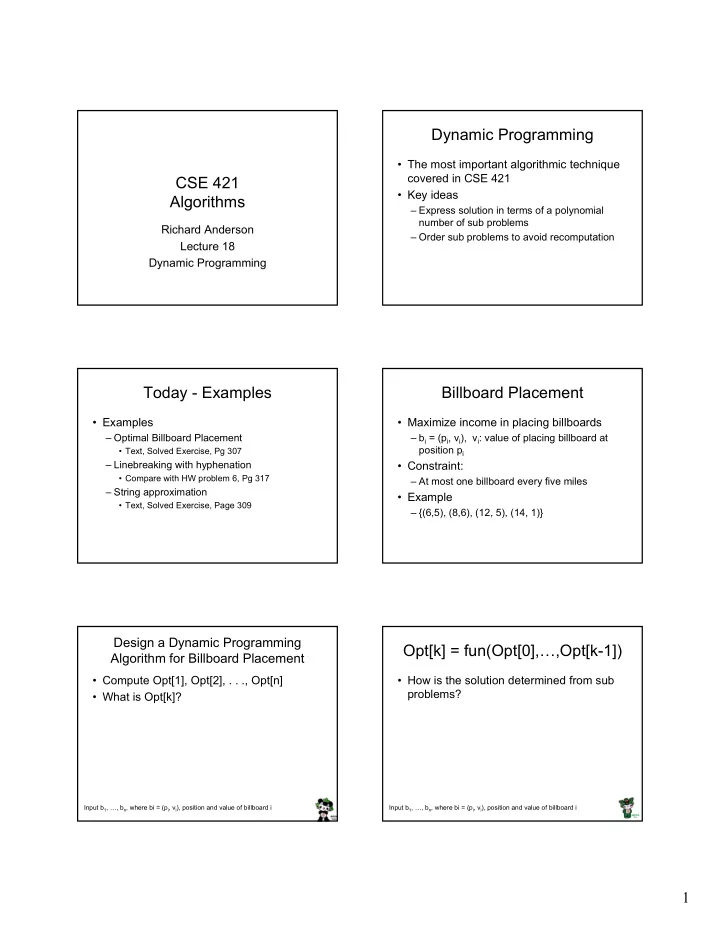
Dynamic Programming The most important algorithmic technique covered in CSE 421 CSE 421 Key ideas Algorithms Express solution in terms of a polynomial number of sub problems Richard Anderson Order sub problems to avoid


slide-1
SLIDE 1

1

CSE 421 Algorithms

Richard Anderson Lecture 18 Dynamic Programming

Dynamic Programming

  • The most important algorithmic technique

covered in CSE 421

  • Key ideas

– Express solution in terms of a polynomial number of sub problems – Order sub problems to avoid recomputation

Today - Examples

  • Examples

– Optimal Billboard Placement

  • Text, Solved Exercise, Pg 307

– Linebreaking with hyphenation

  • Compare with HW problem 6, Pg 317

– String approximation

  • Text, Solved Exercise, Page 309

Billboard Placement

  • Maximize income in placing billboards

– bi = (pi, vi), vi: value of placing billboard at position pi

  • Constraint:

– At most one billboard every five miles

  • Example

– {(6,5), (8,6), (12, 5), (14, 1)}

Design a Dynamic Programming Algorithm for Billboard Placement

  • Compute Opt[1], Opt[2], . . ., Opt[n]
  • What is Opt[k]?

Input b1, …, bn, where bi = (pi, vi), position and value of billboard i

Opt[k] = fun(Opt[0],…,Opt[k-1])

  • How is the solution determined from sub

problems?

Input b1, …, bn, where bi = (pi, vi), position and value of billboard i

slide-2
SLIDE 2

2

Solution

j = 0; // j is five miles behind the current position // the last valid location for a billboard, if one placed at P[k] for k := 1 to n while (P[ j ] < P[ k ] – 5) j := j + 1; j := j – 1; Opt[ k] = Max(Opt[ k-1] , V[ k ] + Opt[ j ]);

Optimal line breaking and hyphen- ation

  • Problem: break lines and insert hyphens to

make lines as balanced as possible

  • Typographical considerations:

– Avoid excessive white space – Limit number of hyphens – Avoid widows and orphans – Etc.

Penalty Function

  • Pen(i, j) – penalty of starting a line a

position i, and ending at position j

  • Key technical idea

– Number the breaks between words/syllables

Opt-i-mal line break-ing and hyph-en-a-tion is com-put-ed with dy-nam-ic pro-gram-ming

Design a Dynamic Programming Algorithm for Optimal Line Breaking

  • Compute Opt[1], Opt[2], . . ., Opt[n]
  • What is Opt[k]?

Opt[k] = fun(Opt[0],…,Opt[k-1])

  • How is the solution determined from sub

problems?

Solution

for k := 1 to n Opt[ k ] := infinity; for j := 0 to k-1 Opt[ k ] := Min(Opt[k], Opt[ j ] + Pen(j, k));

slide-3
SLIDE 3

3

But what if you want to layout the text?

  • And not just know the minimum penalty?

Solution

for k := 1 to n Opt[ k ] := infinity; for j := 0 to k-1 temp := Opt[ j ] + Pen(j, k); if (temp < Opt[ k ]) Opt[ k] = temp; Best[ k ] := j;

String approximation

  • Given a string S, and a library of strings B

= {b1, …bm}, construct an approximation of the string S by using copies of strings in B. B = {abab, bbbaaa, ccbb, ccaacc} S = abaccbbbaabbccbbccaabab

Formal Model

  • Strings from B assigned to non-
  • verlapping positions of S
  • Strings from B may be used multiple times
  • Cost of δ for unmatched character in S
  • Cost of γ for mismatched character in S

– MisMatch(i, j) – number of mismatched characters of bj, when aligned starting with position i in s.

Design a Dynamic Programming Algorithm for String Approximation

  • Compute Opt[1], Opt[2], . . ., Opt[n]
  • What is Opt[k]?

Target string S = s1s2…sn Library of strings B = {b1,…,bm} MisMatch(i,j) = number of mismatched characters with bj when aligned starting at position i of S.

Opt[k] = fun(Opt[0],…,Opt[k-1])

  • How is the solution determined from sub

problems?

Target string S = s1s2…sn Library of strings B = {b1,…,bm} MisMatch(i,j) = number of mismatched characters with bj when aligned starting at position i of S.

slide-4
SLIDE 4

4

Solution

for i := 1 to n Opt[k] = Opt[k-1] + δ; for j := 1 to |B| p = i – len(bj); Opt[k] = min(Opt[k], Opt[p-1] + γ MisMatch(p, j));