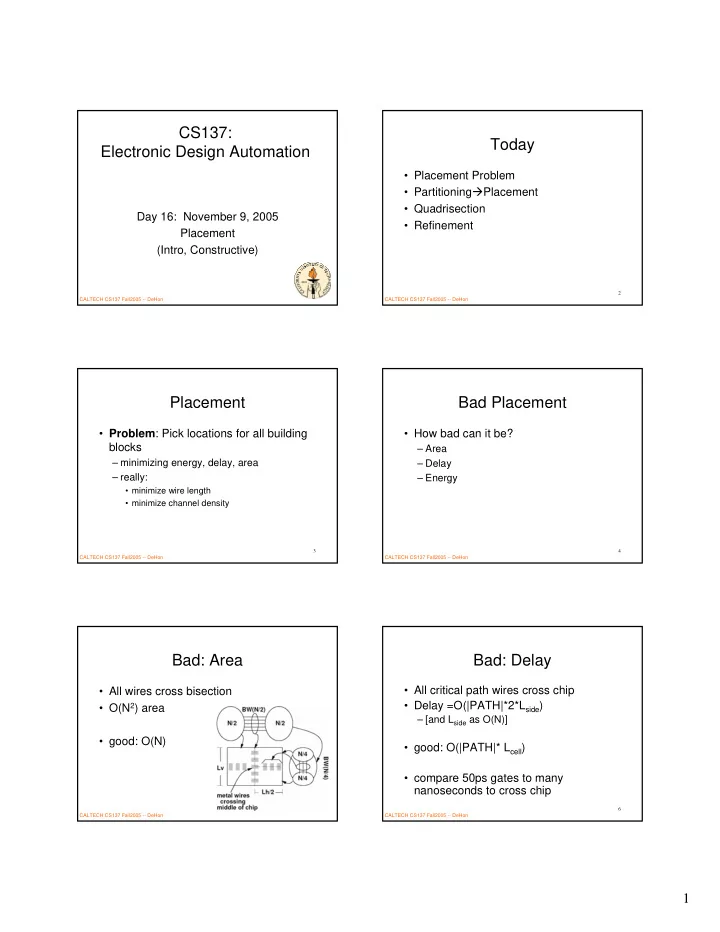
CS137: Today Electronic Design Automation Placement Problem - - PDF document

cs137 today electronic design automation
SMART_READER_LITE
LIVE PREVIEW

CS137: Today Electronic Design Automation Placement Problem - - PDF document

CS137: Today Electronic Design Automation Placement Problem Partitioning Placement Quadrisection Day 16: November 9, 2005 Refinement Placement (Intro, Constructive) 1 2 CALTECH CS137 Fall2005 -- DeHon CALTECH CS137


slide-1
SLIDE 1

1

CALTECH CS137 Fall2005 -- DeHon 1

CS137: Electronic Design Automation

Day 16: November 9, 2005 Placement (Intro, Constructive)

CALTECH CS137 Fall2005 -- DeHon 2

Today

  • Placement Problem
  • PartitioningPlacement
  • Quadrisection
  • Refinement

CALTECH CS137 Fall2005 -- DeHon 3

Placement

  • Problem: Pick locations for all building

blocks

– minimizing energy, delay, area – really:

  • minimize wire length
  • minimize channel density

CALTECH CS137 Fall2005 -- DeHon 4

Bad Placement

  • How bad can it be?

– Area – Delay – Energy

CALTECH CS137 Fall2005 -- DeHon 5

Bad: Area

  • All wires cross bisection
  • O(N2) area
  • good: O(N)

CALTECH CS137 Fall2005 -- DeHon 6

Bad: Delay

  • All critical path wires cross chip
  • Delay =O(|PATH|*2*Lside)

– [and Lside as O(N)]

  • good: O(|PATH|* Lcell)
  • compare 50ps gates to many

nanoseconds to cross chip

slide-2
SLIDE 2

2

CALTECH CS137 Fall2005 -- DeHon 7

Clock Cycle Radius

  • Radius of logic can reach in one cycle (45 nm)

– Radius 10

  • Few hundred PEs

– Chip side 600-700 PE

  • 400-500 thousand PEs

– 100s of cycles to cross

CALTECH CS137 Fall2005 -- DeHon 8

Bad: Energy

  • All wires cross chip:

O(Lside) long → O(Lside) capacitance per wire

  • Recall AreaO(N2)
  • So Lside O(N)

×O(N) wires → O(N2) capacitance

  • Good:

O(1) long wires → O(N) capacitance

CALTECH CS137 Fall2005 -- DeHon 9

Distance

  • Can we place everything close?

CALTECH CS137 Fall2005 -- DeHon 10

“Closeness”

  • Try placing “everything” close

CALTECH CS137 Fall2005 -- DeHon 11

Problem Characteristics

  • Familiar

– NP Complete – local, greedy not work – greedy gets stuck in local minima

CALTECH CS137 Fall2005 -- DeHon 12

Constructive Placement

slide-3
SLIDE 3

3

CALTECH CS137 Fall2005 -- DeHon 13

Basic Idea

  • Partition (bisect) to define halves of chip

– minimize wire crossing

  • Recurse to refine
  • When get down to single component, done

CALTECH CS137 Fall2005 -- DeHon 14

Adequate?

  • Does recursive bisection capture the

primary constraints of two-dimensional placement?

CALTECH CS137 Fall2005 -- DeHon 15

Problems

  • Greedy, top-down cuts

– maybe better pay cost early?

  • Two-dimensional problem

– (often) no real cost difference between H and V cuts

  • Interaction between subtrees

– not modeled by recursive bisect

CALTECH CS137 Fall2005 -- DeHon 16

Interaction

CALTECH CS137 Fall2005 -- DeHon 17

Example

Ideal split (not typical) “Equivalent” split ignoring external constraints Practically -- makes all H cuts also be V cuts

CALTECH CS137 Fall2005 -- DeHon 18

Interaction

slide-4
SLIDE 4

4

CALTECH CS137 Fall2005 -- DeHon 19

Problem

  • Need to keep track of where things are

– outside of current partition – include costs induced by above

  • Don’t necessarily know where things are

– still solving problem

CALTECH CS137 Fall2005 -- DeHon 20

Improvement: Ordered

  • Order operations
  • Keep track of existing solution
  • Use to constrain or pass costs to next

subproblem

B A

CALTECH CS137 Fall2005 -- DeHon 21

Improvement: Ordered

  • Order operations
  • Keep track of existing solution
  • Use to constrain or pass costs to next

subproblem

  • Flow cut

– use existing in src/sink – A nets = src, B nets = sink

B A S T

CALTECH CS137 Fall2005 -- DeHon 22

Improvement: Ordered

  • Order operations
  • Keep track of existing solution
  • Use to constrain or pass costs to next

subproblem

  • Flow cut

– use existing in src/sink – A nets = src, B nets = sink

  • FM: start with fixed,

unmovable nets for side-biased inputs

B A S T

CALTECH CS137 Fall2005 -- DeHon 23

Improvement: Constrain

  • Partition once
  • Constrain movement within existing

partitions

  • Account for both H and V crossings
  • Partition next

– (simultaneously work parallel problems) – easy modification to FM

CALTECH CS137 Fall2005 -- DeHon 24

Constrain Partition

Solve AB and CD concurrently. C D A B

slide-5
SLIDE 5

5

CALTECH CS137 Fall2005 -- DeHon 25

Improvement: Quadrisect

  • Solve more of problem at once
  • Quadrisection:

– partition into 4 bins simultaneously – keep track of costs all around

CALTECH CS137 Fall2005 -- DeHon 26

Quadrisect

  • Modify FM to work on multiple buckets
  • k-way has:

– k(k-1) buckets

– |from|×|to| – quad→ 12

  • reformulate gains
  • update still O(1)

CALTECH CS137 Fall2005 -- DeHon 27

Quadrisect

  • Cases (15):

– (1 partition) x 4 – (2 part) x 6 = (4 choose 2) – (3 part) x 4 = (4 choose 3) – (4 part) x 1

CALTECH CS137 Fall2005 -- DeHon 28

Recurse

  • Keep outside constraints

– (cost effects)

  • Don’t know detail place
  • Model as at center of

unrefined region

CALTECH CS137 Fall2005 -- DeHon 29

Option: Terminal Propagation

  • Abstract inputs as

terminals

  • Partition based upon
  • Represent cost effects
  • n placement/refinement

decisions

CALTECH CS137 Fall2005 -- DeHon 30

Option: Refine

  • Keep refined

placement

  • Use in cost estimates
slide-6
SLIDE 6

6

CALTECH CS137 Fall2005 -- DeHon 31

Problem

  • Still have ordering problem
  • Earlier subproblems solved with weak

constraints from later

– (cruder placement estimates)

  • Solved previous case by flattening

– …but in extreme give up divide and conquer

CALTECH CS137 Fall2005 -- DeHon 32

Iterate

  • After solve later problems
  • Relax solution
  • Solve earlier problems

again with refined placements (cost estimates)

  • Repeat until converge

CALTECH CS137 Fall2005 -- DeHon 33

Iteration/Cycling

  • General technique to deal with phase-
  • rdering problem

– what order do we perform transformations, make decisions? – How get accurate information to everyone

  • Still basically greedy

CALTECH CS137 Fall2005 -- DeHon 34

Refinement

  • Relax using overlapping

windows

  • Deal with edging effects
  • Khang etc. claim 10-

15% improve

– cycle – overlap

CALTECH CS137 Fall2005 -- DeHon 35

Possible Refinement

  • Allow unbalanced cuts

– most things still work – just distort refinement groups – allowing unbalance using FM quadrisection looks a bit tricky – gives another 5-10% improvement

CALTECH CS137 Fall2005 -- DeHon 36

Runtime

  • Each gain update still O(1)

– (bigger constants) – so, FM partition pass still O(N)

  • O(1) iterations expected
  • assume O(1) overlaps exploited
  • O(log(N)) levels
  • Total: O(N log(N))

– very fast compared to typical annealing

  • (annealing next time)
slide-7
SLIDE 7

7

CALTECH CS137 Fall2005 -- DeHon 37

Uses

  • Good by self
  • Starting point for simulated annealing

– speed convergence

  • With synthesis (both high level and logic)

– get a quick estimate of physical effects

– (play role in estimation/refinement at larger level)

  • Early/fast placement

– before willing to spend time looking for best

  • For fast placement where time matters

– FPGAs, online placement?

CALTECH CS137 Fall2005 -- DeHon 38

Summary

  • Partition to minimize cut size
  • Additional constraints to do well

– Improving constant factors

  • Quadrisection
  • Keep track of estimated placement
  • Relax/iterate/Refine

CALTECH CS137 Fall2005 -- DeHon 39

Admin

  • ???

CALTECH CS137 Fall2005 -- DeHon 40

Big Ideas:

  • Potential dominance of interconnect
  • Divide-and-conquer
  • Successive Refinement
  • Phase ordering: estimate/relax/iterate