CS137: Today Electronic Design Automation Retiming Cycle time - - PDF document

cs137 today electronic design automation
SMART_READER_LITE
LIVE PREVIEW

CS137: Today Electronic Design Automation Retiming Cycle time - - PDF document

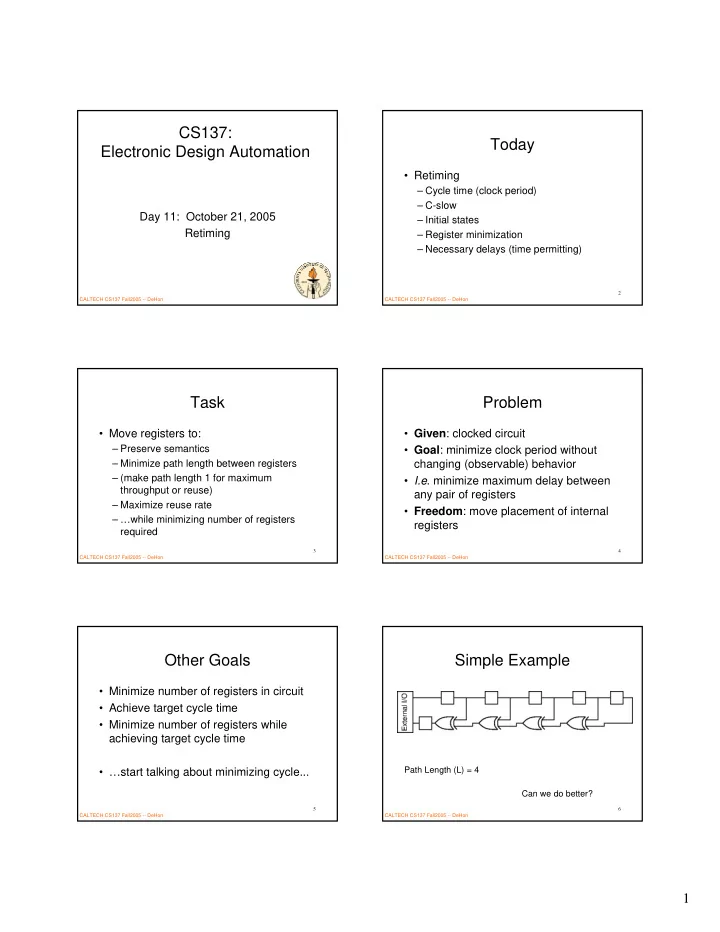
CS137: Today Electronic Design Automation Retiming Cycle time (clock period) C-slow Day 11: October 21, 2005 Initial states Retiming Register minimization Necessary delays (time permitting) 1 2 CALTECH CS137


slide-1
SLIDE 1

1

CALTECH CS137 Fall2005 -- DeHon 1

CS137: Electronic Design Automation

Day 11: October 21, 2005 Retiming

CALTECH CS137 Fall2005 -- DeHon 2

Today

  • Retiming

– Cycle time (clock period) – C-slow – Initial states – Register minimization – Necessary delays (time permitting)

CALTECH CS137 Fall2005 -- DeHon 3

Task

  • Move registers to:

– Preserve semantics – Minimize path length between registers – (make path length 1 for maximum throughput or reuse) – Maximize reuse rate – …while minimizing number of registers required

CALTECH CS137 Fall2005 -- DeHon 4

Problem

  • Given: clocked circuit
  • Goal: minimize clock period without

changing (observable) behavior

  • I.e. minimize maximum delay between

any pair of registers

  • Freedom: move placement of internal

registers

CALTECH CS137 Fall2005 -- DeHon 5

Other Goals

  • Minimize number of registers in circuit
  • Achieve target cycle time
  • Minimize number of registers while

achieving target cycle time

  • …start talking about minimizing cycle...

CALTECH CS137 Fall2005 -- DeHon 6

Simple Example

Path Length (L) = 4 Can we do better?

slide-2
SLIDE 2

2

CALTECH CS137 Fall2005 -- DeHon 7

Legal Register Moves

  • Retiming Lag/Lead

CALTECH CS137 Fall2005 -- DeHon 8

Canonical Graph Representation

Separate arc for each path Weight edges by number of registers (weight nodes by delay through node)

CALTECH CS137 Fall2005 -- DeHon 9

Critical Path Length

Critical Path: Length of longest path of zero weight nodes Compute in O(|E|) time by levelizing network: Topological sort, push path lengths forward until find register.

CALTECH CS137 Fall2005 -- DeHon 10

Retiming Lag/Lead

Retiming: Assign a lag to every vertex

weight(e′) = weight(e) + lag(head(e))-lag(tail(e))

CALTECH CS137 Fall2005 -- DeHon 11

Valid Retiming

  • Retiming is valid as long as:

– ∀e in graph

  • weight(e′) = weight(e) + lag(head(e))-lag(tail(e)) ≥ 0
  • Assuming original circuit was a valid

synchronous circuit, this guarantees:

– non-negative register weights on all edges

  • no travel backward in time :-)

– all cycles have strictly positive register counts – propagation delay on each vertex is non-negative (assumed 1 for today)

CALTECH CS137 Fall2005 -- DeHon 12

Retiming Task

  • Move registers ≡ assign lags to nodes

– lags define all locally legal moves

  • Preserving non-negative edge weights

– (previous slide) – guarantees collection of lags remains consistent globally

slide-3
SLIDE 3

3

CALTECH CS137 Fall2005 -- DeHon 13

Retiming Transformation

  • N.B.: unchanged by retiming

– number of registers around a cycle – delay along a cycle

  • Cycle of length P must have

– at least P/c registers on it – to be retimeable to cycle c

CALTECH CS137 Fall2005 -- DeHon 14

Optimal Retiming

  • There is a retiming of

– graph G – w/ clock cycle c – iff G-1/c has no cycles with negative edge weights

  • G-α ≡ subtract α from each edge weight

CALTECH CS137 Fall2005 -- DeHon 15

1/c Intuition

  • Want to place a register every c delay

units

  • Each register adds one
  • Each delay subtracts 1/c
  • As long as remains more positives than

negatives around all cycles

– can move registers to accommodate – Captures the regs=P/c constraints

CALTECH CS137 Fall2005 -- DeHon 16

G-1/c

CALTECH CS137 Fall2005 -- DeHon 17

Compute Retiming

  • Lag(v) = shortest path to I/O in G-1/c
  • Compute shortest paths in O(|V||E|)

– Bellman-Ford – also use to detect negative weight cycles when c too small

CALTECH CS137 Fall2005 -- DeHon 18

Bellman Ford

  • For I←0 to N

– ui ←∞ (except ui=0 for IO)

  • For k←0 to N

– for ei,j∈E

  • ui ←min(ui ,uj+w(ei,j))
  • For ei,j∈E

//still updatenegative cycle

  • if ui >uj+w(ei,j)

– cycles detected

slide-4
SLIDE 4

4

CALTECH CS137 Fall2005 -- DeHon 19

Apply to Example

CALTECH CS137 Fall2005 -- DeHon 20

Try c=1

CALTECH CS137 Fall2005 -- DeHon 21

Apply: Find Lags

Negative weight cycles? Shortest paths?

CALTECH CS137 Fall2005 -- DeHon 22

Apply: Lags

CALTECH CS137 Fall2005 -- DeHon 23

Apply: Move Registers

weight(e′) = weight(e) + lag(head(e))-lag(tail(e)) 1 1 1 1 1

CALTECH CS137 Fall2005 -- DeHon 24

Apply: Retimed

slide-5
SLIDE 5

5

CALTECH CS137 Fall2005 -- DeHon 25

Apply: Retimed Design

CALTECH CS137 Fall2005 -- DeHon 26

Revise Example (fanout delay)

CALTECH CS137 Fall2005 -- DeHon 27

Revised: Graph

CALTECH CS137 Fall2005 -- DeHon 28

Revised: Graph

CALTECH CS137 Fall2005 -- DeHon 29

Revised: C=1?

CALTECH CS137 Fall2005 -- DeHon 30

Revised: C=2?

slide-6
SLIDE 6

6

CALTECH CS137 Fall2005 -- DeHon 31

Revised: Lag

CALTECH CS137 Fall2005 -- DeHon 32

Revised: Lag

Take ceiling to convert to integer lags:

  • 1

CALTECH CS137 Fall2005 -- DeHon 33

Revised: Apply Lag

  • 1
  • 1

CALTECH CS137 Fall2005 -- DeHon 34

Revised: Apply Lag

1 1 1 1 1 1 1 1

  • 1
  • 1

CALTECH CS137 Fall2005 -- DeHon 35

Revised: Retimed

1 1 1 1 1 1 1 1

CALTECH CS137 Fall2005 -- DeHon 36

Pipelining

  • We can use this retiming to pipeline
  • Assume we have enough (infinite

supply) registers at edge of circuit

  • Retime them into circuit
slide-7
SLIDE 7

7

CALTECH CS137 Fall2005 -- DeHon 37

C>1 ==> Pipeline

CALTECH CS137 Fall2005 -- DeHon 38

Add Registers

G

n 1 1 1 1 1

CALTECH CS137 Fall2005 -- DeHon 39

Add Registers

n 1 1 1 1 1 G G-1/1

CALTECH CS137 Fall2005 -- DeHon 40

Pipeline Retiming: Lag

CALTECH CS137 Fall2005 -- DeHon 41

Pipelined Retimed

CALTECH CS137 Fall2005 -- DeHon 42

Real Cycle

slide-8
SLIDE 8

8

CALTECH CS137 Fall2005 -- DeHon 43

Real Cycle

CALTECH CS137 Fall2005 -- DeHon 44

Cycle C=1?

CALTECH CS137 Fall2005 -- DeHon 45

Cycle C=2?

CALTECH CS137 Fall2005 -- DeHon 46

Cycle: C-slow

Cycle=c ⇒ C-slow network has Cycle=1

CALTECH CS137 Fall2005 -- DeHon 47

2-slow Cycle ⇒ C=1

CALTECH CS137 Fall2005 -- DeHon 48

2-Slow Lags

slide-9
SLIDE 9

9

CALTECH CS137 Fall2005 -- DeHon 49

2-Slow Retime

CALTECH CS137 Fall2005 -- DeHon 50

Retimed 2-Slow Cycle

CALTECH CS137 Fall2005 -- DeHon 51

C-Slow applicable?

  • Available parallelism

– solve C identical, independent problems

  • e.g. process packets (blocks) separately
  • e.g. independent regions in images
  • Commutative operators

– e.g. max example

CALTECH CS137 Fall2005 -- DeHon 52

Max Example

CALTECH CS137 Fall2005 -- DeHon 53

Max Example

CALTECH CS137 Fall2005 -- DeHon 54

Note

  • Algorithm/examples shown

– for special case of unit-delay nodes

  • For general delay,

– a bit more complicated – still polynomial

slide-10
SLIDE 10

10

CALTECH CS137 Fall2005 -- DeHon 55

Initial State

  • What about initial state?

1

CALTECH CS137 Fall2005 -- DeHon 56

Initial State

CALTECH CS137 Fall2005 -- DeHon 57

Initial State

1 1 In general, constraints satisfiable? 1 1

CALTECH CS137 Fall2005 -- DeHon 58

Initial State

1 1 0,1? 1

CALTECH CS137 Fall2005 -- DeHon 59

Initial State

1 Cycle1: 1 Cycle2: /(0*/in)=1 init=0 Cycle1: 1 Cycle2: /(/init*/in)=in init=1 Cycle1: 0 Cycle2: /(/init*/in)=1 ? Cycle1: /init Cycle2: /(/init*/in)=in+init init

CALTECH CS137 Fall2005 -- DeHon 60

Initial State

  • Cannot always get exactly the same initial

state behavior on the retimed circuit

– without additional care in the retiming transformation – sometimes have to modify structure of retiming to preserve initial behavior

  • Only a problem for startup transient

– if you’re willing to clock to get into initial state, not a limitation

slide-11
SLIDE 11

11

CALTECH CS137 Fall2005 -- DeHon 61

Minimize Registers

CALTECH CS137 Fall2005 -- DeHon 62

Minimize Registers

  • Number of registers: Σ w(e)
  • After retime: Σ w(e)+Σ (FI(v)-FO(v))lag(v)
  • delta only in lags
  • So want to minimize: Σ (FI(v)-FO(v))lag(v)

– subject to earlier constraints

  • non-negative register weights, delays
  • positive cycle counts

CALTECH CS137 Fall2005 -- DeHon 63

Minimize Registers

  • Can be formulated as flow problem
  • Can add cycle time constraints to flow

problem

  • Time: O(|V||E|log(|V|)log|(|V|2/|E|))

CALTECH CS137 Fall2005 -- DeHon 64

HSRA Retiming

  • HSRA

– adds mandatory pipelining to interconnect

  • One additional twist

– long, pipelined interconnect

  • ⇒ need more than
  • ne register on paths

CALTECH CS137 Fall2005 -- DeHon 65

Accommodating HSRA Interconnect Delays

  • Add buffers to LUT→LUT path to match

interconnect register requirements

  • Retime to C=1 as before
  • Buffer chains force enough registers to

cover interconnect delays

CALTECH CS137 Fall2005 -- DeHon 66

Accommodating HSRA Interconnect Delays

slide-12
SLIDE 12

12

CALTECH CS137 Fall2005 -- DeHon 67

Summary

  • Can move registers to minimize cycle time
  • Formulate as a lag assignment to every node
  • Optimally solve cycle time in O(|V||E|) time
  • Also

– Compute multithreaded computations – Minimize registers

  • Watch out for initial values
  • Can accommodate mandatory delays

CALTECH CS137 Fall2005 -- DeHon 68

Admin

  • Homework Due Today
  • No class on Monday and Wednesday
  • Class next Friday

CALTECH CS137 Fall2005 -- DeHon 69

Big Ideas

  • Exploit freedom
  • Formulate transformations (lag

assignment)

  • Express legality constraints
  • Technique:

– graph algorithms – network flow