1 CPI (cycles per instruction) CPI (cycles per instruction) - - PDF document

1
SMART_READER_LITE
LIVE PREVIEW

1 CPI (cycles per instruction) CPI (cycles per instruction) - - PDF document

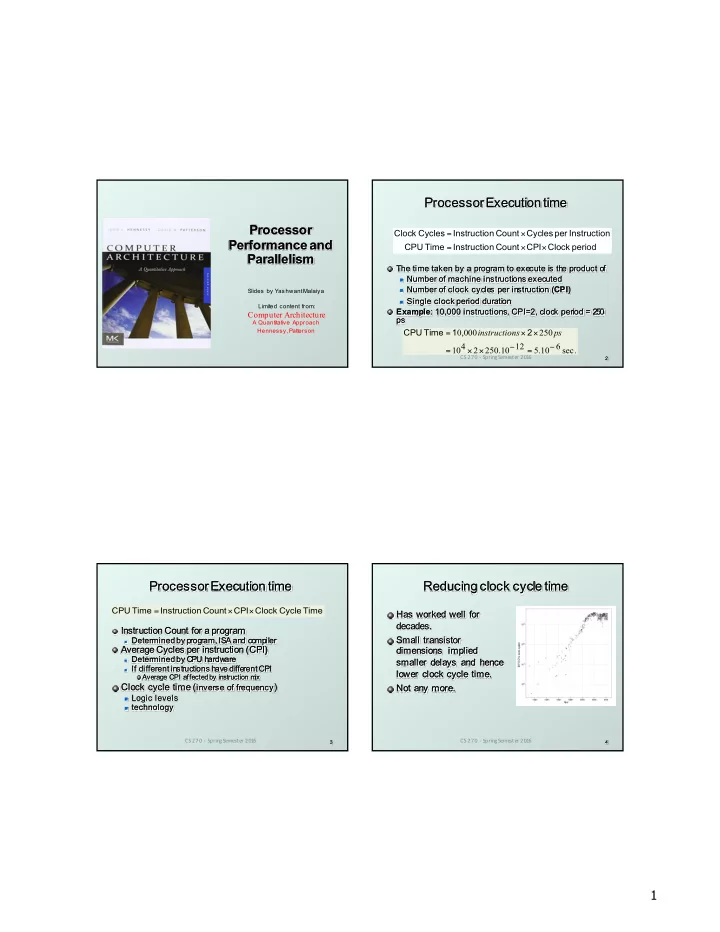
Processor Execution time Processor Execution time Processor Processor Clock Cycles Instructio n Count Cycles per Instructio n = Performance and Performance and CPU Time Instructio n Count CPI Clock period =


slide-1
SLIDE 1

1 Processor Performance and Parallelism Processor Performance and Parallelism

Slides by YashwantMalaiya Limited content from:

Computer Architecture

A Quantitative Approach Hennessy, Patterson

Processor Execution time Processor Execution time

The time taken by a program to execute is the product of

n Number of machine instructions executed n Number of clock cycles per instruction (CPI) n Single clock period duration

Example: 10,000 instructions, CPI=2, clock period = 250 ps The time taken by a program to execute is the product of

n Number of machine instructions executed n Number of clock cycles per instruction (CPI) n Single clock period duration

Example: 10,000 instructions, CPI=2, clock period = 250 ps

period Clock CPI Count n Instructio Time CPU n Instructio per Cycles Count n Instructio Cycles Clock × × = × = . sec 6 10 . 5 12 10 . 250 2 4 10 250 000 , − = − × × = × × = ps ns instructio 2 1 Time CPU

CS 270 - Spring Semester 2016

2

Processor Execution time Processor Execution time

Instruction Count for a program

n Determined by program, ISA and compiler

Average Cycles per instruction (CPI)

n Determined by C

PU hardw are

n If different instructions have different CPI

Average CPI affected by instruction m ix

Clock cycle time (inverse of frequency)

n Logic levels n technology

Instruction Count for a program

n Determined by program, ISA and compiler

Average Cycles per instruction (CPI)

n Determined by C

PU hardw are

n If different instructions have different CPI

Average CPI affected by instruction m ix

Clock cycle time (inverse of frequency)

n Logic levels n technology

Time Cycle Clock CPI Count n Instructio Time CPU × × =

CS 270 - Spring Semester 2016

3

Reducing clock cycle time Reducing clock cycle time

Has worked well for decades. Small transistor dimensions implied smaller delays and hence lower clock cycle time. Not any more. Has worked well for decades. Small transistor dimensions implied smaller delays and hence lower clock cycle time. Not any more.

CS 270 - Spring Semester 2016

4

slide-2
SLIDE 2

2 CPI (cycles per instruction) CPI (cycles per instruction)

What is LC-3 cycles per instruction? Instructions take 5-9 cycles (p. 568), assuming memory access time is one clock period.

n LC-3 CPI may be about 6*. (ideal)

No cache, memory access time = 100 cycles?

n LC-3 CPI would be very high.

Cache reduces access time to 2 cycles.

n LC-3 CPI higher than 6, but still reasonable.

What is LC-3 cycles per instruction? Instructions take 5-9 cycles (p. 568), assuming memory access time is one clock period.

n LC-3 CPI may be about 6*. (ideal)

No cache, memory access time = 100 cycles?

n LC-3 CPI would be very high.

Cache reduces access time to 2 cycles.

n LC-3 CPI higher than 6, but still reasonable. Load/store instructions are about 20-30%

CS 270 - Spring Semester 2016

5

Parallelism to save time Parallelism to save time

Do things in parallel to save time. Example: Pipelining

n Divide flow into stages. n Let instructions flow into the pipeline. n At a time multiple instructions are under execution.

Do things in parallel to save time. Example: Pipelining

n Divide flow into stages. n Let instructions flow into the pipeline. n At a time multiple instructions are under execution.

CS 270 - Spring Semester 2016

6 CS 270 - Spring Semester 2016 CS 270 - Spring Semester 2016

Pipelining Analogy Pipelining Analogy

Pipelined laundry: overlapping execution

n Parallelism improves performance

Pipelined laundry: overlapping execution

n Parallelism improves performance

n Four loads:

n time

= 4x2 = 8 hours

n Pipelined:

n Time in example

= 7x0.5 = 3.5 hours

n Non-stop

= 4x0.5 = 2 hours.

7 CS 270 - Spring Semester 2016 CS 270 - Spring Semester 2016

Pipeline Processor Performance Pipeline Processor Performance

Single-cycle (T

c= 800ps)

Pipelined (T

c= 200ps) 8

slide-3
SLIDE 3

3 Pipelining: Issues Pipelining: Issues

Cannot predict which branch will be taken.

n Actually you may be able to make a good guess. n Some performance penalty for bad guesses.

Instructions may depend on results of previous instructions.

n There may be a way to get around that problem in

some cases.

Cannot predict which branch will be taken.

n Actually you may be able to make a good guess. n Some performance penalty for bad guesses.

Instructions may depend on results of previous instructions.

n There may be a way to get around that problem in

some cases.

CS 270 - Spring Semester 2016

9

Instruction level parallelism (ILP): Instruction level parallelism (ILP):

Pipelining is one example. Multiple issue: have multiple copies of resources

n Multiple instructions start at the same time n Need careful scheduling

Compiler assisted scheduling Hardware assisted (“superscaler”): “dynamic scheduling”

n

Ex: AMD Opteron x4

n

CPI can be less than 1!.

Pipelining is one example. Multiple issue: have multiple copies of resources

n Multiple instructions start at the same time n Need careful scheduling

Compiler assisted scheduling Hardware assisted (“superscaler”): “dynamic scheduling”

n

Ex: AMD Opteron x4

n

CPI can be less than 1!.

CS 270 - Spring Semester 2016

10 10

Flynn’s taxonomy Flynn’s taxonomy

Michael J. Flynn, 1966 Michael J. Flynn, 1966

Data Streams Single Multiple Instruction Streams Single SISD: Intel Pentium 4 SIMD: SSE instructions of x86 Multiple MISD: No examples today MIMD: Intel Xeon e5345

n Instruction level parallelism is still SISD n SSE (Streaming SIMD Extensions): vector

  • perations

n Intel Xeon e5345: 4 cores CS 270 - Spring Semester 2016

11 11

Multi what? Multi what?

Multitasking: tasks share a processor Multithreading: threads share a processor Multiprocessors: using multiple processors

n For example multi-core processors (multiples

processors on the same chip)

n Scheduling of tasks/subtasks needed

Thread level parallelism:

n multiple threads on one/more processors

Simultaneous multi-threading:

n multiple threads in parallel (using multiple states)

Multitasking: tasks share a processor Multithreading: threads share a processor Multiprocessors: using multiple processors

n For example multi-core processors (multiples

processors on the same chip)

n Scheduling of tasks/subtasks needed

Thread level parallelism:

n multiple threads on one/more processors

Simultaneous multi-threading:

n multiple threads in parallel (using multiple states)

CS 270 - Spring Semester 2016

12 12

slide-4
SLIDE 4

4 Multi-core processors Multi-core processors

Power consumption has become a limiting factor Key advantage: lower power consumption for the same performance

n Ex: 20% low

er clock frequency: 87% performance, 51% power.

A processor can switch to lower frequency to reduce power. N cores: can run n or more threads. Power consumption has become a limiting factor Key advantage: lower power consumption for the same performance

n Ex: 20% low

er clock frequency: 87% performance, 51% power.

A processor can switch to lower frequency to reduce power. N cores: can run n or more threads.

CS 270 - Spring Semester 2016

13 13

Multi-core processors Multi-core processors

Cores may be identical or specialized Higher level caches are shared. Lower level cache coherency required. Cores may use superscalar or simultaneous multi-threading architectures. Cores may be identical or specialized Higher level caches are shared. Lower level cache coherency required. Cores may use superscalar or simultaneous multi-threading architectures.

CS 270 - Spring Semester 2016

14 14

LC-3 states LC-3 states

Instructio n Cycles ADD, AND, NOT , JMP 5 TRAP 8 LD, LDR, ST , STR 7 LDI, STI 9 BR 5, 6 JSR 6

15 15

CS 270 - Spring Semester 2016