CS137: Simplifying Structure Electronic Design Automation K-LUT - - PDF document

cs137 simplifying structure electronic design automation
SMART_READER_LITE
LIVE PREVIEW

CS137: Simplifying Structure Electronic Design Automation K-LUT - - PDF document

CS137: Simplifying Structure Electronic Design Automation K-LUT can implement any K-input function Day 3: September 29, 2005 Clustering (LUT Mapping, Delay) 1 4 CALTECH CS137 Fall2005 -- DeHon CALTECH CS137 Fall2005 -- DeHon Today


slide-1
SLIDE 1

1

CALTECH CS137 Fall2005 -- DeHon 1

CS137: Electronic Design Automation

Day 3: September 29, 2005 Clustering (LUT Mapping, Delay)

CALTECH CS137 Fall2005 -- DeHon 2

Today

  • How do we map to LUTs?
  • What happens when delay dominates?
  • Lessons…

– for non-LUTs – for delay-oriented partitioning

CALTECH CS137 Fall2005 -- DeHon 3

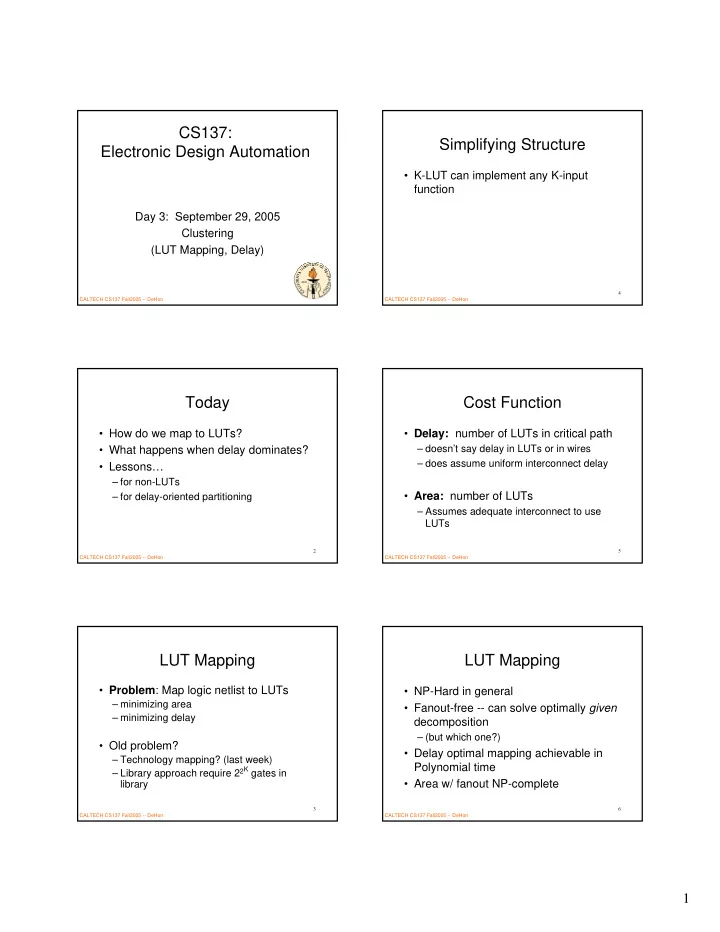
LUT Mapping

  • Problem: Map logic netlist to LUTs

– minimizing area – minimizing delay

  • Old problem?

– Technology mapping? (last week) – Library approach require 22K gates in library

CALTECH CS137 Fall2005 -- DeHon 4

Simplifying Structure

  • K-LUT can implement any K-input

function

CALTECH CS137 Fall2005 -- DeHon 5

Cost Function

  • Delay: number of LUTs in critical path

– doesn’t say delay in LUTs or in wires – does assume uniform interconnect delay

  • Area: number of LUTs

– Assumes adequate interconnect to use LUTs

CALTECH CS137 Fall2005 -- DeHon 6

LUT Mapping

  • NP-Hard in general
  • Fanout-free -- can solve optimally given

decomposition

– (but which one?)

  • Delay optimal mapping achievable in

Polynomial time

  • Area w/ fanout NP-complete
slide-2
SLIDE 2

2

CALTECH CS137 Fall2005 -- DeHon 7

Preliminaries

  • What matters/makes this interesting?

– Area / Delay target – Decomposition – Fanout

  • replication
  • reconvergent

CALTECH CS137 Fall2005 -- DeHon 8

Area vs. Delay

CALTECH CS137 Fall2005 -- DeHon 9

Decomposition

CALTECH CS137 Fall2005 -- DeHon 10

Decomposition

CALTECH CS137 Fall2005 -- DeHon 11

Fanout: Replication

CALTECH CS137 Fall2005 -- DeHon 12

Fanout: Replication

slide-3
SLIDE 3

3

CALTECH CS137 Fall2005 -- DeHon 13

Fanout: Reconvergence

CALTECH CS137 Fall2005 -- DeHon 14

Fanout: Reconvergence

CALTECH CS137 Fall2005 -- DeHon 15

Monotone Property

  • Does cost function increase

monotonicly as more of the graph is included? (do all subsets have property)

– gate count? – I/o?

  • Important?

– How far back do we need to search?

CALTECH CS137 Fall2005 -- DeHon 16

Delay

CALTECH CS137 Fall2005 -- DeHon 17

Dynamic Programming

  • Optimal covering of a logic cone is:

– Minimum cost (all possible coverings)

  • Evaluate costs of each node based on:

– cover node – cones covering each fanin to node cover

  • Evaluate node costs in topological order
  • Key: are calculating optimal solutions to

subproblems

– only have to evaluate covering options at each node

CALTECH CS137 Fall2005 -- DeHon 18

Flowmap

  • Key Idea:

– LUT holds anything with K inputs – Use network flow to find cuts

  • ≡ logic can pack into LUT including

reconvergence

  • …allows replication

– Optimal depth arise from optimal depth solution to subproblems

slide-4
SLIDE 4

4

CALTECH CS137 Fall2005 -- DeHon 19

  • Delay objective:

– minimum height, K-feasible cut – I.e. cut no more than K edges – start by bounding fanin ≤ K

  • Height of node will be:

– height of predecessors or – one greater than height of predecessors

  • Check shorter first

Flowmap

1 1 1 1 2

CALTECH CS137 Fall2005 -- DeHon 20

Flowmap

  • Construct flow problem

– sink ← target node being mapped – source ← start set (primary inputs) – flow infinite into start set – flow of one on each link – to see if height same as predecessors

  • collapse all predecessors of maximum height

into sink (single node, cut must be above)

  • height +1 case is trivially true

CALTECH CS137 Fall2005 -- DeHon 21

1 1 2 2 1 1

Example Subgraph

Target: K=4

CALTECH CS137 Fall2005 -- DeHon 22

3 1 1 2 2 1 1

Trivial: Height +1

CALTECH CS137 Fall2005 -- DeHon 23

1 1 2 2 1 1

Collapse at max height

CALTECH CS137 Fall2005 -- DeHon 24

2 1 1 2 2 1 1

Collapse not work (different/larger graph)

Forced to label height+1

slide-5
SLIDE 5

5

CALTECH CS137 Fall2005 -- DeHon 25

2 1 1 1 2 1

Reconvergent fanout (different/larger graph)

Can label at height

1

CALTECH CS137 Fall2005 -- DeHon 26

Flowmap

  • Max-flow Min-cut algorithm to find cut
  • Use augmenting paths to until discover

max flow > K

  • O(K|e|) time to discover K-feasible cut

– (or that does not exist)

  • Depth identification: O(KN|e|)

CALTECH CS137 Fall2005 -- DeHon 27

Flowmap

  • Min-cut may not be unique

CALTECH CS137 Fall2005 -- DeHon 28

Two 3-cuts

CALTECH CS137 Fall2005 -- DeHon 29

Flowmap

  • Min-cut may not be unique
  • To minimize area achieving delay
  • ptimum

– find max volume min-cut

  • Compute max flow ⇒ find min cut
  • remove edges consumed by max flow
  • DFS from source
  • Compliment set is max volume set

CALTECH CS137 Fall2005 -- DeHon 30

Graph

slide-6
SLIDE 6

6

CALTECH CS137 Fall2005 -- DeHon 31

Graph: maxflow (K=3)

CALTECH CS137 Fall2005 -- DeHon 32

Graph: BFS source

Reachable

CALTECH CS137 Fall2005 -- DeHon 33

Max Volume min-cut

CALTECH CS137 Fall2005 -- DeHon 34

Flowmap

  • Covering from labeling is straightforward

– process in reverse topological order – allocate identified K-feasible cut to LUT – remove node – postprocess to minimize LUT count

  • Notes:

– replication implicit (covered multiple places) – nodes purely internal to one or more covers may not get their own LUTs

CALTECH CS137 Fall2005 -- DeHon 35

Flowmap Roundup

  • Label

– Work from inputs to outputs – Find max label of predecessors – Collapse new node with all predecessors at this label – Can find flow cut ≤ K?

  • Yes: mark with label (find max-volume cut extent)
  • No: mark with label+1
  • Cover

– Work from outputs to inputs – Allocate LUT for identified cluster/cover – Recurse covering selection on inputs to identified LUT

CALTECH CS137 Fall2005 -- DeHon 36

Area

slide-7
SLIDE 7

7

CALTECH CS137 Fall2005 -- DeHon 37

DF-Map

  • Duplication Free Mapping

– can find optimal area under this constraint – (but optimal area may not be duplication free) [Cong+Ding, IEEE TR VLSI Sys. V2n2p137]

CALTECH CS137 Fall2005 -- DeHon 38

Maximum Fanout Free Cones

MFFC: bit more general than trees

CALTECH CS137 Fall2005 -- DeHon 39

MFFC

  • Follow cone backward
  • end at node that fans out (has output)
  • utside the code

CALTECH CS137 Fall2005 -- DeHon 40

MFFC example

CALTECH CS137 Fall2005 -- DeHon 41

MFFC example

CALTECH CS137 Fall2005 -- DeHon 42

DF-Map

  • Partition into graph into MFFCs
  • Optimally map each MFFC
  • In dynamic programming

– for each node

  • examine each K-feasible cut

– note: this is very different than flowmap where only had to examine a single cut

  • pick cut to minimize cost

– 1 + Σ MFFCs for fanins

slide-8
SLIDE 8

8

CALTECH CS137 Fall2005 -- DeHon 43

DF-Map Example

Cones?

CALTECH CS137 Fall2005 -- DeHon 44

DF-Map Example

CALTECH CS137 Fall2005 -- DeHon 45

DF-Map Example

CALTECH CS137 Fall2005 -- DeHon 46

DF-Map Example

CALTECH CS137 Fall2005 -- DeHon 47

DF-Map Example

CALTECH CS137 Fall2005 -- DeHon 48

DF-Map Example

slide-9
SLIDE 9

9

CALTECH CS137 Fall2005 -- DeHon 49

DF-Map Example

Start mapping cone

CALTECH CS137 Fall2005 -- DeHon 50

DF-Map Example

1 1 1 1

CALTECH CS137 Fall2005 -- DeHon 51

DF-Map Example

? 1 1 1 1

CALTECH CS137 Fall2005 -- DeHon 52

DF-Map Example

? 1 1 1 1

CALTECH CS137 Fall2005 -- DeHon 53

DF-Map Example

? 1 1 1 1

CALTECH CS137 Fall2005 -- DeHon 54

DF-Map Example

1 1 1 1 1

slide-10
SLIDE 10

10

CALTECH CS137 Fall2005 -- DeHon 55

DF-Map Example

1 1 1 1 1 1 1 Similar to previous

CALTECH CS137 Fall2005 -- DeHon 56

DF-Map Example

? 1 1 1 1 1 1 1

CALTECH CS137 Fall2005 -- DeHon 57

DF-Map Example

? 1 1 1 1 1 1 1

CALTECH CS137 Fall2005 -- DeHon 58

DF-Map Example

? 1 1 1 1 1 1 1 3

CALTECH CS137 Fall2005 -- DeHon 59

DF-Map Example

? 1 1 1 1 1 1 1

CALTECH CS137 Fall2005 -- DeHon 60

DF-Map Example

? 1 1 1 1 1 1 1 2

slide-11
SLIDE 11

11

CALTECH CS137 Fall2005 -- DeHon 61

DF-Map Example

? 1 1 1 1 1 1 1

CALTECH CS137 Fall2005 -- DeHon 62

DF-Map Example

? 1 1 1 1 1 1 1 3

CALTECH CS137 Fall2005 -- DeHon 63

DF-Map Example

2 1 1 1 1 1 1 1

CALTECH CS137 Fall2005 -- DeHon 64

DF-Map Example

2 ? 1 1 1 1 1 1 1

CALTECH CS137 Fall2005 -- DeHon 65

DF-Map Example

2 ? 1 1 1 1 1 1 1

CALTECH CS137 Fall2005 -- DeHon 66

DF-Map Example

2 ? 1 1 1 1 1 1 1 3

slide-12
SLIDE 12

12

CALTECH CS137 Fall2005 -- DeHon 67

DF-Map Example

2 ? 1 1 1 1 1 1 1 3

CALTECH CS137 Fall2005 -- DeHon 68

DF-Map Example

2 ? 1 1 1 1 1 1 1 3 3

CALTECH CS137 Fall2005 -- DeHon 69

DF-Map Example

2 ? 1 1 1 1 1 1 1 3 3

CALTECH CS137 Fall2005 -- DeHon 70

DF-Map Example

2 ? 1 1 1 1 1 1 1 3 3 3

CALTECH CS137 Fall2005 -- DeHon 71

DF-Map Example

2 3 1 1 1 1 1 1 1

CALTECH CS137 Fall2005 -- DeHon 72

DF-Map Example

2 3 1 1 1 1 ? 1 1 1

slide-13
SLIDE 13

13

CALTECH CS137 Fall2005 -- DeHon 73

DF-Map Example

2 3 1 1 1 1 ? 1 1 1

CALTECH CS137 Fall2005 -- DeHon 74

DF-Map Example

2 3 1 1 1 1 ? 1 1 1 4

CALTECH CS137 Fall2005 -- DeHon 75

DF-Map Example

2 3 1 1 1 1 ? 1 1 1 4

CALTECH CS137 Fall2005 -- DeHon 76

DF-Map Example

2 3 1 1 1 1 ? 1 1 1 4 3

CALTECH CS137 Fall2005 -- DeHon 77

DF-Map Example

2 3 1 1 1 1 ? 1 1 1 4 3

CALTECH CS137 Fall2005 -- DeHon 78

DF-Map Example

2 3 1 1 1 1 ? 1 1 1 4 3 3

slide-14
SLIDE 14

14

CALTECH CS137 Fall2005 -- DeHon 79

DF-Map Example

2 3 1 1 1 1 ? 1 1 1 4 3 3

CALTECH CS137 Fall2005 -- DeHon 80

DF-Map Example

2 3 1 1 1 1 ? 1 1 1 4 3 3 4

CALTECH CS137 Fall2005 -- DeHon 81

DF-Map Example

2 3 1 1 1 1 ? 1 1 1 4 3 3 4

CALTECH CS137 Fall2005 -- DeHon 82

DF-Map Example

2 3 1 1 1 1 ? 1 1 1 4 3 3 4 3

CALTECH CS137 Fall2005 -- DeHon 83

DF-Map Example

2 3 1 1 1 1 3 1 1 1

CALTECH CS137 Fall2005 -- DeHon 84

DF-Map Example

? 2 3 1 1 1 1 3 1 1 1

slide-15
SLIDE 15

15

CALTECH CS137 Fall2005 -- DeHon 85

DF-Map Example

? 2 3 1 1 1 1 3 1 1 1

CALTECH CS137 Fall2005 -- DeHon 86

DF-Map Example

? 2 3 1 1 1 1 3 1 1 1 8

CALTECH CS137 Fall2005 -- DeHon 87

DF-Map Example

? 2 3 1 1 1 1 3 1 1 1 8 7

CALTECH CS137 Fall2005 -- DeHon 88

DF-Map Example

? 2 3 1 1 1 1 3 1 1 1 8 7

CALTECH CS137 Fall2005 -- DeHon 89

DF-Map Example

? 2 3 1 1 1 1 3 1 1 1 8 7 5

CALTECH CS137 Fall2005 -- DeHon 90

DF-Map Example

5 2 3 1 1 1 1 3 1 1 1

slide-16
SLIDE 16

16

CALTECH CS137 Fall2005 -- DeHon 91

DF-Map Example

5 2 3 1 1 1 1 3 1 1 1

CALTECH CS137 Fall2005 -- DeHon 92

Composing

  • Don’t need minimum delay off the

critical path

  • Don’t always want/need minimum delay
  • Composite:

– map with flowmap – Greedy decomposition of “most promising” non-critical nodes – DF-map these nodes

CALTECH CS137 Fall2005 -- DeHon 93

Variations on a Theme

CALTECH CS137 Fall2005 -- DeHon 94

Applicability to Non-LUTs?

  • E.g. LUT Cascade

– can handle some functions of K inputs

  • How apply?

CALTECH CS137 Fall2005 -- DeHon 95

Adaptable to Non-LUTs

  • Sketch:

– Initial decomposition to nodes that will fit

– Find max volume, min-height K-feasible cut – ask if logic block will cover

  • yes ⇒ done
  • no ⇒ exclude one (or more) nodes from block and

repeat – exclude == collapse into start set nodes – this makes heuristic

CALTECH CS137 Fall2005 -- DeHon 96

Partitioning?

  • Effectively partitioning logic into clusters

– LUT cluster

  • unlimited internal “gate” capacity
  • limited I/O (K)
  • simple delay cost model

– 1 cross between clusters – 0 inside cluster

slide-17
SLIDE 17

17

CALTECH CS137 Fall2005 -- DeHon 97

Partitioning

  • Clustering

– if strongly I/O limited, same basic idea works for partitioning to components

  • typically: partitioning onto multiple FPGAs
  • assumption: inter-FPGA delay >> intra-FPGA

delay

– w/ area constraints

  • similar to non-LUT case

– make min-cut – will it fit? – Exclude some LUTs and repeat

CALTECH CS137 Fall2005 -- DeHon 98

Clustering for Delay

  • W/ no IO constraint
  • area is monotone property
  • DP-label forward with delays

– grab up largest labels (greatest delays) until fill cluster size

  • Work backward from outputs creating

clusters as needed

CALTECH CS137 Fall2005 -- DeHon 99

Area and IO?

  • Real problem:

– FPGA/chip partitioning

  • Doing both optimally is NP-hard
  • Heuristic around IO cut first should do

well

– (e.g. non-LUT slide) – [Yang and Wong, FPGA’94]

CALTECH CS137 Fall2005 -- DeHon 100

Partitioning

  • To date:

– primarily used for 2-level hierarchy

  • I.e. intra-FPGA, inter-FPGA
  • Open/promising

– adapt to multi-level for delay-optimized partitioning/placement on fixed-wire schedule

  • localize critical paths to smallest subtree

possible?

CALTECH CS137 Fall2005 -- DeHon 101

Summary

  • Optimal LUT mapping NP-hard in

general

– fanout, replication, ….

  • K-LUTs makes delay optimal feasible

– single constraint: IO capacity – technique: max-flow/min-cut

  • Heuristic adaptations of basic idea to

capacity constrained problem

– promising area for interconnect delay

  • ptimization

CALTECH CS137 Fall2005 -- DeHon 102

Admin

  • No class Monday, October 3rd
slide-18
SLIDE 18

18

CALTECH CS137 Fall2005 -- DeHon 103

Today’s Big Ideas:

  • IO may be a dominant cost

– limiting capacity, delay

  • Exploit structure: K-LUTs
  • Mixing dominant modes

– multiple objectives

  • Define optimally solvable subproblem

– duplication free mapping