Algorithm development, performance, and demonstration Nhan Tran CD-1 - - PowerPoint PPT Presentation

algorithm development performance and demonstration
SMART_READER_LITE
LIVE PREVIEW

Algorithm development, performance, and demonstration Nhan Tran CD-1 - - PowerPoint PPT Presentation

Algorithm development, performance, and demonstration Nhan Tran CD-1 Directors Review March 19-21, 2019 1 Brief Biological Sketch Wilson Fellow (Fermilab) L3 Manager: Correlator trigger Development of Particle Flow and PUPPI in L1 trigger


slide-1
SLIDE 1

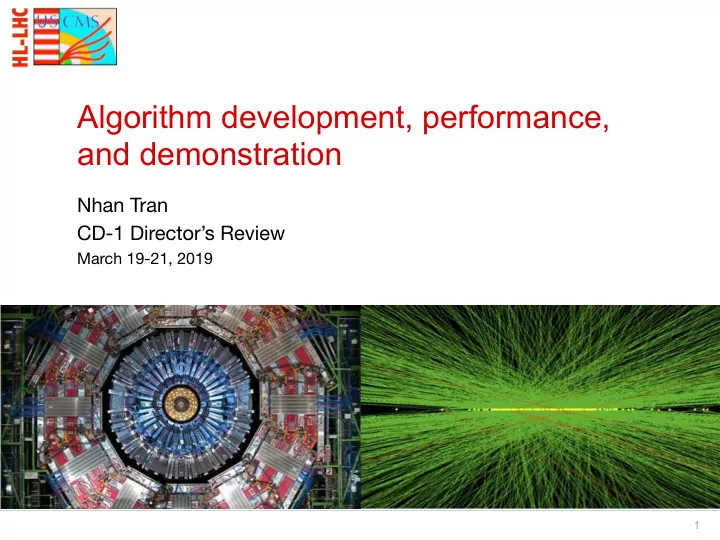
Algorithm development, performance, and demonstration

Nhan Tran CD-1 Director’s Review

March 19-21, 2019

1
slide-2
SLIDE 2

Brief Biological Sketch

2

Wilson Fellow (Fermilab)

L3 Manager: Correlator trigger Development of Particle Flow and PUPPI in L1 trigger Lead on hls4ml: high level synthesis for machine learning

Postdoc (Fermilab)

Track trigger ASIC development and testing for Vertically Integrated Pattern Recognition Associative Memory (VIPRAM) Development of PUPPI algorithm

slide-3
SLIDE 3

Outline

3

Trigger overview and DOE scope Algorithm development and design Functional algorithm overview Algorithm suite Physics performance Firmware demonstration

slide-4
SLIDE 4

TRIGGER OVERVIEW AND DOE SCOPE

4

slide-5
SLIDE 5

Trigger Scope Overview

5 Outer Tracker Detector Barrel Muon System Endcap Muon System Track Trigger CE BE BMU BE EMU BE Ba Barrel Calo Tr Trigger RC RCT Co Correlator Trigger Layer-1 Correlator / Global Trigger Layer-2 Barrel Muon Track Finder Endcap Muon Track Finder BE+L1 System: 40, 40,000 000 kHz Hz event data processing 36 Boards 27+2 Boards 5-10 Boards 162 boards

NSF Trigger/DAQ scope Other US CMS scope

750 kHz To HLT

DA DAQ/HL HLT System Event Builder HLT Storage Manager

7.5 kHz To Offline

DTC: Outer Tracker BE Barrel Calorimeters EB/HB/HF BE Ba Barrel Calo Tr Trigger GC GCT 3 Boards 13 boards 6 boards

DOE Trigger/DAQ scope

Pixel Tracker MIP Timing Detector

slide-6
SLIDE 6

Trigger requirements (DOE scope)

6

Maintain performant trigger under high luminosity conditions Upgrade L1 trigger accept rate: 750 kHz Upgrade L1 trigger total latency: 12.5 μs Detector/Trigger Upgrades

Tracking trigger for tracks with pT > 2 GeV New high granularity endcap calorimeter Full crystal readout of barrel ECal New muon detectors for improved high η coverage and higher granularity readout

DOE trigger scope Barrel calorimeter Correlator trigger (combining muon, calorimeter, tracker inputs)

slide-7
SLIDE 7

System overview

7

Sorting/Merging Layer
 Endcap Muon Track Finder MPC CSC RPC Correlator Trigger Layer-1 
 (Particle Flow + PUPPI) Splitters ECAL EB HCAL HB HCAL HF single xtal Barrel Regional Calo Trigger

Muon Trigger Track Trigger

GEM + 
 iRPC Global Trigger Tracker Stubs Barrel Global Calo Trigger HGCal EC Correlator Trigger Layer-2
 (Obj ID: µ’s, e’s, γ’s, τ’s, jets, MET) Barrel Muon Backend and formation of η & φ data DT fan-out

Calorimeter Trigger

Vertex Finder

Track Finder Endcap Calo Trigger LB fan-out Barrel Muon Track Finder

New for upgrade

slide-8
SLIDE 8

System overview

8

Sorting/Merging Layer
 Endcap Muon Track Finder MPC CSC RPC Correlator Trigger Layer-1 
 (Particle Flow + PUPPI) Splitters ECAL EB HCAL HB HCAL HF single xtal Barrel Regional Calo Trigger

Muon Trigger Track Trigger

GEM + 
 iRPC Global Trigger Tracker Stubs Barrel Global Calo Trigger HGCal EC Correlator Trigger Layer-2
 (Obj ID: µ’s, e’s, γ’s, τ’s, jets, MET) Barrel Muon Backend and formation of η & φ data DT fan-out

Calorimeter Trigger

Vertex Finder

Track Finder Endcap Calo Trigger LB fan-out Barrel Muon Track Finder

DOE Scope

slide-9
SLIDE 9

General Algorithm Strategy

9

Deliver a suite of algorithms which cover both robustness and has good physics performance Single system triggers* Robust, simpler algorithms Global Calorimeter Trigger objects Track-only Trigger objects Multi-system optimized reconstruction More complex, performant algorithms Track + muon correlated trigger objects Track + muon + calorimeter correlated (particle flow and PUPPI) trigger objects

* muon system only triggers in NSF scope

slide-10
SLIDE 10

Offline reconstruction flow

10

jets and MET

PF candidates

charged hadrons neutral hadrons photons electrons muons

tracking, local ECAL/ HCAL reconstruction

pileup removal and jet energy corrections

jet tagging and ID

ECAL and HCAL PF cluster calibrations

PF leptons and photons

photons electrons muons taus

slide-11
SLIDE 11

Functional algorithm diagram

11

TRACK TRIGGER ENDCAP CALORIMETER BARREL CALORIMETER MUON

SYSTEMS

TRACK+MUON

OBJECTS

PF ENGINE (TRACK+CALO+MUON) TRACK-

ONLY OBJECTS

CALO-

ONLY OBJECTS

PF PHYSICS OBJECTS INTER-OBJECT

CORRELATION AND GLOBAL TRIGGER MUON- ONLY OBJECTS

slide-12
SLIDE 12

photon

µ

neutral
 hadron

µ

HCAL
 clusters ECAL clusters

Detector Particle Flow

Particle Flow Engine

12

Use inspiration from offline reconstruction for best performance Particle Flow: efficient combination of complementary detector subsystems particle interpretation of the event, improves any single system energy/ spatial resolution

Detector pT-resolution η/Φ-segmentation Tracker 0.6% (0.2 GeV) – 5% (500 GeV) 0.002 x 0.003 (first pixel layer) ECAL 1% (20 GeV) – 0.4% (500 GeV) 0.017 x 0.017 (barrel) HCAL 30% (30 GeV) – 5% (500 GeV) 0.087 x 0.087 (barrel)

slide-13
SLIDE 13

PF, offline experience

13

Large gains from PF on jet and MET resolutions

arXiv:1706.04965 [PF paper]

(GeV)

Ref T

p

20 100 200 1000

Energy resolution

0.2 0.4 0.6 CMS

Simulation

Calo PF , R = 0.4

T

Anti-k | < 1.3

Ref

η |

(GeV)

miss T,Ref

p

50 100 150 200 250

resolution

miss T

Relative p

0.05 0.1 0.15 0.2 0.25 0.3 0.35 0.4 0.45 0.5

Calo PF

CMS

Simulation

improved jet pT resolution improved missing pT resolution Particle flow impact

slide-14
SLIDE 14

Pileup mitigation

14 )

C i

α weight (

0.2 0.4 0.6 0.8 1

fraction of particles

  • 3

10

  • 2

10

  • 1

10

neutrals LV neutrals PU

Use inspiration from offline reconstruction for best performance PUPPI (PileUp Per Particle Id): based on PF paradigm

Framework determines per particle weight for how likely a particle is from PU key insight: uses track vertexing and local radiation shape to infer neutral pileup contribution with QCD ansatz

C i

α

  • 5

5 10 15

fraction of particles

0.02 0.04 0.06

charged LV charged PU neutrals LV neutrals PU

Local discriminator Particle weights

slide-15
SLIDE 15

Pileup mitigation

15

Use inspiration from offline reconstruction for best performance PUPPI (PileUp Per Particle Id): based on PF paradigm

Framework determines per particle weight for how likely a particle is from PU key insight: uses track vertexing and local radiation shape to infer neutral pileup contribution with QCD ansatz

Large reduction in particle content (bandwidth) for trigger calculations

slide-16
SLIDE 16

Level-1 Trigger Menu

16

Work in progress — full trigger menu

  • Muons:
  • Track-matched muon
  • Stand-alone matched to L1 Tracks
  • BMTF: default matching, OMTF default matching, EMTF optimized matching
  • Electrons/Photons:
  • Stand-alone electron/photon from:
  • barrel clusters with dedicated WP for photons/electrons
  • HGCAL clusters with dedicated EG ID
  • Track-matched-electron: stand-alone electron matched to L1 Track
  • Track-matched-iso electron: track-matched electron with Tracks Isolation
  • Track-iso photon: stand-alone photon with Track Isolation
  • Jets/HT/MET:
  • PF+Puppi Jets/HT/MET: from clustering of PF+Puppi candidates
  • HT computed with jets with pT>30 GeV and |η|<2.4
  • Taus:
  • PF+Puppi Taus: Phase2 HPS Tau algo on L1 PF+Puppi candidates
  • PF+Puppi Iso Taus: isolation defined with sum of PF+Puppi charged candidates
slide-17
SLIDE 17

Level-1 Trigger Menu

17

L1_SingleTkMu (single muon) 18.7 22 |η|<2.4 L1_DoubleTkMu (double muon) 1.5 15,7 |η|<2.4, dZ<1cm L1_TripleTkMu (triple muon) 11.9 5,3,3 |η|<2.4, dZ<1cm L1_SingleTkEle (single electron) 95.8 36 |η|<2.4 L1_SingleTkEleIso (single electron iso) 90.5 28 |η|<2.4 L1_SingleTkEMIso (single photon iso) 66.4 36 (NA Now) |η|<2.4 L1_TkEleIso_EG (single ele iso + EG) 59.8 22,12 |η|<2.4 L1_DoubleTkEle (double ele) 67.0 25,12 |η|<2.4, dZ<1cm L1_DoubleTkEMIso (double photon iso) 23.1 22, 12 (NA Now) |η|<2.4 L1_SinglePFTau (single tau) 7.9 120 |η|<2.1 L1_PFTau_PFTau (double tau) 4.0 70,70 |η|<2.1 L1_PFIsoTau_PFIsoTau (double tau iso) 11.8 44, 44 (33,33 Now) |η|<2.1 L1_SinglePfJet (single jet) 54.4 180 (200 Now) |η|<2.4 L1_DoublePFJet_dEtaMax (double jet dEta) 62.8 125,125 (112,112 Now) |η|<2.4, dη<1.6 L1_PFHT (ht) 19.7 360 L1_PFMet (met) 71.7 150 Rates (kHz) Thresholds

(‘offline’, GeV)

Additional requirements

slide-18
SLIDE 18

Level-1 Trigger Menu

18

Cross triggers:

L1_TkMu_TkEGIso (mu,eleIso) 3.3 7,20 |η|<2.4, dZ<1cm L1_TkMu_TkEG (mu,ele) 9.1 7,23 |η|<2.4, dZ<1cm L1_TkEG_TkMu (ele,mu) 4.2 10,20 |η|<2.4, dZ<1cm L1_TkMu_DoubleTkEle (mu,ele,ele) 2.7 6,17,17 |η|<2.4, dZ<1cm L1_DoubleTkMu_TkEle (mu,mu,ele) 9.4 5,9,9 |η|<2.4, dZ<1cm L1_TkMu_PfHTT (mu,HT) 6,7 6,240 |η|<2.4, dZ<1cm L1_TkMu_PFJet_dRMax_DoubleJet_dEtaMax 18.7 12,40,40 |η|<2.4, dR<0.1,

(mu, jet, jet) dη<1.6, dZ<1cm

L1_TkMu_PfJet_PfMet (mu,jet,met) 37.4 3,120 (100 Now),60 |η|<2.1/2.4, dZ<1cm L1_DoubleTkMu_PfJet_PfMet (mu,mu,jet,met) 22.7 3,3,60,70 |η|<2.4, dZ<1cm L1_DoubleTkMu_PfHT (mu, mu, ht) 3.3 3,3,220 |η|<2.4, dZ<1cm L1_DoubleTkEle_PfHT (mu, ele, ht) 21 8,8,300 |η|<2.4, dZ<1cm L1_TkEleIso_PfHT (eleIso, HT) 21.9 26,100 |η|<2.4, dZ<1cm L1_TkEle_PFJet_dRMin (ele, jet) 103.1 28,60 (34 Now) |η|<2.1/2.4, dR>0.3, dZ L1_PFIsoTau_TkMu (tauIso, mu) 8.9 24,18 |η|<2.1/2.4, dZ<1cm L1_TkEleIso_PFIsoTau_dRMin (eleIso, tauIso) 41.7 22, 26 |η|<2.1/2.4, dR>0.3, dZ L1_PFIsoTau_PFMet (tauIso, met) 14.5 50,(40 Now) 120 |η|<2.1 L1_PFHTT_QuadJet (ht, quadjet) 21.2 320, 70,55,40,40 |η|<2.4 TOTAL RATE 477 !!!!!!!!!!!!!!!!!!!!!!!!!!!!!!!!!!!!!!!!!!!!!!!!! Rates (kHz) Thresholds

(‘offline’, GeV)

Additional requirements

(target: 750 kHz)

slide-19
SLIDE 19

ALGORITHM DEVELOPMENT

19

Goals of this talk:
 Present algorithm status, physics performance, and firmware readiness towards trigger baseline design in DOE scope

slide-20
SLIDE 20

A note on algorithm development

20

FPGA development of algorithms in languages like VHDL or Verilog (RTL) have long development cycles and require a lot of engineering support New tools: HLS, high level synthesis C-level programming with specialized preprocessor directives which synthesizes optimized firmware Particle flow example:

Algorithmic firmware developed in 2-3 months using HLS, only physicists

Engineering firmware support still required (of course!) — our experience: system interfaces, infrastructure, and signal routing, etc.

slide-21
SLIDE 21

Functional algorithm diagram

21

TRACK TRIGGER ENDCAP CALORIMETER BARREL CALORIMETER MUON

SYSTEMS

TRACK+MUON

OBJECTS

PF ENGINE (TRACK+CALO+MUON) TRACK-

ONLY OBJECTS

CALO-

ONLY OBJECTS

PF PHYSICS OBJECTS INTER-OBJECT

CORRELATION AND GLOBAL TRIGGER MUON- ONLY OBJECTS

slide-22
SLIDE 22

Functional algorithm diagram

22

TRACK TRIGGER ENDCAP CALORIMETER

Calorimeter clustering and ID and calibration

MUON

SYSTEMS

Track + muon tracks Track + muon stubs Displaced muons Track propagation Particle Flow algorithm PUPPI algorithm Vertexing Track jets Track MET Track combos Calo Jets, MET, EG objects, taus

PF PHYSICS OBJECTS INTER-OBJECT

CORRELATION AND GLOBAL TRIGGER MUON- ONLY OBJECTS

slide-23
SLIDE 23

Functional algorithm diagram

23 Calorimeter clustering and ID and calibration Track + muon tracks Track + muon stubs Displaced muons Track propagation Particle Flow algorithm PUPPI algorithm Vertexing Track jets Track MET Track combos Calo Jets, MET, EG objects, taus

baseline algo firmware Clustering ID Calibration

Legend done in progress unstarted

slide-24
SLIDE 24

Calorimeter clustering

24

ECAL VFE+FE HCAL RBX HCAL BE ECAL BE CALO TRG L1 CALO TRG L2

36x 216x 36x 2448x 36x 3x

12:1 ratio 1:1 ratio 12:1 ratio To GT/Correlator 9792 fibers 1152 fibers 216 fibers Only data fibers represented 288 fibers

RCT GCT

Task: absorb data from calorimeter backend electronics; New — single crystal granularity from ECal Regional Calorimeter Trigger (RCT) — clusters and towers Top 12 3x5 EG clusters per region (and shower shape info) + unclustered energy saved in tower information

slide-25
SLIDE 25

Calorimeter clustering

25

Clustering procedure implemented using HLS

Moderate resource usage (8% FFs, 13% LUTs, 72 clock latency)

Room for: Tower computations (depth), 
 cluster ID, and calibration resources

Cluster ID with NN in development

slide-26
SLIDE 26

Cluster calibration

26

Full cluster calibration chain similar for endcap and barrel calorimeter Calibrations currently set up as a look up table: pT, eta, EM fraction

Calo Clusters EM Clusters Calo Clusters EM Clusters Calibrate to Photon Tracks Propagate to Calorimeter Cluster to 3x3 cells Calibrate to Photon

H G C a l

Calibrate to Pion Cluster to 3x3 cells

Merge Merge

E/γ clusters

slide-27
SLIDE 27

Functional algorithm diagram

27 Calorimeter clustering and ID and calibration Track + muon tracks Track + muon stubs Displaced muons Track propagation Particle Flow algorithm PUPPI algorithm Vertexing Track jets Track MET Track combos Calo Jets, MET, EG objects, taus

baseline algo firmware Track prop PF block Vertexing PUPPI

Legend done in progress unstarted

slide-28
SLIDE 28

PF+PUPPI schematic

28 tracks muons

PF+PUPPI Cands TK particles PF Cands

Calo clusters EM Calo - Tk linking μ - Tk linking Calo - Tk linking PU estimate PUPPI calculation vertexing EM clusters

slide-29
SLIDE 29

PF+PUPPI schematic

29 tracks muons

PF+PUPPI Cands TK particles PF Cands

Calo clusters EM Calo - Tk linking μ - Tk linking Calo - Tk linking PU estimate PUPPI calculation vertexing EM clusters

PF inherently local,
 Event regionalized into 0.6η x 0.6φ blocks

slide-30
SLIDE 30

Particle flow regions

30

Tracks PV Ecal e/γ HGC 3D HF PF (PFAlgo3) HCal 3x3 tower clusters Puppi 3x3 tower clusters PF (PFAlgoHGC) PF (PFAlgo3) Puppi Puppi

Barrel Endcap Forward

slide-31
SLIDE 31

Vertexing algorithms

31

Vertexing can be done in parallel to particle flow but is needed for pileup mitigation techniques

First “fast histogramming” algorithms implemented as a baseline, improvements and alternative approaches under study

slide-32
SLIDE 32

Vertexing

32

Resources are reasonable (several %) Considering to send multiple vertices for best coverage Important for softer processes

slide-33
SLIDE 33

PUPPI

33

α = log ΣNEIGHBORS (pT/ΔR)

PILEUP-LIKE NOT PILEUP-LIKE

Central region, look at charged primary vertex particles Forward region, look at all neighboring particles Upshot: two “flavors” of PUPPI on whether you have tracking information “Forward PUPPI” requires more resources

slide-34
SLIDE 34

Resources, PF + (Central) PUPPI

34

For typical region with 25 tracks and 25 EM/had clusters each Further optimizations of the algorithm improve resource usage Also consider computing PUPPI for multiple vertices to increase reconstruction efficiency

# Vtx

1 3 5

Latency (cycles) 124 125 126 LUTs as Logic (%) 41.22 50.73 59.72 Registers (%) 22.74 25.79 29.68 DSPs (%) 38.67 39.43 40.37

barrel PF + PUPPI algorithm

slide-35
SLIDE 35

Resources, PF + (Forward) PUPPI

35

For typical region with 25 tracks and 25 EM/had clusters each Further optimizations of the algorithm improve resource usage Also consider computing PUPPI for multiple vertices to increase reconstruction efficiency

F

  • r

w a r d P F + P U P P I a l g

  • r

i t h m

slide-36
SLIDE 36

Jet and HT performance

36

PF+PUPPI algorithms bring significant improvement for hadronic trigger

  • bjects

Continual improvements to algorithms Jet algorithms still offline style, work in progress

HT trigger multijet trigger

slide-37
SLIDE 37

MET performance

37

Tuning of the PF+Puppi algorithm for MET performance Comparison against other types of MET Significant gains in MET rates/efficiency for the full PF+PUPPI MET

VBF Hinv vs MB ttbar vs MB

slide-38
SLIDE 38

Functional algorithm diagram

38 Calorimeter clustering and ID and calibration

Track+muon tracks Track+muon stubs Displaced muons

Track propagation Particle Flow algorithm PUPPI algorithm Vertexing Track jets Track MET Track combos Calo Jets, MET, EG objects, taus

baseline algo firmware trk+mu trk trk+mu stub displaced

Legend done in progress unstarted

slide-39
SLIDE 39

Muon-track correlation

39

TT track-endcap standalone muon correlation: Dynamic Window Matching

2 −

10

1 −

10 1 10

2

10

3

10

4

10

5

10

Rate [kHz]

Dynamic Windows R = 0.7 match Δ Fixed R = 0.2 match Δ Fixed = 14 TeV, PU 200, 2808 colliding bunches s 10 20 30 40 50 60 70

threshold [GeV]

T

p

2 −

10

1 −

10 1

Ratio

✓ pT dependent matching in η & φ ✓ Large rate reduction achieved w.r.t. fixed ΔR matching

➡ 10 kHz @ 20 GeV

✓ High efficiency Florida Fermilab Belgrade

10 20 30 40 50 60 70 80 90 100

threshold [GeV]

T

p

0.2 0.4 0.6 0.8 1

Efficiency

Dynamic Windows R = 0.7 match Δ Fixed R = 0.2 match Δ Fixed CMS-TDR-15-02 (TP, 140 PU)

= 14 TeV, PU 200 s > 20 GeV

T

p

slide-40
SLIDE 40

Muon-track correlation

40

Variants of muon algorithms to improve muon performance as much as possible Track + muon stubs very efficient but non-linear effects with pileup — optimal cuts found to improve performance

5 is due to detector gaps → less likely to find stubs in gap since it can have at most 2

slide-41
SLIDE 41

Functional algorithm diagram

41 Calorimeter clustering and ID and calibration Track+muon tracks Track+muon stubs Displaced muons Track propagation Particle Flow algorithm PUPPI algorithm Vertexing Track jets Track MET Track combos Calo Jets, MET, EG

  • bjects, taus

baseline algo firmware calo jet trk jet τ’s calo e/γ

Legend done in progress unstarted

slide-42
SLIDE 42

Calo-only jets

42

Robust trigger builds jets only from calorimeter information Algorithm is based off of current trigger algorithm Reduced size jets due to increase pileup (7x7 towers ~ R = 0.3 jets)

Resource usage well understood from current implementation

slide-43
SLIDE 43

Calo-only jets

43

Robust trigger builds jets only from calorimeter information Algorithm is based off of current trigger algorithm Reduced size jets due to increase pileup (7x7 towers ~ R = 0.3 jets)

Pileup corrections in development Performance under control

slide-44
SLIDE 44

Track Jet algorithm in a nutshell

44

slide-45
SLIDE 45

Track jet performance

45

Performance studies show good performance; quad jet triggers 95% efficient at 75 GeV First firmware implementation fits with vertexing on the track-

  • nly board
slide-46
SLIDE 46

FIRMWARE-HARDWARE DEMONSTRATION

46

slide-47
SLIDE 47

Demonstration

47

Ultimately, need demonstration of algorithm, firmware, and hardware Developing a phased approach to work on each piece in a modular way Hardware development in progress, see next talk! Develop algorithms as a firmware blocks Develop firmware infrastructure using similar legacy hardware Evolve hardware step-by-step

slide-48
SLIDE 48

Demonstration

48

Generation 0 Legacy μTCA boards with Virtex-7 FPGA (CTP7) Multi-board algorithm demonstration Generation 1 CTP7 boards with improved link protocol (64/66b) Generation 2 Mixed CTP7 + APx (new ATCA with Virtex Ultrascale+) Generation 3 All APx setup

slide-49
SLIDE 49

Generation 0 demonstration

49

A first demonstration

slide-50
SLIDE 50

Demonstration

50

A first demonstration

slide-51
SLIDE 51

Demonstration

51

A first demonstration

slide-52
SLIDE 52

Particle flow demonstration

52

First demonstration is the PF + PUPPI algorithm in the Generation0 setup

Reduced input PF block (10 Tracks, 10 EG, 10 Had objects) Run the demo in both 1-board and 3-board configuration Perfect agreement in expected outputs, HLS outputs, and HW results

Can test bigger blocks too

**Muon algo demonstration
 also performed using legacy hardware

slide-53
SLIDE 53

SUMMARY

53

slide-54
SLIDE 54

Summary of algorithm status

54

baseline algo firmware Clustering ID Calibration Track prop PF block Vertexing PUPPI trk+mu trk trk+mu stub displaced calo jet trk jet τ’s calo e/γ

Legend done in progress unstarted

Suite of algorithms to meet physics needs (menu) demonstrated Firmware for most resource intensive algorithms within system requirements to meet mission need

slide-55
SLIDE 55

Institutions and contributed labor

55

Contributing institutions

Clustering and ID: UW Calibration: MIT, Fermilab, UIC Track propagation: TAMU Muon-track correlation: UCLA, UF , TAMU, Fermilab Vertexing and track-based objects: CU Boulder, Rutgers Particle Flow and PUPPI: MIT, Fermilab, UIC Calo-based objects: UW

slide-56
SLIDE 56

Summary

56

Algorithm performance and firmware have progressed since 2018 CD1 Algorithms for: barrel calorimeter trigger, global calorimeter trigger, correlator (including vertexing, track- based objects) Full demonstration system for algorithm firmware progressing First demonstration performed In sync with iCMS milestones for TDR in 2019

slide-57
SLIDE 57

BACKUP

57