CS137: Today Electronic Design Automation - - PDF document

cs137 today electronic design automation
SMART_READER_LITE
LIVE PREVIEW

CS137: Today Electronic Design Automation - - PDF document

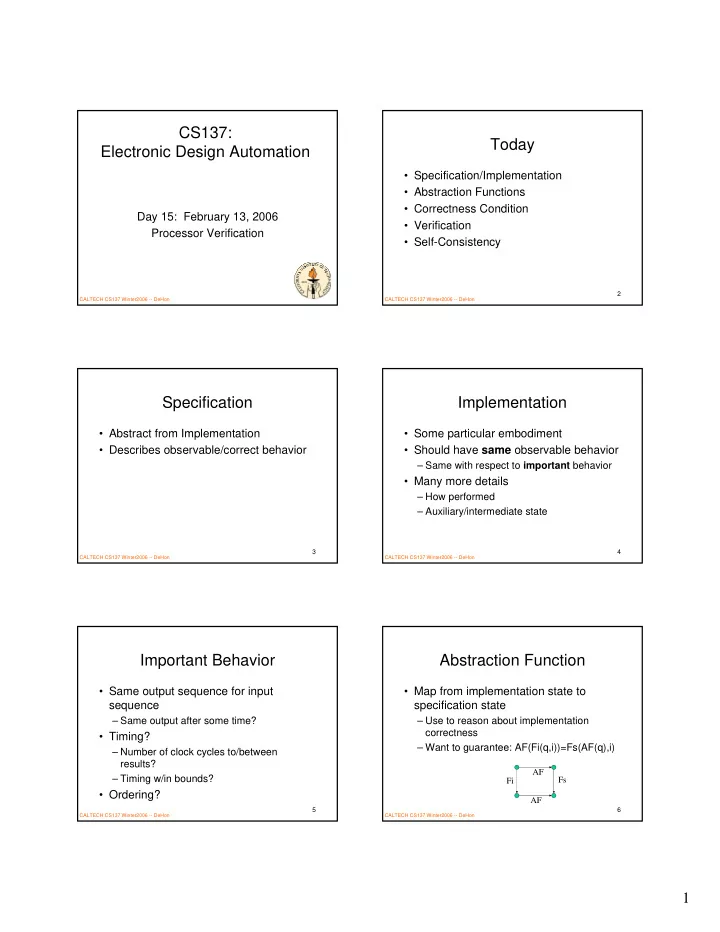
CS137: Today Electronic Design Automation Specification/Implementation Abstraction Functions Correctness Condition Day 15: February 13, 2006 Verification Processor Verification Self-Consistency 1 2 CALTECH CS137


slide-1
SLIDE 1

1

CALTECH CS137 Winter2006 -- DeHon

1

CS137: Electronic Design Automation

Day 15: February 13, 2006 Processor Verification

CALTECH CS137 Winter2006 -- DeHon

2

Today

  • Specification/Implementation
  • Abstraction Functions
  • Correctness Condition
  • Verification
  • Self-Consistency

CALTECH CS137 Winter2006 -- DeHon

3

Specification

  • Abstract from Implementation
  • Describes observable/correct behavior

CALTECH CS137 Winter2006 -- DeHon

4

Implementation

  • Some particular embodiment
  • Should have same observable behavior

– Same with respect to important behavior

  • Many more details

– How performed – Auxiliary/intermediate state

CALTECH CS137 Winter2006 -- DeHon

5

Important Behavior

  • Same output sequence for input

sequence

– Same output after some time?

  • Timing?

– Number of clock cycles to/between results? – Timing w/in bounds?

  • Ordering?

CALTECH CS137 Winter2006 -- DeHon

6

Abstraction Function

  • Map from implementation state to

specification state

– Use to reason about implementation correctness – Want to guarantee: AF(Fi(q,i))=Fs(AF(q),i)

AF AF Fs Fi

slide-2
SLIDE 2

2

CALTECH CS137 Winter2006 -- DeHon

7

Familiar Example

  • Memory Systems

– Specification:

  • W(A,D)
  • R(A)D from last D written to this address

– Specification state: contents of memory – Implementation:

  • Multiple caches, VM, pipelined, Write Buffers…

– Implementation state: much richer…

CALTECH CS137 Winter2006 -- DeHon

8

Memory AF

  • Maps from

– State of caches/WB/etc.

  • To

– Abstract state of memory

  • Guarantee AF(Fi(q,I))==Fs(AF(q),I)

– Guarantee change to state always represents the correct thing

CALTECH CS137 Winter2006 -- DeHon

9

Abstract Timing

  • For computer memory system

– Cycle-by-cycle timing not part of specification – Must abstract out

  • Solution:

– Way of saying “no response”

  • Saying “skip this cycle”
  • Marking data presence

– (tagged data presence pattern)

CALTECH CS137 Winter2006 -- DeHon

10

Filter to Abstract Timing

  • Filter input/output sequence
  • Os(in)out
  • FilterStall(Implin) = in
  • FilterStall(Implout) = out
  • Forall sequences Implin

– FilterOut(Oi(Implin)) = Os(FilterStall(Implin))

CALTECH CS137 Winter2006 -- DeHon

11

DLX Datapath

DLX unpipelined datapath from H&P (Fig. 3.1 e2, A.17 e3) CS184b: Day3

CALTECH CS137 Winter2006 -- DeHon

12

Processors

  • Pipeline is big difference between

specification state and implementation state.

  • Specification State:

– Register contents (incl. PC) – Memory contents

slide-3
SLIDE 3

3

CALTECH CS137 Winter2006 -- DeHon

13

Revised Pipeline

DLX repipelined datapath from H&P (Fig. 3.22 e2, A.24 e3) CS184b: Day3

CALTECH CS137 Winter2006 -- DeHon

14

Processors

  • Pipeline is big difference between

specification state and implementation state.

  • Specification State:

– Register contents (incl. PC) – Memory contents

  • Implementation State:

+ Instruction in pipeline + Lots of bits

Many more states State-space explosion to track

CALTECH CS137 Winter2006 -- DeHon

15

Compare

CALTECH CS137 Winter2006 -- DeHon

16

Observation

  • After flushing pipeline,

– Reduce implementation state to specification state

  • Can flush pipeline with series of NOPs
  • r stall cycles

CALTECH CS137 Winter2006 -- DeHon

17

Pipelined Processor Correctness

  • w = input sequence
  • wf = flush sequence

– Enough NOPs to flush pipeline state

  • Forall states q and prefix w

– Fi(q,w wf)Fs(q,w wf) – Fi(q,w wf)Fs(q,w)

  • FSM observation

– Finite state in pipeline – only need to consider finite w

CALTECH CS137 Winter2006 -- DeHon

18

Pipeline Correspondence

[Burch+Dill, CAV’94]

slide-4
SLIDE 4

4

CALTECH CS137 Winter2006 -- DeHon

19

Equivalence

  • Now have a logical condition for

equivalence

  • Need to show that it holds

– Is a Tautology

  • Or find a counter example

CALTECH CS137 Winter2006 -- DeHon

20

Ideas

  • Extract Transition Function
  • Segregate datapath
  • Symbolic simulation on variables

– For q, w’s

  • Case splitting search

– Implication pruning

CALTECH CS137 Winter2006 -- DeHon

21

Extract Transition Function

  • From HDL
  • Similar to what we saw for FSMs

CALTECH CS137 Winter2006 -- DeHon

22

Segregate Datapath

  • Big state blowup is in size of datapath

– Represent data symbolically/abstractly

  • Independent of bitwidth

– Not verify datapath/ALU functions as part

  • f this
  • Can verify ALU logic separately using

combinational verification techniques

  • Abstract/uninterpreted functions for datapath

CALTECH CS137 Winter2006 -- DeHon

23

Burch&Dill Logic

  • Quantifier-free
  • Uninterpreted functions (datapath)
  • Predicates with

– Equality – Propositional connectives

CALTECH CS137 Winter2006 -- DeHon

24

B&D Logic

  • Formula = ite(formula, formula, formula)

⏐ (term=term) ⏐ psym(term,…term) ⏐ pvar | true | false

  • Term = ite(formula,term,term)

⏐ fsym(term,…term) ⏐ tvar

slide-5
SLIDE 5

5

CALTECH CS137 Winter2006 -- DeHon

25

Sample

  • Regfile:

– (ite stall regfile (write regfile dest (alu op (read regfile src1) (read regfile src2))))

CALTECH CS137 Winter2006 -- DeHon

26

Sample Pipeline

CALTECH CS137 Winter2006 -- DeHon

27

Example Logic

  • arg1:

– (ite (or bubble-ex (not (= src1 dest-ex))) (read (ite bubble-wb regfile (write regfile dest-wb result)) src1) (alu op-ex arg1 arg2))

CALTECH CS137 Winter2006 -- DeHon

28

Symbolic Simulation

  • Create logical expressions for
  • utputs/state

– Taking initial state/inputs as variables

CALTECH CS137 Winter2006 -- DeHon

29

Case Splitting Search

  • Satisfiability Problem
  • Pick an unresolved variable
  • Branch on true and false
  • Push implications
  • Bottom out at consistent specification
  • Exit on contradiction
  • Pragmatic: use memoization to reuse

work

CALTECH CS137 Winter2006 -- DeHon

30

Review: What have we done?

  • Reduced to simpler problem

– Simple, clean specification

  • Abstract Simulation

– Explore all possible instruction sequences

  • Abstracted the simulation

– Focus on control – Divide and Conquer: control vs. arithmetic

  • Used Satisfiability for reachability in

search in abstract simulation

slide-6
SLIDE 6

6

CALTECH CS137 Winter2006 -- DeHon

31

Achievable

  • Burch&Dill: Verify 5-stage pipeline DLX

– 1 minute in 1994

CALTECH CS137 Winter2006 -- DeHon

32

Self Consistency

CALTECH CS137 Winter2006 -- DeHon

33

Self-Consistency

  • Compare same implementation in two

different modes of operation

– (which should not affect result)

  • Compare pipelined processor

– To self w/ NOPs separating instructions

  • So only one instruction in pipeline at a time

CALTECH CS137 Winter2006 -- DeHon

34

Self-Consistency

  • w = instruction sequence
  • S(w) = w with no-ops
  • Show: Forall q, w

– F(q,w) = F(q,S(w))

CALTECH CS137 Winter2006 -- DeHon

35

Sample Result

[Jomes, Seger, Dill/FMCAD 1996] n.b. Jones&Seger at Intel

CALTECH CS137 Winter2006 -- DeHon

36

Sample Result

[Skakkebæk, Jones, and Dill / CAV 1998] Verification running on P2-200MHz

slide-7
SLIDE 7

7

CALTECH CS137 Winter2006 -- DeHon

37

Key Idea

  • Implementation State reduces to

Specification state after finite series of

  • perations
  • Abstract datapath to avoid dependence
  • n bitwidth

CALTECH CS137 Winter2006 -- DeHon

38

Admin

  • No class Wednesday
  • Friday

– Sequential Implementation – Present Proposed Plan of Attack

CALTECH CS137 Winter2006 -- DeHon

39

Big Ideas

  • Proving Invariants
  • Divide and Conquer
  • Exploit structure