CS137: Today Electronic Design Automation Routing Pathfinder - - PDF document

cs137 today electronic design automation
SMART_READER_LITE
LIVE PREVIEW

CS137: Today Electronic Design Automation Routing Pathfinder - - PDF document

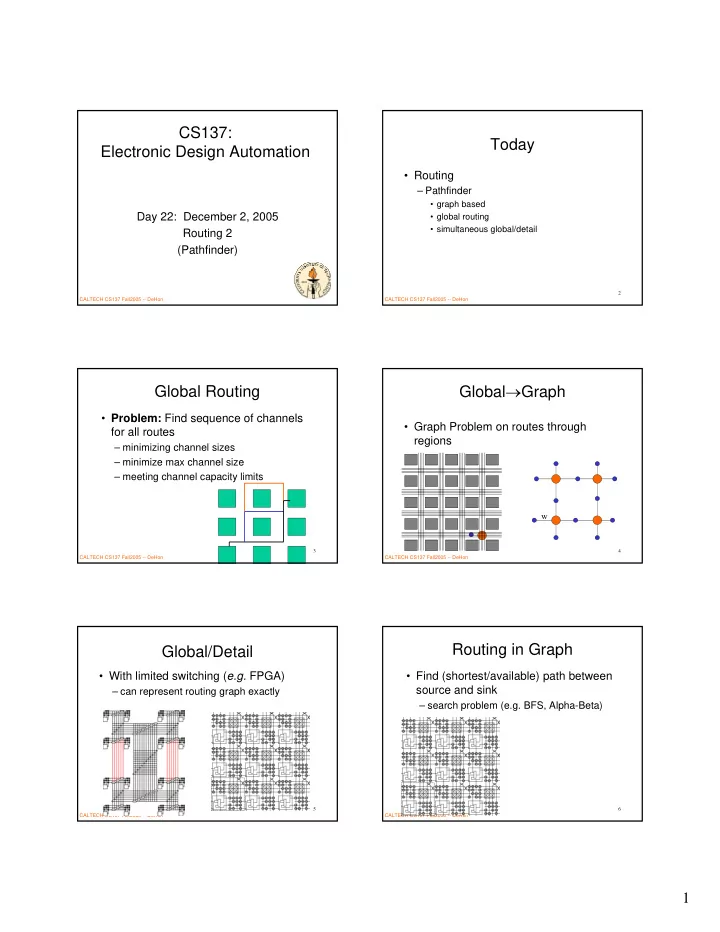
CS137: Today Electronic Design Automation Routing Pathfinder graph based Day 22: December 2, 2005 global routing simultaneous global/detail Routing 2 (Pathfinder) 1 2 CALTECH CS137 Fall2005 -- DeHon CALTECH CS137


slide-1
SLIDE 1

1

CALTECH CS137 Fall2005 -- DeHon 1

CS137: Electronic Design Automation

Day 22: December 2, 2005 Routing 2 (Pathfinder)

CALTECH CS137 Fall2005 -- DeHon 2

Today

  • Routing

– Pathfinder

  • graph based
  • global routing
  • simultaneous global/detail

CALTECH CS137 Fall2005 -- DeHon 3

Global Routing

  • Problem: Find sequence of channels

for all routes

– minimizing channel sizes – minimize max channel size – meeting channel capacity limits

CALTECH CS137 Fall2005 -- DeHon 4

Global→Graph

  • Graph Problem on routes through

regions

w

CALTECH CS137 Fall2005 -- DeHon 5

Global/Detail

  • With limited switching (e.g. FPGA)

– can represent routing graph exactly

CALTECH CS137 Fall2005 -- DeHon 6

Routing in Graph

  • Find (shortest/available) path between

source and sink

– search problem (e.g. BFS, Alpha-Beta)

slide-2
SLIDE 2

2

CALTECH CS137 Fall2005 -- DeHon 7

Easy?

  • Finding a path is moderately easy
  • What’s hard?

– Can I just iterate and pick paths?

CALTECH CS137 Fall2005 -- DeHon 8

Example

s1 s3 s2 d2 d1 d3 All links capacity 1

si →di

CALTECH CS137 Fall2005 -- DeHon 9

Challenge

  • Satisfy all routes simultaneously
  • Routes share potential resources
  • Greedy/iterative

– not know who needs will need which resources – i.e. resource/path choice looks arbitrary – …but earlier decisions limit flexibility for later

  • like scheduling

– order effect result s1 s3 s2 d2 d1 d3

CALTECH CS137 Fall2005 -- DeHon 10

Negotiated Congestion

  • Old idea

– try once – see where we run into problems – undo problematic/blocking allocation

  • rip-up

– use that information to redirect/update costs on subsequent trials

  • retry

CALTECH CS137 Fall2005 -- DeHon 11

Negotiated Congestion

  • Here

– route signals – allow overuse – identify overuse and encourage signals to avoid

  • reroute signals based on overuse/past

congestion

CALTECH CS137 Fall2005 -- DeHon 12

Basic Algorithm

  • Route signals along minimum cost path
  • If congestion/overuse

– assign higher cost to congested resources

  • Repeat until done
slide-3
SLIDE 3

3

CALTECH CS137 Fall2005 -- DeHon 13

Key Idea

  • Congested paths/resources become

expensive

  • When there is freedom

– future routes, with freedom to avoid congestion will avoid it

  • When there is less freedom

– must take congested routes

  • Routes which must use congested resources

will, while others will chose uncongested paths

CALTECH CS137 Fall2005 -- DeHon 14

Cost Function (1)

  • PathCost=Σ (link costs)
  • LinkCost = base × f(#routes using, time)
  • Base cost of resource

– E.g. delay of resource – Encourage minimum resource usage

  • (minimum length path, if possible)

– minimizing delay = minimizing resources

  • Congestion

– penalizes (over) sharing – increase sharing penalty over time s1 s3 s2 d2 d1 d3 2 3 4 3 1 1 1 1 1 4 4 3 2 1 1 1 3+1+4=8

CALTECH CS137 Fall2005 -- DeHon 15

Example (first order congestion)

Base costs (delays) s1 s3 s2 d2 d1 d3 2 3 4 3 1 1 1 1 1 4 4 3 2 1 1 1 Capacity

CALTECH CS137 Fall2005 -- DeHon 16

Example (first order congestion)

s1 s3 s2 d2 d1 d3 2 3 4 3 1 1 1 1 1 4 4 3 2 Base costs (delays) 1 1 1 Capacity

All, individual routes prefer middle; create congestion.

CALTECH CS137 Fall2005 -- DeHon 17

Example (first order congestion)

s1 s3 s2 d2 d1 d3 2 3 4 3 1 1 1 1 1 4 4 3 2 Base costs (delays) 1 1 1 Capacity

Reroute, avoid congestion.

CALTECH CS137 Fall2005 -- DeHon 18

Example (need for history)

Base costs (delays) Capacity Need to redirect uncongested paths; how encourage? s1 s2 d2 d1 2 1 1 s3 d3 1 s4 d4 2 2 1 1 1 1 2 1 1 1 2 1 1

slide-4
SLIDE 4

4

CALTECH CS137 Fall2005 -- DeHon 19

Example (need for history)

Cannot route s3d3 s1 s2 d2 d1 2 2 2 1 1 1 1 s3 d3 1 1 2 1 1 1 Local congestion alone won’t drive in right directions. Both paths equal cost …neither resolves problem. May ping-pong back and forth. (can imagine longer chain like this) s4 d4 1 1 2 1 1 1

CALTECH CS137 Fall2005 -- DeHon 20

Cost Function (2)

  • Cost = (base + history)*f(#resources,time)
  • History

– avoid resources with history of congestion

CALTECH CS137 Fall2005 -- DeHon 21

Example (need for history)

S3d3 and s4d4 initially ping-pong Builds up congestion history on path 3 and 4 Eventually makes path 3 and 4 more expensive than path 1; …resolves conflict…

Adaptive cost scheme.

s1 s2 d2 d1 2 2 2 1 1 1 1 s3 d3 1 1 2 1 1 1 s4 d4 1 2 1 1

CALTECH CS137 Fall2005 -- DeHon 22

What about delay?

  • Existing formulation uses delay to

reduces resources, but doesn’t directly treat

  • Want:

– prioritize critical path elements for shorter delay – allow nodes with slack to take longer paths

CALTECH CS137 Fall2005 -- DeHon 23

Cost Function (Delay)

  • Cost=

– W(edge)*delay + (1-W(edge))*congest – congest as before

  • (base+history)*f(#signals,time)
  • W(edge) = D(edge)/Dmax

– 1 for edge on critical path critical path – <1 for paths with slack

  • Use W(edge) to order routes
  • Update critical path and W each round

CALTECH CS137 Fall2005 -- DeHon 24

Convergence

  • Chan+Schlag [FPGA’2000]

– cases where doesn’t converge – special case of bipartite graphs

  • converge if incremental
  • or if prefer uncongested to least history cost
  • theory (continuous)

– only reroute overflow – converge in O(|E|) reroutes – But then have fractional routes…

slide-5
SLIDE 5

5

CALTECH CS137 Fall2005 -- DeHon 25

Rerouting

  • Default: reroute everything
  • Can get away rerouting only congested

nodes

– if keep routes in place – history force into new tracks

  • causing greedy/uncongested routes to be

rerouted

CALTECH CS137 Fall2005 -- DeHon 26

Rerouting

  • Effect of only reroute congested?

– maybe more iterations

  • (not reroute a signal until congested)

– less time – ? Better convergence – ? Hurt quality?

  • (not see strong case for)

– …but might hurt delay quality

  • Maybe followup rerouting everything once clear

up congesiton?

CALTECH CS137 Fall2005 -- DeHon 27

Run Time?

  • Route |E| edges
  • Each path search O(|Egraph|) worst case

– …generally less

  • Iterations?

CALTECH CS137 Fall2005 -- DeHon 28

Quality and Runtime Experiment

  • For Synthetic netlists on HSRA

– Expect to be worst-case problems

  • Number of individual route trials limited

(measured) as multiple of nets in design

– (not measuring work per route trial)

CALTECH CS137 Fall2005 -- DeHon 29

Quality: fixed runtime

CALTECH CS137 Fall2005 -- DeHon 30

Quality Target

slide-6
SLIDE 6

6

CALTECH CS137 Fall2005 -- DeHon 31

Quality vs. Time

CALTECH CS137 Fall2005 -- DeHon 32

Conclusions?

  • Iterations increases with N
  • Quality degrade as we scale?

CALTECH CS137 Fall2005 -- DeHon 33

Search Ordering

  • Default: breadth first search for shortest

– O(total-paths) – O(Np) for HSRA

  • Alternately: use A*:

– estimated costs/path length, prune candidates earlier – can be more depth first

  • (search promising paths as long as know can’t

be worse)

CALTECH CS137 Fall2005 -- DeHon 34

Search: one-side vs. two-sides

  • One-side vs. Two-sides

CALTECH CS137 Fall2005 -- DeHon 35

Search: Oblivious vs. Directed (BFS vs. A*)

CALTECH CS137 Fall2005 -- DeHon 36

Single-side, Directed (A*)

Only expand search windows as prove necessary to have longer route.

slide-7
SLIDE 7

7

CALTECH CS137 Fall2005 -- DeHon 37

Searching

  • In general:

– greedy/depth first searching

  • find a path faster
  • may be more expensive

– (not least delay, congest cost)

– tradeoff by weighting

  • estimated delay on remaining path vs. cost to this

point

  • control greediness of router

– More greedy is faster at cost of less optimal paths (wider channels)

  • 40% W 10x time reduction [Tessier/thesis’98]

CALTECH CS137 Fall2005 -- DeHon 38

Searching

  • Use alpha-beta like search

– Always expanded (deepen) along shortest …as long as can prove no other path will dominate – Uncongested: takes O(path-length) time – Worst-case reduces to breadth-first

  • O(total-paths)
  • O(Np) for HSRA

CALTECH CS137 Fall2005 -- DeHon 39

Domain Negotiation

  • For Conventional FPGAs (and many

networks)

– path freedom

  • bushy in middle
  • low on endpoints

CALTECH CS137 Fall2005 -- DeHon 40

Mesh Expand

1 2 4 4 2

CALTECH CS137 Fall2005 -- DeHon 41

Multistage/Benes

Switches in all paths 0000 to 1111

CALTECH CS137 Fall2005 -- DeHon 42

Conventional FPGA Domains

Called: subset disjoint

slide-8
SLIDE 8

8

CALTECH CS137 Fall2005 -- DeHon 43

Conventional FPGA Domains

Called: subset disjoint

CALTECH CS137 Fall2005 -- DeHon 44

Domain Routing

  • No point in

searching along an entire path from source

  • Just to find it’s

heavily congested at sink

(SRC)

sink

CALTECH CS137 Fall2005 -- DeHon 45

HSRA Domains

CALTECH CS137 Fall2005 -- DeHon 46

Domain Negotiation

  • Path bottlenecks exist at both endpoints
  • Most critical place for congestion
  • Most efficient: work search from both ends

– more limiting in A*/Alpha-Beta search – focus on paths with least (no) congestion on endpoints first – FPGAs -- picking “domain” first – otherwise paths may look equally good up to end (little pruning)

CALTECH CS137 Fall2005 -- DeHon 47

Summary

  • Finding short path easy/well known
  • Complication: need to route set of

signals

– who gets which path? – Arbitrary decisions earlier limit options later

  • Idea: iterate/relax using congestion

history

– update path costs based on congestion

  • Cost adaptive to route

– reroute with new costs

  • Accommodate delay and congestion

CALTECH CS137 Fall2005 -- DeHon 48

Next Term

  • Next term

– Project

  • Bias: Graph Machine focused

– Attack EDA problems with Graph Machine

– Go through all phases

  • Select problem
  • Formulate
  • Literature/technique review
  • Propose solution
  • Initial implementation
  • Final implementation

– Select lectures

  • Driven by projects, interests
slide-9
SLIDE 9

9

CALTECH CS137 Fall2005 -- DeHon 49

Admin

  • This was last lecture
  • Final Assignment

– Due 12/7

  • EAS Course Questionnaires

CALTECH CS137 Fall2005 -- DeHon 50

Big Ideas

  • Exploit freedom
  • Technique:

– Graph algorithms (BFS, DFS) – Search techniques (A*, Alpha-Beta) – Iterative improvement/relaxation