
SLIDE 1
The Elder & Disability Advocacy Firm of Christine A. Alsop, LLC | 1
The Elder & Disability Advocacy Firm of Christine A. Alsop, LLC (314) 644-3200 | calsop@alsopelderlaw.com
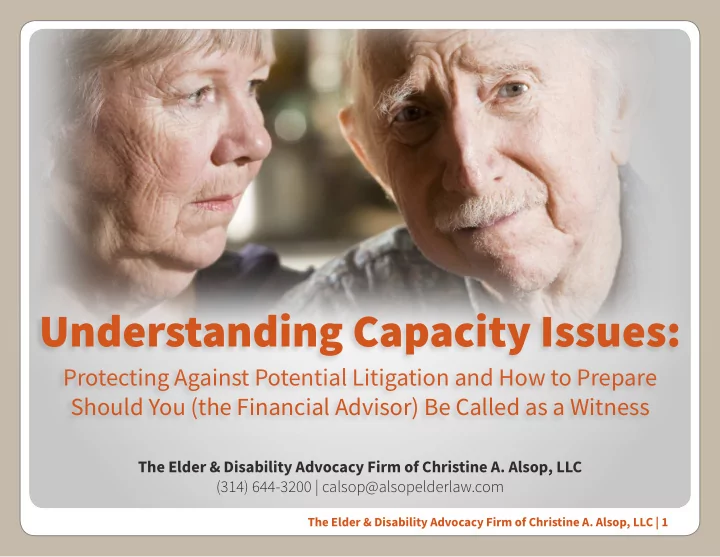
Understanding Capacity Issues: Protecting Against Potential - - PowerPoint PPT Presentation
Understanding Capacity Issues: Protecting Against Potential Litigation and How to Prepare Should You (the Financial Advisor) Be Called as a Witness The Elder & Disability Advocacy Firm of Christine A. Alsop, LLC (314) 644-3200 |
The Elder & Disability Advocacy Firm of Christine A. Alsop, LLC | 1
The Elder & Disability Advocacy Firm of Christine A. Alsop, LLC (314) 644-3200 | calsop@alsopelderlaw.com
The Elder & Disability Advocacy Firm of Christine A. Alsop, LLC | 2
To view PDF Presentation, visit www.AlsopElderLaw.com. Mouseover Firm News and then click Events and Seminars.
The Elder & Disability Advocacy Firm of Christine A. Alsop, LLC | 3
Click Capacity Issues - PDF Presentation. This link can be found underneath the March 15, 2016, seminar entry.
The Elder & Disability Advocacy Firm of Christine A. Alsop, LLC | 4
Americans who are aged 65-years and older will have more than doubled to 83.7 million which is 20.9% of the population.
the population.
From Diminished Capacity: Recognizing and Responding to the Signs. RegEd. www.reged.com
The Elder & Disability Advocacy Firm of Christine A. Alsop, LLC | 5
In order to ensure proper representation of your client, it is important to understand who your client is, how capacity is defined and whether or not your client has capacity.
The Elder & Disability Advocacy Firm of Christine A. Alsop, LLC | 6
those who are supposed to/authorized to have it.
formulate recommended actions and implement and monitor responsibilities.
information, including disclosing the assets that you are going to take control of and of which you will ofger investment advice on.
The Elder & Disability Advocacy Firm of Christine A. Alsop, LLC | 7
nature of the act and its consequences.
The Elder & Disability Advocacy Firm of Christine A. Alsop, LLC | 8
“But weaknesses and diseases incident to old age are not necessarily inconsistent with sanity. Merely to show that one sufgers from senility, confusion or forgetfulness, or is possessed of a mental weakness, is not enough to avoid a gifu, although these are factors to be considered. One must go further and show that the donor did not possess sufgicient mind to understand, in a reasonable manner, the nature and efgect of the act in which she was engaged.” Flynn v. Union National Bank of Springfield, 378 SW 2d 1, 8–9 (Mo. App. S.D. 1964).
The Elder & Disability Advocacy Firm of Christine A. Alsop, LLC | 9
From Diminished Capacity: Recognizing and Responding to the Signs. RegEd. www.reged.com
The Elder & Disability Advocacy Firm of Christine A. Alsop, LLC | 10
Client has trouble communicating:
Client shows signs of short-term memory loss:
Client shows signs of disorientation:
From Diminished Capacity: Recognizing and Responding to the Signs. RegEd. www.reged.com
The Elder & Disability Advocacy Firm of Christine A. Alsop, LLC | 11
Client exhibits problems with comprehension:
Client shows signs of emotional distress:
From Diminished Capacity: Recognizing and Responding to the Signs. RegEd. www.reged.com
The Elder & Disability Advocacy Firm of Christine A. Alsop, LLC | 12
The signs of diminished financial capacity specifically include any
plus one or more of the following:
the check register, incorrectly or incompletely fills out entries or incorrectly fills out the payment amount)
client’s previously agreed upon investment objectives
From Diminished Capacity: Recognizing and Responding to the Signs. RegEd. www.reged.com
The Elder & Disability Advocacy Firm of Christine A. Alsop, LLC | 13
The signs of diminished financial capacity specifically include any
plus one or more of the following (cont’d):
are out of character in terms of riskiness (e.g. a newly found interest in get-rich-quick schemes)
everything, but, this week, he or she wants to buy more)
no unauthorized money movements or no money movements at all
From Diminished Capacity: Recognizing and Responding to the Signs. RegEd. www.reged.com
The Elder & Disability Advocacy Firm of Christine A. Alsop, LLC | 14
You have a duty to ensure the suitability
the trading is excessive
without authority
with a third-party’s instruction, without first receiving client authorization in writing
The Elder & Disability Advocacy Firm of Christine A. Alsop, LLC | 15
Prospective client, Tom Brady, a 95-year old gentleman, walks into your
He states that he wants to add Lola’s name onto his investments, which are valued in the range of $850,000. You have known Tom for quite some time through your father, but you never served as his financial advisor before and have had no real relationship with him. You are aware that Tom has three children, one of whom is an attorney. Do you retitle the account and make Tom and Lola joint owners? What if Tom was 52-years old and newly divorced? Would your answer change?
The Elder & Disability Advocacy Firm of Christine A. Alsop, LLC | 16
to make decisions?
your client (i.e. an attorney-in-fact under a power of attorney) have the legal authority to do so?
family members who are speaking on behalf of your client?
absent from the conversation and what possible issues could arise amongst the family members?
The Elder & Disability Advocacy Firm of Christine A. Alsop, LLC | 17
except as required in response to proper legal process in connection with a civil dispute
inform the client of any and all material deficiencies.
conduct of advisors with such credentials. Examples of self-regulating organizations:
The Elder & Disability Advocacy Firm of Christine A. Alsop, LLC | 18
Follow Your Firm’s Procedures:
you see or suspect signs of diminished cognitive and/or financial capacity.
Document Your Observations:
end up serving as evidence in a complaint situation, legal case or arbitration.
From Diminished Capacity: Recognizing and Responding to the Signs. RegEd. www.reged.com
The Elder & Disability Advocacy Firm of Christine A. Alsop, LLC | 19
DO - Examples of What to Write:
appeared to have not bathed in days. This is the first time that I have seen the client unkempt.”
been here many times before and is usually on time or early.”
DON’T - Examples of What Not to Write:
From Diminished Capacity: Recognizing and Responding to the Signs. RegEd. www.reged.com
The Elder & Disability Advocacy Firm of Christine A. Alsop, LLC | 20
Report Your Observations:
concerned that one of your clients may sufger from diminished cognitive and/or financial capacity.
proceed.
capacity, obtain guidance from your firm as to how that should be done.
From Diminished Capacity: Recognizing and Responding to the Signs. RegEd. www.reged.com
The Elder & Disability Advocacy Firm of Christine A. Alsop, LLC | 21
Report Your Observations (cont’d):
diminished cognitive and/or financial capacity, do not take it upon yourself to contact your client’s family members about your suspicions without clear, written authorization from your firm to do so, as this could be a breach of your firm’s privacy policy.
and/or financial capacity, request that your supervisor or someone from the compliance department attend the meeting as well in order to provide additional observation of your client’s behavior.
From Diminished Capacity: Recognizing and Responding to the Signs. RegEd. www.reged.com
The Elder & Disability Advocacy Firm of Christine A. Alsop, LLC | 22
Evaluate Whether or Not to Make Recommendations:
transactions in the account of an investor, without clear guidance from your firm, until the diminished cognitive and/or financial capacity concern no longer exists.
Escalate Your Concerns to Your Supervisor:
designated person in charge of responding to senior investor issues), follow them carefully.
From Diminished Capacity: Recognizing and Responding to the Signs. RegEd. www.reged.com
The Elder & Disability Advocacy Firm of Christine A. Alsop, LLC | 23
There are several questions that should be asked when assisting a client who may have potential capacity issues.
What is your client’s health situation and is there enough time to be of assistance? Is there sufgicient time to determine key issues?
The Elder & Disability Advocacy Firm of Christine A. Alsop, LLC | 24
There are several questions that should be asked when assisting a client who may have potential capacity issues.
When dealing with multiple parties, what ethical issues can arise? What resources are available?
The Elder & Disability Advocacy Firm of Christine A. Alsop, LLC | 25
Building a team of professionals in order to provide your client with comprehensive support and assistance is important in upholding your duty of care to your clients.
Social workers, geriatric care managers, physicians and other specialists assist in life care planning and assessments. Financial advisors and banks are relied upon to notify and/or report suspicious activities or behaviors. Elder law attorneys create estate plans, including powers of attorney, and assist in guardianship/ conservatorship processes in order to protect client interests.
The Elder & Disability Advocacy Firm of Christine A. Alsop, LLC | 26
privilege in Missouri.
financial advisor to disclose the identity, afgairs or investments of any kind of any client to a third-party, unless required by law to do so or unless consented to by the client (15 CSR 30-51.172(1)(Q)).
The Elder & Disability Advocacy Firm of Christine A. Alsop, LLC | 27
that have rules and ethical standards regarding the advisor-client relationship.
confidential, as well as a suitability standard when dealing with client investments.
account all relevant facts known about the client to determine if an investment decision is appropriate for the client.
The Elder & Disability Advocacy Firm of Christine A. Alsop, LLC | 28
and the client, then the financial advisor owes the client the duties of loyalty and care.
interests of the client above all else.
The Elder & Disability Advocacy Firm of Christine A. Alsop, LLC | 29
Durable Power of Attorney: The power of the attorney-in-fact to act on the principal’s behalf continues despite the principal’s incapacity, whether or not a court decrees the principal to be incapacitated. Power of Attorney (without “Durable” language): The power of attorney is revoked and the power of the attorney-in-fact to act for the principal automatically stops if the principal becomes incapacitated.
The Elder & Disability Advocacy Firm of Christine A. Alsop, LLC | 30
Springing Power of Attorney: This type of power of attorney is efgective only when the principal is incapacitated or when some other stipulated event or condition occurs, thus “springing” the power of attorney into action. Non-Springing of Attorney: This type of power of attorney is efgective immediately upon execution of the document and remains efgective in the event of the principal’s disability or incapacity.
The Elder & Disability Advocacy Firm of Christine A. Alsop, LLC | 31
The attorney-in-fact (AIF) has a duty to act in the interest of the principal and to maintain contact with the principal, communicate with him or her and follow his or her wishes. The AIF must avoid self-dealing and must act using a high degree of care. Once the Durable Power of Attorney is signed, the AIF has a fiduciary relationship and
Powers include:
The Elder & Disability Advocacy Firm of Christine A. Alsop, LLC | 32
that the person lacked the mental capacity to execute the document
The Elder & Disability Advocacy Firm of Christine A. Alsop, LLC | 33
The Elder & Disability Advocacy Firm of Christine A. Alsop, LLC | 34
Your client, Wilma Flinstone, has just been diagnosed with Alzheimer’s-related dementia. Her husband, Fred, passed away approximately two years ago. Wilma’s dementia is considered mild. She is living at home by herself. She seems in good spirits and has not changed physically or mentally at all in your observation. She is worried about her future and wants to make sure that she is well taken care of. She is a bit hard- headed and independent. Her assets are significant. Her daughter, Pebbles, and her son, Bam-Bam, are named as her agents under a Durable Power of Attorney over Finances, executed with Christine Alsop one (1) year ago. You have known Pebbles and Bam-Bam for quite some time and find them to be good, supportive children. What do you do?
The Elder & Disability Advocacy Firm of Christine A. Alsop, LLC | 35
Advance planning prior to a crisis can significantly mitigate potential problems with subsequent diminished cognitive and/or financial capacity in the future. Ask questions (including lifestyle questions) that broaden the conversation with your client and document their responses:
you retire?
From Diminished Capacity: Recognizing and Responding to the Signs. RegEd. www.reged.com
The Elder & Disability Advocacy Firm of Christine A. Alsop, LLC | 36
At Account Opening
2008 SEC Report notes that some firms:
From Diminished Capacity: Recognizing and Responding to the Signs. RegEd. www.reged.com
The Elder & Disability Advocacy Firm of Christine A. Alsop, LLC | 37
Planning for Incapacity
2010 SEC Addendum notes that some firms:
This helps to determine if the client is at the distribution stage v. the accumulation stage.
secure place to ensure that the documents are easily accessible in case of an emergency: a Inventory of assets with account numbers a Passwords and locations of safe deposit boxes a List of debts and regular obligations, including list of institutions to which they are owed a List of important contacts (e.g. doctor, lawyer, securities professional)
the identified individual if there is an issue or concern related to diminished mental capacity
From Diminished Capacity: Recognizing and Responding to the Signs. RegEd. www.reged.com
The Elder & Disability Advocacy Firm of Christine A. Alsop, LLC | 38
Continued Planning Discussions Throughout the Life of the Account
in evaluating the client’s cognitive ability
health, investment objectives, etc.)
granting authority over the client’s account to a trusted friend or family member.
From Diminished Capacity: Recognizing and Responding to the Signs. RegEd. www.reged.com
The Elder & Disability Advocacy Firm of Christine A. Alsop, LLC | 39
minimal cognitive impairment can be scrutinized
another annuity or life insurance policy with another company can be judged by regulators
From Diminished Capacity: Recognizing and Responding to the Signs. RegEd. www.reged.com
The Elder & Disability Advocacy Firm of Christine A. Alsop, LLC | 40
Recommendations and Documenting Rationale
customer claim of an unsuitable transaction
addition to what is marked on any forms
between successfully defending an accusation and settling the case and leaving a black mark on a producer’s record
From Diminished Capacity: Recognizing and Responding to the Signs. RegEd. www.reged.com
The Elder & Disability Advocacy Firm of Christine A. Alsop, LLC | 41
Documentation Checklist
P Appropriate information was collected P Information was carefully analyzed P Every recommendation was made because the product’s features and benefits addressed the client’s needs and objectives P Risks and costs were discussed with the client
From Diminished Capacity: Recognizing and Responding to the Signs. RegEd. www.reged.com
The Elder & Disability Advocacy Firm of Christine A. Alsop, LLC | 42
Specific documentation (hard copy or electronic) should include all of the following:
about outliving retirement savings, etc.)
etc., that he or she currently holds (and what client likes and dislikes about each)
annuity contracts, tax returns, etc., that were used in fact finding
her accountant, tax advisor, attorney, etc., and for any other decision-makers, such as a spouse, sibling or child
From Diminished Capacity: Recognizing and Responding to the Signs. RegEd. www.reged.com
The Elder & Disability Advocacy Firm of Christine A. Alsop, LLC | 43
Specific documentation (hard copy or electronic) should include all of the following:
selection of the product, including any optional features such as riders, living benefit
choice of one over the others
how any client questions were addressed
From Diminished Capacity: Recognizing and Responding to the Signs. RegEd. www.reged.com
The Elder & Disability Advocacy Firm of Christine A. Alsop, LLC | 44
Joe Namath, Sr., is a client you have known and worked with for over three years. He brings his son, Joe, Jr., into your ofgice. You knew that Joe, Sr., recently had a stroke, but you had not seen him since that time. Joe, Jr., owns several automotive supply stores in the area that you know are on the verge of closing. Before his stroke, Joe, Sr., confided in you many times that he believes that Joe, Jr., is a terrible money manager and would not trust him with his afgairs. During the meeting, Joe, Jr., answers all of the questions that you pose related to his father. He also states that Joe, Sr., agrees that his financial portfolio must change and he hands you a list of the investments that he says Joe, Sr., now wants you to make. He hands you a Financial Durable Power of Attorney, signed by his father, two days prior to your meeting. Joe, Sr., remains quiet. What would you do?
The Elder & Disability Advocacy Firm of Christine A. Alsop, LLC | 45
period of time
and ATM activity
the person
The Elder & Disability Advocacy Firm of Christine A. Alsop, LLC | 46
declare undying afgection for the person and isolate the person from long-term friends or family
physical and/or mental health status of the person
the person
documents
The Elder & Disability Advocacy Firm of Christine A. Alsop, LLC | 47
inappropriate, such as a televangelist who has been publicly accused of mishandling funds
unexplained address
client, despite attempts to do so
such as a family member or caretaker
From Diminished Capacity: Recognizing and Responding to the Signs. RegEd. www.reged.com
The Elder & Disability Advocacy Firm of Christine A. Alsop, LLC | 48
From Diminished Capacity: Recognizing and Responding to the Signs. RegEd. www.reged.com
that were made or questionable transactions that took place
transaction patterns
are outside of the norm
financial afgairs
The Elder & Disability Advocacy Firm of Christine A. Alsop, LLC | 49
People born in the 1930s, 1940s and 1950s were raised to be polite and trusting. Conmen prey on these qualities. Criminals know that the memory impairment sufgered by those who are aging makes it difgicult for them to understand financial schemes.
From Diminished Capacity: Recognizing and Responding to the Signs. RegEd. www.reged.com
The Elder & Disability Advocacy Firm of Christine A. Alsop, LLC | 50
The steps to follow if you suspect senior financial abuse are similar to those for when you suspect diminished cognitive and/or financial capacity, but may call for a higher degree of urgency if the client’s money is being siphoned ofg by the abuser. The steps are as follows:
35-years old and is currently unemployed. He is on parole afuer serving the past 5 years in prison and is living with Mrs. Grassley while he gets back on his feet. At his urging, she withdrew $25,000 from her mutual fund account to fund what he says is a promising business venture. During the meeting Mrs. Grassley seemed anxious, tense and emotional. Her nephew interrupted her several times when she was responding to my questions. l am concerned about his influence on her financial decisions and have notified my supervisor and the compliance department.” Document your suspicions. Include specific observations that cause you concern and, as always, avoid using emotional or judgmental language.
getting out of jail (again) and he’s convinced her (again) to take money out of her mutual fund account for his latest so called ‘business venture’...”
From Diminished Capacity: Recognizing and Responding to the Signs. RegEd. www.reged.com
The Elder & Disability Advocacy Firm of Christine A. Alsop, LLC | 51
concerns to your supervisor or your legal/compliance department. The next slides ofger some additional resources for reporting elder abuse.
From Diminished Capacity: Recognizing and Responding to the Signs. RegEd. www.reged.com
The Elder & Disability Advocacy Firm of Christine A. Alsop, LLC | 52
Elder abuse takes many forms: financial, physical, sexual, emotional, etc.
Missouri Department of Social Services Elder Abuse Hotline Phone: (800) 392-0210 Website: http://health.mo.gov/safety/abuse/ Long-Term Care Ombudsman Program Designed to provide assistance in cases of abuse/neglect within a nursing home setting Phone: (573) 526-0727 or (800) 309-3282 Email: LTCOmbudsman@health.mo.gov Website: http://health.mo.gov/seniors/ombudsman/
The Elder & Disability Advocacy Firm of Christine A. Alsop, LLC | 53
Elder abuse takes many forms: financial, physical, sexual, emotional, etc.
Mid-East Area Agency on Aging (MEAAA)
(800) AGE-6060 Email: info@agingmissouri.org Website: http://www.mid-eastaaa.org/ Local Elder Law Attorneys Estate planning and emergency guardianship and conservatorship proceedings Find a Lawyer: https://www.naela.org/findlawyer
The Elder & Disability Advocacy Firm of Christine A. Alsop, LLC | 54
An attorney who you know in the community, Robert Kon, calls you to discuss one of your clients, Jerry Seinfeld. You represented Jerry for years and, recently, you were told that he sufgers from severe Alzheimer’s disease and was confined in a locked nursing
you that Jerry wanted to change the TOD beneficiary on his investment account. You changed the TOD beneficiary to Kramer, in accordance with Jerry’s wishes. Jerry has two other children, George and Elaine. Mr. Kon tells you that he represents Elaine and wants to know about the change to the TOD beneficiary. You believe that, on the day that Jerry changed the TOD to Kramer, he was lucid and clear on what he wanted. You also know that Jerry transferred considerable wealth to both Elaine and George during his lifetime. Would you talk to Mr. Kon?
The Elder & Disability Advocacy Firm of Christine A. Alsop, LLC | 55
The Elder & Disability Advocacy Firm of Christine A. Alsop, LLC | 56
pursuant to code of state regulations and independent regulatory organization rules
in response to the legal process
mandated by court order
The Elder & Disability Advocacy Firm of Christine A. Alsop, LLC | 57
The Elder & Disability Advocacy Firm of Christine A. Alsop, LLC | 58
THE ELDER & DISABILITY ADVOCACY FIRM OF CHRISTINE A. ALSOP, LLC 6654 Chippewa Street, St. Louis, MO 63109 (314) 644-3200 | www.AlsopElderLaw.com
To view this presentation, please see the link, Capacity Issues - PDF Presentation, listed