Capacity & Cost Trends Capacity & Cost Trends Cost of - - PowerPoint PPT Presentation

capacity cost trends capacity cost trends
SMART_READER_LITE
LIVE PREVIEW

Capacity & Cost Trends Capacity & Cost Trends Cost of - - PowerPoint PPT Presentation

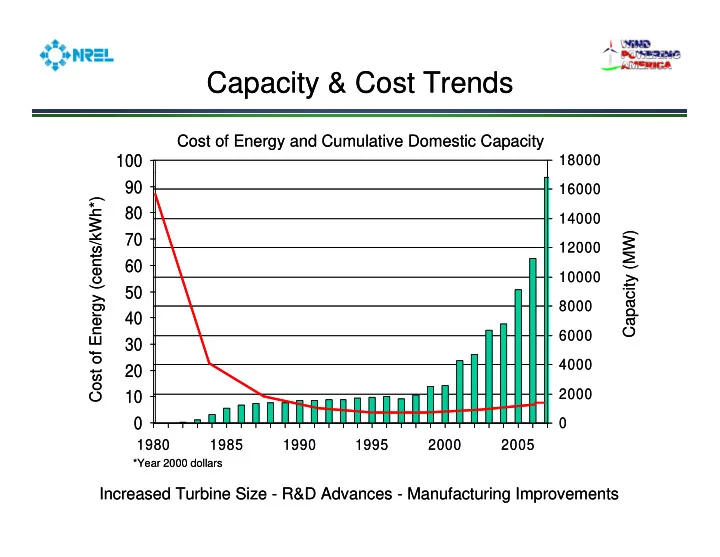
Capacity & Cost Trends Capacity & Cost Trends Cost of Energy and Cumulative Domestic Capacity Cost of Energy and Cumulative Domestic Capacity 100 100 18000 18000 90 90 16000 16000 /kWh*) /kWh*) 80 80 14000 14000 W) W) 70


slide-1
SLIDE 1

Capacity & Cost Trends Capacity & Cost Trends

18000

100 Cost of Energy and Cumulative Domestic Capacity

18000

100 Cost of Energy and Cumulative Domestic Capacity

12000 14000 16000

70 80 90 W) /kWh*)

12000 14000 16000

70 80 90 W) /kWh*)

8000 10000 12000

40 50 60 70 pacity (MW rgy (cents/

8000 10000 12000

40 50 60 70 pacity (MW rgy (cents/

4000 6000

20 30 40 Cap

  • st of Ener

4000 6000

20 30 40 Cap

  • st of Ener

2000 1980 1985 1990 1995 2000 2005

10 Co

2000 1980 1985 1990 1995 2000 2005

10 Co Increased Turbine Size - R&D Advances - Manufacturing Improvements

*Year 2000 dollars

Increased Turbine Size - R&D Advances - Manufacturing Improvements

*Year 2000 dollars

slide-2
SLIDE 2

U.S. Wind Power Capacity Up 46% in 2007 U.S. Wind Power Capacity Up 46% in 2007

6,000 18,000 4,000 5,000 ty (MW) 12,000 15,000 city (MW) Annual US Capacity (left scale) Cumulative US Capacity (right scale) 2,000 3,000 ual Capacit 6,000 9,000 ative Capac 1,000 2,000 Annu 3,000 6,000 Cumula

Record year for new U S wind capacity:

1982 1983 1984 1985 1986 1987 1988 1989 1990 1991 1992 1993 1994 1995 1996 1997 1998 1999 2000 2001 2002 2003 2004 2005 2006 2007

Source: AWEA

Record year for new U.S. wind capacity:

  • 5,329 MW of wind added (more than double previous record)
  • Roughly $9 billion in investment
slide-3
SLIDE 3

People Want Renewable Energy! People Want Renewable Energy!

110000

Total Installed Wind Capacity Total Installed Wind Capacity

80000 90000 100000

  • 1. Germany: 23,300 MW
  • 2. United States: 20,413 MW

50000 60000 70000

acity (MW)

  • 3. Spain: 15,900 MW
  • 4. China: 9000 MW
  • 5. India: 8,757 MW

30000 40000 50000

Capa

  • 5. India: 8,757 MW

World total Oct 2008: 105,732 MW

10000 20000 2 3 4 5 6 7 8 9 1 2 3 4 5 6 7 8 9 1 2 3 4 5 6 7 8 1 9 8 2 1 9 8 3 1 9 8 4 1 9 8 5 1 9 8 6 1 9 8 7 1 9 8 8 1 9 8 9 1 9 9 1 9 9 1 1 9 9 2 1 9 9 3 1 9 9 4 1 9 9 5 1 9 9 6 1 9 9 7 1 9 9 8 1 9 9 9 2 2 1 2 2 2 3 2 4 2 5 2 6 2 7 2 8

United States Europe Rest of World Source: WindPower Monthly

slide-4
SLIDE 4

U.S Lagging Other Countries in Wind U.S Lagging Other Countries in Wind As a Percentage of Electricity Consumption As a Percentage of Electricity Consumption

20% 22%

  • n

As a Percentage of Electricity Consumption As a Percentage of Electricity Consumption

12% 14% 16% 18% 20% Generation Consumpti Approximate Wind Penetration, end of 2007 Approximate Wind Penetration, end of 2006 4% 6% 8% 10% 12% ected Wind

  • f Electricity

0% 2% 4% mark pain ugal land many eece ands stria ndia UK Italy eden U.S. ance ralia nada rway hina apan razil TAL Proj as % o Denm Sp Portu Irel Germ Gre Netherla Aus In Swe Fra Austr Can Nor Ch Ja B TO

Source: Berkeley Lab estimates based on data from BTM Consult and elsewhere

Note: Figure only includes the 20 countries with the most installed wind capacity at the end of 2007

slide-5
SLIDE 5

Wind Power Contributed 35% of Wind Power Contributed 35% of All New Generating Capacity in the US in 2007 All New Generating Capacity in the US in 2007 All New Generating Capacity in the US in 2007 All New Generating Capacity in the US in 2007

100% ns 100 W)

  • Wind was the 2nd-

largest resource added for the 3rd- straight year

80% acity Addition 80 Additions (GW

straight year

  • Up from 19% in

2006, 12% in 2005,

40% 60% Annual Capa 40 60 al Capacity A

and <4% in 2000- 2004

0% 20% Percent of A 20 Total Annu % 2000 2001 2002 2003 2004 2005 2006 2007

Wind Other Renewable Gas (CCGT) Gas (non-CCGT) Coal Other non-Renewable Total Capacity Additions (right axis)

Source: EIA, Ventyx, AWEA, IREC, Berkeley Lab

slide-6
SLIDE 6

Installed Project Costs Are On the Installed Project Costs Are On the Rise, After a Long Period of Decline Rise, After a Long Period of Decline Rise, After a Long Period of Decline Rise, After a Long Period of Decline

$3,500 $4,000 $4,500 07 $/kW)

Individual Project Cost (253 projects totaling 15.8 GW) Average Project Cost Polynomial Trend Line

$2,000 $2,500 $3,000 ject Cost (20 $500 $1,000 $1,500 , nstalled Proj

Increase of ~$700/kW

$0 $500 1982 1983 1984 1985 1986 1987 1988 1989 1990 1991 1992 1993 1994 1995 1996 1997 1998 1999 2000 2001 2002 2003 2004 2005 2006 2007 2008 I

Source: Berkeley Lab database (some data points suppressed to protect confidentiality)

Increase of ~$700/kW

Source: Berkeley Lab database (some data points suppressed to protect confidentiality)

Note: Includes 227 projects built from 1983-2007, totaling ~13 GW (77% of capacity at end of 2007); additional ~2.8 GW of projects proposed for installation in 2008

slide-7
SLIDE 7

Wind Has Been Competitive with Wind Has Been Competitive with Wholesale Power Prices in Recent Years Wholesale Power Prices in Recent Years

90

Wholesale Power Prices in Recent Years Wholesale Power Prices in Recent Years

60 70 80 Wh Wind project sample includes projects built from 1998-2007 30 40 50 2007 $/M 10 20 2003 2004 2005 2006 2007 Nationwide Wholesale Power Price Range (for a flat block of power) Cumulative Capacity-Weighted Average Wind Power Price 003 00 005 006 00 53 projects 66 projects 87 projects 107 projects 128 projects 2,466 MW 3,267 MW 4,396 MW 5,801 MW 8,303 MW

Source: FERC 2006 and 2004 "State of the Market" reports, Berkeley Lab database, Ventyx

  • Wholesale price range reflects flat block of power across 23 pricing nodes (see previous map)
  • Wind prices are capacity-weighted averages from cumulative project sample
slide-8
SLIDE 8

Wind Built After 1997 Was Competitive Wind Built After 1997 Was Competitive with Wholesale Prices in Most Regions in 2007 with Wholesale Prices in Most Regions in 2007

80 Wind project sample includes projects built from 1998 2007

with Wholesale Prices in Most Regions in 2007 with Wholesale Prices in Most Regions in 2007

50 60 70 Wh Wind project sample includes projects built from 1998-2007 30 40 50 2007 $/MW 10 20 2007 Average Wholesale Power Price Range By Region 2007 Capacity-Weighted Average Wind Power Price By Region Individual Project 2007 Wind Power Price By Region

Texas Heartland Mountain Northwest California Great Lakes East New England Total US 4 projects 65 projects 15 projects 13 projects 12 projects 6 projects 12 projects 1 project 128 projects 476 MW 2,857 MW 1,757 MW 1,219 MW 691 MW 547 MW 714 MW 42 MW 8,303 MW

Source: Berkeley Lab database, Ventyx

Note: Even within a region there are a range of wholesale power prices because multiple wholesale price hubs exist in each area (see earlier map)

slide-9
SLIDE 9

Installed Wind Capacities Installed Wind Capacities (‘99 (‘99 – October ‘08) October ‘08) ( 99 ( 99 October 08) October 08)

*Preliminary data

slide-10
SLIDE 10

Drivers for Wind Power Drivers for Wind Power

D li i Wi d C t

  • Declining Wind Costs
  • Fuel Price Uncertainty
  • Federal and State
  • Federal and State

Policies

  • Economic Development
  • Public Support
  • Green Power
  • Energy Security
  • Carbon Risk
slide-11
SLIDE 11

CO CO2 prices significantly prices significantly increase the cost of coal increase the cost of coal increase the cost of coal increase the cost of coal

slide-12
SLIDE 12

Windy Rural Areas Need Windy Rural Areas Need Economic Development Economic Development Economic Development Economic Development

slide-13
SLIDE 13

Oklahoma Oklahoma – – Economic Impacts Economic Impacts

from 1000 MW of new wind development from 1000 MW of new wind development

Wind energy’s economic “ripple effect”

Direct Impacts Indirect & Induced Impacts Totals (construction + 20yrs)

Payments to Landowners:

  • $2.7 Million/yr

Local Property Tax Revenue:

  • $6.4 Million/yr

Construction Phase:

  • 1,650 new jobs
  • $141 M to local

economies

Total economic benefit =

$1.16 billion

New local jobs during t ti

3 500

Induced Impacts (construction + 20yrs)

y Construction Phase:

  • 1,800 new jobs
  • $189 M to local economies

Operational Phase:

250 ne long term jobs economies

Operational Phase:

  • 250 local jobs
  • $20 M/yr to local

economies

construction = 3,500 New local long-term jobs

= 500

  • 250 new long-term jobs
  • $21 M/yr to local economies

Construction Phase = 1-2 years Operational Phase = 20+ years

All jobs rounded to the nearest 50 jobs; All values greater than $10 million are rounded to the nearest million

slide-14
SLIDE 14

Weatherford Wind Energy Center, OK Weatherford Wind Energy Center, OK

  • 147 MW (1.5-MW

turbines) turbines)

  • Landowner payments:

$300,000 in annual lease payments lease payments

  • 150 workers during peak

construction

  • 6 fulltime O&M positions

6 fulltime O&M positions

  • Property taxes: $17

million over 20 years

  • Sawartzky Construction
  • Sawartzky Construction

received $300,000 in revenue from the project

  • Owned by FPL Energy
  • Owned by FPL Energy
  • Constructed in 2005
slide-15
SLIDE 15

Soaring Demand Spurs Expansion Soaring Demand Spurs Expansion

  • f U.S. Wind Turbine Manufacturing
  • f U.S. Wind Turbine Manufacturing

Online Prior to 2007 Online or Announced in 2007 Announced in 2008

Source: AWEA, updated Sept 2008

slide-16
SLIDE 16

Environmental Benefits Environmental Benefits

  • No SOx or NOx

No SOx or NOx

  • No particulates

No mercury

  • No mercury
  • No CO2
  • No water
slide-17
SLIDE 17

Source: NOAA

slide-18
SLIDE 18

Energy Energy-

  • Water Nexus

Water Nexus

slide-19
SLIDE 19
slide-20
SLIDE 20
slide-21
SLIDE 21

“The future ain’t what it used to be.”

  • Yogi Berra

g

slide-22
SLIDE 22

Supply Curve for Wind Energy: Supply Curve for Wind Energy: Energy and Transmission Costs Energy and Transmission Costs

140 160

Onshore

Class 7

Offshore

Class 7

10% of existing 10% of existing transmission capacity transmission capacity

Energy and Transmission Costs Energy and Transmission Costs

120 140 y, $/MWh

Class 6 Class 4 Class 5 Class 3 Class 6 Class 4 Class 5 Class 3

transmission capacity transmission capacity available to wind available to wind

80 100 t of Energy 40 60 elized Cost 20 40 Leve

  • 200

400 600 800 1,000 Quantity Available, GW

2010 Costs w/o PTC, $1,600/MW-mile, w/o Integration costs

slide-23
SLIDE 23

What does 20% Wind look like? What does 20% Wind look like?

Source: DOE 20% Report

slide-24
SLIDE 24

46 States Would Have 46 States Would Have Substantial Wind Development by 2030 Substantial Wind Development by 2030 p y p y

Wind Capacity Total Installed (2030)

(GW)

0.0 - 0.1 Includes offshore wind The black open square in the center of a state represents the land area needed for a single wind farm to produce the projected installed capacity in that state. The brown square represents the actual land area that would be dedicated to the wind turbines (2% of the black open square). 0.1 - 1 1 - 5 5 - 10 > 10 Includes offshore wind.

slide-25
SLIDE 25

20% Wind Scenario Impact 20% Wind Scenario Impact

  • n Generation Mix in 2030
  • n Generation Mix in 2030
  • Reduces electric utility

t l ti b

U.S. electrical energy mix

100%

natural gas consumption by 50%

  • Reduces total natural gas

80%

Reduces total natural gas consumption by 11%

  • Natural gas consumer

b fi $86 214 billi

*

40% 60%

benefits: $86-214 billion*

  • Reduces electric utility coal

consumption by 18%

20% 40%

consumption by 18%

  • Avoids construction of 80 GW
  • f new coal power plants

0% No New Wind 20% Wind Natural Gas Coal Nuclear Hydro Wind

Source *: Hand et al., 2008

slide-26
SLIDE 26

CO2 Emissions from the Electricity Sector CO2 Emissions from the Electricity Sector

4 000 4,500

  • r

4 000 4,500 4 000 4,500

  • r

3,500 4,000

ctric Secto ns)

3,500 4,000 3,500 4,000

ctric Secto ns)

2,500 3,000

n the Elec metric ton

2,500 3,000 2,500 3,000

n the Elec metric ton

1,500 2,000

missions in (million

1,500 2,000 1,500 2,000

missions in (million

500 1,000 No New Wind Scenario CO2 emissions 20% Wind Scenario CO2 emissions USCAP path to 80% below today’s levels by 2050

CO2 Em

500 1,000 No New Wind Scenario CO2 emissions 20% Wind Scenario CO2 emissions USCAP path to 80% below today’s levels by 2050 500 1,000 No New Wind Scenario CO2 emissions 20% Wind Scenario CO2 emissions USCAP path to 80% below today’s levels by 2050

CO2 Em

2006 2010 2014 2018 2022 2026 2030 500 USC pat to 80% be o todays e e s by 050 2006 2010 2014 2018 2022 2026 2030 500 USC pat to 80% be o todays e e s by 050 2006 2010 2014 2018 2022 2026 2030 500 USC pat to 80% be o todays e e s by 050

slide-27
SLIDE 27

Oklahoma Oklahoma – – Economic Impacts Economic Impacts

From the 20% Scenario From the 20% Scenario 38 484 MW new development 38 484 MW new development

Wind energy’s economic “ripple effect”

38,484 MW new development 38,484 MW new development

Indirect & Induced Impacts Totals (construction + 20yrs) Direct Impacts

Construction Phase:

  • 64,500 new jobs
  • $5.4 B to local economies

Operational Phase: Total economic benefit =

$44.6 Billion

New local jobs during t ti

134 300

Induced Impacts (construction + 20yrs)

Payments to Landowners:

  • $105 Million/yr

Local Property Tax Revenue:

  • $250 Million/yr

Operational Phase:

  • 8,800 local jobs
  • $780 M/yr to local

economies

construction = 134,300 New local long-term jobs

= 18,800

$ y Construction Phase:

  • 69,900 new jobs
  • $7.3 B to local economies

Operational Phase:

9 900 l t j b

  • 9,900 new long-term jobs
  • $815 M/yr to local economies

Construction Phase = 1-2 years Operational Phase = 20+ years

All jobs rounded to the nearest hundred jobs; Millions of dollars greater than 10 million are rounded to the nearest five million

slide-28
SLIDE 28

National (U.S.) National (U.S.) – – Economic Impacts Economic Impacts

Cumulative impacts from 2007 Cumulative impacts from 2007-

  • 2030

2030

From the 20% Scenario From the 20% Scenario- 300 GW new Onshore and Offshore development 300 GW new Onshore and Offshore development

Wind energy’s economic “ripple effect”

From the 20% Scenario From the 20% Scenario 300 GW new Onshore and Offshore development 300 GW new Onshore and Offshore development

Indirect & Induced Impacts Totals (construction + 20yrs) Direct Impacts

Construction Phase:

  • 4.46 M FTE jobs
  • $651 B to the US economy

Operations:

  • Total economic benefit =

$1,359 billion

  • New jobs during

construction = 6 2 M FTE

p y )

Payments to Landowners:

  • $782 M

Local Property Tax Revenue:

  • $1,877 M

Operations:

  • 2.15 M FTE jobs
  • $293 B to the US economy

construction

6.2 M FTE jobs

  • New operations jobs =3.3

M FTE jobs

, Construction Phase:

  • 1.75 M FTE jobs
  • $ 293 B to the US economy

Operations:

1 16 M FTE j b

  • 1.16 M FTE jobs
  • $122 B to the US economy

All monetary values are in 2006 dollars. Construction Phase = 1-2 years

slide-29
SLIDE 29

Jobs Supported by the 20% Scenario Jobs Supported by the 20% Scenario

Over 500,000 jobs would be supported between 2007 and 2030

Over 500,000 jobs supported by the industry in 2030

  • Approx. 180,000

directly employed by wind

}

by wind

}

slide-30
SLIDE 30

Cumulative Water Savings from 20% Scenario Cumulative Water Savings from 20% Scenario

Reduces water consumption of 4 trillion gallons through 2030 (represents a reduction in electric sector water consumption by 17% in 2030)

slide-31
SLIDE 31

Economic Costs of 20% Wind Scenario Economic Costs of 20% Wind Scenario

$3000

Incremental investment cost of 20% Wind Scenario

$2000 $2500 $3000

  • llars

2% investment difference between 20% Wi d d

$1500 $2000

  • f 2006 Do

20% Wind and No New Wind

$500 $1000 Billions $0 20% Wind No New Wind Wind O&M Costs Transmission Costs Wind Capital Costs Fuel Costs Conventional O&M Costs Conventional Capital Costs

slide-32
SLIDE 32

Results: Results: Costs Costs & Benefits & Benefits

Incremental direct cost to society $43 billion Incremental direct cost to society $43 billion Reductions in emissions of greenhouse gasses and other atmospheric pollutants 825 M tons (2030) $98 billion $ Reductions in water consumption 8% total electric 17% in 2030 Jobs created and other economic benefits 140,000 direct $450 billion total Reductions in natural gas use and price pressure 11% $150 billion

N t B fit $205B W t i Net Benefits: $205B + Water savings

slide-33
SLIDE 33

Carpe Ventem Carpe Ventem

www.windpoweringamerica.gov