Trends in High Performance Trends in High Performance Computing and - - PDF document

trends in high performance trends in high performance
SMART_READER_LITE
LIVE PREVIEW

Trends in High Performance Trends in High Performance Computing and - - PDF document

Trends in High Performance Trends in High Performance Computing and the Grid Computing and the Grid Jack Dongarra University of Tennessee and Oak Ridge National Laboratory 1 Technology Trends: Technology Trends: Microprocessor Capacity


slide-1
SLIDE 1

1

1

Trends in High Performance Trends in High Performance Computing and the Grid Computing and the Grid

Jack Dongarra University of Tennessee and Oak Ridge National Laboratory

2

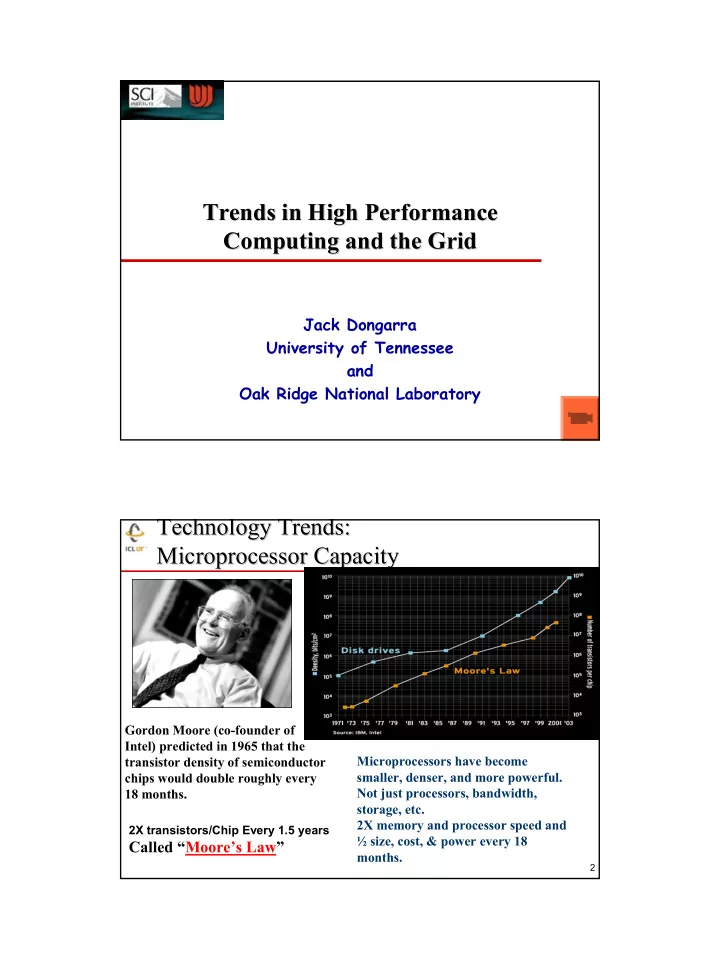
Technology Trends: Technology Trends: Microprocessor Capacity Microprocessor Capacity

2X transistors/Chip Every 1.5 years

Called “Moore’s Law”

Microprocessors have become smaller, denser, and more powerful. Not just processors, bandwidth, storage, etc. 2X memory and processor speed and ½ size, cost, & power every 18 months. Gordon Moore (co-founder of Intel) predicted in 1965 that the transistor density of semiconductor chips would double roughly every 18 months.

slide-2
SLIDE 2

2

3 Earth Simulator ASCI White Pacific EDSAC 1 UNIVAC 1 IBM 7090 CDC 6600 IBM 360/195 CDC 7600 Cray 1 Cray X-MP Cray 2 TMC CM-2 TMC CM-5 Cray T3D ASCI Red

1950 1960 1970 1980 1990 2000 2010 1 KFlop/s 1 MFlop/s 1 GFlop/s 1 TFlop/s 1 PFlop/s

Scalar Super Scalar Vector Parallel Super Scalar/Vector/Parallel

Moore Moore’ ’s Law s Law

1941 1 (Floating Point operations / second, Flop/s) 1945 100 1949 1,000 (1 KiloFlop/s, KFlop/s) 1951 10,000 1961 100,000 1964 1,000,000 (1 MegaFlop/s, MFlop/s) 1968 10,000,000 1975 100,000,000 1987 1,000,000,000 (1 GigaFlop/s, GFlop/s) 1992 10,000,000,000 1993 100,000,000,000 1997 1,000,000,000,000 (1 TeraFlop/s, TFlop/s) 2000 10,000,000,000,000 2003 35,000,000,000,000 (35 TFlop/s)

4

  • H. Meuer, H. Simon, E. Strohmaier, & JD
  • H. Meuer, H. Simon, E. Strohmaier, & JD
  • Listing of the 500 most powerful

Computers in the World

  • Yardstick: Rmax from LINPACK MPP

Ax=b, dense problem

  • Updated twice a year

SC‘xy in the States in November Meeting in Mannheim, Germany in June

  • All data available from www.top500.org

Size Rate

TPP performance

slide-3
SLIDE 3

3

5

A Tour de Force in Engineering A Tour de Force in Engineering

Homogeneous, Centralized, Proprietary, Expensive!

Target Application: CFD-Weather, Climate, Earthquakes

640 NEC SX/6 Nodes (mod)

5120 CPUs which have vector ops Each CPU 8 Gflop/s Peak ♦

40 TFlop/s (peak)

$1/2 Billion for machine & building

Footprint of 4 tennis courts

7 MWatts

Say 10 cent/KWhr - $16.8K/day = $6M/year! ♦

Expect to be on top of Top500 until 60-100 TFlop ASCI machine arrives

From the Top500 (June 2003) Performance of ESC ≈ Σ Next Top 4 Computers ~ 10% of performance of all the Top500 machines

6

June 2003 June 2003

5120 2560 2001 Commissariat a l'Energie Atomique (CEA) Bruyeres-le-Chatel 3980 AlphaServer SC ES45/1 GHz Hewlett- Packard 10 6032 3016 2001 Pittsburgh Supercomputing Center Pittsburgh 4463 AlphaServer SC ES45/1 GHz Hewlett- Packard 9 6160 1540 2003 Pacific Northwest National Laboratory Richland 4881 rx2600 Itanium2 1 GHz Cluster - Quadrics Hewlett- Packard 8 11980 2304 2002 National Aerospace Lab Tokyo 5406 PRIMEPOWER HPC2500 (1.3 GHz) Fujitsu 7 9216 1920 2003 Lawrence Livermore National Laboratory Livermore 6586 xSeries Cluster Xeon 2.4 GHz - Quadrics IBM/Quadrics 6 9984 6656 2002 NERSC/LBNL Berkeley 7304 SP Power3 375 MHz 16 way IBM 5 12288 8192 2000 Lawrence Livermore National Laboratory Livermore 7304 ASCI White, SP Power3 375 MHz IBM 4 11060 2304 2002 Lawrence Livermore National Laboratory Livermore 7634 MCR Linux Cluster Xeon 2.4 GHz - Quadrics Linux NetworX Quadrics 3 20480 8192 2002 Los Alamos National Laboratory Los Alamos 13880 ASCI Q - AlphaServer SC ES45/1.25 GHz Hewlett- Packard 2 40960 5120 2002 Earth Simulator Center Yokohama 35860 Earth-Simulator NEC 1 Rpeak # Proc Year Installation Site Rmax Computer Manufacturer

slide-4
SLIDE 4

4

7

TOP500 TOP500 – – Performance Performance -

  • June 2003

June 2003

374 TF/s 1.17 TF/s 59.7 GF/s 35.8 TF/s 0.4 GF/s 244 GF/s

J u n

  • 9

3 N

  • v
  • 9

3 J u n

  • 9

4 N

  • v
  • 9

4 J u n

  • 9

5 N

  • v
  • 9

5 J u n

  • 9

6 N

  • v
  • 9

6 J u n

  • 9

7 N

  • v
  • 9

7 J u n

  • 9

8 N

  • v
  • 9

8 J u n

  • 9

9 N

  • v
  • 9

9 J u n

  • N
  • v
  • J

u n

  • 1

N

  • v
  • 1

J u n

  • 2

N

  • v
  • 2

J u n

  • 3

Fujitsu 'NWT' NAL NEC ES Intel ASCI Red Sandia IBM ASCI White LLNL

N=1 N=500 SUM

1 Gflop/s 1 Tflop/s 100 Mflop/s 100 Gflop/s 100 Tflop/s 10 Gflop/s 10 Tflop/s 1 Pflop/s

My Laptop 8

Virginia Tech Virginia Tech “ “Big Mac Big Mac” ” G5 Cluster G5 Cluster

♦ Apple G5 Cluster Dual 2.0 GHz IBM Power PC 970s

16 Gflop/s per node

2 CPUs * 2 fma units/cpu * 2 GHz * 2(mul-add)/cycle

1100 Nodes or 2200 Processors

Theoretical peak 17.6 Tflop/s

Infiniband 4X primary fabric

Cisco Gigabit Ethernet secondary fabric

Linpack Benchmark using 2112 processors Theoretical peak of 16.9 Tflop/s Achieved 9.555 Tflop/s

Could be #3 on 11/03 Top500

Cost is $5.2 million which includes the system itself, memory, storage, and communication fabrics

slide-5
SLIDE 5

5

9

Detail on the Virginia Tech Machine Detail on the Virginia Tech Machine

Dual Power PC 970 2GHz

4 GB DRAM. 160 GB serial ATA mass storage. 4.4 TB total main memory. 176 TB total mass storage. ♦

Primary communications backplane based on infiniband technology.

Each node can communicate with the network at 20 Gb/s, full duplex, "ultra-low" latency. Switch consists of 24 96-port switches in fat-tree topology. ♦

Secondary Communications Network:

Gigabit fast ethernet management backplane. Based on 5 Cisco 4500 switches, each with 240 ports. ♦

Software:

Mac OSX. MPIch-2 C, C++ compilers - IBM xlc and gcc 3.3 Fortran 95/90/77 Compilers - IBM xlf and NAGWare

10

Top 5 Machines for the Top 5 Machines for the Linpack Benchmark Linpack Benchmark

5 4 3 2 1

11059 7634 2304 Linux NetworX (2.4 GHz Pentium 4 Xeon w/Quadrics) 11616 8633 1936 HP RX2600 Itanium 2 (1.5GHz w/Quadrics) 16896 9555 2112 Apple G5 dual IBM Power PC (2 GHz, 970s, w/Infiniband 4X) 20480 13880 8160 ASCI Q AlphaServer EV-68 (1.25 GHz w/Quadrics) 40960 35860 5120 Earth Simulator

RPeak GFlop/s Rmax GFlop/s Number

  • f Procs

Computer (Full Precision)

slide-6
SLIDE 6

6

11

Performance Extrapolation Performance Extrapolation

J u n

  • 9

3 J u n

  • 9

4 J u n

  • 9

5 J u n

  • 9

6 J u n

  • 9

7 J u n

  • 9

8 J u n

  • 9

9 J u n

  • J

u n

  • 1

J u n

  • 2

J u n

  • 3

J u n

  • 4

J u n

  • 5

J u n

  • 6

J u n

  • 7

J u n

  • 8

J u n

  • 9

J u n

  • 1

N=1 N=500 Sum

1 GFlop/s 1 TFlop/s 1 PFlop/s 100 MFlop/s 100 GFlop/s 100 TFlop/s 10 GFlop/s 10 TFlop/s 10 PFlop/s

Blue Gene 130,000 proc ASCI P 12,544 proc

TFlop/s To enter the list PFlop/s Computer

12

Performance Extrapolation Performance Extrapolation

J u n

  • 9

3 J u n

  • 9

4 J u n

  • 9

5 J u n

  • 9

6 J u n

  • 9

7 J u n

  • 9

8 J u n

  • 9

9 J u n

  • J

u n

  • 1

J u n

  • 2

J u n

  • 3

J u n

  • 4

J u n

  • 5

J u n

  • 6

J u n

  • 7

J u n

  • 8

J u n

  • 9

J u n

  • 1

N=1 N=500 Sum

1 GFlop/s 1 TFlop/s 1 PFlop/s 100 MFlop/s 100 GFlop/s 100 TFlop/s 10 GFlop/s 10 TFlop/s 10 PFlop/s

My Laptop

Blue Gene 130,000 proc ASCI P 12,544 proc

slide-7
SLIDE 7

7

13

To To Exaflop/s Exaflop/s (10 (1018

18 and Beyond)

and Beyond)

100 Mflops 1 Gflops 10 Gflops 100 Gflops 1 Tflops 10 Tflops 100 Tflops 1 Pflops 10 Pflops 100 Pflops 1 Eflops 10 Eflops 2000 2010 2020 2023 1995 2005 2015 1993

SUM N=1 N=500

My Laptop 14

ASCI Purple & IBM Blue Gene/L ASCI Purple & IBM Blue Gene/L

♦ Announced 11/19/02

One of 2 machines for LLNL 360 TFlop/s 130,000 proc Linux FY 2005 Preliminary machine

IBM Research BlueGene/L

PowerPC 440, 500MHz w/custom proc/interconnect 512 Nodes (1024 processors) 1.435 Tflop/s (2.05 Tflop/s Peak)

Plus ASCI Purple IBM Power 5 based 12K proc, 100 TFlop/s

slide-8
SLIDE 8

8

15

Selected System Characteristics Selected System Characteristics

Earth Simulator Cray X1 ASCI Q MCR (NEC) (Cray) (HP ES45) (Dual Xeon) Year of Introduction 2002 2003 2003 2002 Node Architecture Vector Vector Alpha micro Xeon micro SMP SMP SMP SMP System Topology NEC single-stage 2D Torus Quadrics QsNet Quadrics QsNet Crossbar Interconnect Fat-tree Fat-tree Number of Nodes 640 32 2048 1152 Processors - per node 8 4 4 2

  • system total

5120 128 8192 2304 Processor Speed 500 MHz 800 MHz 1.25 GHz 2.4 GHz

Peak Speed

  • per processor

8 Gflops 12.8 Gflops 2.5 Gflops 4.8 Gflops

  • per node

64 Gflops 51.2 Gflops 10 Gflops 9.6 Gflops

  • system total

40 Tflops 1.6 Tflops 30 Tflops 10.8 Tflops Memory

  • per node

16 GB 8-64 GB 16 GB 16 GB

  • per processor

2 GB 2-16 GB 4 GB 2 GB

  • system total

10.24 TB 48 TB 4.6 TB Memory Bandwidth (peak)

  • L1 Cache

N/A 76.8 GB/s 20 GB/s 20 GB/s

  • L2 Cache

N/A 13 GB/s 1.5 GB/s Main (per proc) 32 GB/s 34.1 GB/s 2 GB/s 2 GB/s Inter-node MPI

  • Latency

8.6 µsec 8.6 µsec 5 µsec 4.75 µsec

  • Bandwidth

11.8 GB/s 11.9 GB/s 300 MB/s 315 MB/s Bytes/flop to main memory 4 3 0.8 0.4 Bytes/flop interconnect 1.5 1 0.12 0.07 16

Phases I Phases I -

  • III

III

02 05 06 07 08 09 10 03 04 Products Metrics, Benchmarks Academia Research Platforms Early Software Tools Early Pilot Platforms

Phase II R&D

3 companies ~$50M each

Phase III Full Scale Development

commercially ready in the 2007 to 2010 timeframe. $100M ? Metrics and Benchmarks System Design Review

Industry Application Analysis Performance Assessment HPCS Capability or Products

Fiscal Year Concept Reviews PDR Research Prototypes & Pilot Systems Phase III Readiness Review Technology Assessments Requirements and Metrics Phase II Readiness Reviews

Phase I Industry Concept Study

5 companies $10M each Reviews Industry Procurements Critical Program Milestones DDR

slide-9
SLIDE 9

9

17

SETI@home SETI@home: Global Distributed Computing : Global Distributed Computing

♦ Running on 500,000 PCs, ~1300 CPU

Years per Day

1.3M CPU Years so far

♦ Sophisticated Data & Signal

Processing Analysis

♦ Distributes Datasets from Arecibo

Radio Telescope

18

SETI@home SETI@home

♦ Use thousands of Internet-

connected PCs to help in the search for extraterrestrial intelligence.

♦ When their computer is idle

  • r being wasted this

software will download ~ half a MB chunk of data for analysis. Performs about 3 Tflops for each client in 15 hours.

♦ The results of this analysis

are sent back to the SETI team, combined with thousands of other participants.

♦ Largest distributed

computation project in existence

Averaging 55 Tflop/s 1368 users

slide-10
SLIDE 10

10

19

Forward link Back links

Google query attributes

150M queries/day (2000/second) 100 countries 3B documents in the index

Data centers

15,000 Linux systems in 6 data centers

15 TFlop/s and 1000 TB total capability 40-80 1U/2U servers/cabinet 100 MB Ethernet switches/cabinet with gigabit Ethernet uplink

growth from 4,000 systems (June 2000)

18M queries then

Performance and operation simple reissue of failed commands to new servers no performance debugging

  • problems are not reproducible

Source: Monika Henzinger, Google & Cleve Moler

20

How Google Works; How Google Works; You have to think big

You have to think big

This is done “offline” … Number of inlinks to a web page is a sign of the importance of the web page

Generate an incidence matrix of links to and from web pages For each web page there’s a row/column

  • Matrix of order 3x10⁹

Form a transition probability matrix of the Markov chain

  • Matrix is not sparse, but it is a rank one modification of a

sparse matrix ♦

Compute the eigenvector corresponding to the largest eigenvalue, which is 1.

  • Solve Ax = x.
  • Use the power method? (x=initial guess; iterate x Ax;)
  • Each component of the vector x corresponds to a web page and

represents the weight (importance) for that web page.

  • This is the basis for the “Page rank”

Create an inverted index of the web;

  • word : web pages that contain that word

When a query, set of words, comes in:

Go to the inverted index and get the corresponding web pages for the query ♦

Rank the resulting web pages by the “Page rank” and return pointers to those page in that order.

Forward link are referred to in the rows Back links are referred to in the columns

Source: Monika Henzinger, Google & Cleve Moler

Eigenvalue problem n=3x10⁹ (see: MathWorks Cleve’s Corner)
slide-11
SLIDE 11

11

21 The Global Grid

♦ Proliferation of resources

Everyone has computers Multiple IP addresses per person

♦ Increased demand

Immense amounts of data Applications increasingly

Multi-scale Multi-disciplinary Information-driven

♦ Coordination/collaboration is a

default mode of interaction

The Internet Globalization, virtualization Open source movement

Today Today’ ’s computational and information infrastructure s computational and information infrastructure must address both science and technology trends must address both science and technology trends

Computational Science and the Grid Computational Science and the Grid

22

Grid Computing is About Grid Computing is About … …

Resource sharing & coordinated problem solving in dynamic, multi-institutional virtual

  • rganizations
QuickTime™ and a decompressor are needed to see this picture. QuickTime™ and a decompressor are needed to see this picture.

IMAGING INSTRUMENTS COMPUTATIONAL RESOURCES LARGE-SCALE DATABASES DATA ACQUISITION ,ANALYSIS ADVANCED VISUALIZATION

“Telescience Grid”, Courtesy of Mark Ellisman

slide-12
SLIDE 12

12

23

The Grid

24

“ “Benefits of the Grid Benefits of the Grid” ”

1.

Higher Utilization of Distributed Resources

  • E.g., Supercomputing Center Grid, Nationwide Virtual

Supercomputers

  • No increase in the overall “pie”

2.

Higher Reliability and Upgradability of compute resources

  • Same objectve as the Internet (or, ARPANet)

3.

“Collaboratory Science”: tight collaboration of virtual

  • rganizations over the network
  • E.g., EU DataGrid w/3000 worldwide high-energy physicists

4.

Tight Integration of Data, Sensors, Human Resources

  • VLBI (Astronomy) Project

5.

Ultra-Scaling of Resources

  • Distributed placement of (otherwise oversized) resources

6.

Exploitation of Idle Cycles/Storage on non-dedicated, commodity resources

  • Peer-to-Peer(P2P), Voluntary Computing
slide-13
SLIDE 13

13

25

TeraGrid 2003 TeraGrid 2003

Prototype for a National Cyberinfrastructure Prototype for a National Cyberinfrastructure

40 Gb/s 20 Gb/s 30 Gb/s 10 Gb/s 10 Gb/s

26

Atmospheric Sciences Grid Atmospheric Sciences Grid

Real time data

Data Fusion General Circulation model Regional weather model Photo-chemical pollution model Particle dispersion model Topography Database Topography Database Vegetation Database Vegetation Database Bushfire model Emissions Inventory Emissions Inventory

slide-14
SLIDE 14

14

27

Standard Implementation Standard Implementation

GASS

Real time data

Data Fusion General Circulation model Regional weather model Photo-chemical pollution model Particle dispersion model Topography Database Topography Database Vegetation Database Vegetation Database Emissions Inventory Emissions Inventory

MPI MPI

MPI

GASS/GridFTP/GRC

MPI MPI

Bushfire model GASS

Change Models

28

Some Grid Requirements Some Grid Requirements – – User Perspective User Perspective

♦ Single sign-on: authentication to any

Grid resources authenticates for all

  • thers

♦ Single compute space: one scheduler for

all Grid resources

♦ Single data space: can address files and

data from any Grid resources

♦ Single development environment: Grid

tools and libraries that work on all grid resources

slide-15
SLIDE 15

15

29

NetSolve Grid Enabled Server NetSolve Grid Enabled Server

♦ NetSolve is an example of a Grid based

hardware/software/data server.

♦ Based on a Remote Procedure Call model but

with …

resource discovery, dynamic problem solving capabilities, load balancing, fault tolerance asynchronicity, security, … ♦ Easy-of-use paramount ♦ Its about providing transparent access to

resources.

30

NetSolve: NetSolve: The The Big Big Picture Picture

AGENT(s)

S1 S2 S3 S4

Client

Matlab, Octave, Scilab Mathematica C, Fortran, Excel Schedule Database

No knowledge of the grid required, RPC like.

IBP Depot

slide-16
SLIDE 16

16

31

NetSolve: NetSolve: The The Big Big Picture Picture

AGENT(s)

S1 S2 S3 S4

Client

Matlab, Octave, Scilab Mathematica C, Fortran, Excel Schedule Database

No knowledge of the grid required, RPC like. A , B

IBP Depot

32

NetSolve: NetSolve: The The Big Big Picture Picture

AGENT(s)

S1 S2 S3 S4

Client

Matlab, Octave, Scilab Mathematica C, Fortran, Excel Schedule Database

No knowledge of the grid required, RPC like.

Handle back

IBP Depot

slide-17
SLIDE 17

17

33

NetSolve: NetSolve: The The Big Big Picture Picture

AGENT(s)

S1 S2 S3 S4

Client Answer (C)

S2 ! Request

Op(C, A, B)

Matlab, Octave, Scilab Mathematica C, Fortran, Excel Schedule Database

No knowledge of the grid required, RPC like. A , B O P , handle

IBP Depot

34

User Request Agent Selects HWServer & SWServer SWS, User’s Request Passed to HW Server Software Description Passed to Repository Software Returned Results Back to User

Client Agent

Software Server (SWS) Hardware Server (HWS) TRUSTED ENVIRONMENT

Client

Call NetSolve(…)

slide-18
SLIDE 18

18

35

Hiding the Parallel Processing Hiding the Parallel Processing

♦ User maybe unaware of parallel

processing

♦ NetSolve takes care of the starting the message

passing system, data distribution, and returning the results. (Using LFC software)

36

SCIRun torso defibrillator application – Chris Johnson, U of Utah

Netsolve and SCIRun

slide-19
SLIDE 19

19

37

Basic Usage Scenarios Basic Usage Scenarios

♦ Grid based numerical library

routines

User doesn’t have to have software library on their machine, LAPACK, SuperLU, ScaLAPACK, PETSc, AZTEC, ARPACK ♦ Task farming applications “Pleasantly parallel” execution eg Parameter studies ♦ Remote application execution Complete applications with user specifying input parameters and receiving output

♦ “Blue Collar” Grid Based

Computing

Does not require deep knowledge of network programming Level of expressiveness right for many users User can set things up, no “su” required In use today, up to 200 servers in 9 countries

♦ Can plug into Globus,

Condor, NINF, …

38

University of Tennessee Deployment: University of Tennessee Deployment: S Scalable calable In Intracampus tracampus R Research esearch G Grid: rid: SInRG SInRG

Federated Ownership: CS, Chem Eng., Medical School, Computational Ecology, El. Eng.

Real applications, middleware development, logistical networking

The Knoxville Campus has two DS-3 commodity Internet connections and one DS-3 Internet2/Abilene connection. An OC-3 ATM link routes IP traffic between the Knoxville campus, National Transportation Research Center, and Oak Ridge National Laboratory. UT participates in several national networking initiatives including Internet2 (I2), Abilene, the federal Next Generation Internet (NGI) initiative, Southern Universities Research Association (SURA) Regional Information Infrastructure (RII), and Southern Crossroads (SoX). The UT campus consists of a meshed ATM OC-12 being migrated over to switched Gigabit by early 2002.

slide-20
SLIDE 20

20

39

New Features for New Features for NetSolve NetSolve 2.0 2.0

New version available!

♦ New easy to use Interface Definition Language

Simplified PDF

♦ Dynamic servers

Add/delete problems without restarting servers

♦ New bindings for

GridRPC Octave Condor-G

♦ Separate hardware/software servers ♦ Support for Mac OS X & Windows 2K/XP ♦ Web based monitoring ♦ Allow user to specify server ♦ Allow user to abort execution

40

GridRPC GridRPC -

  • Introduction

Introduction

♦ Attempting to provide: Simple API upon which higher-level services could be implemented Low burden on programmer attempting to transition code to the Grid

♦ Provide standardized, portable, and simple

programming interface for Remote Procedure Call

♦ Attempt to unify client access to existing grid

computing systems (such as NetSolve and Ninf-G)

♦ Working towards standardization through GGF

WG

Initially standardize API; later deal with protocol Standardize only minimal set of features; higher-level features can be built on top Provide several reference implementations

Not attempting to dictate any implementation details

slide-21
SLIDE 21

21

41

GridRPC GridRPC -

  • Features

Features

♦ Medium to coarse-

grained calls (due to communication

  • verhead)

♦ Asynchronous task-

parallel programming

♦ Dynamic resource

discovery and scheduling

♦ Jack Dongarra & Keith Seymour University of Tennessee ♦ Hidemoto Nakada National Institute of Advanced Industrial Science and Technology (AIST) Tokyo Institute of Technology ♦ Satoshi Matsuoka Tokyo Institute of Technology National Institute of Informatics ♦ Craig Lee The Aerospace Corporation ♦ Henri Casanova San Diego Supercomputer Center UCSD

42

NetSolve NetSolve-

  • Things Not Touched On

Things Not Touched On

♦ Integration with other NMI tools

Globus, Condor, Network Weather Service

♦ Security

Using Kerberos V5 for authentication.

♦ Separate Server Characteristics

Hardware and Software servers

♦ Monitor NetSolve Network

Track and monitor usage

♦ Fault Tolerance ♦ Local / Global Configurations ♦ Dynamic Nature of Servers ♦ Automated Adaptive Algorithm Selection

Dynamic determine the best algorithm based on system status and nature of user problem

♦ NetSolve evolving into GridRPC

Being worked on under GGF with joint with NINF

slide-22
SLIDE 22

22

43

The Computing Continuum The Computing Continuum

♦ Each strikes a different balance

computation/communication coupling

♦ Implications for execution efficiency ♦ Applications for diverse needs

computing is only one part of the story!

Loosely Coupled Tightly Coupled

Clusters Highly Parallel “Grids”

Special Purpose “SETI / Google”

44

Grids vs. Capability vs. Cluster Computing Grids vs. Capability vs. Cluster Computing

♦ Not an “either/or” question

Each addresses different needs Each are part of an integrated solution

♦ Grid strengths

Coupling necessarily distributed resources

instruments, software, hardware, archives, and people

Eliminating time and space barriers

remote resource access and capacity computing

Grids are not a cheap substitute for capability HPC

♦ Capability computing strengths

Supporting foundational computations

terascale and petascale “nation scale” problems

Engaging tightly coupled computations and teams

♦ Clusters

Low cost, group solution Potential hidden costs

♦ Key is easy access to resources in a transparent way

slide-23
SLIDE 23

23

45

Collaborators / Support Collaborators / Support

♦ TOP500

  • H. Meuer, Mannheim U
  • H. Meuer, Mannheim U
  • H. Simon, NERSC
  • H. Simon, NERSC
  • E. Strohmaier, NERSC
  • E. Strohmaier, NERSC

♦ NetSolve

Sudesh Agrawal, UTK Henri Casanova, UCSD Kiran Sagi, UTK Keith Seymour, UTK Sathish Vadhiyar, UTK