Trends in High Performance Trends in High Performance Computing and - - PDF document

trends in high performance trends in high performance
SMART_READER_LITE
LIVE PREVIEW

Trends in High Performance Trends in High Performance Computing and - - PDF document

Trends in High Performance Trends in High Performance Computing and Using Numerical Computing and Using Numerical Libraries on Clusters Libraries on Clusters ( Supercomputer and Clusters and Grids, Oh My!) ( Supercomputer and Clusters and


slide-1
SLIDE 1

1

1

Trends in High Performance Trends in High Performance Computing and Using Numerical Computing and Using Numerical Libraries on Clusters Libraries on Clusters ( (Supercomputer and Clusters and Grids, Oh My!)

Supercomputer and Clusters and Grids, Oh My!)

Jack Dongarra University of Tennessee Oak Ridge National Laboratory

2

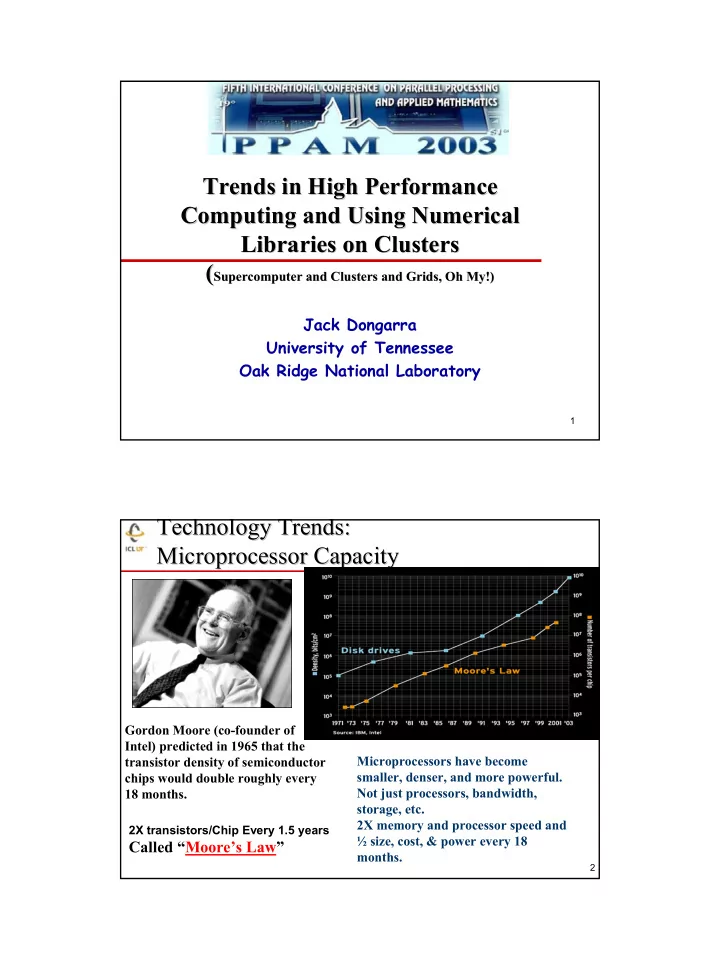
Technology Trends: Technology Trends: Microprocessor Capacity Microprocessor Capacity

2X transistors/Chip Every 1.5 years

Called “Moore’s Law”

Microprocessors have become smaller, denser, and more powerful. Not just processors, bandwidth, storage, etc. 2X memory and processor speed and ½ size, cost, & power every 18 months. Gordon Moore (co-founder of Intel) predicted in 1965 that the transistor density of semiconductor chips would double roughly every 18 months.

slide-2
SLIDE 2

2

3 Earth Simulator ASCI White Pacific EDSAC 1 UNIVAC 1 IBM 7090 CDC 6600 IBM 360/195 CDC 7600 Cray 1 Cray X-MP Cray 2 TMC CM-2 TMC CM-5 Cray T3D ASCI Red

1950 1960 1970 1980 1990 2000 2010 1 KFlop/s 1 MFlop/s 1 GFlop/s 1 TFlop/s 1 PFlop/s

Scalar Super Scalar Vector Parallel Super Scalar/Vector/Parallel

Moore’s Law Moore’s Law

1941 1 (Floating Point operations / second, Flop/s) 1945 100 1949 1,000 (1 KiloFlop/s, KFlop/s) 1951 10,000 1961 100,000 1964 1,000,000 (1 MegaFlop/s, MFlop/s) 1968 10,000,000 1975 100,000,000 1987 1,000,000,000 (1 GigaFlop/s, GFlop/s) 1992 10,000,000,000 1993 100,000,000,000 1997 1,000,000,000,000 (1 TeraFlop/s, TFlop/s) 2000 10,000,000,000,000 2003 35,000,000,000,000 (35 TFlop/s)

4

  • H. Meuer, H. Simon, E. Strohmaier, & JD
  • H. Meuer, H. Simon, E. Strohmaier, & JD
  • Listing of the 500 most powerful

Computers in the World

  • Yardstick: Rmax from LINPACK MPP

Ax=b, dense problem

  • Updated twice a year

SC‘xy in the States in November Meeting in Mannheim, Germany in June

  • All data available from www.top500.org

Size Rate

TPP performance

slide-3
SLIDE 3

3

5

A Tour de Force in Engineering A Tour de Force in Engineering

Homogeneous, Centralized, Proprietary, Expensive!

Target Application: CFD-Weather, Climate, Earthquakes

640 NEC SX/6 Nodes (mod)

5120 CPUs which have vector ops Each CPU 8 Gflop/s Peak ♦

40 TFlop/s (peak)

$1/2 Billion for machine & building

Footprint of 4 tennis courts

7 MWatts

Say 10 cent/KWhr - $16.8K/day = $6M/year! ♦

Expect to be on top of Top500 until 60-100 TFlop ASCI machine arrives

From the Top500 (June 2003) Performance of ESC ≈ Σ Next Top 4 Computers ~ 10% of performance of all the Top500 machines

6

June 2003 June 2003

5120 2560 2001 Commissariat a l'Energie Atomique (CEA) Bruyeres-le-Chatel 3980 AlphaServer SC ES45/1 GHz Hewlett- Packard 10 6032 3016 2001 Pittsburgh Supercomputing Center Pittsburgh 4463 AlphaServer SC ES45/1 GHz Hewlett- Packard 9 6160 1540 2003 Pacific Northwest National Laboratory Richland 4881 rx2600 Itanium2 1 GHz Cluster - Quadrics Hewlett- Packard 8 11980 2304 2002 National Aerospace Lab Tokyo 5406 PRIMEPOWER HPC2500 (1.3 GHz) Fujitsu 7 9216 1920 2003 Lawrence Livermore National Laboratory Livermore 6586 xSeries Cluster Xeon 2.4 GHz - Quadrics IBM/Quadrics 6 9984 6656 2002 NERSC/LBNL Berkeley 7304 SP Power3 375 MHz 16 way IBM 5 12288 8192 2000 Lawrence Livermore National Laboratory Livermore 7304 ASCI White, SP Power3 375 MHz IBM 4 11060 2304 2002 Lawrence Livermore National Laboratory Livermore 7634 MCR Linux Cluster Xeon 2.4 GHz - Quadrics Linux NetworX Quadrics 3 20480 8192 2002 Los Alamos National Laboratory Los Alamos 13880 ASCI Q - AlphaServer SC ES45/1.25 GHz Hewlett- Packard 2 40960 5120 2002 Earth Simulator Center Yokohama 35860 Earth-Simulator NEC 1 Rpeak # Proc Year Installation Site Rmax Computer Manufacturer

slide-4
SLIDE 4

4

7

TOP500 TOP500 – – Performance Performance -

  • June 2003

June 2003

374 TF/s 1.17 TF/s 59.7 GF/s 35.8 TF/s 0.4 GF/s 244 GF/s

J u n

  • 9

3 N

  • v
  • 9

3 J u n

  • 9

4 N

  • v
  • 9

4 J u n

  • 9

5 N

  • v
  • 9

5 J u n

  • 9

6 N

  • v
  • 9

6 J u n

  • 9

7 N

  • v
  • 9

7 J u n

  • 9

8 N

  • v
  • 9

8 J u n

  • 9

9 N

  • v
  • 9

9 J u n

  • N
  • v
  • J

u n

  • 1

N

  • v
  • 1

J u n

  • 2

N

  • v
  • 2

J u n

  • 3

Fujitsu 'NWT' NAL NEC ES Intel ASCI Red Sandia IBM ASCI White LLNL

N=1 N=500 SUM

1 Gflop/s 1 Tflop/s 100 Mflop/s 100 Gflop/s 100 Tflop/s 10 Gflop/s 10 Tflop/s 1 Pflop/s

My Laptop 8

Performance Extrapolation Performance Extrapolation

J u n

  • 9

3 J u n

  • 9

4 J u n

  • 9

5 J u n

  • 9

6 J u n

  • 9

7 J u n

  • 9

8 J u n

  • 9

9 J u n

  • J

u n

  • 1

J u n

  • 2

J u n

  • 3

J u n

  • 4

J u n

  • 5

J u n

  • 6

J u n

  • 7

J u n

  • 8

J u n

  • 9

J u n

  • 1

N=1 N=500 Sum

1 GFlop/s 1 TFlop/s 1 PFlop/s 100 MFlop/s 100 GFlop/s 100 TFlop/s 10 GFlop/s 10 TFlop/s 10 PFlop/s

Blue Gene 130,000 proc ASCI P 12,544 proc

TFlop/s To enter the list PFlop/s Computer

slide-5
SLIDE 5

5

9

Performance Extrapolation Performance Extrapolation

J u n

  • 9

3 J u n

  • 9

4 J u n

  • 9

5 J u n

  • 9

6 J u n

  • 9

7 J u n

  • 9

8 J u n

  • 9

9 J u n

  • J

u n

  • 1

J u n

  • 2

J u n

  • 3

J u n

  • 4

J u n

  • 5

J u n

  • 6

J u n

  • 7

J u n

  • 8

J u n

  • 9

J u n

  • 1

N=1 N=500 Sum

1 GFlop/s 1 TFlop/s 1 PFlop/s 100 MFlop/s 100 GFlop/s 100 TFlop/s 10 GFlop/s 10 TFlop/s 10 PFlop/s

My Laptop

Blue Gene 130,000 proc ASCI P 12,544 proc

10

Excerpt from the Top500 Excerpt from the Top500 -

  • 21th list

21th list

Rank Manufacturer Computer Rmax [TF/s] Installation Site Country # Proc

… … … … … …

3 Linux Networx MCR Linux Cluster Xeon - Quadrics 7.634 Lawrence Livermore National Laboratory USA 2304 6 IBM xSeries Cluster Xeon – Quadrics 6.586 Lawrence Livermore National Laboratory USA 1920 8 Hewlett- Packard rx2600 Itanium2 - Quadrics 4.881 Pacific Northwest National Laboratory USA 1540 11 HPTi Aspen Systems, Xeon – Myrinet2000 3.337 Forecast Systems Laboratory – NOAA USA 1536 19 Atipa Technology P4 Xeon Cluster - Myrinet 2.207 Louisiana State University USA 1024 25 Dell PowerEdge 2650 P4 Xeon – Myrinet 2.004 University at Buffalo, SUNY, CCR USA 600 31 IBM Titan Cluster Itanium2 – Myrinet 1.593 NCSA USA 512 39 Self-made PowerRACK-HX Xeon GigE 1.202 University of Toronto Canada 512

… … … … … … …

♦ Not “bottom feeders” ♦ 149 Clusters on the Top500 ♦ 119 are Intel based ♦ A substantial part of these are installed at industrial

customers especially in the oil-industry.

♦ 23 of these clusters are labeled as 'Self-Made'.

slide-6
SLIDE 6

6

11

SETI@home SETI@home: Global Distributed Computing : Global Distributed Computing

♦ Running on 500,000 PCs, ~1300 CPU

Years per Day

1.3M CPU Years so far

♦ Sophisticated Data & Signal

Processing Analysis

♦ Distributes Datasets from Arecibo

Radio Telescope

12

SETI@home SETI@home

♦ Use thousands of Internet-

connected PCs to help in the search for extraterrestrial intelligence.

♦ When their computer is idle

  • r being wasted this

software will download ~ half a MB chunk of data for analysis. Performs about 3 Tflops for each client in 15 hours.

♦ The results of this analysis

are sent back to the SETI team, combined with thousands of other participants.

♦ Largest distributed

computation project in existence

Averaging 55 Tflop/s

slide-7
SLIDE 7

7

13

Forward link Back links

Google query attributes

150M queries/day (2000/second) 100 countries 3B documents in the index

Data centers

15,000 Linux systems in 6 data centers

15 TFlop/s and 1000 TB total capability 40-80 1U/2U servers/cabinet 100 MB Ethernet switches/cabinet with gigabit Ethernet uplink

growth from 4,000 systems (June 2000)

18M queries then

Performance and operation simple reissue of failed commands to new servers no performance debugging

  • problems are not reproducible

Eigenvalue problem

  • n=2.7x10⁹

(see: MathWorks Cleve’s Corner)

  • 1 if there’s a hyperlink from page i to j

Form a transition probability matrix of the Markov chain

  • Matrix is not sparse, but it is a rank
  • ne modification of a sparse matrix

Largest eigenvalue is equal to one; want the corresponding eigenvector (the state vector of the Markov chain).

  • The elements of eigenvector are

Google’s PageRank (Larry Page). ♦

When you search: They have an inverted index of the web pages

  • Words and links that have those words

Your query of words: find links then

  • rder lists of pages by their PageRank.

Source: Monika Henzinger, Google & Cleve Moler

14

Grid Computing is About … Grid Computing is About …

Resource sharing & coordinated problem solving in dynamic, multi-institutional virtual

  • rganizations
QuickTime™ and a decompressor are needed to see this picture. QuickTime™ and a decompressor are needed to see this picture.

IMAGING INSTRUMENTS COMPUTATIONAL RESOURCES LARGE-SCALE DATABASES DATA ACQUISITION ,ANALYSIS ADVANCED VISUALIZATION

“Telescience Grid”, Courtesy of Mark Ellisman

slide-8
SLIDE 8

8

15

The Computing Continuum The Computing Continuum

♦ Each strikes a different balance

computation/communication coupling

♦ Implications for execution efficiency ♦ Applications for diverse needs

computing is only one part of the story!

Loosely Coupled Tightly Coupled

Clusters Highly Parallel “Grids”

Special Purpose “SETI / Google”

16

Selected System Characteristics Selected System Characteristics

Earth Simulator Cray X1 ASCI Q MCR (NEC) (Cray) (HP ES45) (Dual Xeon) Year of Introduction 2002 2003 2003 2002 Node Architecture Vector Vector Alpha micro Xeon micro SMP SMP SMP SMP System Topology NEC single-stage 2D Torus Quadrics QsNet Quadrics QsNet Crossbar Interconnect Fat-tree Fat-tree Number of Nodes 640 32 2048 1152 Processors - per node 8 4 4 2

  • system total

5120 128 8192 2304 Processor Speed 500 MHz 800 MHz 1.25 GHz 2.4 GHz

Peak Speed

  • per processor

8 Gflops 12.8 Gflops 2.5 Gflops 4.8 Gflops

  • per node

64 Gflops 51.2 Gflops 10 Gflops 9.6 Gflops

  • system total

40 Tflops 1.6 Tflops 30 Tflops 10.8 Tflops Memory

  • per node

16 GB 8-64 GB 16 GB 16 GB

  • per processor

2 GB 2-16 GB 4 GB 2 GB

  • system total

10.24 TB 48 TB 4.6 TB Memory Bandwidth (peak)

  • L1 Cache

N/A 76.8 GB/s 20 GB/s 20 GB/s

  • L2 Cache

N/A 13 GB/s 1.5 GB/s Main (per proc) 32 GB/s 34.1 GB/s 2 GB/s 2 GB/s Inter-node MPI

  • Latency

8.6 µsec 8.6 µsec 5 µsec 4.75 µsec

  • Bandwidth

11.8 GB/s 11.9 GB/s 300 MB/s 315 MB/s Bytes/flop to main memory 4 3 0.8 0.4 Bytes/flop interconnect 1.5 1 0.12 0.07

slide-9
SLIDE 9

9

17

Phases I Phases I -

  • III

III

02 05 06 07 08 09 10 03 04 Products Metrics, Benchmarks Academia Research Platforms Early Software Tools Early Pilot Platforms

Phase II R&D

3 companies ~$50M each

Phase III Full Scale Development

commercially ready in the 2007 to 2010 timeframe. $100M ? Metrics and Benchmarks System Design Review

Industry Application Analysis Performance Assessment HPCS Capability or Products

Fiscal Year Concept Reviews PDR Research Prototypes & Pilot Systems Phase III Readiness Review Technology Assessments Requirements and Metrics Phase II Readiness Reviews

Phase I Industry Concept Study

5 companies $10M each Reviews Industry Procurements Critical Program Milestones DDR

18

Linpack (100x100) Analysis Linpack (100x100) Analysis

♦ Compaq 386/SX20 SX with FPA - .16 Mflop/s ♦ Pentium IV – 2.8 GHz – 1317 Mflop/s ♦ 12 years we see a factor of ~ 8231

Doubling in less than a year, for 12 years

♦ Moore’s Law gives us a factor of 256 (factor of 2

18 months).

♦ How

Clock speed increase = 128x External Bus Width & Caching –

16 vs. 64 bits = 4x

Floating Point -

4/8 bits multi vs. 64 bits (1 clock) = 8x

Compiler Technology = 2x

♦ However the potential for that Pentium 4 is

5.6 Gflop/s and here we are getting 1.32 Gflop/s

Still a factor of 4.25 off of peak

Complex set of interaction between Users’ applications Algorithm Programming language Compiler Machine instruction Hardware Many layers of translation from the application to the hardware Changing with each generation

slide-10
SLIDE 10

10

19

Where Does the Performance Go? or Where Does the Performance Go? or Why Should I Care About the Memory Hierarchy? Why Should I Care About the Memory Hierarchy?

1 100 10000 1000000 1 9 8 1 9 8 2 1 9 8 4 1 9 8 6 1 9 8 8 1 9 9 1 9 9 2 1 9 9 4 1 9 9 6 1 9 9 8 2 2 2 2 4

Year Performance

Processor-DRAM Memory Gap (latency) µProc 60%/yr. (2X/1.5yr) DRAM 9%/yr. (2X/10 yrs) “Moore’s Law” Processor-Memory Performance Gap: (grows 50% / year)

CPU DRAM 20

The Memory Hierarchy The Memory Hierarchy

Registers Level 1 Cache 1cy 3-10 words/cycle compiler managed 1-3cy 1-2 words/cycle hardware managed 5-10cy 1 word/cycle hardware managed 30-100cy 0.5 words/cycle OS managed 106-107cy 0.01 words/cycle OS managed Level 2 Cache CPU Chip DRAM Chips Mech Disk Tape

♦ By taking advantage of the principle of locality:

Present the user with as much memory as is available in the cheapest technology. Provide access at the speed offered by the fastest technology.

slide-11
SLIDE 11

11

21

♦ Diversity of execution environments

Growing complexity of modern microprocessors.

  • Deep memory hierarchies
  • Out-of-order execution
  • Instruction level parallelism

Growing diversity of platform characteristics

  • SMPs
  • Clusters (employing a range of interconnect technologies)
  • Highly parallel systems (> 100K processors)
  • Grids (heterogeneity, wide range of characteristics)

♦ Wide range of application needs

Dimensionality and sizes Data structures and data types Languages and programming paradigms

Challenges in Achieving High Challenges in Achieving High Performance on Today’s Systems Performance on Today’s Systems

22

Software Technology & Performance Software Technology & Performance

♦ Tendency to focus on hardware ♦ Software required to bridge an ever widening gap ♦ Gaps between usable and deliverable performance

is very steep

Performance only if the data and controls are setup just right

Otherwise, dramatic performance degradations, very unstable situation Will become more unstable

♦ Challenge of Numerical Libraries, PSEs and Tools

is formidable with Tflop/s level, even greater with Pflops, some might say insurmountable.

slide-12
SLIDE 12

12

23

Motivation Self Adapting Motivation Self Adapting Numerical Software (SANS) Effort Numerical Software (SANS) Effort

♦ Optimizing software to exploit the features of a

given system has historically been an exercise in hand customization. Time consuming and tedious Hard to predict performance from source code Must be redone for every architecture and compiler Software technology often lags architecture Best algorithm may depend on input, so some tuning may be needed at run-time. Need for quick/dynamic deployment of optimized routines.

24

Software Generation Software Generation Strategy Strategy -

  • ATLAS BLAS

ATLAS BLAS

♦ Takes ~ 20 minutes to run,

generates Level 1,2, & 3 BLAS

♦ “New” model of high

performance programming where critical code is machine generated using parameter

  • ptimization.

♦ Designed for modern

architectures

Need reasonable C compiler ♦ Today ATLAS in used within

various ASCI and SciDAC activities and by Matlab, Mathematica, Octave, Maple, Debian, Scyld Beowulf, SuSE,…

♦ Parameter study of the hw ♦ Generate multiple versions

  • f code, w/difference

values of key performance parameters

♦ Run and measure the

performance for various versions

♦ Pick best and generate

library

♦ Level 1 cache multiply

  • ptimizes for:

TLB access L1 cache reuse FP unit usage Memory fetch Register reuse Loop overhead minimization

See: http://icl.cs.utk.edu/atlas/ for the ATLAS software

0.0 500.0 1000.0 1500.0 2000.0 2500.0 3000.0 3500.0

A M D A t h l

  • n
  • 6

D E C e v 5 6

  • 5

3 3 D E C e v 6

  • 5

H P 9 / 7 3 5 / 1 3 5 I B M P P C 6 4

  • 1

1 2 I B M P

  • w

e r 2

  • 1

6 I B M P

  • w

e r 3

  • 2

I n t e l P

  • I

I I 9 3 3 M H z I n t e l P

  • 4

2 . 5 3 G H z w / S S E 2 S G I R 1 i p 2 8

  • 2

S G I R 1 2 i p 3

  • 2

7 S u n U l t r a S p a r c 2

  • 2

Architectures MFLOP/S

Vendor BLAS ATLAS BLAS F77 BLAS
slide-13
SLIDE 13

13

25

Self Adapting Numerical Software Self Adapting Numerical Software -

  • SANS Effort

SANS Effort

♦ Provide software technology to aid in high performance on

commodity processors, clusters, and grids.

♦ Pre-run time (library building stage) and run time

  • ptimization.

♦ Integrated performance modeling and analysis ♦ Automatic algorithm selection – polyalgorithmic functions ♦ Automated installation process ♦ Can be expanded to areas such as communication software

and selection of numerical algorithms

TUNING SYSTEM Different Algorithms, Segment Sizes Best Algorithm, Segment Size

26

Self Adaptive Software Self Adaptive Software

♦ Software can adapt its workings to

the environment in (at least) 3 ways

Kernels, optimized for platform (Atlas, Sparsity): static determination Scheduling, taking network conditions into account (LFC): dynamic, but data- independent Algorithm choice (Salsa): dynamic, strongly dependent on user data.

slide-14
SLIDE 14

14

27

Cluster Library Cluster Library

♦ Want to relieve the user of

some of the tasks via Cluster Middleware

♦ Make decisions on the

number of processors to use based on the user’s problem and the state of the system Optimize for the best time to solution Distribute the data on the processors and collections of results Start the SPMD library routine on all the platforms

User problem Resources hardware software Library Middleware

28

♦ Numerical software for dense linear

algebra intended for cluster computing environments

♦ Descendant of LAPACK and ScaLAPACK ♦ Partly derived from Grid environment.

GrADS (Grid Application Development Software)

♦ In the class of SANS (Self Adaptive

Numerical Software)

♦ Part of the NSF NPACI’s NPACkage

LAPACK for Clusters LAPACK for Clusters

slide-15
SLIDE 15

15

29

Cluster Numerical Library Cluster Numerical Library

♦ Want to relieve the user of some of the tasks ♦ Make decisions on which machines to use based on

the user’s problem and the state of the system Determinate set of procs that should be used Optimize for the best time to solution Distribute the data on the processors and collections of results Start the SPMD library routine on all the platforms Check to see if the computation is proceeding as planned

If not perhaps migrate application

30 m n (m,n), number of (rows,columns) in natural A (mb,nb), number of (rows,columns) defining the block size of the mapping (p,q), number of (rows,columns) in logical process grid (p*mb) rows of natural A (q*nb) columns of natural A

Variables defining the 2d block cyclic mapping

  • f the user’s ‘natural’

data

mb nb

With With ScaLAPACK ScaLAPACK Data Layout Data Layout Critical for Performance Critical for Performance

Number of processors Aspect ratio of processes Block size

slide-16
SLIDE 16

16

31

Nprocs = 10

Number of processors Grid aspect ratio for runs Blocksize

1 x 10 2 x 5 5 x 2 10 x 1

Needs An Expert To Do The Tuning

32 ~ Mbit Switch, (fully connected) ~ Gbit Switch, (fully connected) Remote memory server, e.g. IBP (TCP/IP) Local network file server, SUN’s NFS (UDP/IP) e.g. 100 Mbit Users, etc.

LFC Sample Computing Environment:

slide-17
SLIDE 17

17

33

User has problem to solve (e.g. Ax = b)

Natural Data (A,b)

Middleware Application Library (e.g. LAPACK, ScaLAPACK, PETSc,…)

Natural Answer (x) Structured Data (A’,b’) Structured Answer (x’)

User Interface/Middleware User Interface/Middleware

34

File System File System -

  • based

based

User A b Stage data to disk

slide-18
SLIDE 18

18

35

File System File System -

  • based

based

User A b Library Middle-ware

36

File System File System -

  • based

based

User A b Library Middle-ware NWS Resource Selection Time function minimization

slide-19
SLIDE 19

19

37

File System File System -

  • based

based

User A b Library Middle-ware NWS Resource Selection 0,0 0,1 … Time function minimization

Has been applied to Grid infrastructure, i.e.Globus/NWS, but doesn’t have to.

38

Time to solution of Ax=b (n=60k)

5000 10000 15000 20000 25000 32 34 36 39 42 45 47 49 51 54 56 58 62 64 Number of processors T im e (s e c

  • n

d s ) Naive LFC

LFC Performance Results LFC Performance Results

Increasing margin

  • f potential

user error Using up to 64 of AMD 1.4 GHz processors at Ohio Supercomputer Center

slide-20
SLIDE 20

20

39

Executing Executing Matlab Matlab Programs on a Cluster Programs on a Cluster

Cluster server_connect(35000); A = lfc_fread(…); b = lfc_fread(…); x = A \ b; r = b – A * x; z = A \ r; x = x + z; …

> mpirun -np 128 lfc_server port=35000 &

  • Arrays will live on the

server and execution takes place there via LFC / ScaLAPACK.

  • Debug on laptop, run on cluster

Plans for Python, Mathematica, Maple … as well

> Matlab

40

Grids vs. Capability vs. Cluster Grids vs. Capability vs. Cluster Computing Computing

♦ Not an “either/or” question

Each addresses different needs Each are part of an integrated solution

♦ Grid strengths

Coupling necessarily distributed resources

instruments, software, hardware, archives, and people

Eliminating time and space barriers

remote resource access and capacity computing

Grids are not a cheap substitute for capability HPC

♦ Capability computing strengths

Supporting foundational computations

terascale and petascale “nation scale” problems

Engaging tightly coupled computations and teams

♦ Clusters

Low cost, group solution Potential hidden costs

slide-21
SLIDE 21

21

41

Collaborators / Support Collaborators / Support

♦ TOP500

  • H. Meuer, Mannheim U
  • H. Meuer, Mannheim U
  • H. Simon, NERSC
  • H. Simon, NERSC
  • E. Strohmaier, NERSC
  • E. Strohmaier, NERSC

♦ SANS

Kenny Roche, UTK Piotr Luszczek, UTK Jeffery Chen, UTK Victor Eijkhout, UTK Antoine Petitet, Sun Micro Clint Whaley, U of Florida