SVENSK KÄRNBRÄNSLEHANTERING
Underground nuclear waste storage Groundwater flow and radionuclide - - PowerPoint PPT Presentation
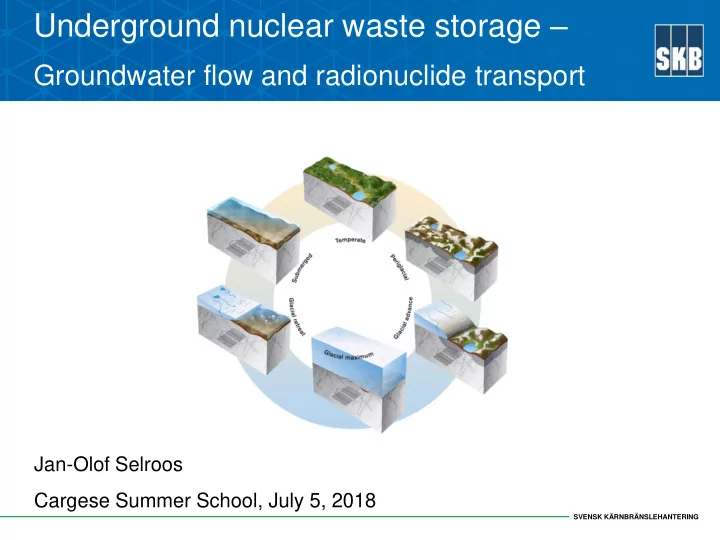
Underground nuclear waste storage Groundwater flow and radionuclide transport Jan-Olof Selroos Cargese Summer School, July 5, 2018 SVENSK KRNBRNSLEHANTERING Contents: Concept for geological disposal of nuclear waste A few words
SVENSK KÄRNBRÄNSLEHANTERING
- Concept for geological disposal of nuclear waste
- A few words on Performance/Safety Assessments
- Hydrogeological modelling in support of geological disposal of nuclear
waste
- Site-descriptive understanding
- Safety assessment applications
- Examples
- Conditioning of DFN models
- The ENIGMA experiment at Äspö HRL
- Conclusions
Contents:
SVENSK KÄRNBRÄNSLEHANTERING
Concept for geological disposal of nuclear waste – the SKB example
Nuclear power plants Low- and intermediate- level waste Health care, industry and research Transportation by m/s Sigrid High-level waste Final Repository for Short-lived Radioactive Waste Interim Storage Facility for Spent Nuclear Fuel with planned encapsulation facility Final Repository for Spent Nuclear Fuel
SVENSK KÄRNBRÄNSLEHANTERING
SKB’s method
Concept for geological disposal of nuclear waste – the SKB example
Fuel pellet of uranium dioxide Spent nuclear fuel Nodular iron insert Bentonite clay Surface part of final repository Cladding tube Fuel assembly of BWR type Copper canister Crystalline bedrock Underground part of final repository
approx. 500 m
SVENSK KÄRNBRÄNSLEHANTERING
Assessment of consequences
DOI 10.1007/s13280-013-0395-5
SVENSK KÄRNBRÄNSLEHANTERING
Assessment methodology – SKB SR-Site
SVENSK KÄRNBRÄNSLEHANTERING
Linking groundwayter flow and radionuclide transport simulations
DOI 10.1007/s10040-012-0888-5 Groundwater flow Nearfield RN transport Farfield RN transport
SVENSK KÄRNBRÄNSLEHANTERING
Radionuclide transport
SVENSK KÄRNBRÄNSLEHANTERING
Final risk estimate SR-Site (TR-11-01)
SVENSK KÄRNBRÄNSLEHANTERING
Site-descriptive modelling and Performance/Safety asessment modelling
SVENSK KÄRNBRÄNSLEHANTERING
Site investigations
SVENSK KÄRNBRÄNSLEHANTERING
- Surface investigations
- Airborne photography and surface geophysical investigations
- Lithological mapping and mapping of structural characteristics
- Investigations of Quaternary deposits
- Meteorological and hydrological monitoring, hydrochemical sampling
- f precipitation, surface waters and shallow groundwater
- Drilling and borehole measurements
- 25 (Forsmark) and 43 (Laxemar) deep (800 - 1,000 m) cored drilled
boreholes
- Several more shallow core drilled and percussion drilled boreholes
- Mapping, testing and monitoring boreholes and bore cores
- Many soil/rock boreholes through Quaternary deposits
Surface-based site investigations
SVENSK KÄRNBRÄNSLEHANTERING
Site-descriptive modelling
SVENSK KÄRNBRÄNSLEHANTERING
Site-descriptive modelling
SVENSK KÄRNBRÄNSLEHANTERING
Site-descriptive modelling
SVENSK KÄRNBRÄNSLEHANTERING
- A site descriptive model integrates
various types of data from field investigations and associated laboratory studies in a single, coherent, logical and defensible description of a site.
- The site descriptive model not
- nly provides specialized
information and data needed to support safety assessment and engineering studies, but also provides complementary evidence to support a safety case.
Site-descriptive modelling
SVENSK KÄRNBRÄNSLEHANTERING
Groundwater leakage into open tunnels How does inflow of water affect construction and operations? How can inflow be minimized? Environmental Impact Assessment How are lakes and wetlands above the repository affected during construction and
- perations?
Groundwater flow and chemistry How will groundwater at repository depth affect the technical barriers? Transport of radionuclides In case of canister breach, how are radionuclides transported through the gesophere to the biosphere?
Modeling of construction,
- perations and safety after closure
SVENSK KÄRNBRÄNSLEHANTERING
The Safety Assessment SR-Site
SVENSK KÄRNBRÄNSLEHANTERING
Embedding of models/concepts
SVENSK KÄRNBRÄNSLEHANTERING
Temperate climate conditions:
- Saturation of backfill
- Hydrogeological and hydrogeochemical development
- Recharge and discharge locations
- Performance measures (Darcy flux, equivalent flow rate, flow-related
transport resistance, advective travel time)
- Penetration of dilute water
- Effect of engineering imperfections (EDZ, crown space, spalling)
- Site-descriptive model-based variants (uncertainty)
- Unsealed boreholes and other what-if analyses
Typical hydrogeological issues in PA/SA
SVENSK KÄRNBRÄNSLEHANTERING
Example results: Discharge as a function
- f time
SVENSK KÄRNBRÄNSLEHANTERING
Example results: Darcy flux at deposition holes
SVENSK KÄRNBRÄNSLEHANTERING
Glacial/periglacial climate conditions:
- Advancing ice sheet (glaciation)
- Different ice sheet movement/speed
- Different types of periglacial conditions
- Different permeability conditions
(permafrost, hydro-mechanical effect)
- Maximum ice sheet coverage
- Retreating ice sheet (deglaciation)
Typical hydrogeological issues in PA/SA
SVENSK KÄRNBRÄNSLEHANTERING
Example results: Darcy flux at deposition holes
SVENSK KÄRNBRÄNSLEHANTERING
- Main radiological risks are associated
with the erosion-corrosion (both flow- related) and shear load scenarios.
- If (large) flowing fractures can be
avoided in deposition hole positions and deposition tunnels, risk is dramatically reduced.
- Two-fold objective:
- To increase determinism in description of
fracture intersections with deposition holes (geometry and flow).
- To have correct distribution of flow in
deposition holes within full repository.
Conditioning of DFN models – the deterministic-stochastic transition
SVENSK KÄRNBRÄNSLEHANTERING
- Fracture traces: Fracture orientations
can be matched. Size still unknown!
- Hydraulic data (hydraulic
signatures) provide information
- n network characteristics.
Conditioning - data sources and issues
SVENSK KÄRNBRÄNSLEHANTERING
- To evaluate the performance we need common test- or benchmark
cases: a Hypothetical Site
- Perfectly known geology (geometries, properties, trends and ”recipe”)
- Controlled samples (all intersections can be traced to a unique fracture)
- Nested models (allows realistic resolution of samples)
Use of a Synthetic reality
r0 = 10 m r0 = 1m r0 = 0.1 r0 = 0.038 m
SVENSK KÄRNBRÄNSLEHANTERING
- In unconditional
simulation, fractures not matching traces removed.
- A library of fractures pre-
calculated; a matching fracture picked from library and placed in position where trace found.
- Also hydraulic criteria can
be applied when choosing fracture from library.
Conditioning approach
SVENSK KÄRNBRÄNSLEHANTERING
Unconditional vs conditional simulation of specific capacity (”transmissivity”) vs synthetic true value
Results of conditioning
SVENSK KÄRNBRÄNSLEHANTERING
- Conditioning creates models
honoring reality in higher degree concerning location of deposition holes with flowing fractures.
- Important if different conditions
prevail for different parts of repository (e.g. recharge/discharge)
- Conditional simulations
exhibit less stochastic variability in Darcy flux (U) and Flow-related transport resistance (F) than unconditional simulations.
- Less uncertainty in predictions
- f radiological risk!
Safety assessment implications
Mean difference in log(U) or log(F) for flowing holes between observed and conditioned data, based on conditioning in pilot holes for deposition holes
SVENSK KÄRNBRÄNSLEHANTERING
- Will combined hydraulic-tracer-
geophysical (GPR) data provide additional constraining power (conditioning data) on the fracture network characteristics in the vicinity of deposition holes?
- ENIGMA PhD project: Flow and transport
in fracture networks: reducing uncertainty
- f DFN models by conditioning to
geology and geophysical data (GPR)
- Develop and test a general framework to
condition discrete fracture network (DFN) models to geological mapping and geophysical data in order to reduce the uncertainty of fractured rock properties and flow patterns
The ENIGMA experiment at Äspö HRL
SVENSK KÄRNBRÄNSLEHANTERING
Direction of the end
- f the tunnel
ENIGMA – preliminary GPR results
SVENSK KÄRNBRÄNSLEHANTERING
ENIGMA – suggested boreholes for experiments
Tests to be performed: Push-Pull/SWIW tests Convergent dipole test + surface-based GPR
SVENSK KÄRNBRÄNSLEHANTERING
- Groundwater flow and radionuclide transport modelling are central parts
- f the integrated Performance/Safety asessment.
- Groundwater flow and chemistry affects performance of engineered
barriers, and also transports radionuclides through the geosphere to the biosphere in case of breached containment.
- Fractured crystalline rock can only be described in a stochastic sense
due to natural variability.
- Conditioning can increase determinism, and hence help in avoiding
unsuitable deposition locations.
- The ENIGMA project at Äspö HRL tests novel combined measurement