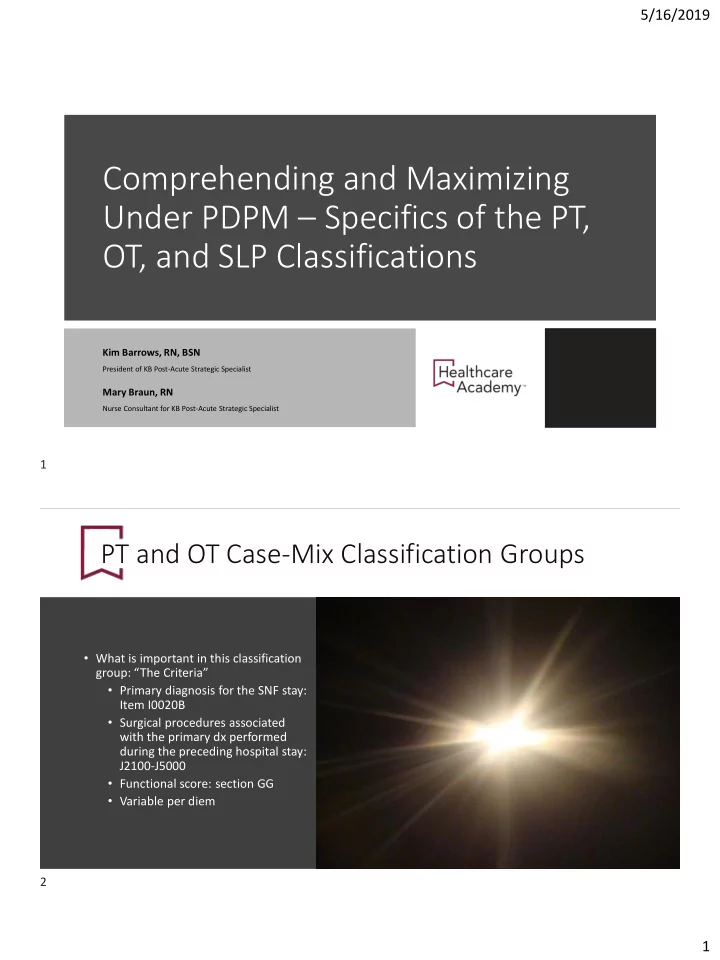
Under PDPM Specifics of the PT, OT, and SLP Classifications Kim - - PDF document

under pdpm specifics of the pt
SMART_READER_LITE
LIVE PREVIEW

Under PDPM Specifics of the PT, OT, and SLP Classifications Kim - - PDF document

5/16/2019 Comprehending and Maximizing Under PDPM Specifics of the PT, OT, and SLP Classifications Kim Barrows, RN, BSN President of KB Post-Acute Strategic Specialist Mary Braun, RN Nurse Consultant for KB Post-Acute Strategic Specialist


slide-1
SLIDE 1

5/16/2019 1

Comprehending and Maximizing Under PDPM – Specifics of the PT, OT, and SLP Classifications

Kim Barrows, RN, BSN

President of KB Post-Acute Strategic Specialist

Mary Braun, RN

Nurse Consultant for KB Post-Acute Strategic Specialist

PT and OT Case-Mix Classification Groups

  • What is important in this classification

group: “The Criteria”

  • Primary diagnosis for the SNF stay:

Item I0020B

  • Surgical procedures associated

with the primary dx performed during the preceding hospital stay: J2100-J5000

  • Functional score: section GG
  • Variable per diem

1 2

slide-2
SLIDE 2

5/16/2019 2

PT and OT Classification Diagnosis

  • Primary Diagnosis
  • Step 1: Classifies the resident into a clinical category
  • Step 2: Adjustments to the clinical category may be made in cases where the

resident received a surgical procedure during the preceding hospital stay associated with that diagnosis.

Section J

3 4

slide-3
SLIDE 3

5/16/2019 3

Section J – Cont’d PT/OT Classification Diagnosis

  • J2100-Recent surgery requiring active SNF care
  • If no, resident will remain in the default clinical category derived from Section I
  • If yes, the resident will convert the resident into a surgical primary clinical

category

  • J2300-J5000
  • Only 1 procedure checked is necessary. But check as many that pertain for an

accurate assessment

  • In items with “other” will not affect the clinical category
  • Ex: 2499 Spinal Surgery - other

5 6

slide-4
SLIDE 4

5/16/2019 4

PT/OT Classification Diagnosis

Step 3: Based on the primary diagnosis and the occurrence of a surgical intervention the resident is then classified into one of ten clinical categories.

For PT and OT Classification PDPM Clinical Category Major Joint Replacement or Spinal Surgery Non-Orthopedic Surgery Acute Neurologic Non-Surgical Orthopedic/Musculoskeletal Orthopedic Surgery (Except Major Joint Replacement or Spinal Surgery) Medical Management Acute Infections Cancer Pulmonary Cardiovascular and Coagulation

PT/OT Classification Diagnosis

PDPM Clinical Category Major Joint Replacement or Spinal Surgery Major Joint Replacement or Spinal Surgery Non-Orthopedic Surgery Non-Orthopedic Surgery and Acute Neurologic Acute Neurologic Non-Surgical Orthopedic/Musculoskeletal Other Orthopedic Orthopedic Surgery (Except Major Joint Replacement or Spinal Surgery) Medical Management Medical Management Acute Infections Cancer Pulmonary Cardiovascular and Coagulation

7 8

slide-5
SLIDE 5

5/16/2019 5

PT/OT Classification Diagnosis

  • Mapping of the ICD-10 diagnosis and/or surgical procedures that will be used to

classify the resident into one of the ten clinical categories is located on the SNF website:

https://www.cms.gov/Medicare/Medicare-Fee-for-Service-Payment/SNFPPS/PDPM.html

  • The spread sheet has 4 columns
  • ICD-10 DM code - has drop down to sort A - Z or Z - A
  • Description - has drop down to sort A - Z or Z - A
  • Default clinical categories- has drop down listing the 10 clinical categories
  • Return to Provider-invalid primary diagnosis
  • Will not provide a PDPM classification
  • The record will reject when submitted

PT/OT Classification Diagnosis

9 10

slide-6
SLIDE 6

5/16/2019 6

ICD-10 DM Code Description

11 12

slide-7
SLIDE 7

5/16/2019 7

Default Clinical Category Major Procedure During the Prior Inpatient Stay

13 14

slide-8
SLIDE 8

5/16/2019 8

PT/OT Classification Diagnosis

  • S22040S - Wedge compression fracture of fourth thoracic vertebra,

sequela

PT/OT Classification Diagnosis

  • M80861P - Other osteoporosis with current pathological fracture,

right lower leg, subsequent encounter for fracture with malunion

15 16

slide-9
SLIDE 9

5/16/2019 9

PT/OT Classification Diagnosis

  • M00072 - Staphylococcal arthritis, left ankle and foot

PT/OT Classification Diagnosis

  • H53121 - Transient visual loss, right eye

17 18

slide-10
SLIDE 10

5/16/2019 10

PT/OT Classification Diagnosis

  • Strategies for Successful ICD-10-CM Barriers
  • Determine the primary diagnosis as a TEAM
  • Can start now, day after a new admission meet as a team to determine

the primary diagnosis

  • Updated ICD-10-CM manuals
  • Triple Check
  • Maintain an accurate diagnosis list

PT/OT Classification Diagnosis

  • Pitfalls leading to Unsuccessful ICD-10-CM coding
  • Do not use “unspecified” codes
  • Do not code resolved diagnosis
  • Incorrect seventh character (for fractures/injuries)
  • “A”- Initial encounter
  • “D”- Subsequent encounter
  • “S”- Sequela
  • Coding a diagnosis that has not been documented by a physician

19 20

slide-11
SLIDE 11

5/16/2019 11

Let’s Run Through Section I Diagnosis Example

  • Hospital COC has Dx

M84.345S-

  • Clinical Mapping -

Stress Fracture L finger sequella

  • Maybe eligible for 1
  • f 2 orthopedic

categories

  • From the clinical

mapping

Let’s Run Through Section J-Surgery Related Items

  • Resident admitted to SNF on 10/30/19
  • Hospital records indicate that resident was involved in MVA

10/20/19 where he sustained multiple bone fx and abdominal

  • injuries. Major surgeries include:
  • Surgery to repair comminuted fx of L wrist
  • ORIF to repair fx bilateral tibia/fibula, lower legs,
  • Large Bowel Resection (Partial Colectomy)
  • ORIF to repair fx L clavicle
  • Resident admitted to SNF for Nursing, PT, OT services

21 22

slide-12
SLIDE 12

5/16/2019 12

Coding Section J PT/OT Classification Functional Score

  • Functional Score
  • Calculated from Section GG
  • Functional Score will range 0 - 24
  • Increasing score now means increased independence
  • There is no direct relationship between increasing dependence and

increasing payment

  • Promotes CMS goal of standardizing assessment items across all payment

settings

  • Also better coordinates payment with other quality initiatives
  • For the PT/OT components the score is based on 10 items have been highly

related to PT/OT costs per day

23 24

slide-13
SLIDE 13

5/16/2019 13

PT/OT Classification Functional Score

2 – Bed Mobility 3 – Transfer Items 1 – Eating Item 1 – Toileting Item 1 – Oral Hygiene Item 2 – Walking Items 10 Items

PT/OT Classification Functional Score Definitions

25 26

slide-14
SLIDE 14

5/16/2019 14

Section GG

Self Care Items

Section GG

Mobility

27 28

slide-15
SLIDE 15

5/16/2019 15

PT/OT Classification Functional Score PT/OT Classification Functional Score

  • The two tables the first including the 2 walking items
  • The second table, excluding the walking items; The additional

response “Resident cannot walk”

  • Makes it possible for those residents who cannot walk for their assessments

to still calculate a functional score.

  • Will use:
  • 07 - resident refused
  • 09 - not applicable
  • 10 - not attempted d/t environmental conditions
  • 88 - not attempted due to medical/safety concerns

29 30

slide-16
SLIDE 16

5/16/2019 16

PT/OT Classification Functional Score

  • The final score:
  • Average score for 2 mobility items
  • Average score for 3 transfer items
  • Average score for average of 2 walking items
  • Score for eating
  • Score for oral hygiene
  • Score for toilet hygiene

31 32

slide-17
SLIDE 17

5/16/2019 17

Calculating the Functional Score

  • From the MDS previous slide:
  • Eating - 3 = 2 pts
  • Oral hygiene - 3 = 2 pts
  • Toileting hygiene - 2= 1 pt
  • Sit to lying - 2= 1 pt
  • Lying to sitting on side of the bed - 2 = 1 pt
  • Sit to stand - 3 = 2 pts
  • Chair/bed-to-chair transfer – 2 = 1 pt
  • Toilet transfer - 3 = 2 pts
  • Walk 50 ft with 2 turns - 88 = 0 pts
  • Walk 150 ft - 88 = 0 pts

Calculating the Functional Score

  • Eating - 2 pts
  • Plus
  • Oral hygiene - 2 pts
  • Plus
  • Toilet hygiene - 1 pt
  • Plus
  • Average 2 items for bed mobility 1 + 1 = 2 divided by 2 = 1
  • Average 3 items for transfers 2 + 1 +2 = 5 divided by 3 = 1.6666
  • Average 2 items for walking 0 + 0 = 0 divided by 2 = 0

Do the Math

33 34

slide-18
SLIDE 18

5/16/2019 18

Calculating the Functional Score

  • 2 + 2 + 1 + 1 + 1.67 + 0 = 7.67
  • Rounded up at the end
  • Functional score 8.

PT/OT Case Mix Classification Groups

35 36

slide-19
SLIDE 19

5/16/2019 19

Putting it all together to get a PT/OT Classification Group

  • MDS completed, coding included:
  • Section I-I0200B coded: M97.11XS –
  • Peri prosthetic fx around internal prosthetic R knee joint sequella.
  • Clinical category from mapping- Major Joint Replacement or Spinal Surgery
  • Section J-J2000 coded: yes
  • Section J-J2100 coded: yes
  • Section J-J2300: checked
  • Functional score calculated section GG: 6
  • What is PT/OT Case Mix Group?
  • Answer?

Variable Per Diem Adjustment/Factors PT/OT Component

Medicare Payment Days Adjustment Factor 1-20 1.00 21-27 0.98 28-34 0.96 35-41 0.94 42-48 0.92 49-55 0.90 56-62 0.88 63-69 0.86 70-76 0.84 77-83 0.82 84-90 0.80 91-97 0.78 98-100 0.76

37 38

slide-20
SLIDE 20

5/16/2019 20

Bonus Question: Variable Per Diem Adjustment

  • Resident admitted on 10/10/19
  • 5 Day PPS ARD 10/17/19 with PT/OT Classification Group Score: TB
  • Date is now 10/21/19
  • With the Variable Per Diem
  • For Medicare Payment Days, what adjustment factor will be applied to the PT/OT

classification scores?

  • Adjustment Factor 1.0
  • (100% of the rate)

Speech/Language Pathology Case-Mix Classification Group

  • What is important in this classification group. The Criteria:
  • Clinical Category
  • Derived from the primary diagnosis (I0020B)
  • Acute Neurologic
  • Cognitive Impairment
  • Presence of SLP related Comorbidity
  • Mechanically Altered Diet and/or Swallowing Disorder
  • Section K – Swallowing/Nutritional Status

39 40

slide-21
SLIDE 21

5/16/2019 21

Acute Neurologic

SLP Case-Mix Classification Group Cognitive Impairment

  • Comes from the Cognitive Score
  • Found in Section C – Cognitive Patterns
  • BIMS- Brief Interview for Mental Status
  • Resident Interview - (make every attempt)
  • Add all the item numbers together
  • Score range 0-15
  • CPS- Cognitive Performance Scale
  • Staff interview (only if resident cannot be interviewed)
  • Score range 0 - 6
  • The Cognitive Function Scale combines scores from both scales to cover all

residents

41 42

slide-22
SLIDE 22

5/16/2019 22

SLP Case-Mix Classification Group Cognitive Impairment

43 44

slide-23
SLIDE 23

5/16/2019 23

  • CMS has Identified 12 comorbidities which have been found to

directly impact increased costs under SLP

  • The presence of only of these conditions are required to fulfill the

requirement for resident to qualify under this criteria of the SLP classification

  • 1 out of 12 is all that is required

SLP Case-Mix Classification Group

SLP Related Comorbidities

SLP Case-Mix Classification Group

SLP Related Comorbidities

45 46

slide-24
SLIDE 24

5/16/2019 24

Identify SLP Related Comorbidities

  • Resident admitted to SNF. Information from the hospital transfer

records and include:

  • S/P MVA
  • Ventilator Dependent via tracheostomy
  • Has fractures bilateral tibia and fibula
  • Has fracture L wrist
  • Dx include CHF; COPD; Diverticulitis
  • Dx of apraxia related to endotracheal tube while at hospital

Identify SLP Comorbidities

  • How many identified?
  • 3
  • Tracheostomy
  • Ventilator
  • Apraxia
  • Remember only need 1 condition; is sufficient to qualify for the SLP

Comorbidities criteria.

47 48

slide-25
SLIDE 25

5/16/2019 25

Identify SLP Comorbidities Identify SLP Comorbidities

49 50

slide-26
SLIDE 26

5/16/2019 26

SLP Case Mix Classification

Mechanically Altered Diet Swallowing Disorder Found in Section K

SLP Case Mix Classification

  • K0510C - Mechanically Altered Diet
  • Definition in RAI has not changed
  • Altered texture/consistency of foods
  • Soft solids
  • Pureed foods
  • Ground meats
  • Thickened Liquids
  • Mechanically Altered Diet is not necessarily considered also a therapeutic diet.
  • Enteral feedings are not considered a Mechanically Altered Diet

Mechanically Altered Diet Swallowing Disorder

51 52

slide-27
SLIDE 27

5/16/2019 27

DEFINITIONS MECHANICALLY ALTERED DIET A diet specifically prepared to alter the texture or consistency of food to facilitate oral intake. Examples include soft solids, pureed foods, ground meat, and thickened liquids. A mechanically altered diet should not automatically be considered a therapeutic diet.

Section K0510C Identifying a Swallowing Disorder

  • Within the 7 day look back period it was documented by the 7p-7a

night shift nurse that resident was noted coughing as she was swallowing her 10 pm medications. The night nurse crushed her 6am medications (not contraindicated) and placed in applesauce. Resident tolerated well and no further coughing noted. The nurse reviews residents dx list and notes that does not have an actual swallowing disorder diagnosis

  • Swallowing disorder?

53 54

slide-28
SLIDE 28

5/16/2019 28

Identifying a Mechanically Altered Diet

  • Within the 7 day look back period it was noted on the physician
  • rder sheet the resident has order for Regular Diet NAS ground
  • meats. Thin liquids.
  • Code Mechanically Altered Diet?

SLP: Bringing All the Criteria Together

55 56

slide-29
SLIDE 29

5/16/2019 29

Calculating the SLP Classification Score

  • Once MDS coding completion noted:
  • Did not qualify in having an acute neurologic condition
  • BIMS score of 3
  • Has dx of Laryngeal Cancer
  • Noted in documentation that resident has speech and language deficits
  • Tolerating ordered downgrade diet mechanical soft diet with nectar thickened
  • liquids. No further choking during meals/medication pass

SLP Classification Score Calculation

  • Criteria that applies first column:
  • BIMS score 3 - moderately impaired
  • Laryngeal Cancer
  • Speech and Language Deficit
  • Criteria that applies second column:
  • Mechanical altered diet

57 58

slide-30
SLIDE 30

5/16/2019 30

SLP Classification Score Calculation FY 2020 Unadjusted Federal Rate Per Diem

Urban Rural

Rate Component

PT OT SLP Nursing NTA Non-Case Mix Per Diem Amount $61.16 $56.93 $22.83 $106.64 $80.45 $95.48

Rate Component

PT OT SLP Nursing NTA Non-Case Mix Per Diem Amount $69.72 $64.03 $28.76 $101.88 $76.86 $97.25

www.proactivemedicalreview.com/snf-proposed-payment-updates-for-fy-2020/

59 60

slide-31
SLIDE 31

5/16/2019 31

  • PT/OT
  • Increase education ICD-10 coding and have updated ICD-10 coding book
  • Daily meetings after morning meeting to discuss primary diagnosis
  • Develop check lists for including criteria for each classification component and fill out
  • ne for each new admission/readmission
  • Nursing and therapy WORK TOGETHER on section GG
  • Develop a crosswalk between therapy language and language on MDS in

section GG to make the definitions of levels of assistance more congruent

  • Accuracy is the key when coding section GG. Even 1 slight error can have a

significant impact on the functional score at the very end with “rounding up”

Strategies for the PT/OT and SLP Components

  • PT/OT continued
  • Access to the clinical cross walk spread sheet for all key staff members
  • Start to convert existing diagnoses to appropriate diagnosis which are

mapped and attached to a PDPM clinical category

  • Communicate with referring hospitals on the pertinent information needed

with transfer records and COC

Strategies for the PT/OT and SLP Components

61 62

slide-32
SLIDE 32

5/16/2019 32

Strategies for the PT/OT and SLP Components

  • SLP
  • Educate nursing staff on common hot list of diagnoses that indicate Acute

Neurologic classification

  • Consider OT/ST to complete the BIMS if applicable during the evaluation
  • Consider ST to complete check off list of the items listed in K0100 during

evaluation

  • Have documentation charting template designed for nurses and STNAs to

document any signs/symptoms of swallowing disorders each shift.

  • Laminate list of the 12 SLP comorbidities for each nurses station and/or med

cart

  • Enhance Communication between Dietician/SLP/Nursing on ordered diet and

if it constitutes a mechanically altered diet

Thank you!

Questions? Email questions to kbarrows@kb-pass.com

63 64

slide-33
SLIDE 33

5/16/2019 33

References

  • Centers for Medicare & Medicaid Services. (2018). Long-term care facility resident assessment instrument 3.0 user’s manual. Retrieved March 3, 2019,

from https://downloads.cms.gov/files/1-MDS-30-RAI-Manual-v1-16-October-1-2018.pdf

  • Centers for Medicare & Medicaid Services. (2018). Medicare issues fiscal year 2019 payment & policy changes for skilled nursing facilities. Retrieved

July 31, 2018, from www.cms.gov/newsroom/fact-sheets/medicare-issues-fiscal-year-2019-payment-policy-changes-skilled-nursing-facilities

  • Centers for Medicare & Medicaid Services. (2019). Patient Driven Payment Model. Retrieved August 31, 2018, from

www.cms.gov/Medicare/Medicare-Fee-for-Service-Payment/SNFPPS/PDPM.html

  • Centers for Medicare & Medicaid Services. (2019). Patient Driven Payment Model- Fact sheet: PDPM functional and cognitive scoring. Retrieved

February 14, 2019, from https://www.cms.gov/Medicare/Medicare-Fee-for-Service- Payment/SNFPPS/Downloads/PDPM_Fact_Sheet_FunctionalCognitiveScoring_Final_v3_508.pdf

  • Centers for Medicare & Medicaid Services. (2019). Patient Driven Payment Model-Fact sheet: PDPM patient classification. Retrieved February 14,

2019, from https://www.cms.gov/Medicare/Medicare-Fee-for-Service-Payment/SNFPPS/Downloads/PDPM_Fact_Sheet_Template_Payment- Overview_v4_508.pdf

  • Centers for Medicare & Medicaid Services. (2019). PDPM FAQs. Retrieved February 14, 2019, from https://www.cms.gov/Medicare/Medicare-Fee-for-

Service-Payment/SNFPPS/PDPM.html

  • Centers for Medicare & Medicaid Services. (2019). PDPM ICD-10 mappings: Clinical category. Retrieved February 14, 2019, from

https://www.cms.gov/Medicare/Medicare-Fee-for-Service-Payment/SNFPPS/PDPM.html

65