UNDERSTANDING PDPM PDPM POLICIES; COMPONENTS; & MDS 3.0 CODING - - PDF document

understanding pdpm
SMART_READER_LITE
LIVE PREVIEW

UNDERSTANDING PDPM PDPM POLICIES; COMPONENTS; & MDS 3.0 CODING - - PDF document

7/22/2019 GREATER NY HEALTHCARE FACILITIES ASSOCIATION UNDERSTANDING PDPM PDPM POLICIES; COMPONENTS; & MDS 3.0 CODING IN PDPM NELIA ADACI RN, BSN, CDONA, DNS-CT, RAC-CTA VP, The CHARTS Group PROBLEMS WITH CURRENT MODEL: Payment is


slide-1
SLIDE 1

7/22/2019 1

NELIA ADACI RN, BSN, CDONA, DNS-CT, RAC-CTA VP, The CHARTS Group

UNDERSTANDING PDPM

PDPM POLICIES; COMPONENTS; & MDS 3.0 CODING IN PDPM

GREATER NY HEALTHCARE FACILITIES ASSOCIATION

SNF QRP Provider Training | July/August2018 49

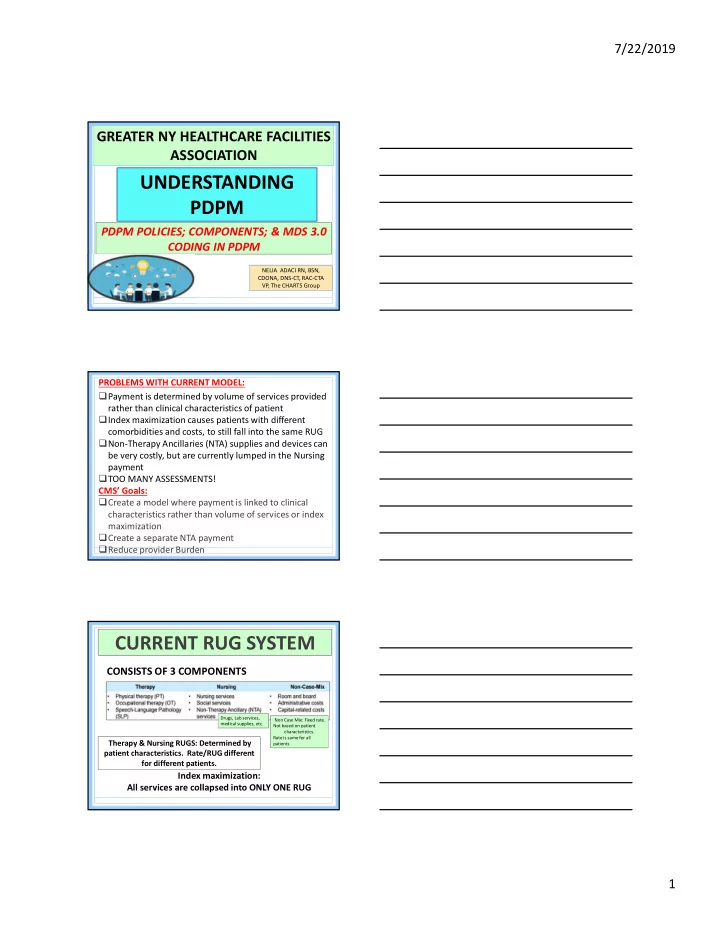
PROBLEMS WITH CURRENT MODEL: Payment is determined by volume of services provided rather than clinical characteristics of patient Index maximization causes patients with different comorbidities and costs, to still fall into the same RUG Non-Therapy Ancillaries (NTA) supplies and devices can be very costly, but are currently lumped in the Nursing payment TOO MANY ASSESSMENTS! CMS’ Goals: Create a model where payment is linked to clinical characteristics rather than volume of services or index maximization Create a separate NTA payment Reduce provider Burden

SNF QRP Provider Training | July/August2018 49

CURRENT RUG SYSTEM

CONSISTS OF 3 COMPONENTS

Therapy & Nursing RUGS: Determined by patient characteristics. Rate/RUG different for different patients.

Drugs, Lab services, medical supplies, etc. Non Case Mix: Fixed rate. Not based on patient characteristics. Rate is same for all patients

Index maximization: All services are collapsed into ONLY ONE RUG

slide-2
SLIDE 2

7/22/2019 2

RUG-IV vs. PDPM

 While RUG-IV (left) reduces everything about a patient to a single, typically volume-driven, case-mix group, PDPM (right) focuses on the unique, individualized needs, characteristics, and goals of each patient

4

PDPM Patient Classification

5

Under PDPM, each patient is classified into a group for each of the 5 case-mix adjusted components: PT, OT, SLP, NTA, and Nursing Each component utilizes different criteria as the basis for patient classification:

  • PT: Clinical Category, Functional Score
  • OT: Clinical Category, Functional Score
  • SLP: Presence of Acute Neurologic Condition, SLP-

related Comorbidity or Cognitive Impairment, Mechanically-altered Diet, Swallowing Disorder

  • NTA: NTA Comorbidity Score
  • Nursing: Same characteristics as under RUG-IV

PDPM COMPONENTS

6

PDPM consists of 5 Case-Mix Adjusted Components (all based on patient characteristics) and 1 Non Case Mix Rate:

  • 1. Physical Therapy (PT) = RUG Score
  • 2. Occupational Therapy (OT) = RUG Score
  • 3. Speech Language Pathology (SLP) = RUG Score
  • 4. Non-Therapy Ancillary (NTA) = RUG Score
  • 5. Nursing = RUG Score
  • 6. Non-Case-Mix Rate = FLAT RATE (No RUG Score)

PDPM also includes a “Variable Per Diem Adjustment” (VPDA) that adjusts the per diem rate over the course of the stay

slide-3
SLIDE 3

7/22/2019 3

PDPM SNAPSHOT

7

7/22/2019 IMPROVING LIVES BY DELIVERING SOLUTIONS FOR QUALITY CARE 8

Resident Classification Happens in 3 Stages

1. 2. 3.

SNF ADMISSION & ASSESSMENT  SNF Clinician Diagnoses  Admission MDS assessment timing and accuracy  MDS Coordinator codes based on MDS items & ICD-10 codes Hospital Discharges

 HOSPITAL RECORDS  Discharge information  Surgery information from hospital is new

PAYMENT CLASSIFICATION

 Case Mix Group (CMG) Assigned for each Component  Payment Characteristics for Component CMG DIFFER

PATIENT-DRIVEN PAYMENT MODEL

9

P D P M

*First 5 are based on patient characteristics. Patient gets 5 separate RUG categories instead of one.

slide-4
SLIDE 4

7/22/2019 4

PHYSICAL THERAPY & OCCUPATIONAL THERAPY COMPONENTS

10 11

PT AND OT COMPONENT CRITERIA

Components 1 & 2: PT & OT

16 RUG Categories Based on:

  • A. Clinical Category – Based on the following:

① Clinical Reason for the SNF Stay (Section I0020B) ② Recent Surgery Requiring Active SNF Care, if applicable (Section J2100; J2300-J5000)

  • B. Functional Score (SECTION GG)

Note: PT and OT components will always result in the same case-mix group but will have different case-mix indices and payment rates

12

PT AND OT: CLINICAL CATEGORY

  • A. CLINICAL CATEGORY

① Classify into a Clinical Category based on the “Primary Diagnosis for the SNF stay”  It is possible that the primary diagnosis for the SNF stay may be different from the primary diagnosis from the preceding hospital stay).  Choose the “REASON why the patient was admitted to the SNF for Post-Acute Care”

slide-5
SLIDE 5

7/22/2019 5

13

  • I0020B. NEW ITEM under PDPM: Resident’s

Primary Medical Condition Category

Item I0020B: Enter the code that represents the primary medical condition that resulted in the resident’s SNF

  • admission. Include the primary medical condition coded

in this item in Section I: Active Diagnoses in last 7 days.

FOR SNF QRP FOR PDPM $$$$$$$$$

14

NEW ITEM IN PDPM: I0020B. Indicate the

Primary Diagnosis for the SNF Stay “Primary Diagnosis for the SNF Stay” ICD-10-CM codes, coded on the MDS 3.0 in Item I0020B, are mapped to a PDPM clinical category. ICD-10 mapping available at: https://www.cms.gov/Medicare/Medicar e- Fee-for-Service- Payment/SNFPPS/PDPM.html

15

PDPM ICD-10-CM Mappings

No Data in this row Purpose ICD-10-CM related mappings for the purposes of resident classification under the proposed Patient-Driven Payment Model (PDPM) for Medicare Part A SNF stays. No Data in this row Table of Contents No Data in this row ICD-10-CM to Clinical Category Mapping Clinical Category Mapping of the ICD-10-CM Recorded in Item I0020B of the MDS Assessment to PDPM Clinical Categories SLP Comorbidity to ICD-10-CM Mapping SLP_Comorbidity Mapping of Comorbidities Included in the PDPM SLP Component to ICD-10-CM Codes NTA Comorbidity to ICD-10-CM Mapping NTA_Comorbidity Mapping of Comorbidities Included in the PDPM NTA Component to ICD-10-CM Codes No Data in this row Updates No Data in this row

  • 1. Revised the PDPM clinical category mapping so that all initial, subsequent

and sequela encounters for femur fractures are mapped to the default clinical category of "Non-Surgical Orthopedic/Musculoskeletal", and "May be Eligible for One of the Two Orthopedic Surgery Categories" as an alternative category if the resident had a major procedure during the prior inpatient stay that impacted the SNF care plan.

  • 2. Revised the PDPM clinical category mapping by assigning some codes

affected by the "code first" guideline to "Return to Provider" to align with ICD- 10-CM Official Guidelines for Coding and Reporting.

  • 3. Revised the PDPM clinical category mapping by adding 31 FY2019 ICD-10-

CM codes that were previous missing and deleting 2 retired codes.

  • 4. Revised the PDPM clinical category mapping by adding "May be Eligible for

One of the Two Orthopedic Surgery Categories" to Z47.82 and Z47.89 as an alternative category if the resident had a major spinal surgery during the prior inpatient stay that impacted the SNF care plan.

  • 5. Revised the PDPM SLP comorbidity to ICD-10-CM mapping by adding more

speech related sequelae of cerebrovascular disease.

slide-6
SLIDE 6

7/22/2019 6

16 M6259 Muscle wasting and atrophy, not elsewhere classified, multiple sites Non-Surgical Orthopedic/Musculoskeletal N/A M6281 Muscle weakness (generalized) Return to Provider N/A M6282 Rhabdomyolysis Non-Surgical Orthopedic/Musculoskeletal N/A M62830 Muscle spasm of back Return to Provider N/A M62831 Muscle spasm of calf Return to Provider N/A M62838 Other muscle spasm Return to Provider N/A

M62.81: MUSCLE WEAKNESS – RETURN TO PROVIDER

NA1

17

PT / OT CLINICAL CATEGORIES

② In order to capture surgical information which may be relevant to classifying the patient into a PDPM clinical category, CMS is adding new items in Section J of the MDS.  Items J2100 – J5000. These items are used to capture any major surgical procedures that occurred during the inpatient hospital stay that immediately preceded the SNF admission, i.e., the qualifying hospital stay. These items will be used, in conjunction with the diagnosis code captured in I0020B, to classify patients into the PT and OT case-mix classification groups for PDPM. Similar to the active diagnoses captured in Section I, these Section J items will be in the form of check-boxes.

18

Section J2100: NEW ITEM UNDER PDPM

Did the resident have a major surgical procedure during the prior inpatient hospital stay that requires active care during the SNF stay?

Complete only if 5-Day or IPA. If YES, proceed to J2300 – J5000

GATEWAY QUESTION

slide-7
SLIDE 7

Slide 16 NA1

Nelia Adaci, 6/9/2019

slide-8
SLIDE 8

7/22/2019 7

19

Section J2300 – J500:

(Used to determine PT & OT Clinical Category for specified ICD-10 Codes)

20

Section J2300 – J500: NEW ITEMS UNDER PDPM

SECTION J2300 – J5000

 * J2300, J2310, J2320, J2330, J2400, J2410, and J2420

can qualify for the Major Joint Replacement or Spinal Surgery primary diagnosis clinical category. ** J2500, J2510, J2520, and J2530 can qualify for the Orthopedic Surgery (Except Major Joint Replacement

  • r Spinal Surgery) primary diagnosis clinical category.

*** J2600, J2610, J2620, J2700, J2710, J2800, J2810, J2900, J2910, J2920, J2930, and J2940 can qualify for the Non-Orthopedic Surgery primary diagnosis clinical category.

21

slide-9
SLIDE 9

7/22/2019 8

22

Example: Patient has a Wedge Compression Fracture

  • f the 3rd Lumbar Vertebra, subsequent encounter for

fracture with routine healing

I0020B will be coded as S32.030D

1) If patient was treated in Prior Hospital Stay with Spinal Fusion Surgery and Coded in Section J, then patient will qualify under the Major Joint Replacement /Spinal Surgery” Category 2) If treated without surgery or if treated with Spinal Fusion Surgery but was NOT coded in MDS, then patient will qualify only under “Other Orthopedic” Category

EXAMPLE

PDPM Clinical Categories

23

10 PDPM CLINICAL CATEGORIES

Major Joint Replacement or Spinal Surgery Acute Infections Acute Neurologic Pulmonary Orthopedic Surgery (Except Major Joint Replacement or Spinal Surgery) Cardiovascular and Coagulations Non-Surgical Orthopedic/Musculoskeletal Cancer Non-Orthopedic Surgery Medical Management

PT & OT Clinical Categories

24

 Based on data showing similar costs among certain clinical categories, the PT & OT components use four collapsed clinical categories for patient classification. PDPM Clinical Categories 4 PT & OT Clinical Categories

Major Joint Replacement or Spinal Surgery

Major Joint Replacement or Spinal Surgery

Acute Neurologic

Non-Orthopedic Surgery & Acute Neurologic

Non-Orthopedic Surgery Non-Surgical Orthopedic/Musculoskeletal

Other Orthopedic

Orthopedic Surgery (Except Major Joint Replacement or Spinal Surgery) Medical Management

Medical Management

Cancer Pulmonary Cardiovascular & Coagulations Acute Infections

slide-10
SLIDE 10

7/22/2019 9

25

PT / OT CLINICAL CATEGORIES

All patient diagnoses have been cross-walked to

  • ne of FOUR PT/OT clinical categories:

CLINICAL CATEGORY

  • 1. MAJOR JOINT REPLACEMENT OR SPINAL

SURGERY

  • 2. OTHER ORTHOPEDIC
  • 3. MEDICAL MANAGEMENT
  • 4. NON ORTHOPEDIC SURGERY & ACUTE

NEUROLOGIC

26

Not “all diagnoses are considered valid primary diagnoses for the SNF stay.” Some diagnoses will NOT be mapped to one of the 4 Clinical categories and will be rejected. Invalid primary diagnoses are listed as “return to provider” in the ICD-10 Clinical Category Crosswalk. EXAMPLES OF INVALID PRIMARY DIAGNOSES:

  • C00.2 (Malignant Neoplasm of External Lip, unspecified)
  • I68.8 (Other Cerebrovascular Disorders in Diseases,

classified elsewhere)

  • S82.266D (Non-Displaced Segmental Fracture of Shaft of

Unspecified Tibia, Subsequent Encounter for Closed Fracture with Routine Healing)

REMINDERS

27

PT AND OT: FUNCTIONAL SCORES ② FUNCTIONAL SCORE: After getting classified in a Clinical Category, the patient is also classified into a PT and OT component group using the patient’s functional score Based on Section GG Item Scores: Includes Late Loss ADL’s and some Early Loss ADL’s

slide-11
SLIDE 11

7/22/2019 10

SELF-CARE ITEMS: 1) Self Care: EATING 2) Self Care ORAL HYGIENE 3) Self Care: TOILETING HYGIENE MOBILITY ITEMS: 4) BED MOBILITY - Sit to lying BED MOBILITY - Lying to sitting on side of bed 5) TRANSFER - Sit to stand TRANSFER - Chair/bed transfer TRANSFER - Toilet Transfer 6) AMBULATION - Walk 50 feet w/ 2 turns AMBULATION - Walk 150 feet

Section GG (FUNCTIONAL SCORE - PT & OT COMPONENTS)

GG0130: EATING

Eating: The ability to use suitable utensils to bring food and/or liquid to the mouth and swallow food and/or liquid

  • nce the meal is placed before the resident.
  • If the resident eats and drinks by mouth, and relies partially
  • n obtaining nutrition and liquids via tube feedings or TPN,

code Eating based on the amount of assistance the resident requires to eat and drink by mouth. Assistance with tube feedings or TPN is not considered when coding Eating.

  • If the resident eats finger foods using his or her hands, then

code Eating based upon the amount of assistance provided. If the resident eats finger foods with his or her hands independently, for example, the resident would be coded as 06, Independent.

GG0130: ORAL HYGIENE

Oral hygiene: The ability to use suitable items to clean teeth. Dentures (if applicable): The ability to insert and remove dentures into and from the mouth, and manage denture soaking and rinsing with use of equipment.

  • If a resident does not perform oral hygiene

during therapy, determine the resident’s abilities based on performance on the nursing care unit.

slide-12
SLIDE 12

7/22/2019 11

GG0130: TOILETING HYGIENE

Toileting hygiene: The ability to maintain perineal hygiene, adjust clothes before and after voiding or having a bowel movement. If managing an ostomy, include wiping the opening but not managing equipment..

  • Toileting hygiene includes managing

undergarments, clothing, and incontinence products and performing perineal cleansing before and after voiding or having a bowel movement.

  • If the resident does not usually use undergarments,

then assess the resident’s need for assistance to manage lower-body clothing and perineal hygiene.

GG0130: TOILETING HYGIENE

  • Toileting hygiene takes place before and after use
  • f the toilet, commode, bedpan, or urinal. If the

resident completes a bowel toileting program in bed, code Toileting hygiene based on the resident’s need for assistance in managing clothing and perineal cleansing.

  • If the resident has an indwelling urinary catheter

and has bowel movements, code the Toilet hygiene item based on the amount of assistance needed by the resident before and after moving his or her bowels.

GG0170: BED MOBILITY

Sit to Lying: The ability to move from sitting on side of bed to lying flat on the bed. Lying to Sitting on side of bed: The ability to move from lying on the back to sitting

  • n the side of the bed with feet flat on the

floor, and with no back support.

slide-13
SLIDE 13

7/22/2019 12

GG0170: TRANSFERS

Sit to Stand: The ability to come to a standing position from sitting in a chair, wheelchair, or on the side of the bed Chair/Bed-to-Chair Transfer: The ability to transfer to and from a bed to a chair (or wheelchair). Toilet Transfer: The ability to get on and

  • ff a toilet or commode.

GG0170: WALKING

Walk 50 feet with two turns: Once standing, the ability to walk at least 50 feet and make two turns. Walk 150 feet: Once standing, the ability to walk at least 150 feet in a corridor or similar space.

Section GG CODING  Section GG assesses the need for assistance with self-care and mobility activities  Must be a collaboration & integration between Therapy and Nursing!  Requires supporting documentation  Utilized not just for SNF-QRP’s but also for PDPM!!!

slide-14
SLIDE 14

7/22/2019 13

37

Section GG Coding

Overview of Coding Instructions: Admission Performance – code based on first 3 days of Medicare Part A stay (based on A2400B) Coding is based on “Usual Performance” – will require clinical judgment If activity occurs multiple times (e.g., eating, toileting, dressing, bed mobility activities, bed/chair transfers, do not code most dependent, do not code most independent. Some items may only be assessed once, code that

  • status. (e.g., car transfers, curbs, stairs).

38

Steps for Assessment: Assess the resident’s self-care performance based on direct observation, INCORPORATING resident’s self- report and reports from qualified clinicians, care staff, or family documented in the resident’s medical record during the three-day assessment period. CMS anticipates that an interdisciplinary team of qualified clinicians is involved in assessing the resident during the three-day assessment period.  QUALIFIED CLINICIAN: Healthcare professionals practicing within their scope of practice and consistent with Federal, State, and local law and regulations.

GG0130 and GG170: Review of Coding Instructions

39

.

GG0130 and GG170: Review of Coding Instructions

Information added to Steps for Assessment strengthening concept of collaboration to collect the resident’s self-performance in the items to be assessed during the 3-Day Assessment Period. Documentation in the medical record is used to support assessment coding of section GG

slide-15
SLIDE 15

7/22/2019 14

40

The admission functional assessment, when possible, should be conducted prior to the person benefitting from treatment interventions in order to determine a true baseline functional status on admission. If treatment has started, for example, on the day of admission, a baseline functional status assessment can still be conducted. Treatment should not be withheld in order to conduct the functional assessment.  Refer to facility, Federal, and State policies and procedures to determine which staff members may complete an assessment. Resident assessments are to be done in compliance with facility, Federal, and State requirements.

GG0130 and GG170: Review of Coding Instructions

41

Assessment Period Admission: The 5-Day PPS assessment (A0310B = 01) is the first Medicare-required assessment to be completed when the resident is admitted for a SNF Part A stay.

  • For the 5-Day PPS assessment, code the resident’s

functional status based on a clinical assessment of the resident’s performance that occurs soon after the resident’s admission.

  • This functional assessment must be completed within the

1st 3 calendar days of Medicare Part A stay, starting with the date in A2400B, Start of Most Recent Medicare Stay, & the following two days, ending at 11:59 PM on day 3.

  • The admission function scores are to reflect the resident’s

admission baseline status & are to be based on an assessment.

GG0130: Review of Coding Instructions

42

 To clarify your own understanding of the resident’s performance of an activity, ask probing questions to the care staff about the resident, beginning with the general and proceeding to the more specific.  Documentation in the medical record is used to support assessment coding of Section GG.  Data entered should be consistent with the clinical assessment documentation in the resident’s medical record.  This assessment can be conducted by appropriate healthcare personnel as defined by facility policy and in accordance with State and Federal regulations.

GG0130 and GG170: Review of Coding Instructions

slide-16
SLIDE 16

7/22/2019 15 GG0130 & GG170: Review of Coding Instructions

Code the resident’s usual performance for each activity using the six - point scale: Code “06” for Independent Code “05” for Setup or clean - up assistance Code “04” for Verbal Cues, Supervision or Touching/Steadying Assistance, CGA Code “03” for Partial/moderate assistance Code “02” for Substantial/maximal assistance Code “01” for Dependent or the assistance of two or more helpers to complete the activity. GG0130 & GG0170: Review of Coding Instructions

Code “07”, If Resident refused Code “09” If Not applicable: If the activity was not attempted & the resident did not perform this activity prior to the current illness, exacerbation, or injury. Code “10”, Not attempted due to environmental

  • limitations. Examples include lack of equipment and

weather constraints. Code “88”, Not attempted due to medical condition or safety concerns: if the activity was not attempted due to medical condition or safety concerns.

45

PT / OT CLINICAL CATEGORIES

Section GG items Score GG0130A1 Self-care: Eating 0–4 GG0130B1 Self-care: Oral hygiene 0–4 GG0130C1 Self-care: Toileting hygiene 0–4 GG0170B1 Mobility: Sit to lying 0–4 (avg. of 2 bed mobility items) GG0170C1 Mobility: Lying to sitting on side

  • f bed

GG0170D1 Mobility: Sit to stand 0–4 (avg. of 3 transfer items) GG0170E1 Mobility: Chair/bed-to- chair transfer GG0170F1 Mobility: Toilet transfer GG0170J1 Mobility: Walk 50 feet with 2 turns 0–4 (avg. of 2 walking items) GG0170K1 Mobility: Walk 150 feet

Scoring Response for Section GG Items Score 05, 06 Set-up assistance, independent 4 04 Supervision or touching assistance 3 03 Partial/moderate assistance 2 02 Substantial/maximal assistance 1 01, 07, 09, 88 Dependent, refused, not attempted

FUNCTIONAL SCORE

slide-17
SLIDE 17

7/22/2019 16

PT & OT Functional Score: GG Items

46

Section GG items included in the PT & OT FunctionalScore

Section GG Item Functional Score Range

GG0130A1 – Self-care:Eating 0 – 4 GG0130B1 – Self-care: Oral Hygiene 0 – 4 GG0130C1 – Self-care: Toileting Hygiene 0 – 4 GG0170B1 – Mobility: Sit to Lying 0 – 4 (average of 2 items) GG0170C1 – Mobility: Lying to Sitting on side of bed GG0170D1 – Mobility: Sit to Stand 0 – 4 (average of 3 items) GG0170E1 – Mobility: Chair/bed-to-chair transfer GG0170F1 – Mobility: Toilet Transfer GG0170J1 – Mobility: Walk 50 feet with 2 turns 0 – 4 (average of 2 items) GG0170K1 – Mobility: Walk 150 feet

47

RUG-IV & PDPM Function Score Differences

Notable differences between G & GG scoring methodologies: Reverse Scoring Methodology:

  • Under Section G, increasing score means increasing

dependence

  • Under Section GG, increasing score means increasing

independence Non-linear Relationship to Payment:

  • Under RUG-IV, increasing dependence, within a given

RUG category, translates to higher payment

  • Under PDPM, there is not a direct relationship between

increasing dependence and increasing payment

PT & OT Component: Payment for 3 Clinical Categories is lower for the most & least dependent patients (who are less likely to require high therapy amounts of therapy), compared to those in between (who are more likely to require high amounts of therapy)

48

PT & OT Components: Payment Groups

Clinical Category PT & OT Function Score PT & OT Case Mix Group PT CMI OT CMI Major Joint Replacement or Spinal Surgery 0-5 TA 1.53 1.49 Major Joint Replacement or Spinal Surgery 6-9 TB 1.69 1.63 Major Joint Replacement or Spinal Surgery 10-23 TC 1.88 1.68 Major Joint Replacement or Spinal Surgery 24 TD 1.92 1.53 Other Orthopedic 0-5 TE 1.42 1.41 Other Orthopedic 6-9 TF 1.61 1.59 Other Orthopedic 10-23 TG 1.67 1.64 Other Orthopedic 24 TH 1.16 1.15 Medical Management 0-5 TI 1.13 1.17 Medical Management 6-9 TJ 1.42 1.44 Medical Management 10-23 TK 1.52 1.54 Medical Management 24 TL 1.09 1.11 Non-Orthopedic Surgery and Acute Neurologic 0-5 TM 1.27 1.30 Non-Orthopedic Surgery and Acute Neurologic 6-9 TN 1.48 1.49 Non-Orthopedic Surgery and Acute Neurologic 10-23 TO 1.55 1.55 Non-Orthopedic Surgery and Acute Neurologic 24 TP 1.08 1.09

slide-18
SLIDE 18

7/22/2019 17

49

FY 2020 PROPOSED RULE: BRONX, KINGS, NY, QUEENS, RICHMOND, WESTCHESTER WAGE INDEX = 1.2639

SPEECH LANGUAGE PATHOLOGY THERAPY COMPONENT

50 51

SLP Component

For the SLP component, PDPM uses a number of different patient characteristics that were predictive

  • f increased SLP costs:

STEP 1: a) Acute Neurologic Clinical Classification b) Certain SLP-related Comorbidities c) Presence of Cognitive Impairment STEP 2: a) Use of a Mechanically-Altered Diet b) Presence of Swallowing Disorder

slide-19
SLIDE 19

7/22/2019 18

52

  • 1. (a) SLP Component: I0020B

Examples:  D33.4: Benign neoplasm of spinal cord  G61.0: Guillain-Barre syndrome  G80.4: Ataxic Cerebral Palsy  I69.151Hemiplegia following non-traumatic intracerebral hemorrhage affecting right dominant side  I69.120 Aphasia following non-traumatic intracerebral hemorrhage Clinical Category will be determined from I0020B (Acute Neurologic)

53

 The item will ask “What is the main reason this person is being admitted to the SNF?”  Item I0020B will be coded when Item I0020 is coded as any response 1 – 13.

  • I0020B. Indicate the Primary Diagnosis for the SNF

Stay: Triggers SLP Component if ACUTE NEUROLOGIC ICD-10-CM CODE is coded

54

PDPM ICD-10-CM Mappings

No Data in this row Purpose ICD-10-CM related mappings for the purposes of resident classification under the proposed Patient-Driven Payment Model (PDPM) for Medicare Part A SNF stays. No Data in this row Table of Contents No Data in this row ICD-10-CM to Clinical Category Mapping Clinical Category Mapping of the ICD-10-CM Recorded in Item I0020B of the MDS Assessment to PDPM Clinical Categories SLP Comorbidity to ICD-10-CM Mapping SLP_Comorbidity Mapping of Comorbidities Included in the PDPM SLP Component to ICD-10-CM Codes NTA Comorbidity to ICD-10-CM Mapping NTA_Comorbidity Mapping of Comorbidities Included in the PDPM NTA Component to ICD-10-CM Codes No Data in this row Updates No Data in this row

  • 1. Revised the PDPM clinical category mapping so that all initial, subsequent

and sequela encounters for femur fractures are mapped to the default clinical category of "Non-Surgical Orthopedic/Musculoskeletal", and "May be Eligible for One of the Two Orthopedic Surgery Categories" as an alternative category if the resident had a major procedure during the prior inpatient stay that impacted the SNF care plan.

  • 2. Revised the PDPM clinical category mapping by assigning some codes

affected by the "code first" guideline to "Return to Provider" to align with ICD- 10-CM Official Guidelines for Coding and Reporting.

  • 3. Revised the PDPM clinical category mapping by adding 31 FY2019 ICD-10-

CM codes that were previous missing and deleting 2 retired codes.

  • 4. Revised the PDPM clinical category mapping by adding "May be Eligible for

One of the Two Orthopedic Surgery Categories" to Z47.82 and Z47.89 as an alternative category if the resident had a major spinal surgery during the prior inpatient stay that impacted the SNF care plan.

  • 5. Revised the PDPM SLP comorbidity to ICD-10-CM mapping by adding more

speech related sequelae of cerebrovascular disease.

slide-20
SLIDE 20

7/22/2019 19

55

  • 1. (b) SLP Comorbidities

 Predictive of higher SLP costs; Conditions & services combined into a single SLP-related comorbidity flag  Patient qualifies if any of the conditions/services is present SLP COMORBIDITIES Aphasia Laryngeal Cancer* CVA,TIA, or Stroke Apraxia* Hemiplegia or Hemiparesis Dysphagia* Traumatic Brain Injury ALS* Tracheostomy (while Resident) Oral Cancers* Ventilator (while Resident) Speech & Language Deficits*

*ICD-10-CM CODE Required to Map

56

SLP CO-MORBIDITY ICD-10-CM MAPPING

57

  • 1. (c) PDPM Cognitive Scoring

Under PDPM, a patient’s cognitive status is assessed in exactly the same way as under RUG-IV (i.e., via the BIMS or Staff Assessment) Scoring the patient’s cognitive status, for purposes of classification, is based on the Cognitive Function Scale (CFS), which is able to provide consistent scoring across the BIMS and staff assessment

slide-21
SLIDE 21

7/22/2019 20

58 59

Review whether BIMS Summary Score item (C0500), is coded 99, unable to complete interview. Coding Instructions: Code 0, No: if the BIMS was completed and scored between 00 and 15. Skip to C1310. Code 1, Yes: if the resident chooses not to participate in the BIMS

  • r if four or more items were coded 0 because the resident chose not

to answer or gave a nonsensical response. Continue to C0700-C1000 and perform the Staff Assessment for Mental Status. Note: C0500 should be coded 99. If a resident is scored 00 on C0500, C0700-C1000, Staff Assessment, should not be completed. 00 is a legitimate value for C0500 & indicates that the interview was complete. To have an incomplete interview, a resident had to choose not to answer or had to give completely unrelated, nonsensical responses to 4 or more BIMS items.

60

C0700: SHORT-TERM MEMORY (Will affect SLP-Cognition)

slide-22
SLIDE 22

7/22/2019 21

61

C1000: COGNITIVE SKILLS FOR DAILY DECISION-MAKING (Will affect SLP-Cognition)

62

B0700: Makes Self Understood (Will affect SLP- Cognition)

MAKES SELF UNDERSTOOD Able to express or communicate requests, needs, opinions, and to conduct social conversation in his or her primary language, whether in speech, writing, sign language, gestures, or a combination of these. Deficits in the ability to make one’s self understood (expressive communication deficits) can include reduced voice volume and difficulty in producing sounds, or difficulty in finding the right word, making sentences, writing, and/or gesturing.

63

PDPM Cognitive Scoring

Because a PDPM cognitive level is utilized in the speech language pathology (SLP) payment component of PDPM, assessment of resident cognition with the BIMS or Staff Assessment for Mental Status is a requirement for all PPS assessments. As such, only in the case of PPS assessments, staff may complete the Staff Assessment for Mental Status for an interviewable resident when the resident is unexpectedly discharged from a Part A stay prior to the completion of the BIMS. In this case, the assessor should enter 0, No in C0100: Should Brief Interview for Mental Status Be Conducted? and proceed to the Staff Assessment for Mental Status. (RAI 2019, C- 2)

slide-23
SLIDE 23

7/22/2019 22

64

PDPM Cognitive Score: Methodology

PDPM Cognitive Measure Classification Methodology

Cognitive Level BIMS Score CPS Score Cognitively Intact 13 – 15 Mildly Impaired 8 – 12 1 – 2 Moderately Impaired 0 – 7 3 – 4 Severely Impaired

  • 5 – 6

65

  • 2. (a) MECHANICALLY ALTERED DIET:

K0510C

66

K0510: Nutritional Approaches

MECHANICALLY ALTERED DIET A diet specifically prepared to alter the texture or consistency of food to facilitate

  • ral intake. Examples include soft solids,

puréed foods, ground meat, and thickened

  • liquids. A mechanically altered diet should

not automatically be considered a therapeutic diet.

slide-24
SLIDE 24

7/22/2019 23

67

  • 2. (b) K0100: SWALLOWING

DISORDER

K0100: SWALLOWING DISORDER

Assess for signs and symptoms that suggest a swallowing disorder that has NOT been successfully treated or managed with diet modifications or other interventions (e.g., tube feeding, double swallow, turning head to swallow, etc.) and therefore represents a functional problem for the resident.

K0100: SWALLOWING DISORDER

 When necessary, the resident should be evaluated by the physician, speech language pathologist and/or occupational therapist to assess for any need for swallowing therapy and/or to provide recommendations regarding the consistency of food and liquids.  Care plan should be developed to assist resident to maintain safe and effective swallow using compensatory techniques, alteration in diet consistency, and positioning during and following meals.

slide-25
SLIDE 25

7/22/2019 24

K0100: SWALLOWING DISORDER

CODING INSTRUCTIONS: Do not code a swallowing problem when interventions have been successful in treating the problem and therefore the signs/symptoms of the problem (K0100A through K0100D) did not occur during the 7- day look-back period.

71

SLP Component: Payment Groups

Presence of Acute Neurologic Condition, SLP Related Comorbidity, or Cognitive Impairment Mechanically Altered Diet or Swallowing Disorder SLP Case Mix Group SLP Case Mix Index None Neither SA 0.68 None Either SB 1.82 None Both SC 2.66 Any one Neither SD 1.46 Any one Either SE 2.33 Any one Both SF 2.97 Any two Neither SG 2.04 Any two Either SH 2.85 Any two Both SI 3.51 All three Neither SJ 2.98 All three Either SK 3.69 All three Both SL 4.19

72

FY 2020 PROPOSED RULE: BRONX, KINGS, NY, QUEENS, RICHMOND, WESTCHESTER

WAGE INDEX = 1.2639

slide-26
SLIDE 26

7/22/2019 25

NURSING COMPONENT

73 74

Nursing Component

PDPM utilizes the same basic nursing classification structure as RUG-IV, with certain modifications.

  • Function score based on Section GG
  • f the MDS 3.0
  • Collapsed functional groups, reducing

the number of nursing groups from 43 to 25

75

NURSING CASE MIX CATEGORY

FUNCTIONAL SCORE

Section GG items Score GG0130A1 Self-care: Eating 0–4 GG0130C1 Self-care: Toileting hygiene 0–4 GG0170B1 Mobility: Sit to lying 0–4 (avg. of 2 bed mobility items) GG0170C1 Mobility: Lying to sitting on side of bed GG0170D1 Mobility: Sit to stand 0–4 (avg. of 3 transfer items) GG0170E1 Mobility: Chair/bed- to- chair transfer GG0170F1 Mobility: Toilet transfer Scoring Response for Section GG Items Score 05, 06 Set-up assistance, independent 4 04 Supervision or touchingassistance 3 03 Partial/moderate assistance 2 02 Substantial/maximal assistance 1 01, 07, 09, 88 Dependent, refused, not attempted

slide-27
SLIDE 27

7/22/2019 26

Nursing Functional Score: GG Items

76

Section GG items included in the Nursing functional score

Section GG Item Functional Score Range

GG0130A1 – Self-care:Eating 0 – 4 GG0130C1 – Self-care: Toileting Hygiene 0 – 4 GG0170B1 – Mobility: Sit to Lying 0 – 4 (average of 2 items) GG0170C1 – Mobility: Lying to Sitting on side of bed GG0170D1 – Mobility: Sit to Stand 0 – 4 (average of 3 items) GG0170E1 – Mobility: Chair/bed-to-chair transfer GG0170F1 – Mobility: Toilet Transfer

77

Nursing Component

78

NURSING COMPONENT EXTENSIVE SERVICES SPECIAL CARE HIGH SPECIAL CARE LOW CLINICALLY COMPLEX

slide-28
SLIDE 28

7/22/2019 27

79

EXTENSIVE SERVICES

* WHILE A RESIDENT

80

 B0100, GG ITEMS: Comatose and completely dependent or activity did not occur at admission  I2100: Septicemia  J2900, N0350A, B: Diabetes with both of the following:

  • Insulin injections (N0350A) for all 7 days
  • Insulin order changes on 2 or more days

(N0350B)  I5100, NURSING FUNCTION SCORE: Quadriplegia with Nursing Function Score <= 11  I6200, J1100C: Chronic Obstructive Pulmonary Disease and Shortness of Breath when lying flat

SPECIAL CARE HIGH

81

 J1550A, others: Fever and one of the following;

  • I2000 Pneumonia
  • J1550B Vomiting
  • K0300 Weight loss (1 or 2)
  • K0510B1 or K0510B2: Feeding tube*

 K0510A1 or K0510A2: Parenteral/IV feedings  O0400D2: Respiratory therapy for all 7 days

*Tube feeding classification requirements: (1) K0710A3 is 51% or more of total calories OR (2) K0710A3 is 26% to 50% of total calories and K0710B3 is 501 cc or more per day fluid enteral intake in the last 7 days.

SPECIAL CARE HIGH

slide-29
SLIDE 29

7/22/2019 28

82

 I4400, Nursing Function Score: Cerebral palsy, with Nursing Function Score <=11  I5200, Nursing Function Score: Multiple sclerosis, with Nursing Function Score <=11  I5300, Nursing Function Score: Parkinson’s disease, with Nursing Function Score <=11  I6300, O0100C2: Respiratory failure and oxygen therapy while a patient  K0510B1 or K0510B2 Feeding tube*  M0300B1 Two or more stage 2 pressure ulcers with two or more selected skin treatments**  M0300C1, D1, F1 Any stage 3 or 4 pressure ulcer with two or more selected skin treatments**

SPECIAL CARE LOW

83

 M1030 Two or more venous/arterial ulcers with two or more selected skin treatments**  M0300B1, M1030 1 stage 2 pressure ulcer and 1 venous/arterial ulcer with 2 or more selected skin treatments**  M1040A, B, C; M1200I Foot infection, diabetic foot ulcer or other open lesion of foot with application of dressings to the feet  O0100B2 Radiation treatment while a patient  O0100J2 Dialysis treatment while a patient

SPECIAL CARE LOW

84

*Tube feeding classification requirements: (1) K0710A3 is 51% or more of total calories OR (2) K0710A3 is 26% to 50% of total calories & K0710B3 is 501 cc or more per day fluid enteral intake in the last 7 days. **Selected skin treatments:  M1200A, B Pressure relieving chair and/or bed  M1200CTurning/repositioning  M1200D Nutrition or hydration intervention  M1200E Pressure ulcer care  M1200G Application of dressings (not to feet)  M1200H Application of ointments (not to feet)

SPECIAL CARE LOW

slide-30
SLIDE 30

7/22/2019 29

85

CLINICALLY COMPLEX

*Selected Skin Treatments: M1200F Surgical wound care, M1200G Application of nonsurgical dressing (other than to feet), M1200H Application of ointments/medications (other than to feet)

MOOD INDICATORS

(NURSING COMPONENT DEPRESSION END-SPLIT FOR SPECIAL CARE HIGH SPECIAL CARE LOW CLINICALLY COMPLEX)

86

SECTION D

Intent: The items in this section address mood distress, a serious condition that is underdiagnosed and undertreated in the nursing home and is associated with significant morbidity. It is particularly important to identify signs and symptoms of mood distress among nursing home residents because these signs and symptoms can be treatable. It is important to note that coding the presence of indicators in Section D does not automatically mean that the resident has a diagnosis of depression or other mood disorder. Assessors do not make or assign a diagnosis in Section D; they simply record the presence or absence of specific clinical mood

  • indicators. Facility staff should recognize these indicators and

consider them when developing the resident’s individualized care plan.

slide-31
SLIDE 31

7/22/2019 30

88

Section D: MOOD (NURSING DEPRESSION END- SPLIT FOR CLINICALLY COMPLEX; SPECIAL CARE HIGH & SPECIAL CARE LOW) The resident mood interview is attempted with all residents, using either the PHQ-9 or the staff assessment, PHQ-9-OV. If the resident seems unable to communicate,

  • ffer alternatives, such as writing, pointing,

sign language, or cue cards. Utilizing the techniques in Appendix D of the RAI User’s Manual as well as cue cards will enhance the resident interview.

89 90

Coding Instructions for Column 1 Symptom Presence Code 0, no: if resident indicates symptoms listed are not present enter 0. Enter 0 in Column 2 as well. Code 1, yes: if resident indicates symptoms listed are present enter 1. Enter 0, 1, 2, or 3 in Column 2, Symptom Frequency. Code 9, no response: if the resident was unable or chose not to complete the assessment, responded nonsensically and/or the facility was unable to complete the

  • assessment. Leave Column 2, Symptom

Frequency, blank.

slide-32
SLIDE 32

7/22/2019 31

91

Coding Instructions for Column 2. Symptom Frequency Record the resident’s responses as they are stated, regardless of whether the resident or the assessor attributes the symptom to something other than mood. Further evaluation of the clinical relevance of reported symptoms should be explored by the responsible clinician. Code 0, never or 1 day: if the resident indicates that he or she has never or has only experienced the symptom on 1 day. Code 1, 2-6 days (several days): if the resident indicates that he or she has experienced the symptom for 2-6 days. Code 2, 7-11 days (half or more of the days): if the resident indicates that he or she has experienced the symptom for 7-11 days. Code 3, 12-14 days (nearly every day): if the resident indicates that he or she has experienced the symptom for 12- 14 days.

92

D0300: TOTAL SEVERITY SCORE

TOTAL SEVERITY SCORE A summary of the frequency scores that indicates the extent of potential depression symptoms. The score does not diagnose a mood disorder, but provides a standard of communication with clinicians and mental health specialists. After completing D0200 A-I:

  • 1. Add the numeric scores across all frequency items in Resident

Mood Interview (D0200) Column 2.

  • 2. The maximum resident score is 27 (3 x 9).

A SCORE OF 10 OR MORE WILL INCREASE THE NURSING COMPONENT CMI SCORE IF RUG SCORE IS CLINICALLY COMPLEX, SPECIAL CARE HIGH OR SPECIAL CARE LOW.

93

slide-33
SLIDE 33

7/22/2019 32

94

D0600: TOTAL SEVERITY SCORE

TOTAL SEVERITY SCORE After completing items D0500 A-J:

  • 1. Add the numeric scores across all frequency items for Staff

Assessment of Mood, Symptom Frequency (D0500) Column 2.

  • 2. Maximum score is 30 (3 × 10).

A SCORE OF 10 OR MORE WILL INCREASE THE NURSING COMPONENT CMI SCORE IF RUG SCORE IS CLINICALLY COMPLEX, SPECIAL CARE HIGH OR SPECIAL CARE LOW. *STAFF ASSESSMENT REQUIRES DOCUMENTATION DURING THE 14- DAY LOOK BACK PERIOD. (FREQUENCY OF OCCURRENCES)

95

Section D: MOOD

Resident Interview (PHQ-9): Items D02002A through D02002I Requires no further documentation RESIDENT responses on the MDS Item Set will be accepted as “Stand Alone” documentation. Must be completed on or before the ARD during the look back period. Staff Interview (PHQ-9-OV) Items D05002A through J *Supporting Documentation Required*

96

NURSING COMPONENT IMPAIRED COGNITION BEHAVIORS PHYSICAL REDUCED

slide-34
SLIDE 34

7/22/2019 33

97

IMPAIRED COGNITION: SECTION C; B

IMPAIRED COGNITION: BIMS < THAN 9 IF STAFF ASSESSMENT, CPS > 3:

  • 1. B0100 Coma (B0100 = 1) & Completely ADL Dependent or ADL

did not occur

  • 2. C1000 Severely Impaired Cognitive Skills (C1000 = 3)

3. B0700, C0700, C1000: Two or more of the following impairment indicators are present: B0700 > 0: Problem being understood C0700 = 1: Short-term memory problem C1000 > 0: Cognitive Skills Problem and 1 or more of the ff. severe impairment indicators are present:

  • B0700 >= 2: Severe problem being understood
  • C1000 >= 2: Severe cognitive skills problem

98

Section E: BEHAVIOR (NURSING COMPONENT – BEHAVIOR/COGNITION QUALIFIER)

Presence of Behavior(s): Need Documentation during the Look Back period to support Coding: E0100A Hallucinations E0100B Delusions Presence and Frequency of Behavior(s): Need Daily Documentation during the Look Back period to support Coding: E0200A Physical Behaviors E0200B Verbal Behaviors E0200C Other Behaviors E0800 Rejection of Care E0900 Wandering

99

REDUCED PHYSICAL FUNCTION

Patients who do not meet the conditions of any of the previous categories, including those who would meet the criteria for the Behavioral Symptoms and Cognitive Performance category but have a PDPM Nursing Function Score less than 11, are placed in this category.

slide-35
SLIDE 35

7/22/2019 34 RESTORATIVE NURSING PROGRAMS

(NURSING COMPONENT END-SPLIT FOR BEHAVIORS, IMPAIRED COGNITION AND REDUCED PHYSICAL)

100 101

RESTORATIVE NURSING MODALITIES

 Urinary Toileting Program or Bowel Toileting Program  Passive ROM  Active ROM  Splint or Brace Assistance  Bed Mobility*  Transfer  Walking*  Dressing or grooming  Eating and swallowing  Amputation/Prosthesis Care  Communication ***Bed Mobility and walking are considered one program and minutes cannot be split between them. Section H0200C: URINARY TOILETING PROGRAM (NURSING RESTORATIVE END-SPLIT)

1.Review medical record for evidence of a toileting program being used to manage incontinence during the 7-day look-back period. Note the # of days during the look-back period that the toileting program was implemented or carried out. 2.Documentation in medical record MUST SHOW 3 requirements:  Implemented an individualized, resident-specific toileting program – based on an assessment of resident’s unique voiding pattern;  Evidence that the individualized program was communicated to staff & resident verbally and through a care plan, flow records, and a written report;  Notations of the resident’s response to the toileting program and subsequent evaluations, as needed.

slide-36
SLIDE 36

7/22/2019 35

Section H0500: BOWEL TOILETING PROGRAM (NURSING RESTORATIVE END-SPLIT)

  • 1. Review the medical record for evidence of a bowel toileting

program being used to manage bowel incontinence during the 7-day look-back period.

  • 2. Must meet 3 requirements in medical records/documentation:

 Implementation of an individualized, resident-specific bowel toileting program based on an assessment of the resident’s unique bowel pattern;  Evidence that the individualized program was communicated to staff and the resident (as appropriate) verbally and through a care plan, flow records, verbal and a written report; and  Notations of the resident’s response to the toileting program and subsequent evaluations, as needed.

104

Section O0500: RESTORATIVE NURSING

(Affects Nursing Restorative End-Split for Impaired Cognition/Behaviors & Physical Reduced)

105

Section O0500: RESTORATIVE NURSING Steps for Assessment

  • 1. Review the restorative nursing program notes

and/or flow sheets in the medical record.

  • 2. For the 7-day look-back period, enter the

number of days on which the technique, training or skill practice was performed for a total of at least 15 minutes during the 24-hour period. (Must be provided for 15 or more minutes a day for 6 or more of the last 7 days)

  • 3. The following criteria for restorative nursing

programs must be met in order to code O0500:

slide-37
SLIDE 37

7/22/2019 36

106

Section O0500: RESTORATIVE NURSING

a) Measurable objectives and interventions must be documented in the care plan and in the medical record. If a restorative nursing program is in place when a care plan is being revised, it is appropriate to reassess progress, goals, and duration/frequency as part of the care planning process. b) Evidence of periodic evaluation by the licensed nurse must be present in the resident’s medical record. When not contraindicated by state practice act provisions, a progress note written by the restorative aide and countersigned by a licensed nurse is sufficient to document the restorative nursing program once the purpose and objectives of treatment have been established.

107

Section O0500: RESTORATIVE NURSING

c) Nursing assistants/aides must be trained in the techniques that promote resident involvement in the activity. d) A registered nurse or a licensed practical (vocational) nurse must supervise the activities in a restorative nursing program. Sometimes, under licensed nurse supervision, other staff and volunteers will be assigned to work with specific residents. Restorative nursing does not require a physician’s order. Nursing homes may elect to have licensed rehabilitation professionals perform repetitive exercises and other maintenance treatments or to supervise aides performing these maintenance services.

108

Section O0500: RESTORATIVE NURSING

In situations where such services do not actually require the involvement of a qualified therapist, the services may not be coded as therapy in item O0400, Therapies, because the specific interventions are considered restorative nursing services (see item O0400, Therapies). The therapist’s time actually providing the maintenance service can be included when counting restorative nursing

  • minutes. Although therapists may participate, members
  • f the nursing staff are still responsible for overall

coordination and supervision of restorative nursing programs. e) This category does not include groups with more than four residents per supervising helper or caregiver.

slide-38
SLIDE 38

7/22/2019 37

109

NURSING COMPONENT POINTS OR END-SPLITS

ADL SCORE NURSING CASE MIX GROUP CMI EXTENSIVE

TRACHEOSTOMY & VENTILATOR (3) 0-14 ES3 4.04

SERVICES

TRACHEOSTOMY OR VENTILATOR (2) 0-14 ES2 3.06 INFECTION ISOLATION (1) 0-14 ES1 2.91 DEPRESSED (2) 0-5 HDE2 2.39 SPECIAL CARE DEPRESSED (2) 6-14 HBC2 2.23 HIGH NOT DEPRESSED (1) 0-5 HDE1 1.99 NOT DEPRESSED (1) 6-14 HBC1 1.85 DEPRESSED (2) 0-5 LDE2 2.07 SPECIAL CARE DEPRESSED (2) 6-14 LBC2 1.71 LOW NOT DEPRESSED (1) 0-5 LDE1 1.72 NOT DEPRESSED (1) 6-14 LBC1 1.43

NURSING CASE MIX CATEGORIES

110

NURSING COMPONENT POINTS OR END-SPLITS

ADL SCORE NURSING CASE MIX GROUP CMI

DEPRESSED (2) 0-5 CDE2 1.86

CLINICALLY

DEPRESSED (2) 6-14 CBC2 1.54

COMPLEX

DEPRESSED (2) 15-16 CA2 1.08 NOT DEPRESSED (1) 0-5 CDE1 1.62 NOT DEPRESSED (1) 6-14 CBC1 1.34 NOT DEPRESSED (1) 15-16 CA1 0.94

BEHAVIOR SYMPTOMS

NURSING REHAB (2) 11-16 BAB2 1.04

COGNITION

NO NURSING REHAB (1) 11-16 BAB1 0.99 NURSING REHAB (2) 0-5 PDE2 1.57

REDUCED

NURSING REHAB (2) 6-14 PBC2 1.21

PHYSICAL

NURSING REHAB (2) 15-16 PA2 0.70

FUNCTION

NO NURSING REHAB (1) 0-5 PDE1 1.47 NO NURSING REHAB (1) 6-14 PBC1 1.13 NO NURSING REHAB (1) 15-16 PA1 0.66

111

FY 2020 PROPOSED RULE: BRONX, KINGS, NY, QUEENS, RICHMOND, WESTCHESTER WAGE INDEX = 1.2639

slide-39
SLIDE 39

7/22/2019 38

112

FY 2020 PROPOSED RULE: BRONX, KINGS, NY, QUEENS, RICHMOND, WESTCHESTER WAGE INDEX = 1.2639

NON-THERAPY ANCILLARY COMPONENT

113

NTA – Non Therapy Ancillary

6 RUG Categories Based on:

  • Diagnoses, conditions, and services, etc.

CMS has a list of conditions and assigned points to each condition (see list) Patients get points for each condition they have The higher the points, the higher the CMI, and the higher the rate

114

slide-40
SLIDE 40

7/22/2019 39

  • A. Based on certain comorbidities or use of certain

extensive services: 50 categories; multiple codes within each category, except HIV/AIDS

  • B. Higher-point value = higher-cost to treat

8 - 1 Condition/Service (HIV/AIDS) 7 - 1 Condition/Service 6 - 0 Condition/Service 5 - 1 Condition/Service 4 - 1 Condition/Service 3 - 2 Condition/Service 2 - 9 Condition/Service 1 - 35 Condition/Service

NTA COMPONENT

116

NTA Component: Comorbidity Coding

 Comorbidities and extensive services for NTA classification are derived from a variety of MDS sources, with some comorbidities identified by ICD- 10-CM codes reported in Item I8000  A mapping between ICD-10-CM codes and NTA comorbidities used for NTA classification is available on the CMS website at: https://www.cms.gov/Medicare/Medicare- Fee-for-Service- Payment/SNFPPS/PDPM.html  One comorbidity (HIV/AIDS) is reported on the SNF claim, in the same manner as under RUG-IV

  • The patient’s NTA classification will be adjusted by the

appropriate number of points for this condition by the CMS PRICER for patients with HIV/AIDS

117

NTA Component: Condition Listing (1)

Condition/Extensive Service Source Points HIV/AIDS SNF Claim 8 Parenteral IV Feeding: Level High MDS Item K0510A2, K0710A2 7 Special Treatments/Programs: Intravenous Medication Post- admit Code MDS Item O0100H2 5 Special Treatments/Programs: Ventilator or Respirator Post- admit Code MDS Item O0100F2 4 Parenteral IV feeding: Level Low MDS Item K0510A2, K0710A2, K0710B2 3 Lung Transplant Status MDS Item I8000 3 Special Treatments/Programs: Transfusion Post-admit Code MDS Item O0100I2 2 Major Organ Transplant Status, Except Lung MDS Item I8000 2 Multiple Sclerosis Code MDS Item I5200 2 Opportunistic Infections MDS Item I8000 2 Asthma COPD Chronic Lung Disease Code MDS Item I6200 2 Bone/Joint/Muscle Infections/Necrosis - Except Aseptic Necrosis of Bone MDS Item I8000 2 Chronic Myeloid Leukemia MDS Item I8000 2 Wound Infection Code MDS Item I2500 2 Diabetes Mellitus (DM) Code MDS Item I2900 2

slide-41
SLIDE 41

7/22/2019 40

118

NTA Component: Condition Listing (2)

Condition/Extensive Service Source Points

Endocarditis MDS Item I8000 1 Immune Disorders MDS Item I8000 1 End-Stage Liver Disease MDS Item I8000 1 Other Foot Skin Problems: Diabetic Foot Ulcer Code MDS Item M1040B 1 Narcolepsy and Cataplexy MDS Item I8000 1 Cystic Fibrosis MDS Item I8000 1 Special Treatments/Programs: Tracheostomy Care Post- admit Code MDS Item O0100E2 1 Multi-Drug Resistant Organism (MDRO) Code MDS Item I1700 1 Special Treatments/Programs: Isolation Post-admit Code MDS Item O0100M2 1 Specified Hereditary Metabolic/Immune Disorders MDS Item I8000 1 Morbid Obesity MDS Item I8000 1 Special Treatments/Programs: Radiation Post-admit Code MDS Item O0100B2 1 Highest Stage of Unhealed Pressure Ulcer - Stage 4 MDS Item M0300D1 1 Psoriatic Arthropathy and Systemic Sclerosis MDS Item I8000 1 Chronic Pancreatitis MDS Item I8000 1 Proliferative Diabetic Retinopathy and Vitreous Hemorrhage MDS Item I8000 1

119

NTA Component: Condition Listing (3)

Condition/Extensive Service Source Points Other Foot Skin Problems: Foot Infection Code, Other Open Lesion on Foot Code, Except Diabetic Foot Ulcer Code MDS Item M1040A, M1040B, M1040C 1 Complications of Specified Implanted Device or Graft MDS Item I8000 1 Bladder and Bowel Appliances: Intermittent Catheterization MDS Item H0100D 1 Inflammatory Bowel Disease MDS Item I1300 1 Aseptic Necrosis of Bone MDS Item I8000 1 Special Treatments/Programs: Suctioning Post-admit Code MDS Item O0100D2 1 Cardio-Respiratory Failure and Shock MDS Item I8000 1 Myelodysplastic Syndromes and Myelofibrosis MDS Item I8000 1 Systemic Lupus Erythematosus, Other Connective Tissue Disorders, and Inflammatory Spondylopathies MDS Item I8000 1 Diabetic Retinopathy - Except Proliferative Diabetic Retinopathy and Vitreous Hemorrhage MDS Item I8000 1 Nutritional Approaches While a Resident: Feeding Tube MDS Item K0510B2 1 Severe Skin Burn or Condition MDS Item I8000 1 Intractable Epilepsy MDS Item I8000 1 Malnutrition Code MDS Item I5600 1

120

NTA Component: Condition Listing (4) Condition/Extensive Service Source Points

Disorders of Immunity - Except : RxCC97: Immune Disorders MDS Item I8000 1 Cirrhosis of Liver MDS Item I8000 1 Bladder and Bowel Appliances: Ostomy MDS Item H0100C 1 Respiratory Arrest MDS Item I8000 1 Pulmonary Fibrosis and Other Chronic Lung Disorders MDS Item I8000 1

slide-42
SLIDE 42

7/22/2019 41

121

NTA Component: Payment Groups

NTA Score Range NTA Case Mix Group NTA Case Mix Index

12+ NA 3.25 9-11 NB 2.53 6-8 NC 1.85 3-5 ND 1.34 1-2 NE 0.96 NF 0.72

122

FY 2020 PROPOSED RULE: BRONX, KINGS, NY, QUEENS, RICHMOND, WESTCHESTER WAGE INDEX = 1.2639

NON-CASE MIX COMPONENT

123

slide-43
SLIDE 43

7/22/2019 42

Non- Case Mix

Fixed rate for all patients  Is not affected by patient characteristics – same rate for all patients Accounts for overhead, administrative costs, etc.

124 125

PATIENT-DRIVEN PAYMENT MODEL

= RESIDENT’S TOTAL RATE

126

PT & OT Components

Day in Stay Adjustment Factor Day in Stay Adjustment Factor 1-20 1.00 63-69 0.86 21-27 0.98 70-76 0.84 28-34 0.96 77-83 0.82 35-41 0.94 84-90 0.80 42-48 0.92 91-97 0.78 49-55 0.90 98-100 0.76 56-62 0.88

NTAComponent

Day in Stay Adjustment Factor 1-3 3.00 4-100 1.00

Variable Per Diem Adjustment

slide-44
SLIDE 44

7/22/2019 43 PDPM Variable Rate Adjustments DAYS 1 – 3: NTA X 3 (HIGHEST RATE)

DAYS 4 – 100: NO NTA ADJUSTMENT

DAYS 21 – 100: PT AND OT DECLINE 2% EVERY 7 DAYS PT and OT decline 2% every 7 da

127

PDPM HIPPS CODING

128

PDPM HIPPS Coding

12 9

Based on responses on the MDS, patients are classified into payment groups, which are billed using a 5- character Health Insurance Prospective Payment System (HIPPS) code. In order to accommodate the new payment groups, the PDPM HIPPS algorithm is revised as follows: Character 1: PT/OT Payment Group Character 2: SLP Payment Group Character 3: NURSING Payment Group Character 4: NTA Payment Group Character 5: Assessment Indicator

slide-45
SLIDE 45

7/22/2019 44

PDPM HIPPS Coding Crosswalk: PT , OT , NTA

13

PT/OT, SLP , NTA Payment Groups to HIPPS Translation

PT/OT Payment Group SLP Payment Group NTA Payment Group HIPPS Character TA SA NA

A

TB SB NB

B

TC SC NC

C

TD SD ND

D

TE SE NE

E

TF SF NF

F

TG SG

G

TH SH

H

TI SI

I

TJ SJ

J

TK SK

K

TL SL

L

TM

M

TN

N

TO

O

TP

P

PDPM HIPPS Coding Crosswalk: Nursing

13 1

Nursing Payment Group to HIPPS Translation

Nursing Payment Group

HIPPS Character

Nursing Payment Group

HIPPS Character

ES3

A

CBC2

N

ES2

B

CA2

O

ES1

C

CBC1

P

HDE2

D

CA1

Q

HDE1

E

BAB2

R

HBC2

F

BAB1

S

HBC1

G

PDE2

T

LDE2

H

PDE1

U

LDE1

I

PBC2

V

LBC2

J

PA2

W

LBC1

K

PBC1

X

CDE2

L

PA1

Y

CDE1

M

PDPM HIPPS Coding Crosswalk: AI

13 2

Assessment Indicator (AI) Crosswalk HIPPS Character Assessment Type IPA 1 PPS 5-day 6 OBRA Assessment (not coded as a PPS Assessment)

slide-46
SLIDE 46

7/22/2019 45

PDPM HIPPS Coding: Examples

13 3

Example 1: PT/OT Payment Group: TN = N SLP Payment Group: SH = H Nursing Payment Group: CBC2 = N NTA Payment Group: NC = C Assessment Type: 5-day PPS Assessment = 1 HIPPS Code = NHNC1 PDPM HIPPS Coding: Examples

13 4

Example 2: PT/OT Payment Group: TC = C SLP Payment Group: SD = D Nursing Payment Group: PBC1= X NTA Payment Group: NE = E Assessment Type: 5-day PPS Assessment = 1 HIPPS Code = CDXE1

135

OT = TB $110.13 PT = TB $123.40 SLP = SH $77.49 NSG = HBC2 $283.51

NTA = NA $309.36 *(X 3 FOR DAYS 1, 2 & 3) = $928.08 NON-CASE MIX=$113.32

BHFA1

RATE FOR DAYS 1,2 &3 : = $1635.93 AFTER DAY 3 = $1017.21

slide-47
SLIDE 47

7/22/2019 46

136

PDPM Policies

MDS Related Changes:

  • MDS Assessment Schedule
  • New MDS Item Sets
  • New MDS Items

Concurrent & Group Therapy Limit Interrupted Stay Policy Administrative Presumption Payment for Patients with AIDS Revised HIPPS Coding RUG-IV – PDPM Transition

MDS Assessment Schedule CHANGES

137 138

RUG-IV Assessment Schedule

RUG-IV PPS Assessment Schedule

Scheduled Assessment Medicare MDS Assessment Schedule Type Assessment Reference Date Assessment Reference Date Grace Days Applicable Standard Medicare Payment Days 5-day Days 1-5 6-8 1 through 14 14-day Days 13-14 15-18 15 through 30 30-day Days 27-29 30-33 31 through 60 60-day Days 57-59 60-63 61 through 90 90-day Days 87-89 90-93 91 through 100 Unscheduled Assessment Start of Therapy OMRA 5-7 days after start of therapy Date of the first day of therapy through the end of the standard payment period End of Therapy OMRA 1-3 days after end of therapy First non-therapy day through the end of the standard payment period Change of Therapy OMRA Day 7 (last day) of COT observation period The first day of the COT observation period until end of standard payment period, or until interrupted by the next COT-OMRA assessment or scheduled or unscheduled PPS Assessment Significant Change in Status Assessment No later than 14 days after significant change identified ARD of Assessment through the end of the standard payment period

slide-48
SLIDE 48

7/22/2019 47

139

PDPM Assessment Schedule

MEDICARE MDS ASSESSMENT ARD Applicable Standard Medicare Payment Days

5-DAY Scheduled PPS Assessment Days 1-8 All covered Part A days until Part A discharge (unless an IPA is completed) Interim Payment Assessment (IPA) Optional Assessment ARD of the assessment through Part A discharge (unless another IPA assessment is completed) PPS Discharge Assessment PPS Discharge: Equal to the End Date of the Most Recent Medicare Stay (A2400C) or End Date N/A

140

PDPM SCHEDULE

 LATE Assessments under PDPM: The provider will bill the default HIPPS code for the number of days out of compliance and then the 5-day assessment HIPPS code for the remainder of the stay, unless an IPA is completed.  Caveat: The default billing will be assessed prior to the 5-day assessment HIPPS code, in terms of counting days for the variable per diem. e.g. If a 5-day assessment is 2 days late, then Days 1 and 2 of the stay, with regard to the variable per diem adjustment, will be calculated using the default HIPPS code and then the 5-day assessment HIPPS code will control payment beginning on Day 3 of the variable per diem schedule.

NEW MDS ITEM SETS

141

slide-49
SLIDE 49

7/22/2019 48

14 2

IPA MDS ITEM SET: INTERIM PAYMENT ASSESSMENT  The IPA has its own IPA item set. This item set contains merely payment items and demographic items, as necessary to attain a billing code under PDPM.  Because the IPA is completely optional, there will be no late assessment penalties for that assessment.

14 3

For States that rely on on the RUG-IV assessment schedule

for calculating case mix group for NF patients:

 As of October 1, 2019, all scheduled PPS assessments (except the 5- day) and all current unscheduled PPS assessments will be retired  To fill this gap in assessments, CMS will introduce the Optional State Assessment (OSA), which may be required by states for NFs to report changes in patient status, consistent with their case-mix rules  There is currently no definitive timeline for retiring the OSA. Once states are able to collect the data necessary to consider a transition to PDPM, CMS will evaluate the continued need for the OSA, in consultation with the states.

OSA MDS ITEM SET: OPTIONAL STATE ASSESSMENT

NEW & REVISED MDS ITEMS

144

slide-50
SLIDE 50

7/22/2019 49

145

MDS Changes: New & Revised Items

SNF Primary Diagnosis

  • Item I0020B (New Item)
  • This item is for providers to report, using an ICD-10-CM

code, the patient’s primary SNF diagnosis

  • “What is the main reason this person is being

admitted to the SNF?” Patient Surgical History

  • Items J2100 – J5000 (New Items)
  • These items are used to capture any major surgical

procedure during the prior inpatient hospital stay that requires active care during the SNF stay?

14 6

Discharge Therapy Collection Items

  • Items 0425A1 – O0425C5 (New Items)
  • Using a look-back of the entire PPS stay, providers

report, by each discipline and mode of therapy, the amount of therapy (in minutes) received by the patient

  • If the total amount of group/concurrent minutes,

combined, comprises more than 25% of the total amount of therapy for that discipline, a warning message is issued on the final validation report

MDS Changes: New & Revised Items

14 7

Section GG Functional Items – Interim Performance

  • On the IPA, Section GG items will be derived

from a new column “5” which will capture the interim performance of the patient

  • The look-back for this new column will be the

three-day window leading up to and including the ARD of the IPA (ARD and the 2 calendar days prior to the ARD)

MDS Changes: New & Revised Items

slide-51
SLIDE 51

7/22/2019 50

CONCURRENT AND GROUP THERAPY LIMIT

148

Concurrent & Group Therapy Limit

14 9

Under RUG-IV, no more than 25% of the therapy services delivered to SNF patients, for each discipline, may be provided in a group therapy setting, while there is no limit on concurrent therapy. Definitions:

  • Concurrent Therapy: One therapist with two patients

doing different activities

  • Group Therapy: One therapist with four patients doing

the same or similar activities Under PDPM, a combined limit will be used for both concurrent and group therapy to be no more than 25%

  • f the therapy received by SNF patients, for each

therapy discipline.

15

Compliance with the concurrent/group therapy limit will be monitored by new items on the PPS Discharge Assessment (O0425).

  • Providers will report the number of minutes, per

mode and per discipline, for the entirety of the PPS stay

  • If the total number of concurrent and group minutes,

combined, comprises more than 25% of the total therapy minutes provided to the patient, for any therapy discipline, then the provider will receive a warning message on their final validation report

Concurrent & Group Therapy Limit

slide-52
SLIDE 52

7/22/2019 51

INTERRUPTED STAY POLICY

151

Interrupted Stay Policy: Background

15 2

Given the introduction, under PDPM, of the variable per diem adjustment, there is a potential incentive for providers to discharge SNF patients from a covered Part A stay & then readmit the patient in order to reset the variable per diem schedule. Frequent patient readmissions and transfers represents a significant risk to patient care, as well as a potential administrative burden on providers from having to complete new patient assessments for each readmission.

Interrupted Stay Policy: Background

15 3

To mitigate this potential incentive, PDPM includes an interrupted stay policy, which would combine multiple SNF stays into a single stay in cases where the patient’s discharge and readmission occurs within a prescribed window.

  • This type of policy also exists in other post-acute

care settings (e.g., Inpatient Rehabilitation Facility (IRF) PPS).

slide-53
SLIDE 53

7/22/2019 52

15 4

 If a patient is discharged from a SNF and readmitted to the same SNF no more than 3 consecutive calendar days after discharge, then the subsequent stay is considered a continuation of the previous stay.

  • Assessment schedule continues from the point just prior

to discharge

  • Variable per diem schedule continues from the point just

prior to discharge  If patient is discharged from SNF and readmitted more than 3 consecutive calendar days after discharge, or admitted to a different SNF, then the subsequent stay is considered a new stay.

  • Assessment schedule and variable per diem schedule

reset to day 1

Interrupted Stay Policy: Background

155

INTERRUPTED STAY POLICY

Readmits to same SNF by 12:00am at the end of the third day

  • Continuation of the previous stay
  • Source of readmission is not relevant

Readmits to same SNF after 3-day interruption window

  • Considered a new stay
  • New 5-day assessment is required upon admission

Readmits to different SNF

  • In any case where the resident is readmitted to a

different SNF, the stay is considered a new stay

  • New 5-day assessment is required upon admission

15 6

Example 1: Patient A is admitted to SNF on 11/07/19, admitted to hospital

  • n 11/20/19, and returns to same SNF on 11/25/19

 New stay  Assessment Schedule: Reset; stay begins with new 5-day assessment  Variable Per Diem: Reset: stay begins on Day 1 of VPD Schedule Example 2: Patient B is admitted to SNF on 11/07/19, admitted to hospital

  • n 11/20/19, and admitted to different SNF on 11/22/19

 New stay  Assessment Schedule: Reset; stay begins with new 5-day assessment  Variable Per Diem: Reset; stay begins on Day 1 of VPD Schedule Example 3: Patient C is admitted to SNF on 11/07/19, admitted to hospital

  • n 11/20/19, and returns to same SNF on 11/22/19

 Continuation of previous stay  Assessment Schedule: No PPS assessments required, IPA optional  Variable Per Diem: Continues from Day 14 (Day of Discharge)

Interrupted Stay Policy: EXAMPLES

slide-54
SLIDE 54

7/22/2019 53

ADMINISTRATIVE PRESUMPTION OF COVERAGE

157

Administrative Presumption: Background

15 8

The SNF PPS includes an administrative presumption in which a beneficiary who is correctly assigned one of the designated, more intensive case-mix classifiers on the 5- day PPS assessment is automatically classified as requiring an SNF level of care through the assessment reference date for that assessment. Those beneficiaries not assigned one of the designated classifiers are not automatically classified as either meeting or not meeting the level of care definition, but instead receive an individual determination using the existing administrative criteria.

15 9

The following PDPM classifiers are designated under the presumption:

  • Those nursing groups encompassed by the Extensive

Services, Special Care High, Special Care Low, and Clinically Complex nursing categories;

  • PT & OT groups TA, TB, TC, TD, TE, TF, TG, TJ, TK, TN,

and TO;

  • SLP groups SC, SE, SF, SH, SI, SJ, SK, and SL; and
  • The NTA component’s uppermost (12+) comorbidity

group

Administrative Presumption: CLASSIFIERS

slide-55
SLIDE 55

7/22/2019 54

PAYMENT FOR SNF PATIENTS WITH AIDS (ICD-10-CM Code: B20)

160

PDPM Payments for SNF Patients with HIV/AIDS

PDPM Payment for Residents with AIDS (B20): 1)8 POINTS in NTA component : Assigned the highest point value (8 points) of any condition or service for purposes of classification under the PDPM’s NTA Component 2)18% ADD-ON to the NURSING COMPONENT of the PDPM payment. *NOTE: As under the RUG-IV model, the presence of an AIDS diagnosis continues to be identified through the SNF’s entry of ICD-10-CM code B20 on the claim.

161

RUG-IV AND PDPM TRANSITION

162

slide-56
SLIDE 56

7/22/2019 55

RUG-IV & PDPM Transition

As discussed in the FY 2019 SNF PPS Final Rule, there is no transition period between RUG-IV and PDPM, given that running both systems at the same time would be administratively infeasible for providers & CMS.

  • RUG-IV billing ends September 30, 2019
  • PDPM billing begins October 1, 2019

RUG-IV & PDPM Transition

To receive a PDPM HIPPS code that can be used for billing beginning October 1, 2019, all providers will be required to complete an IPA with an ARD no later than October 7, 2019 for all SNF Part A patients.

  • October 1, 2019 will be considered Day 1 of the

VPD schedule under PDPM, even if the patient began their stay prior to October 1, 2019. Any “transitional IPAs” with an ARD after October 7, 2019 will be considered late & relevant penalty for late assessments would apply

STRATEGIES: HOW TO PREPARE

slide-57
SLIDE 57

7/22/2019 56

166

REMINDERS

5-day MDS can determine payment for entire stay Accuracy of coding and PROPER DOCUMENTATION TO SUPPORT THE 5-DAY ASSESSMENT is CRUCIAL ICD-10 accuracy is IMPERATIVE ! Skilled requirements did not change ICD-10-CM training in LTC is a MUST!!! MDS Accuracy Quality of Charting Restorative Program Conducting Resident Interviews Properly

167

KEY TO PDPM SUCCESS

KEY: The establishment & implementation of efficient systems, processes and user-friendly tools, starting from “PRE-Admission Screening (Obtaining ALL Hospital Records); Conducting Comprehensive Admission Assessments to establish an individualized POC; Active MD Involvement in Documentation & ICD-10 Coding; Individualized Case Management of each patient during the Medicare Stay (spearheaded by MDS Coordinator); Proactive IDCP Teamwork & Communication with Nursing to

  • btain the proper documentation - to ensure Accurate MDS

Coding, ICD-10 Coding, UB-04 Coding & Documentation to support Daily Skilled Services rendered for Appropriate Clinical Reimbursement & ending with Submission of Clean Claims.

slide-58
SLIDE 58

7/22/2019 57

HOPE IS NEVER A STRATEGY

169

THANK YOU!

RESOURCES

www.cms.gov www.ahca.org www.hcanj.org www.aanac.org www.oig.hhs.gov www.novitas-solutions.com www.ngsmedicare.com www.noridian.com www.wps.com Medicare Benefits Policy Manual Chapter 8 Medicare Claims Processing Manual Chapter 6 Medicare Program Integrity Manual Chapter 3 Medicare Program Integrity manual Chapter 6