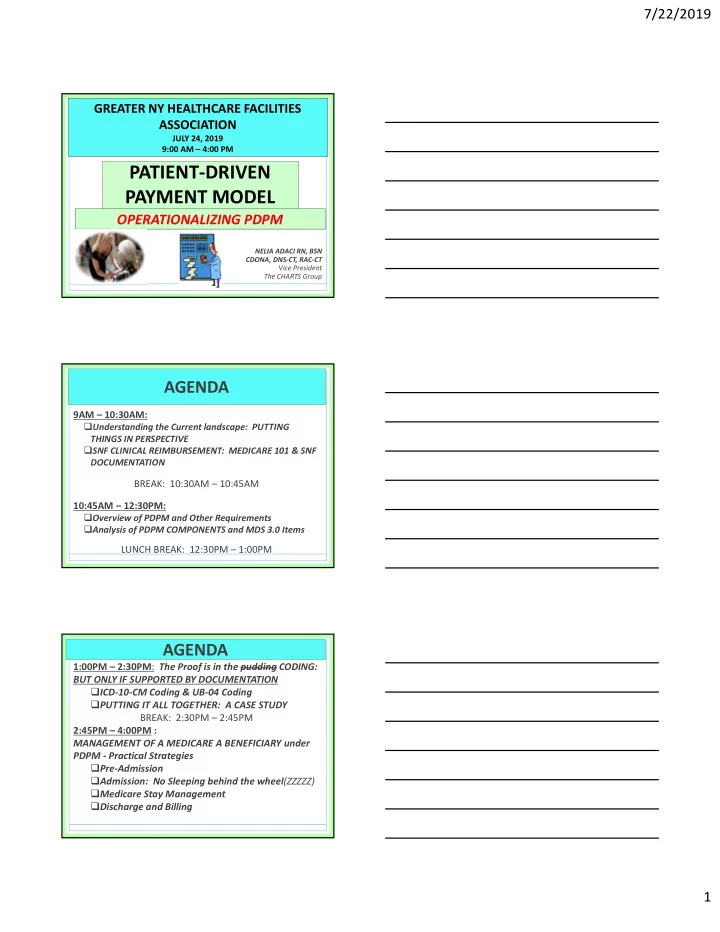
PATIENT-DRIVEN PAYMENT MODEL OPERATIONALIZING PDPM NELIA ADACI RN, - - PDF document

patient driven payment model
SMART_READER_LITE
LIVE PREVIEW

PATIENT-DRIVEN PAYMENT MODEL OPERATIONALIZING PDPM NELIA ADACI RN, - - PDF document

7/22/2019 GREATER NY HEALTHCARE FACILITIES ASSOCIATION JULY 24, 2019 9:00 AM 4:00 PM PATIENT-DRIVEN PAYMENT MODEL OPERATIONALIZING PDPM NELIA ADACI RN, BSN CDONA, DNS-CT, RAC-CT Vice President The CHARTS Group 1 AGENDA 9AM


slide-1
SLIDE 1

7/22/2019 1

PATIENT-DRIVEN PAYMENT MODEL

OPERATIONALIZING PDPM

NELIA ADACI RN, BSN CDONA, DNS-CT, RAC-CT Vice President The CHARTS Group

1

GREATER NY HEALTHCARE FACILITIES ASSOCIATION

JULY 24, 2019 9:00 AM – 4:00 PM

2

AGENDA

9AM – 10:30AM:

Understanding the Current landscape: PUTTING THINGS IN PERSPECTIVE SNF CLINICAL REIMBURSEMENT: MEDICARE 101 & SNF DOCUMENTATION

BREAK: 10:30AM – 10:45AM 10:45AM – 12:30PM:

Overview of PDPM and Other Requirements Analysis of PDPM COMPONENTS and MDS 3.0 Items

LUNCH BREAK: 12:30PM – 1:00PM

3

AGENDA

1:00PM – 2:30PM: The Proof is in the pudding CODING: BUT ONLY IF SUPPORTED BY DOCUMENTATION ICD-10-CM Coding & UB-04 Coding PUTTING IT ALL TOGETHER: A CASE STUDY BREAK: 2:30PM – 2:45PM 2:45PM – 4:00PM : MANAGEMENT OF A MEDICARE A BENEFICIARY under PDPM - Practical Strategies Pre-Admission Admission: No Sleeping behind the wheel(ZZZZZ) Medicare Stay Management Discharge and Billing

slide-2
SLIDE 2

7/22/2019 2

UNDERSTANDING THE CURRENT SNF LANDSCAPE

CURRENT STATE OF AFFAIRS

5

Health Care Expenditures: Total National Health Expenditures = $3.3 Trillion (17.9% of GDP) Patient Demographics: Medicare beneficiaries will increase from 54 million to 81 million by 2030. Medicare Trust Fund Solvency: Part A could run out by 2026 - 3 years earlier than projected in last year’s Medicare Trustees’ Report Improper Payments: Reports from the US Department

  • f Health and Human Services; CMS; OIG; etc.
  • CMS CERT Program: Reported $130 billion Improper

Medicare Payments over the past three years

6

U.S. DEPARTMENT OF HEALTH AND HUMAN SERVICES

Most Medicare FFS improper payments: Secondary to documentation and billing errors These errors could be unintentional, due to lack

  • f education or review and in many cases, lack
  • f effective communication between the

clinicians and the billers. When compliance is not met, providers risk (whether intentionally or with gross negligence) False Claims Act violations and potential criminal or civil proceedings.

slide-3
SLIDE 3

7/22/2019 3

Many Agencies Charged with Oversight: Our Esteemed Auditors

8

CMS UPDATES

CMS implemented unprecedented TECHNOLOGICAL UPGRADES in Claims Processing & Management:  Automatic Denials due to increase in “EDITS” (NCCI Edits; Medically Unlikely Edits; MAC Medical Review Edits)  Enhanced Coordination of Benefits: To detect

  • verlapping of claims (sequencing), avoid duplication of

services, follow the beneficiary across care settings  Determine compliance with Medicare regulations via “data (e.g. Dates, Codes, Modifiers) in the UB-04 (electronic claims submitted as reflected in FISS) and MDS’s from the National Repository.

8 9

FREQUENT REASONS FOR DENIALS/RECOVERIES MDS Errors - Coding; ARD; Completion; Transmission Billing Errors – e.g. Discrepancies between UB-04 & MDS; Missing CC’s, OC or Occurrence Span Codes & Dates; Wrong QHS Dates; Wrong ICD-10-CM Codes Insufficient Hospital Records - e.g. “Qualifying hospital days were not medically necessary”; “Skilled PT/ Skilled OT /Skilled ST were not related to a condition that was treated in the hospital”; “No referral in the hospital for in-patient skilled therapy intervention”; “Intensity of Rehab services did not warrant in-patient SNF stay”, etc.) Incomplete MD Certs/Re-certs; Proper Beneficiary Notices not given; Records not signed/dated legibly

slide-4
SLIDE 4

7/22/2019 4

10

RECENT REASONS FOR DENIALS: MEDICARE A

“Medical records do not support beneficiary was evaluated by, treated by, or referred for inpatient skilled therapy while receiving inpatient hospital care” “There is no documentation within the content of the qualifying hospital record to support a new profound weakness or necessity of in-patient skilled care”. “SNF Re-certification was not signed timely – one day late.” “Hospital records did not indicate need for daily skilled Rehab services in a SNF”

11

RECENT REASONS FOR DENIALS: MEDICARE A

“The Medical Record did not include PT and OT Evaluations or Re-evaluations and new Plans Of Care when beneficiary transitioned from Medicare Advantage to Medicare A coverage. New evaluations are needed for the Medicare schedule of assessments to properly align with the documentation. Therefore, the Medicare requirements were not met for payment

  • f services rendered from December 1, 2018 thru

December 31, 2018”. “No 3-Day Qualifying Hospital Stay associated with SNF Admission” “The SNF Admission is more than 30 days from the Qualifying Hospital Stay”.

12

RECENT REASONS FOR DENIALS: MEDICARE HMO’S

“No 5 Day assessment received with requested

  • records. Pays default rate. Admission assessment

cannot be used to replace the PPS assessment” “The number of therapy services provided during the look back period for the 5 day MDS with an ARD

  • f 9/14/18 and RUG RUC10 were not supported by

the orders. The OT therapy plan of care and order indicated therapy was to be provided 3-5 times per week; however, Log shows that services were provided 6 times per week at times”.

slide-5
SLIDE 5

7/22/2019 5

13

RECENT REASONS FOR MEDICARE HMO DENIALS

REASON FOR DENIAL – “INVALID PRINCIPAL DIAGNOSIS CODE USED” = Recouped payment for entire stay

“Resistance to change at all cost is the most senseless act there is” – Frederick Durrenmatt

“Change before you have to” - Jack Welch

14

“Change is inevitable. Growth is optional” – John Maxwell

15

WHY IS CHANGE NECESSARY?

slide-6
SLIDE 6

7/22/2019 6

16

THE PRESENT

17

THE FUTURE?

18

THE FUTURE!!!

Secondary to “Z99.89”: Dependence on enabling machines & devices, not elsewhere classified

slide-7
SLIDE 7

7/22/2019 7

PUTTING THINGS IN PERSPECTIVE

"ARE YOU POSITIONED FOR SUCCESS IN THE NEW WORLD OF HEALTH CARE?" (Knowledge is Power; Ignorance is No Excuse)

N

19

20

2019 SNF & MEDICARE UPDATES: "ARE YOU POSITIONED FOR SUCCESS IN THE NEW WORLD OF HEALTH CARE?" (Knowledge is Power; Ignorance is No Excuse)

 CURRENT CHALLENGES IN SNF CLINICAL REIMBURSEMENT: The Critical Role

  • f Accurate MDS 3.0, ICD-10 &UB-04 Coding in ensuring Financial Success;

CLAIMS & APPEALS  THE NEW CURRENCY in HEALTH CARE: “DATA & OUTCOMES”  The “New” 5-Star Rating System: Health Inspections; Staffing (PBJ); QM’s  SNF-QRP ; Value-Based Purchasing  MDS 3.0 RAI USER’S MANUAL, VERSION 1.17 DRAFT RELEASED  NEW MDS ITEMS; DELETED MDS ITEMS; CLARIFICATIONS; ETC.  REGULATORY COMPLIANCE UPDATES: IMPLEMENTATION STATUS OF THE LTC REQUIREMENTS OF PARTICIPATION – PHASE 3  The New MEDICARE REIMBURSEMENT SYSTEM - PDPM: “Patient-Driven Payment Model”

“THE PROOF IS IN THE PUDDING CODING: ICD-10; MDS 3.0; UB-04”

“KNOW THY SELF:

YOUR SELF; YOUR RESIDENTS & THEIR FAMILIES; YOUR TEAM; YOUR FACILITY”

“The first step toward change is awareness. The second step is acceptance” - Nathaniel Branden

21

slide-8
SLIDE 8

7/22/2019 8

22

SELF-ASSESSMENT:

IF YOU LOOK IN THE MIRROR

DO THESE IMAGES LOOK FAMILIAR TO YOU?

23

KNOW YOUR RESIDENTS

24

KNOW YOUR RESIDENTS

slide-9
SLIDE 9

7/22/2019 9

25

KNOW YOUR RESIDENTS’ FAMILIES

26

KNOW YOUR STAFF

KNOW YOUR TEAM:

Does your team suffer from “Z56.5”? ARGUING

27

ICD-10 CODE Z56.5: UNCONGENIAL WORK ENVIRONMENT

slide-10
SLIDE 10

7/22/2019 10

28

FACILITY ASSESSMENT: HOW DO YOUR RESIDENTS LOOK LIKE?

29

FACILITY ASSESSMENT: HOW DO YOUR RESIDENTS LOOK LIKE?

30

FACILITY ASSESSMENT

slide-11
SLIDE 11

7/22/2019 11

“Efficiency is doing the thing right. Effectiveness is doing the right thing”

  • Peter F. Drucker

“The best preparation for good work tomorrow is to do good work today.”

  • Elbert Hubbard

31

THE PROOF IS IN THE PUDDING CODING (MDS 3.0, ICD-10, UB-04: Supported by Proper Documentation)

VULNERABILITES: Provider Attitude

“We’ve been getting paid for that service - no problem!” *The problem is usually NOT about getting paid. It is about KEEPING the money and MORE…” “Paper Compliance (No regard for the intent of the regulations)”: *It is NOT just about “Paper Compliance.” Use of “Critical Thinking Skills” & “Inter-disciplinary Collaboration” are IMPERATIVE. [Intent of Triple Check]. Medical Records need to reflect the above. Ask yourselves: “Who are you entrusting to be The Gatekeepers of your REVENUE?” – Documentation by Clinicians; Appropriate ICD-10 Coding; Proper MDS 3.0 & UB-04 Coding to ensure Integrity of Claims”; Proper Organization & Retention of Medical Records

32 32 33

TEAM WORK IS A MUST

slide-12
SLIDE 12

7/22/2019 12

34

OUR GOAL

THE ALTERNATIVE?

You may be diagnosed with the following ICD-10 Codes: Z56.6 – Work-Related Mental Stress Z56.2 – Threat of a Job Loss & will Exhibit the ff: R45.82 – Worries R45.81 – Low Self-Esteem R51 – Headache F50.89 – Loss of appetite, non-organic origin Z59.6 – Inadequate Financial Income F43.9 – Reaction to Severe Stress Z65.3 – Problems related to other legal circumstances

35

SNF CLINICAL REIMBURSEMENT

slide-13
SLIDE 13

7/22/2019 13

HOW DO FACILITIES SURVIVE?

Who Pays for a Residents’ Stay in a SNF?

 PRIVATE PAY  COMMERCIAL INSURANCE  HMO’S  MEDICAID: FFS OR HMO  MEDICARE: FFS OR MEDICARE ADVANTAGE  DUAL ELIGIBLE INITIATIVES  CARE COORDINATION INITIATIVES: ACO; Bundled Programs

HOW? Care DOCUMENT Payment

CLAIM: should tell the story of the beneficiary of care provided across settings

slide-14
SLIDE 14

7/22/2019 14

MEDICARE 101 PDPM

WHAT IS MEDICARE?

Federally funded health insurance program for the elderly and disabled

Age 65 and Older Under 65 years old with certain disabilities (who have been receiving Social Security Disability Benefits for a certain amount of time - 24 months in most cases). Any age with Lou Gehrig’s Disease Any age who have ESRD – permanent kidney failure requiring Dialysis or a Transplant

TYPES OF MEDICARE

PART COVERS…

A In-Patient Stays: Hospital & SNF; Home Health; Hospice B Outpatient Care; MD Services; Some Preventative Services (Medical Insurance / Supplemental) C Medicare Advantage Plans/Medicare HMO’s D Prescription Drug Benefits

slide-15
SLIDE 15

7/22/2019 15

MEDICARE PART A COSTS: SKILLED NURSING FACILITY PER 100-DAY BENEFIT PERIOD

PART A CO-PAY IN 2019 MEDICARE DAY # IN BENEFIT PERIOD $0.00 DAYS #1 - #20 $170.50 PER DAY DAYS #21 - #100

Management is subcontracted to “MACS” (Medicare Administrative Contractors) – used to be called “FI” (Fiscal Intermediaries)

NGS: MAC FOR NY

WHAT DOES MEDICARE PART A COVER IN A SNF?

Post- hospitalization SNF In-Patient Daily Skilled Care Up to 100 Days (Technical Eligibility & Clinical Eligibility) May qualify for additional “benefit periods” PDPM Payment is based on RUG Scores (5 Case-Mix Components) that are generated from the completion

  • f a PPS MDS 3.0 Assessment PLUS 1 Non-Case-Mix

Component. Variable Per Diem Adjustments will apply in some components. Still An All-Inclusive Rate with Few Exclusions (Consolidated Billing)

45

*REMEMBER: Published Rates do NOT include the Sequestration Adjustment or Facility-Specific Adjustments or Penalties

2% Sequestration SNF QRP: 2% Market Basket Reduction if SNF did not submit specified quality data submission requirements for the specified data collection period. SNF VBP (Value-Based Purchasing): Rate Adjustment based on Incentive Payment Multiplier – Dependent on Re-hospitalization Rate using SNF RM Measure

slide-16
SLIDE 16

7/22/2019 16

Under PDPM: Summary of Prior Hospitalization, Transfer Requirements & SNF Services Three-Day Stay: Medically necessary inpatient hospital stay; 3-Day Stay Remains in Place; Observation Stay Days DO Not Count Condition addressed by hospital admission requires skilled services following discharge: SNF diagnosis must be “related” to A condition that was treated in the hospital Patient is admitted to the Medicare-certified SNF within 30 days of hospital discharge Medicare-covered SNF services remain the same 30-Day Transfer Exceptions remain the same

*PDPM: 3-DAY QHS remains in place with Interrupted Stay SNF Principal Diagnosis can and may likely be different than Hospital Admitting Diagnosis (SNF: Post-Acute Care Nature)

SNF Coverage Criteria Unchanged: All Must be Met TECHNICAL ELIGIBILITY: Active Part A Enrollment Has SNF Benefit Days remaining 3-Day Qualifying Hospital Stay (Exception: Waivers) SNF admit within 30 days of hospital discharge MD Order for Skilled Services & MD Cert. of SNF Need CLINICAL ELIGIBILITY: Daily Skilled Coverage (Skilled Rehab & Skilled Nursing Care) Requirements are met Level of Care can only be provided in-patient in a SNF UNDER PDPM: *SNF LOC Under Part C (Medicare Advantage) May Differ *Delivery of skilled care requirements remain the same. *CMS will monitor

Physician Certification and Recertification

Required for Medicare coverage Must be obtained at time of admission Certification and Recertification Signage

  • Attending physician
  • Physician on SNF staff who has knowledge of the case;
  • r
  • Physician Assistant, Clinical Nurse Specialist, or a

Nurse Practitioner who does NOT have direct or indirect employment relationship with the facility Routine admission order is not a certification *PDPM: Certification & Diagnosis Processes Unchanged; *Timing becomes critical due to 5-Day MDS Assessment

Window (ARD must be set between Days #1 - #8)

slide-17
SLIDE 17

7/22/2019 17

Physician Certification Content: Regulation

“Must clearly indicate that post-hospital extended care services were required to be given on an inpatient basis because of the individual’s need for skilled care on a continuing basis for any of the conditions for which he/she was receiving inpatient hospital services.”

Source: Medicare General Information, Eligibility, and Entitlement Manual, chapter 4, §40.2

49

CERTIFICATION - Required Content: Advice

Physician Certifications and Re-certifications: Do not just provide a listing of the skilled services to be provided; Describe the medical and/or functional problems requiring the skilled services Example:

  • Skilled PT and Skilled OT for muscle wasting, disuse

atrophy related to CVA

  • Daily IV antibiotics for pneumonia

50

RECERTIFICATION:

Required Content: Regulation

Must contain: Adequate written record of reasons for the continued need for extended care services Estimated period of time required for patient to remain in the facility Plans, where appropriate, for home care

Source: Medicare General Information, Eligibility, and Entitlement Manual, chapter 4, §40.3

51

slide-18
SLIDE 18

7/22/2019 18

RECERTIFICATION:

Required Content: ADVICE

Stating the skilled care to be provided without citing beneficiary's functional impairment or medical condition that requires a skilled level of care may result in denial If continued Part A stay is due to a condition that arose while on Part A in the SNF, recertification must say so

52

Skilled Level of Care and Benefit Period

Level of Care Physician order for daily skilled nursing or daily skilled rehabilitation services following hospitalization Care that can only be provided in SNF by skilled professionals Medicare Benefit Period Tracks days used during inpatient stays (including Utilization days under Medicare HMO/Medicare Advantage Plan) Period of consecutive days during which medical benefits are covered services are available Can be multiple benefit periods in one year Diagnoses do not affect benefit period determination NOMNC and SNF Advanced Beneficiary Notice (SNF-ABN) policies and processes remain the same

Skilled Level of Care AND Benefit Period

For more detail, see Medicare Benefit Policy Manual, Chapter 8 – Coverage of Extended Care (SNF) Services under Hospital Insurance available at https://www.cms.gov/Regulations-and- Guidance/Guidance/Manuals/Download *PDPM PT/OT Per Diem Payments Begin to Decline on Day 21 When Cost Sharing Begins *CMS and OIG will be tracking levels of therapy delivered pre-PDPM and post-PDPM

slide-19
SLIDE 19

7/22/2019 19

WHAT MAKES IT SKILLED?

55

SNF COVERAGE REQUIREMENTS: Care in a SNF is covered ONLY if ALL of the following 4 factors are met:

  • 1. The patient requires skilled nursing services or

skilled rehabilitation services, i.e., services that must be performed by or under the supervision of professional or technical personnel (see § 30.2 - 30.4); are ordered by a physician and the services are rendered for a condition for which the patient received inpatient hospital services or for a condition that arose while receiving care in a SNF for treatment of a condition for which the beneficiary was previously treated in the hospital.

  • 2. The patient requires these skilled services on a daily

basis (see §30.6);

56

SNF COVERAGE REQUIREMENTS: Care in a SNF is covered ONLY if ALL of the following 4 factors are met:

  • 3. As a practical matter, considering economy and

efficiency, the daily skilled services can be provided

  • nly on an inpatient basis in a SNF. (See §30.7.)
  • 4. The services delivered are reasonable and

necessary for the treatment of a patient’s illness or injury, i.e., are consistent with the nature and severity of the individual’s illness or injury, the individual’s particular medical needs, and accepted standards of medical

  • practice. The services must also be reasonable in

terms of duration and quantity.

57

slide-20
SLIDE 20

7/22/2019 20

58

Documentation: SNF Level of Care

Medical record must document as appropriate: History and Physical exam pertinent to the care (including response or changes in behavior to previous administered skilled services); Skilled services provided; Patient’s response to skilled services provided during visit; Plan for future care based on the rationale of prior results; Explanation of the need for the skilled service in light of the patient’s overall medical condition and experiences; The complexity of the service to be performed; Any other pertinent characteristics of the beneficiary

59

Documentation: SNF Level of Care

Documentation must demonstrate that the resident meets Medicare criteria for coverage under Part A Need for inpatient stay on a daily practical basis Need for skilled nursing and/or rehab services

  • Direct care and treatment
  • Management and evaluation of resident’s

care plan

  • Observation and assessment of resident’s

condition

  • Teaching and training activities

60

SNF CHARTING

One good daily note is better than three shift notes saying “Resting comfortably, call bell in place.” Nursing skilled documentation should NOT begin the day after therapy stops—should begin

  • n Day 1 of Medicare stay

Daily note must explain the resident’s response to therapy, treatments, skilled services provided, and support the reason the resident was skilled in a SNF

slide-21
SLIDE 21

7/22/2019 21

61

MBPM Ch. 8, 30.2.2.1

Documentation must be accurate, and avoid vague or subjective descriptions of the patient’s care that would not be sufficient to indicate the need for skilled care. For Example:

  • Resident tolerated treatment well
  • Continue with POC
  • Resident remains stable

62

MBPM Ch. 8, 30.2.2.1

Such phraseology does not provide a clear picture of the results of the treatment, nor the “next steps” that are planned Objective measurements of physical

  • utcomes of treatment should be provided

and/or a clear description of the changed behaviors due to education programs should be recorded so that all concerned can follow the results of the provided services

63

RULE OF THUMB Why me?

  • Why does this require the skills of a

nurse or therapist? Why here?

  • Why can’t the resident receive the

services at home? Why now?

  • Why, specifically, is this resident in this

SNF at this time?

slide-22
SLIDE 22

7/22/2019 22

SKILLED NURSING SERVICES

64

SUPPORTING DOCUMENTATION

NURSING

Documentation must:

  • Focus on the specific reason for Medicare Part A

coverage

  • Meet the standard of practice for nursing

documentation (use assessment tools s/a CAAs)

  • Address the effects of the reason for coverage
  • n the resident’s ADL status, mood status, and
  • verall medical condition
  • Describe the resident’s response to treatment
  • Reflect professional level of critical thinking

65

SUPPORTING DOCUMENTATION

NURSING

Provide accurate evidence of medically necessary daily skilled service

  • Example: IV fluids
  • Signed order
  • Implementation of order daily
  • Evidence of dehydration/documented risk of

dehydration (dietary notes, labs validating need)

  • Evidence that oral methods were insufficient

66

slide-23
SLIDE 23

7/22/2019 23

SUPPORTING DOCUMENTATION

NURSING

Provide accurate evidence of medically necessary daily skilled service

  • Example: Respiratory infection
  • Detailed respiratory assessment
  • Vital signs and O2 sats
  • Description of respiratory status effects on ADLs,

eating, mood, etc.

  • Effectiveness of medications, treatments
  • Evidence of instability of condition or reason to

believe condition will deteriorate

67

SUPPORTING DOCUMENTATION

NURSING

When rehab therapy is the skilled service

  • PT, OT, & ST documentation is primary
  • Nursing documentation should describe

resident’s level of activity with nursing staff

  • Nursing should describe the resident’s response

to therapy

  • Nursing should describe nursing activities that

support rehab’s treatments and goals

68 69

DOCUMENTATION: Indirect Skilled Nursing Services

Does your facility deny the resident his Medicare A benefit days because it cannot recognize or support the daily skilled need for indirect nursing services? Or because you are

  • btaining a “Non-Rehab RUG Score” which pays

less? Ending a SNF stay too early can lead to:

  • Failure at home and unnecessary

hospitalizations for the resident

  • Loss of income for your facility
slide-24
SLIDE 24

7/22/2019 24

70

DOCUMENTATION: Indirect Skilled Nursing Services It is expected that the documentation in the patient’s medical record will reflect the need for the skilled services provided The patient’s medical record is also expected to provide important communication among all members

  • f the care team regarding the development, course,

and outcomes of the skilled observations, assessments, treatment, and training performed Taken as a whole, then, the documentation in the patient’s medical record should illustrate the degree to which the patient is accomplishing the goals as

  • utlined in the care plan. In this way, the

documentation will serve to demonstrate why a skilled service is needed

71

SNF DOCUMENTATION

Supportive documentation includes the whole picture

  • f patient’s clinical condition, including but not limited

to:

  • H&P
  • Nurses’ Notes
  • MARs and TARs
  • C.N.A. Flow sheets
  • Mood and behavior sheets
  • Wound care records
  • Therapy notes
  • Progress notes by physician or NPP, social services,

dietary, therapeutic recreation

  • Care planning

72

SNF DOCUMENTATION

Must reflect evidence of assessment and management

  • f conditions that support reason for skilled care:
  • Respiratory
  • Neurological
  • Pain
  • Circulatory, cardiovascular
  • Gastro-intestinaI
  • Musculoskeletal
  • Renal, hepatic, and other
slide-25
SLIDE 25

7/22/2019 25

73

SNF DOCUMENTATION

DOES NOT SUPPORT DAILY SKILLED SNF NEED Nursing note: Night shift left treatment and dressing for me to change again, which I did, AGAIN! Reported to RN Supervisor. SUPPORTS DAILY SKILLED SNF NEED Nursing note: Wound bed 5 cm in circumference, 1 cm

  • deep. Pink granulation tissue noted 2 cm around inside
  • circumference. 1 cm open area noted in center of

wound bed, red with no drainage/odor. Surrounding skin intact. Pain during treatment noted at 2/10 intensity.

74

SNF DOCUMENTATION

DOES NOT SUPPORT DAILY SKILLED SNF NEED Nursing note: Antibiotics continue. Stable. SUPPORTS DAILY SKILLED SNF NEED Nursing note: Assisted resident to turn, cough, deep breathe after nebulizer treatment. Lung sounds

  • diminished. VS. T101.2, BP140/80, P96, R 24. Resident

cannot lie flat due to shortness of breath. O2 via NC at 2L. Continues IV Vancomycin infusing via pump at 75cc/hr. IV site has no redness, pain, or swelling. Resident up in geri- chair for two hours before asking for assist back to bed.

75

Nursing Documentation to Support Therapy

Nursing should be aware why therapy is working with the resident. Do not simply chart:

  • Resident went to PT/OT
  • Speech therapist fed resident lunch
  • Respiratory therapist in to see resident

Nursing documentation must contain nursing

  • bservations about functional ability when not in
  • therapy. Carry over of functional gains in Therapy must

be communicated to Nursing. (COLLABORATION) Therapy and nursing documentation do not have to match BUT should not contradict

slide-26
SLIDE 26

7/22/2019 26

76

Nursing Documentation to Support Therapy

DOESN’T SUPPORT DAILY SKILLED SNF NEED Nursing note: Took two person assist to get out of bed. Hoyer still broke. Independent in chair. SUPPORTS DAILY SKILLED SNF NEED Nursing note: Resident receiving OT to assist with bed mobility, transfer, and locomotion in wheelchair. Bed mobility: Resident pulled self to sitting position with use

  • f grab bars. Transfers: CNA and LPN assisted resident to

stand, turn, and pivot into wheelchair. Required staff assist to place left leg in position on leg rest, but could

  • participate. Locomotion: Resident used arms and right leg

to propel self with supervision.

77

Nursing Documentation to Support Therapy: EXAMPLE

Resident receiving gait training

DOESN’T SUPPORT DAILY SKILLED SNF NEED Nursing note: Resident up ad lib ambulating in hallways, gait steady SUPPORTS DAILY SKILLED SNF NEED Nursing note: Resident ambulates with assist of one and Front Wheel Walker, remains with short shuffled steps.

78

Practical Matter Test

Resident admitted to SNF to get daily IV antibiotics at night from 10 p.m. to 6 a.m. At 6:30 a.m. daily, the resident was picked up by wife to drive him to

  • work. He ate no meals in the SNF. He got back

about 9:30 p.m. and connected his antibiotic mini- bag, which was always hanging on the pole by his bed, to his PICC line. He took a sleeping pill he brought from home. Wife left after dropping him

  • ff.

**As a practical matter he does not need inpatient care

slide-27
SLIDE 27

7/22/2019 27

SUPPORTING DOCUMENTATION

REHAB

Describe the complexity of interventions and relate them directly to resident’s barriers

  • Teaching compensatory techniques or adaptive

techniques

  • Training in energy conservation
  • Teaching joint protection techniques
  • High-level gait activities such as heel-toe
  • Task segmentation
  • Joint mobilization
  • Visual scanning
  • Safe swallow training

79

SUPPORTING DOCUMENTATION

REHAB

Describe deficits in terms of the specific underlying physical factors that demonstrate the need for skilled therapist

  • Decreased coordination vs. gait disturbance
  • Muscle weakness vs. debility or deconditioning
  • Difficulty initiating movement vs. decreased

participation

  • Shortness of breath on exertion vs. decreased

endurance

80

SUPPORTING DOCUMENTATION

REHAB

Provide evidence of the continued need for coverage based on:

  • Clearly documented progress
  • Objectively compare current status to prior status
  • Describe functional carryover
  • Describe progress toward goals
  • Provide functional interpretation of progress
  • Describe remaining barriers to reaching goals

OR

  • Clearly documented rationale for skilled maintenance

81

slide-28
SLIDE 28

7/22/2019 28

FOOD FOR THOUGHT: COMPLIANCE ACTIVITIES

Coverage Decisions

  • Group decision, not just rehab

Group needs to understand why complex, sophisticated treatments are needed versus repetitive exercises, increasing ambulation distance, restorative interventions by non-skilled personnel

82

SKILLED COVERAGE

Making Correct Coverage Decisions The condition must be of such a nature that the knowledge, skills, and judgment of skilled nursing and rehab personnel are required to safely and effectively perform or supervise the performance of the services Diagnosis or prognosis should never be the sole factor in deciding that a service is or is not skilled

83

SNF PPS BASICS: SUMMARY

Medicare Part A provides an “extended care” benefit when a beneficiary is admitted to the SNF within a specified time period of being discharged from a medically necessary hospital stay in which the beneficiary was an inpatient for not less than 3 consecutive days before discharge from the hospital (3 Day Qualifying Hospital Stay is waived in certain cases) Limited to a maximum of 100 days per benefit period. Patients must need and receive an SNF level of (skilled) care on a daily basis, and must be receiving services that, as a practical matter, can only be provided in an SNF on an inpatient basis

slide-29
SLIDE 29

7/22/2019 29

Provision of Skilled Services (as supported in the Medical Record) MUST BE REFLECTED IN THE 2 MOST IMPORTANT DOCUMENTS FOR PAYMENT - MDS & UB-04

Many Agencies Charged with Oversight: Our Esteemed Auditors

87

CMS UPDATES

CMS implemented unprecedented TECHNOLOGICAL UPGRADES in Claims Processing & Management:  Automatic Denials due to increase in “EDITS” (NCCI Edits; Medically Unlikely Edits; MAC Medical Review Edits)  Enhanced Coordination of Benefits: To detect

  • verlapping of claims (sequencing), avoid duplication of

services, follow the beneficiary across care settings  Determine compliance with Medicare regulations via “data (e.g. Dates, Codes, Modifiers) in the UB-04 (electronic claims submitted as reflected in FISS) and MDS’s from the National Repository.

87

slide-30
SLIDE 30

7/22/2019 30

88

FREQUENT REASONS FOR DENIALS/RECOVERIES MDS Errors - Coding; ARD; Completion; Transmission Billing Errors – e.g. Discrepancies between UB-04 & MDS; Missing CC’s, OC or Occurrence Span Codes & Dates; Wrong QHS Dates; Wrong ICD-10-CM Codes Insufficient Hospital Records - e.g. “Qualifying hospital days were not medically necessary”; “Skilled PT/ Skilled OT /Skilled ST were not related to a condition that was treated in the hospital”; “No referral in the hospital for in-patient skilled therapy intervention”; “Intensity of Rehab services did not warrant in-patient SNF stay”, etc.) Incomplete MD Certs/Re-certs; Proper Beneficiary Notices not given; Records not signed/dated legibly

89

RECENT REASONS FOR DENIALS: MEDICARE A

“Medical records do not support beneficiary was evaluated by, treated by, or referred for inpatient skilled therapy while receiving inpatient hospital care” “There is no documentation within the content of the qualifying hospital record to support a new profound weakness or necessity of in-patient skilled care”. “SNF Re-certification was not signed timely – one day late.” “Hospital records did not indicate need for daily skilled Rehab services in a SNF”

90

RECENT REASONS FOR DENIALS: MEDICARE HMO’S

“No 5 Day assessment received with requested

  • records. Pays default rate. Admission assessment

cannot be used to replace the PPS assessment” “The number of therapy services provided during the look back period for the 5 day MDS with an ARD

  • f 9/14/18 and RUG RUC10 were not supported by

the orders. The OT therapy plan of care and order indicated therapy was to be provided 3-5 times per week; however, Log shows that services were provided 6 times per week at times”.

slide-31
SLIDE 31

7/22/2019 31

91

RECENT REASONS FOR MEDICARE HMO DENIALS

REASON FOR DENIAL – “INVALID PRINCIPAL DIAGNOSIS CODE USED” = Recouped payment for entire stay

92

THE BOTTOM LINE IS…

“THE ONUS IS ON THE FACILITY TO JUSTIFY PAYMENT OF CLAIMS SUBMITTED TO MEDICARE FOR DAILY SKILLED SERVICES RENDERED TO BENEFICIARIES IN ACCORDANCE WITH MEDICARE GUIDELINES”

RESOURCES

www.cms.gov www.ahca.org www.hcanj.org www.aanac.org www.oig.hhs.gov www.novitas-solutions.com www.ngsmedicare.com www.noridian.com www.wps.com Medicare Benefits Policy Manual Chapter 8 Medicare Claims Processing Manual Chapter 6 Medicare Program Integrity Manual Chapter 3 Medicare Program Integrity manual Chapter 6