UML 2.0 vs. SDL/MSC - Ericsson Position Statement SDL and MSC - - PDF document

uml 2 0 vs sdl msc ericsson position statement
SMART_READER_LITE
LIVE PREVIEW

UML 2.0 vs. SDL/MSC - Ericsson Position Statement SDL and MSC - - PDF document

UML 2.0 vs. SDL/MSC - Ericsson Position Statement SDL and MSC Workshop Grenoble June 2000 ystein Haugen, Ericsson NorARC UML 2.0 Position Statement / Slide 1 Ericssons approach to UML 2.0 in OMG We want UML to become better We want


slide-1
SLIDE 1

UML 2.0 Position Statement / Slide 1

Øystein Haugen, Ericsson NorARC

UML 2.0 vs. SDL/MSC - Ericsson Position Statement

SDL and MSC Workshop Grenoble June 2000

UML 2.0 Position Statement / Slide 2
Øystein Haugen, Ericsson NorARC

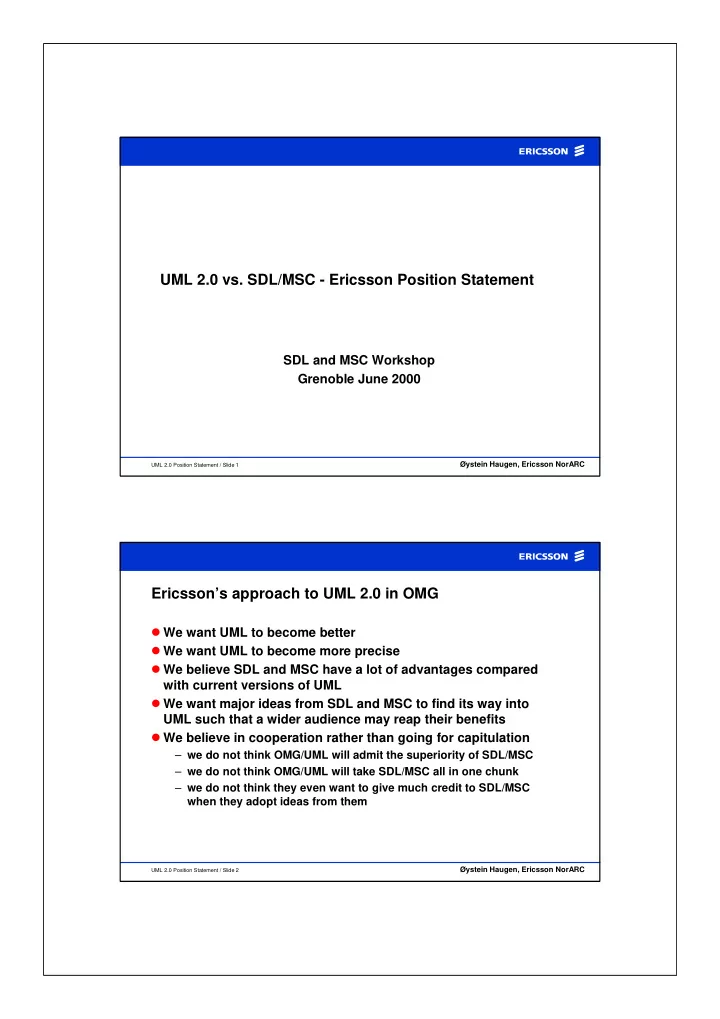
Ericsson’s approach to UML 2.0 in OMG

We want UML to become better We want UML to become more precise We believe SDL and MSC have a lot of advantages compared with current versions of UML We want major ideas from SDL and MSC to find its way into UML such that a wider audience may reap their benefits We believe in cooperation rather than going for capitulation

– we do not think OMG/UML will admit the superiority of SDL/MSC – we do not think OMG/UML will take SDL/MSC all in one chunk – we do not think they even want to give much credit to SDL/MSC when they adopt ideas from them

slide-2
SLIDE 2

UML 2.0 Position Statement / Slide 3

Øystein Haugen, Ericsson NorARC

A c: C b: B

Modelling Large and Complex Systems

For the modeling of large-scale systems and support of component based development it is important for UML to have structuring mechanisms capable

  • f capturing the architecture of a

system in terms of – what objects it is composed of – how these are contained in higher-level objects – how these objects are connected, – and how potential communication is specified

UML 2.0 Position Statement / Slide 4

Øystein Haugen, Ericsson NorARC

Sequence Diagram Roadmaps with references and guards Proposals shall provide for an encapsulation mechanism for states and state machines, e.g., by defining an interface in terms of the entry or exit points of transitions, so that the internal details of a composite state can be defined independently of the use of it in the enclosing state Proposals shall support that the same composite state can appear in more than one state chart in order to allow reuse of behavior (the state may respond in the same manner to a set of events) across a number

  • f classes.

A c: C b: B

AEp : Endpoint AAgt : UA Bagt : UA abracadabra : User Request Play Proceeding Request Play PlayingConfirmed Proceeding getstarted Invoke continue Playing Playing A :Player B :Player

Sequence Diagrams

Proposals shall provide mechanisms to refer within

  • ne interaction to other

interactions within the same (or other) collaboration. Proposals shall define mechanisms to describe the decomposition of a role in an interaction into an interaction

  • f its component parts.

SeqDiagReference

decomposed as PA decomposed as PB

slide-3
SLIDE 3

UML 2.0 Position Statement / Slide 5

Øystein Haugen, Ericsson NorARC

state ATM

VerifyCard ReadAmount OutOfService VerifyTransaction ReleaseCard acceptCard(account) rejectTransaction

state ReadAmount

aborted reenter SelectAmount EnterAmount Amount(amount)

  • therAmout
  • k

abort abort reenter aborted

Structuring States in State Diagrams

Proposals shall provide for an encapsulation mechanism for states and state machines, e.g., by defining an interface in terms of the entry or exit points of transitions