UK HERITAGE FLEET UK HERITAGE FLEET National Historic Ships UK is - - PowerPoint PPT Presentation

uk heritage fleet uk heritage fleet
SMART_READER_LITE
LIVE PREVIEW

UK HERITAGE FLEET UK HERITAGE FLEET National Historic Ships UK is - - PowerPoint PPT Presentation

UK HERITAGE FLEET UK HERITAGE FLEET National Historic Ships UK is government funded independent organisation giving objective advice on all matters relating to UK Historic Ships Over 1,000 vessels on the National Register of Historic


slide-1
SLIDE 1

UK HERITAGE FLEET

slide-2
SLIDE 2

UK HERITAGE FLEET

  • National Historic Ships UK is government funded

independent organisation giving objective advice

  • n all matters relating to UK Historic Ships
  • Over 1,000 vessels on the National Register of

Historic Vessels

  • Register provides an authoritative assessment of

the significance of historic vessels

  • Helps prioritise vessels which should be

preserved

slide-3
SLIDE 3

UK NATIONAL HISTORIC FLEET

  • A sub-group of 200 of these vessels which are:
  • Of pre-eminent national or regional

significance

  • Span the spectrum of UK maritime history
  • Illustrate changes in construction and

technology

  • Merit a higher priority for preservation
slide-4
SLIDE 4

RANGE OF UK HERITAGE FLEET

  • Passenger vessels
  • Sailing Barges
  • Tugs
  • Large Yachts
  • Warships
  • Lifeboats
  • Merchant Sailings Ships
  • Canal barges
slide-5
SLIDE 5

Roles They Fulfil

  • Some fulfil a static role
  • Many are operational utilising traditional skills
  • Others carry larger numbers of passengers
  • All help to demonstrate to present and future

generations the UK’s maritime history

slide-6
SLIDE 6

Ownership & Funding

  • National Historic Ships UK does not own or

fund ships

  • Ownership is in the hands of individuals,

groups, trusts, museums, charities etc

  • Some funding available through Heritage

Lottery Fund

  • Securing adequate funding always difficult
slide-7
SLIDE 7

Historic Passenger Vessels >20m

  • Of the 200 vessels in National Historic Fleet
  • Around 40 are > 20m long and are or could

reasonably be made operational

  • Around 20 of these are or have been vessels

carrying more than 12 passengers

slide-8
SLIDE 8

Examples include

  • Paddle Steamer Waverley operates to sea and
  • n various Inland Waterways
slide-9
SLIDE 9

Passenger Vessel Sir Walter Scott

  • n Loch Katrine
slide-10
SLIDE 10

Thames Sailing Barge Hydrogen

  • n the Thames
slide-11
SLIDE 11

Tug Tender Daniel Adamson

  • n the Manchester Ship Canal
slide-12
SLIDE 12

Passenger Vessel Raven

  • n Ullswater
slide-13
SLIDE 13

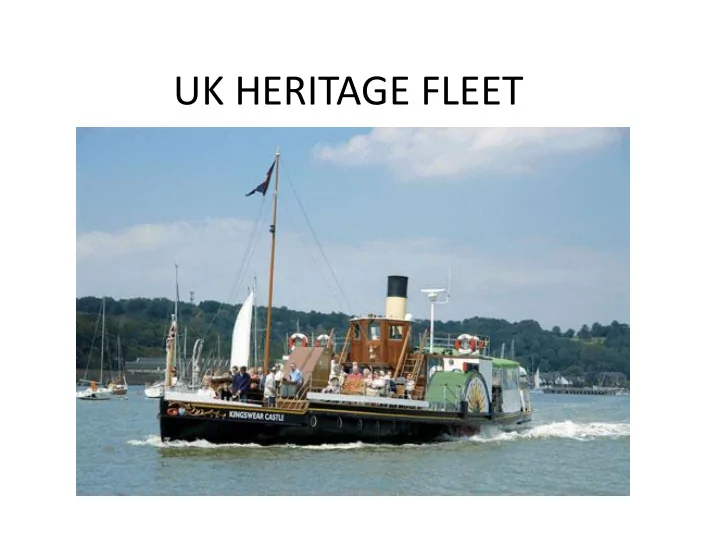
Paddle Steamer Kingswear Castle on the Medway and Thames

slide-14
SLIDE 14

Changing Technologies

  • Ship design and technology change
  • Rivets v welding, wood v steel, steel v iron
  • Hull shape
  • Size of doorways and companionways
  • Emissions from coal fired boilers
  • Etc, etc, etc
  • Historic vessels often cannot comply with new

requirements tailor made for differently designed and built modern high-tech vessels of today

slide-15
SLIDE 15

One Example – Passenger Saloons

  • Historic ships– saloons below deck in the hull
  • Modern ships – saloons should be above deck
  • This cannot be done without changing the

character of the historic ship

slide-16
SLIDE 16

New Traditional Ships

  • 1497 John Cabot crossed Atlantic in Matthew
  • 1997 New replica of Matthew crossed Atlantic
slide-17
SLIDE 17

Building New Traditional ships

  • Traditional ships provide a window into our

Maritime Heritage

  • We must avoid a future where another

Matthew or other ships of traditional design cannot be built

slide-18
SLIDE 18

Replica 18th Century Royal Barge

  • Gloriana currently being built for Queen

Elizabeth II’s Diamond Jubilee

slide-19
SLIDE 19

Key Points

  • Important for historic vessels to survive
  • Important that some should be operational
  • Important to be able to build historic ship

replicas to remind us of our past

  • Important that they should all be operated

safely and to high standards

  • Important that new standards for differently

designed and built modern ships do not inadvertently knock out our historic fleets

slide-20
SLIDE 20

Safety

  • Safety should always be the highest priority for building

and operating historic ships

  • Traditional ship designs are not intrinsically less safe

than those for modern ships

  • Eg Safety record of UK excursion Paddle Steamers in

last 100 years better than modern Ro-Ro ferries

  • They are just different
slide-21
SLIDE 21

That difference needs celebrating & protecting