TULSA AUDUBON SOCIETY by JIM ARTERBURN January 18, 2011 SHOREBIRDS - - PowerPoint PPT Presentation

tulsa audubon society
SMART_READER_LITE
LIVE PREVIEW

TULSA AUDUBON SOCIETY by JIM ARTERBURN January 18, 2011 SHOREBIRDS - - PowerPoint PPT Presentation

SHOREBIRD IDENTIFICATION SEMINAR TULSA AUDUBON SOCIETY by JIM ARTERBURN January 18, 2011 SHOREBIRDS IN NE OKLAHOMA Shorebird Habitat around Tulsa & NE Oklahoma Species Status & Migration Timing Identification Tips


slide-1
SLIDE 1

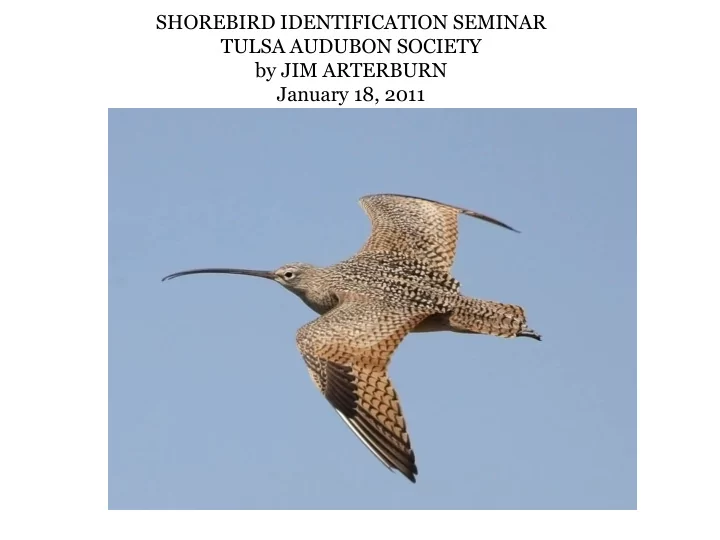
SHOREBIRD IDENTIFICATION SEMINAR TULSA AUDUBON SOCIETY by JIM ARTERBURN January 18, 2011

slide-2
SLIDE 2

SHOREBIRDS IN NE OKLAHOMA

  • Shorebird Habitat around Tulsa & NE Oklahoma
  • Species Status & Migration Timing
  • Identification Tips
  • References
slide-3
SLIDE 3

Shorebird Habitat around Tulsa & NE Oklahoma

  • Sod Farms

– Spring - Especially good during periods of thunderstorms and after heavy

  • vernight rains
  • Prime time is late April through late May
  • Best time is early morning before birds move north & late afternoon &

evening during storms as birds drop in – Fall – Not as good as spring but still good after heavy rains

  • Prime time is late July through mid October
  • Best season for Buff-breasted & Upland Sandpipers

– Prime time is last few days of July through early September – Not as dependent on rain or standing water as other shorebirds but do favor fields being irrigated – Local Area Sod Farms

  • 56th Street North
  • Bixby
  • Leonard
  • Wagoner County
  • Kadashan

– Map provided of area sod farms

  • Prairies –

– North Tulsa County prairies & plowed fields good in early spring for American Golden-Plover

slide-4
SLIDE 4

Shorebird Habitat around Tulsa & NE Oklahoma

  • Lakes

– Several area lakes have ideal shoreline and mudflats depending upon lake levels – Prime time is same as for sod farms – Spring & Fall equally good – Some species more common on lakes than sod farms – Lake Keystone only lake that has habitat at normal but better at 1.5 ft. below normal or lower

  • Osage Point
  • Osage Ramp
  • Feyodi Creek
  • Cowskin Bay South
  • Hwy 48 Overlook to Pawnee Cove
  • Cottonwood Creek South

– Lake Oologah needs to be about a foot below normal to have much habitat and is ideal at 1.5 ft. below normal or lower

  • Winganon Causeway
  • Winganon Flats

– Maps provided identifying productive areas on Keystone & Oologah

slide-5
SLIDE 5

Shorebird Habitat around Tulsa & NE Oklahoma

  • Lakes – Continued

– Sooner Lake is not that dependent upon the lake level

  • Not a lot of flats
  • Prime attraction is rocky causeways
  • Best spot in Oklahoma for late spring migrants

– Black-bellied Plover – Whimbrel – Ruddy Turnstone – Sanderling

  • Unfortunately the north-south causeway is now off limits
  • Sewage Lagoons

– Area sewage lagoons usually not that productive

  • Most don’t have exposed flats

– 56th Street North & Collinsville Sewage Lagoons

  • Only area sewage lagoons with occasional flats

– Skiatook Sewage Lagoons usually not very productive for shorebirds

slide-6
SLIDE 6

SPECIES Black-bellied Plover a., c. American Golden-Plover b. Snow y Plover (Rare) a. Semipalmated Plover Piping Plover (Rare) a. Buff-breasted Sandpiper Short-billed Dow itcher c. Long-billed Dow itcher Wilson's Snipe American Woodcock Wilson's Phalarope Red-necked Phalarope (Rare) * Status and Dates based upon the fourth edition of the OSS Date Guide to the Occurrences of Birds in NE Oklahoma modified by my observations from NE Oklahoma

  • a. - These species usually found w ith greater frequency and in greater numbers on shorelines and mudflats of lakes than sod farms.
  • b. - This species usually found w ith greater frequency and in greater numbers on sod farms and plow ed fields than on shorelines and mudflats of lakes.
  • c. - These species can be found in large numbers during their prime spring migration period (May 5-25) given the proper habitat and w eather conditions.

Uncommon Occurs in low numbers and may not be seen on each trip but may occur sporadically in large numbers. Common Occurs in good numbers during the periods indicated.

SHOREBIRD MIGRATION TIMING IN NE OKLAHOMA*

Rare Occurs in very low numbers each year w ith the possibility of none seen in some years. Occasional Occurs sporadically in very low numbers or occurs sporadically during the w inter. JAN FEB MAR APR

TULSA AUDUBON SOCIETY SHOREBIRDS IN NE OKLAHOMA OCTOBER 17, 2006 JIM ARTERBURN

SEP OCT NOV DEC MAY JUN JUL AUG

Shorebird Migration Timing in NE Oklahoma

slide-7
SLIDE 7

Black-bellied Plover – Alternate Plumage 15 May

slide-8
SLIDE 8

Black-bellied Plover – Basic Plumage 24 October

slide-9
SLIDE 9

Black-bellied Plover – Juvenile Plumage 29 September

slide-10
SLIDE 10

Black-bellied Plover – Juvenile Plumage 18 September

slide-11
SLIDE 11

American Golden-Plover – Probable 1st summer bird 25 June

slide-12
SLIDE 12

American Golden-Plover – Basic Plumage 29 March

slide-13
SLIDE 13

American Golden-Plover – Juvenile Plumage 29 September

slide-14
SLIDE 14

American Golden-Plover – Juvenile Plumage 29 September

slide-15
SLIDE 15

Snowy Plover – Alternate Plumage 7 April

slide-16
SLIDE 16

Snowy Plover – Basic Plumage 5 October

slide-17
SLIDE 17

Snowy Plover – Basic Plumage 29 October

slide-18
SLIDE 18

Snowy Plover – Juvenile Plumage 14 August

slide-19
SLIDE 19

Semipalmated Plover – Alternate Plumage 26 April

slide-20
SLIDE 20

Semipalmated Plover – Juvenile Plumage 22 August

slide-21
SLIDE 21

Piping Plover – Alternate Plumage 22 April

slide-22
SLIDE 22

Piping Plover – Juvenile Plumage 2 September

slide-23
SLIDE 23

Killdeer – Alternate Plumage 13 November

slide-24
SLIDE 24

Black-necked Stilt 22 April

slide-25
SLIDE 25

American Avocet – Alternate Plumage 22 April

slide-26
SLIDE 26

American Avocet – Basic Plumage 29 September

slide-27
SLIDE 27

Greater Yellowlegs – Alternate Plumage 11 May

slide-28
SLIDE 28

Greater Yellowlegs – Basic Plumage with Lesser Yellowlegs - Juvenile/First Winter Plumage 10 October

slide-29
SLIDE 29

Lesser Yellowlegs - Alternate Plumage 11 May

slide-30
SLIDE 30

Lesser Yellowlegs - Alternate Plumage 28 April

slide-31
SLIDE 31

Lesser Yellowlegs - Juvenile Plumage 25 August

slide-32
SLIDE 32

Solitary Sandpiper - Alternate Plumage 24 April

slide-33
SLIDE 33

Solitary Sandpiper - Adult breeding 24 April

slide-34
SLIDE 34

Solitary Sandpiper- Adult breeding 24 April

slide-35
SLIDE 35

Willett – Alternate Plumage 22 April

slide-36
SLIDE 36

Willett – Basic Plumage 28 October

slide-37
SLIDE 37

Willett – Basic Plumage 28 October

slide-38
SLIDE 38

Spotted Sandpiper – Alternate Plumage 4 May

slide-39
SLIDE 39

Spotted Sandpiper – Basic Plumage 5 November

slide-40
SLIDE 40

Upland Sandpiper – Adult 24 April

slide-41
SLIDE 41

Upland Sandpiper – Adult 28 April

slide-42
SLIDE 42

Whimbrel – Alternate Plumage 28 April

slide-43
SLIDE 43

Whimbrel – Alternate Plumage 15 May

slide-44
SLIDE 44

Long-billed Curlew – Adult 6 April

slide-45
SLIDE 45

Long-billed Curlew – Adult 6 April

slide-46
SLIDE 46

Hudsonian Godwit – Alternate Plumage 10 May

slide-47
SLIDE 47

Hudsonian Godwit – Basic Plumage 8 May

slide-48
SLIDE 48

Marbled Godwit – Juvenile Plumage 13 August

slide-49
SLIDE 49

Marbled Godwit – First Winter/Basic Plumage

slide-50
SLIDE 50

Marbled Godwit – Juvenile Plumage 21 August

slide-51
SLIDE 51

Ruddy Turnstone – Alternate Plumage 16 May

slide-52
SLIDE 52

Ruddy Turnstone – Basic Plumage 25 October

slide-53
SLIDE 53

Sanderling – Alternate Plumage 15 May

slide-54
SLIDE 54

Sanderling – Basic Plumage 25 October

slide-55
SLIDE 55

Sanderling – Juvenile Plumage 16 September

slide-56
SLIDE 56

Red Knot – Molting out of Alternate Plumage 28 July

slide-57
SLIDE 57

Red Knot – Basic Plumage 25 October

slide-58
SLIDE 58

Red Knot – Juvenile Plumage 17 September

slide-59
SLIDE 59

Semipalmated Sandpiper – Alternate Plumage 22 April

slide-60
SLIDE 60

Semipalmated Sandpiper – Molting into Alternate Plumage 22 April

slide-61
SLIDE 61

Semipalmated Sandpiper – Juvenile Plumage 21 August

slide-62
SLIDE 62

Western Sandpiper – Alternate Plumage 8 August

slide-63
SLIDE 63

Western Sandpiper – Basic Plumage 11 October

slide-64
SLIDE 64

Western Sandpiper – Juvenile Plumage 21 August

slide-65
SLIDE 65

Least Sandpiper – Alternate Plumage 10 May

slide-66
SLIDE 66

Least Sandpiper – Basic Plumage 21 August

slide-67
SLIDE 67

Least Sandpiper – Juvenile Plumage 21 August

slide-68
SLIDE 68

Least Sandpiper – Juvenile Plumage 11 October

slide-69
SLIDE 69

White-rumped Sandpiper – Alternate Plumage 11 May

slide-70
SLIDE 70

White-rumped Sandpiper – Molting into Alternate Plumage 11 May

slide-71
SLIDE 71

White-rumped Sandpiper – Alternate Plumage Two Least Sandpipers lower left & Semipalmated Sandpiper in middle 9 May

slide-72
SLIDE 72

Baird’s Sandpiper – Alternate Plumage 15 April

slide-73
SLIDE 73

Baird’s Sandpiper – Basic Plumage 7 April

slide-74
SLIDE 74

Baird’s Sandpiper – Juvenile Plumage 11 October

slide-75
SLIDE 75

Pectoral Sandpiper – Alternate Plumage Female (front) & Male 19 September

slide-76
SLIDE 76

Pectoral Sandpiper – Alternate Plumage 26 May

slide-77
SLIDE 77

Pectoral Sandpiper – Juvenile Plumage 25 August

slide-78
SLIDE 78

Dunlin – Molting into Alternate Plumage 11 May

slide-79
SLIDE 79

Dunlin – Basic Plumage 13 March

slide-80
SLIDE 80

Dunlin – Basic Plumage with Least Sandpiper 10 October

slide-81
SLIDE 81

Stilt Sandpiper – Alternate Plumage 15 May

slide-82
SLIDE 82

Stilt Sandpiper – Basic Plumage 6 April

slide-83
SLIDE 83

Stilt Sandpiper – Juvenile Plumage

slide-84
SLIDE 84

Stilt Sandpiper – Juvenile Plumage 29 September

slide-85
SLIDE 85

Buff-breasted Sandpiper – Molting out of Alternate Plumage 22 August

slide-86
SLIDE 86

Buff-breasted Sandpiper – Molting out of Alternate Plumage 11 August

slide-87
SLIDE 87

Short-billed Dowitcher - Alternate Plumage 10 May

slide-88
SLIDE 88

Short-billed Dowitcher - Basic Plumage 29 September

slide-89
SLIDE 89

Short-billed Dowitcher - Juvenile Plumage 28 September

slide-90
SLIDE 90

Long-billed Dowitcher – Alternate Plumage 9 May

slide-91
SLIDE 91

Short-billed Dowitcher (front) & Long-billed Dowitcher – Basic Plumage 29 September

slide-92
SLIDE 92

Long-billed Dowitcher – Basic Plumage 7 April

slide-93
SLIDE 93

Long-billed Dowitcher – Juvenile Plumage 26 September

slide-94
SLIDE 94

Wilson’s Snipe – Basic Plumage 12 December

slide-95
SLIDE 95

Wilson’s Snipe – Basic Plumage 5 January

slide-96
SLIDE 96

American Woodcock – Adult 15 march

slide-97
SLIDE 97

Wilson’s Phalarope – Alternate Plumage Female 24 April

slide-98
SLIDE 98

Wilson’s Phalarope – Basic Plumage 24 bApril

slide-99
SLIDE 99

Red-necked Phalarope – Basic Plumage 9 September

slide-100
SLIDE 100

Red-necked Phalarope – Juvenile Plumage 28 September

slide-101
SLIDE 101

Red Phalarope – Adult non-breeding Plumage 22 August

slide-102
SLIDE 102

REFERENCES

Reference Books (In order of personal preference) O’Brien, M., Crossley, R., and Karlson, K. 2006. The Shorebird Guide. Houghton Mifflin Company, New York, NY. Paulson, D. R. 2005. Shorebirds of North America: the photographic guide. Princeton University Press, Princeton, NJ. Chandler, R. J. 1989. North Atlantic Shorebirds. Facts on File, Inc., New York, NY. (Out of Print) Chandler, R. J. 2009. Shorebirds of the Northern Hemisphere, Christopher Helm Publication, London Hayman, P., Marchant, J., and Prather, T. 1986. Houghton Mifflin Company, Boston, MA. Paulson, D. R. 1993. Shorebirds of the Pacific Northwest. University of Washington Press, Seattle, WA. Prather, A.J., Marchant, J. H., and Vuorinen, J. 1977.Guide to the identification and ageing of Holarctic Waders (BTO Guide 17), Maund & Irvine Ltd., Tring, Herts. (out of Print) Harris, A., Tucker, L., Vinicombe, K. 1989. The Macmillan Field Guide to Bird Identification. The Macmillan Press Ltd., London. (Out of Print) Pringle, J. D. 1987. The Shorebirds of Australia. Angus & Robertson Publishers, London. Field Guides Sibley, D. A. 2000. National Audubon Society The Sibley Guide to Birds. Alfred A. Knopf, Inc., New York, NY. Kaufman, K. 2000. Birds of North America, Houghton Mifflin Company, New York, NY.