Post Construction Monitoring of Post Construction Monitoring of - - PowerPoint PPT Presentation

post construction monitoring of post construction
SMART_READER_LITE
LIVE PREVIEW

Post Construction Monitoring of Post Construction Monitoring of - - PowerPoint PPT Presentation

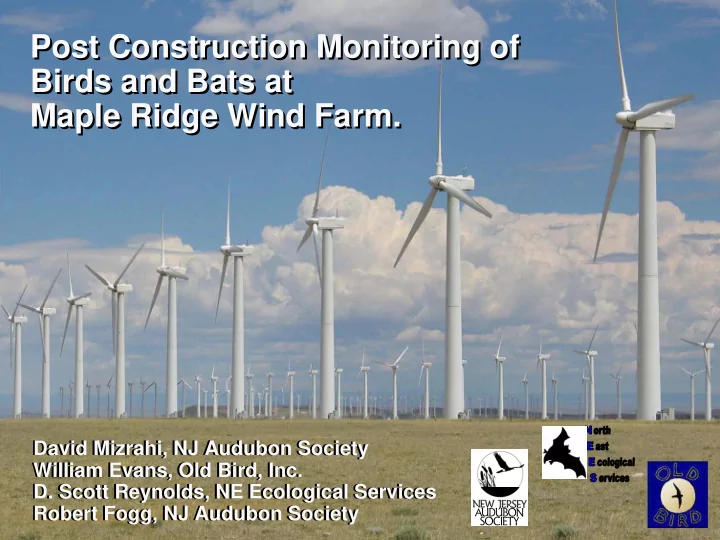
Post Construction Monitoring of Post Construction Monitoring of Birds and Bats at Birds and Bats at Maple Ridge Wind Farm. Maple Ridge Wind Farm. David Mizrahi, NJ Audubon Society David Mizrahi, NJ Audubon Society William Evans, Old Bird,


slide-1
SLIDE 1

Post Construction Monitoring of Birds and Bats at Maple Ridge Wind Farm. Post Construction Monitoring of Birds and Bats at Maple Ridge Wind Farm.

David Mizrahi, NJ Audubon Society William Evans, Old Bird, Inc.

  • D. Scott Reynolds, NE Ecological Services

Robert Fogg, NJ Audubon Society David Mizrahi, NJ Audubon Society William Evans, Old Bird, Inc.

  • D. Scott Reynolds, NE Ecological Services

Robert Fogg, NJ Audubon Society

slide-2
SLIDE 2

Presentation Outline Presentation Outline

  • Background
  • Goals/Objectives
  • Data collection methods
  • Analyses and outputs
  • Background
  • Goals/Objectives
  • Data collection methods
  • Analyses and outputs
slide-3
SLIDE 3

Blowin’ in the Wind Blowin’ in the Wind

  • Globally

– Wind power generation is the fastest growing energy sector (~ 20% annually)

  • USA

– 2nd largest producer of wind energy globally – 11,600 MW installed as of 2006

  • Higher capacity (MW)

– Generate more power/unit operation time

  • Lower cut-in speed

– Wind speed needed to generate electricity

  • Globally

– Wind power generation is the fastest growing energy sector (~ 20% annually)

  • USA

– 2nd largest producer of wind energy globally – 11,600 MW installed as of 2006

  • Higher capacity (MW)

– Generate more power/unit operation time

  • Lower cut-in speed

– Wind speed needed to generate electricity

slide-4
SLIDE 4

Changes in Changes in Technology Technology

Modified from CWR, 2005

1981 10 m 2001 30 m 2004 50 m 2007

Rotor Diameter Hub Height

80 m

slide-5
SLIDE 5

Maple Ridge Wind Farm Maple Ridge Wind Farm

  • Tug Hill Plateau, Lewis County, NY

– Elevation range ~400 - 600 m – Mosaic of habitat types

  • Open crop fields and pastures
  • Successional
  • ld field and shrubland
  • Woodlots, wooded wetlands, and

riparian zones; contiguous forest in western region

  • Largest wind power facility east of

the Mississippi River

– 196 wind turbine generators, 1.65 MW each

  • Hub height ~80 m, rotor diameter

~80 m

  • Turbine strings and individual

turbine sites

  • ~19 km long, ~8,500 hectares
  • Tug Hill Plateau, Lewis County, NY

– Elevation range ~400 - 600 m – Mosaic of habitat types

  • Open crop fields and pastures
  • Successional
  • ld field and shrubland
  • Woodlots, wooded wetlands, and

riparian zones; contiguous forest in western region

  • Largest wind power facility east of

the Mississippi River

– 196 wind turbine generators, 1.65 MW each

  • Hub height ~80 m, rotor diameter

~80 m

  • Turbine strings and individual

turbine sites

  • ~19 km long, ~8,500 hectares
slide-6
SLIDE 6

Project Goals Project Goals

  • Provide data and analyses that assist in precise and

cost-effective determination of impacts (e.g., mortality) to birds and bats at wind power generation sites in New York

  • Relate those impacts to forecasted numbers based on

pre and post construction monitoring (i.e., relationships between exposure and effect)

  • Provide findings to resource managers and policy

makers interested in assessing the effects of wind power development on wildlife

  • Provide data and analyses that assist in precise and

cost-effective determination of impacts (e.g., mortality) to birds and bats at wind power generation sites in New York

  • Relate those impacts to forecasted numbers based on

pre and post construction monitoring (i.e., relationships between exposure and effect)

  • Provide findings to resource managers and policy

makers interested in assessing the effects of wind power development on wildlife

slide-7
SLIDE 7

Project Objectives Project Objectives

1. Use multiple methods to assess potential risk of birds and bats colliding with wind turbines

– Quantify bird/bat movement patterns (rates, altitude and flight direction) during passage through the project area – Investigate how meteorological conditions modify patterns

2. Determine relationships between collision risk (pre and post construction assessments) and collision incidents

– Investigate how meteorological conditions modify these relationships

3. Compare results of pre and post construction collision risk assessments 4. Evaluate the precision and efficacy of assessment methods Maple Ridge post construction wildlife monitoring project is unique – i.e., simultaneously evaluating relationships between risk and effect 1. Use multiple methods to assess potential risk of birds and bats colliding with wind turbines

– Quantify bird/bat movement patterns (rates, altitude and flight direction) during passage through the project area – Investigate how meteorological conditions modify patterns

2. Determine relationships between collision risk (pre and post construction assessments) and collision incidents

– Investigate how meteorological conditions modify these relationships

3. Compare results of pre and post construction collision risk assessments 4. Evaluate the precision and efficacy of assessment methods Maple Ridge post construction wildlife monitoring project is unique – i.e., simultaneously evaluating relationships between risk and effect
slide-8
SLIDE 8

Why birds and bats? Why birds and bats?

  • Exposure and effect

relationships are different for birds and bats

– Preliminary mortality study at Maple Ridge Wind Farm in 2006 suggests that bat collision incidents occur 3-6 times more frequently than in birds

  • Design or operation

modifications to resolve conflicts with bats may be different than with birds

  • Exposure and effect

relationships are different for birds and bats

– Preliminary mortality study at Maple Ridge Wind Farm in 2006 suggests that bat collision incidents occur 3-6 times more frequently than in birds

  • Design or operation

modifications to resolve conflicts with bats may be different than with birds

slide-9
SLIDE 9

Data Collection Methods Data Collection Methods

  • Estimate exposure (i.e., risk)

– Dual marine radar system (passage rates, flight altitude, flight direction) – Bird/bat acoustic detection (passage rates, species identification) – Optically enhanced nocturnal surveys (passage rates, flight direction)

  • Estimate effect

– Collision incident searches – Acoustic strike detection

Multi methodological approach

  • Each method, by itself, is incapable of providing a comprehensive

account of exposure or effect (e.g., radar cannot distinguish between birds and bats)

  • Improves confidence in data from specific monitoring methods and

strengthen the overall conclusions of a study

– Redundancy a priority recommendation from August 2006 NY Wind/Wildlife Technical Workshop

  • Estimate exposure (i.e., risk)

– Dual marine radar system (passage rates, flight altitude, flight direction) – Bird/bat acoustic detection (passage rates, species identification) – Optically enhanced nocturnal surveys (passage rates, flight direction)

  • Estimate effect

– Collision incident searches – Acoustic strike detection

Multi methodological approach

  • Each method, by itself, is incapable of providing a comprehensive

account of exposure or effect (e.g., radar cannot distinguish between birds and bats)

  • Improves confidence in data from specific monitoring methods and

strengthen the overall conclusions of a study

– Redundancy a priority recommendation from August 2006 NY Wind/Wildlife Technical Workshop

slide-10
SLIDE 10

Dual Marine Radar System Dual Marine Radar System

  • Two 25 kW X-band (3 cm

wavelength) radar units

– 6.5 foot open array antennas – Beam 1.23(w) x 20(h)

  • Operate simultaneously in vertical

and horizontal planes Vertical scanning mode

  • Antenna rotates perpendicular to

ground

– Used to estimate (1) target altitude, (2) target passage

Horizontal scanning mode

  • Antenna rotates parallel to ground

– Used to estimate (1) target direction and velocity (2) target passage

slide-11
SLIDE 11

Data Collection Data Collection

  • Radar processing unit sends raster image data direct to

computer

  • Radar processing unit sends raster image data direct to

computer

  • Frame grabber and scheduling

software automate data collection

  • Five successive radar sweeps

(every 2.5 sec) captured as bitmap images every 10 min (i.e., 30 images/hr)

  • Sunset to sunrise the following

morning

  • Frame grabber and scheduling

software automate data collection

  • Five successive radar sweeps

(every 2.5 sec) captured as bitmap images every 10 min (i.e., 30 images/hr)

  • Sunset to sunrise the following

morning

  • 24 Apr -

15 Jun 2007, 52 nights, ~624 hr, ~19,000 images/radar

  • 01 Aug -

15 Oct 2007, 122 nights, ~1450 hr, ~45,000 images/radar

  • 24 Apr -

15 Jun 2007, 52 nights, ~624 hr, ~19,000 images/radar

  • 01 Aug -

15 Oct 2007, 122 nights, ~1450 hr, ~45,000 images/radar

slide-12
SLIDE 12

Radar data - vertically-oriented

  • Radar displays targets using an RGB color scale to represent 29 reflectance levels

(i.e., amount of energy reflected by target)

  • Greens → Yellows → Reds = low → moderate → high reflectance values
  • Target tracking (shown in blue) for user-defined durations
  • Track data can be used to assess target velocity and movement

direction

Unscanned area (antenna

  • riented groundward)

Main bang Ground clutter Ground clutter Targets Radar location Wind turbine

slide-13
SLIDE 13
slide-14
SLIDE 14

Data Processing Data Processing

  • Data images reviewed to identify precipitation, fog, insect

contamination

– Images excluded from analyses

  • Automated data processing (NJAS developed software)

1. Identifies sample area 2. Removes stationary targets (ground clutter) 3. Identifies and enumerates targets 4. Locates target’s position or altitude depending on which scanning mode is considered (i.e., horizontal, vertical respectively) 5. Outputs text file with information on each identified target

  • Text file outputs used to summarize flight characteristics (NJAS

developed software)

– Mean target count, mean flight altitude, % targets ≤ designated altitude, – Temporal patterns: 10 min, hourly and nightly

  • Data images reviewed to identify precipitation, fog, insect

contamination

– Images excluded from analyses

  • Automated data processing (NJAS developed software)

1. Identifies sample area 2. Removes stationary targets (ground clutter) 3. Identifies and enumerates targets 4. Locates target’s position or altitude depending on which scanning mode is considered (i.e., horizontal, vertical respectively) 5. Outputs text file with information on each identified target

  • Text file outputs used to summarize flight characteristics (NJAS

developed software)

– Mean target count, mean flight altitude, % targets ≤ designated altitude, – Temporal patterns: 10 min, hourly and nightly

slide-15
SLIDE 15
slide-16
SLIDE 16

Acoustic Detection - Bats Acoustic Detection - Bats

  • Anabat

II ultrasonic acoustic systems to record bat echolocations

  • Three units installed on each of four

meteorological towers on project site

– ~10 (ground-level), 20 (supracanopy) and 50 m (turbine-level) above ground

  • Capable of detecting echolocation

calls of approaching bats up to 20-25 m away

– 254 m3 potential sampling volume

  • 2007 data collection from 10 May -

30 November

– 1900 – 0700 hours each night – > 1800 hours of recordings

  • Anabat

II ultrasonic acoustic systems to record bat echolocations

  • Three units installed on each of four

meteorological towers on project site

– ~10 (ground-level), 20 (supracanopy) and 50 m (turbine-level) above ground

  • Capable of detecting echolocation

calls of approaching bats up to 20-25 m away

– 254 m3 potential sampling volume

  • 2007 data collection from 10 May -

30 November

– 1900 – 0700 hours each night – > 1800 hours of recordings

Anabat

slide-17
SLIDE 17

Acoustic Detection - Bats Acoustic Detection - Bats

  • Each detector connected to a

data processing and storage unit (Titley Electronics)

– Stores ~7,000 individual bat echolocation incidents

  • Calls identified to species or

species-group

– ID of tree-roosting (e.g., Myotis spp.) and Pipistrellus spp. possible, but difficult to differentiate most others

  • Develop models that describe

relationships between bat activity and meteorological conditions, time of night, date, and season.

  • Each detector connected to a

data processing and storage unit (Titley Electronics)

– Stores ~7,000 individual bat echolocation incidents

  • Calls identified to species or

species-group

– ID of tree-roosting (e.g., Myotis spp.) and Pipistrellus spp. possible, but difficult to differentiate most others

  • Develop models that describe

relationships between bat activity and meteorological conditions, time of night, date, and season.

Big brown bat Silver-haired bat

slide-18
SLIDE 18

Acoustic Monitoring for On- and Off-Shore Wind Development

slide-19
SLIDE 19

Acoustic Detection - Birds Acoustic Detection - Birds

  • Two pressure zone microphone

systems

– Spatially associated with dual marine radar system – 10-12 hours of sounds recorded nightly to computer as a single “wav” file

  • Calls 3-5 kHz detected up to ~700

m; calls > 6 kHz detected to ~300 m

  • Spectrogram analysis using

software developed by W. Evans

– Enumerate calls/unit time – Identify species/species group flight calls

  • Not all species call; species-specific

call rates unknown

  • Two pressure zone microphone

systems

– Spatially associated with dual marine radar system – 10-12 hours of sounds recorded nightly to computer as a single “wav” file

  • Calls 3-5 kHz detected up to ~700

m; calls > 6 kHz detected to ~300 m

  • Spectrogram analysis using

software developed by W. Evans

– Enumerate calls/unit time – Identify species/species group flight calls

  • Not all species call; species-specific

call rates unknown

Indigo Bunting American Redstart Northern Parula

slide-20
SLIDE 20

Optically enhanced nocturnal surveys Optically enhanced nocturnal surveys

  • Night vision goggles (3rd

generation, military specifications) and infrared spotlight

– Monitoring range is limited to ~120 m

  • 1 May -15 Jun, 1 Aug -

30 Sep

– Periods when both birds and bats are present – Nightly surveys begin at sunset, last four hrs

  • Discriminate between bird and bats

– Quantify passage density – Proportion of birds and bats – Estimate flight direction

  • Night vision goggles (3rd

generation, military specifications) and infrared spotlight

– Monitoring range is limited to ~120 m

  • 1 May -15 Jun, 1 Aug -

30 Sep

– Periods when both birds and bats are present – Nightly surveys begin at sunset, last four hrs

  • Discriminate between bird and bats

– Quantify passage density – Proportion of birds and bats – Estimate flight direction

slide-21
SLIDE 21

Assessing Collision Incidents Assessing Collision Incidents

  • Systematic searches conducted

by Curry and Kerlinger, LLC staff at ~60 turbines

– Search area = 15,600 m2 (120 x 130 m) centered on turbine – Searching conducted along transects ~5 m apart – Each turbine searched once every seven days

  • Mortality estimates corrected for
  • bserver efficiency and carcass

removal (i.e., scavenging) rates

  • Systematic searches conducted

by Curry and Kerlinger, LLC staff at ~60 turbines

– Search area = 15,600 m2 (120 x 130 m) centered on turbine – Searching conducted along transects ~5 m apart – Each turbine searched once every seven days

  • Mortality estimates corrected for
  • bserver efficiency and carcass

removal (i.e., scavenging) rates

slide-22
SLIDE 22

Acoustic Strike Detection Acoustic Strike Detection

  • Record distinctive sounds flying

vertebrates make when striking turbine

  • Two discrete two-week periods

– Mid-Aug.: peak bat movements – Late Sept.: peak bird movements

  • Two upward-facing microphones

mounted at the base of 6-8 study turbines

  • Stereo recordings distinguish strike

sounds from turbine noise

  • Verification of strike incidents

– Forward looking infrared recorder (FLIR) – Searches for grounded individuals

  • Record distinctive sounds flying

vertebrates make when striking turbine

  • Two discrete two-week periods

– Mid-Aug.: peak bat movements – Late Sept.: peak bird movements

  • Two upward-facing microphones

mounted at the base of 6-8 study turbines

  • Stereo recordings distinguish strike

sounds from turbine noise

  • Verification of strike incidents

– Forward looking infrared recorder (FLIR) – Searches for grounded individuals

slide-23
SLIDE 23

Lots of data and . . . . . . lots of analyses!! Lots of data and . . . . . . lots of analyses!!

  • Model relationships between meteorological conditions, time of

night, date, season and year

– Radar measures of bird/bat movement (i.e., passage, altitude, direction, velocity) – Other bird/bat passage measures (i.e., bat acoustic, bird acoustic,

  • ptically enhanced nocturnal surveys)
  • Investigate how indices of passage correlate among different data

collection methods

  • Investigate correlations between pre and post construction

measures of bird/bat movement

– Radar, bat acoustic detection

  • Model relationships between proportion of birds/bats detected at

ca. rotor sweep height (i.e.,potential for collision) and number birds/bats found during mortality searches (i.e.,incidence

  • f collision)
  • Model relationships between meteorological conditions, time of

night, date, season and year

– Radar measures of bird/bat movement (i.e., passage, altitude, direction, velocity) – Other bird/bat passage measures (i.e., bat acoustic, bird acoustic,

  • ptically enhanced nocturnal surveys)
  • Investigate how indices of passage correlate among different data

collection methods

  • Investigate correlations between pre and post construction

measures of bird/bat movement

– Radar, bat acoustic detection

  • Model relationships between proportion of birds/bats detected at

ca. rotor sweep height (i.e.,potential for collision) and number birds/bats found during mortality searches (i.e.,incidence

  • f collision)
slide-24
SLIDE 24

Data analyses are just beginning . . . so stay tuned Data analyses are just beginning . . . so stay tuned

Acknowlegdments

  • NYSERDA
  • Maple Ridge Wind Farm
  • Curry and Kerlinger, LLC

Acknowlegdments

  • NYSERDA
  • Maple Ridge Wind Farm
  • Curry and Kerlinger, LLC