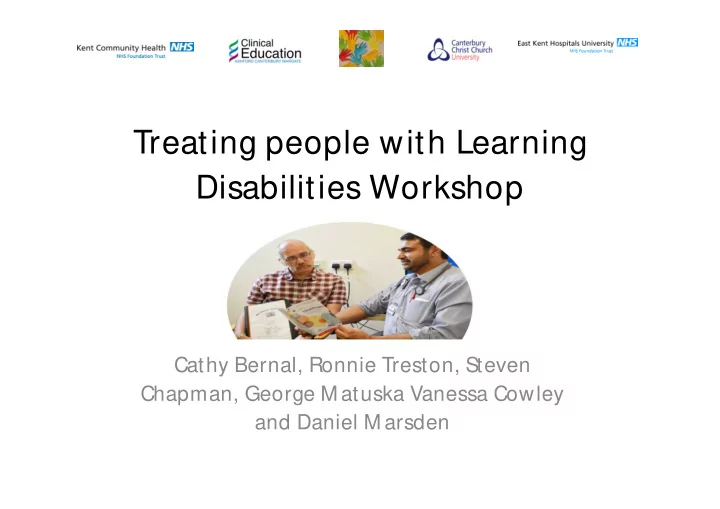
Treating people with Learning Disabilities Workshop Cathy Bernal, - - PowerPoint PPT Presentation

treating people with learning disabilities workshop
SMART_READER_LITE
LIVE PREVIEW

Treating people with Learning Disabilities Workshop Cathy Bernal, - - PowerPoint PPT Presentation

Treating people with Learning Disabilities Workshop Cathy Bernal, Ronnie Treston, Steven Chapman, George M atuska Vanessa Cowley and Daniel M arsden Workshop outline What is a learning disability? Experts by experience perspectives


slide-1
SLIDE 1

Treating people with Learning Disabilities Workshop

Cathy Bernal, Ronnie Treston, Steven Chapman, George M atuska Vanessa Cowley and Daniel M arsden

slide-2
SLIDE 2

Workshop outline

  • What is a learning disability?
  • Experts by experience

perspectives

  • Interactive and Scenario based

sessions

  • National and local evidence
  • Legal Frameworks
  • Leadership and Service

Improvement opportunities

slide-3
SLIDE 3

Workshops Background

  • HEKSS funded
  • 5 Workshops and one

end point conference

  • Collaborative project
slide-4
SLIDE 4

What is a learning disability?

  • The Department of Health defines a

Learning Disability as including the presence of:

  • A significantly reduced ability to

understand new or complex information, or learn new skills (impaired intelligence), with;

  • A reduced ability to cope

independently (impaired social functioning);

  • Which started before adulthood,

with a lasting effect on development.

slide-5
SLIDE 5

Confusing terms

M ental impairment

Used within the UK legal system

M ental Retardation

M ost commonly used term across 147 countries sample by WHO in 2007 76%

Learning Difficulties

Used within UK educational system

Intellectual disability

Learning Disability M ental Handicap

slide-6
SLIDE 6

National Evidence Base

slide-7
SLIDE 7

Coverage of Health Checks by region 2012/ 13

7 Annual LD Health Checks 2012/ 13 www.ihal.org.uk/annualhealthchecks

slide-8
SLIDE 8

Bar chart comparing admissions to EKHUFT services pwld vs general population (Bailey & M arsden, 2013)

100 200 300 400 500 600 DayCase Elective NonElective POD Rate per 1000

Number of admissions per 1 000 (LD) Number of admissions per 1 000 (All)

slide-9
SLIDE 9

Coverage of Health Checks 2013/ 14 (Glover &

Brodigan, 2014)

60% 57% 56% 54% 52% 52% 51% 50% 49% 48% 48% 47% 46% 44% 44% 44% 43% 43% 43% 41% 41% 40% 31% 28% 17% 10% 0% 10% 20% 30% 40% 50% 60% 70% Cheshire, Warrington And Wirral Cumbria, Northumberland, Tyne And Wear Hertfordshire And The South Midlands Merseyside Arden, Herefordshire And Worcestershire Leicestershire And Lincolnshire Durham, Darlington And Tees Bristol, N. Somerset, Somerset And S. Glos. London East Anglia West Yorkshire Greater Manchester Thames Valley Essex England Shropshire And Staffordshire South Yorkshire And Bassetlaw Derbyshire And Nottinghamshire Birmingham And The Black Country Lancashire North Yorkshire And Humber Kent And Medway Wessex Devon, Cornwall And Isles Of Scilly Bath, Gloucestershire, Swindon And Wiltshire Surrey And Sussex

Learning Disability Health Checks 2013/ 14 9

slide-10
SLIDE 10

How people with learning disabilities used EKHUFT services compared to the general population in 2014/ 15 (M arsden & Bailey, 2014)

slide-11
SLIDE 11

Repeated Admissions to EKHUFT services 2012 - 2015 (Bailey & M arsden, 2015)

slide-12
SLIDE 12

What is the M CA

  • A statutory framework to …

  • empower and protect vulnerable people who may

not be able to make their own decisions

  • make clear who can take decisions in which

situations and how they should go about this

  • enable people to plan ahead for a time when they

may lose capacity

slide-13
SLIDE 13

Assessing lack of capacity

  • Single test for assessing capacity to take a

particular decision at a particular time

  • Decision-specific test
  • No one to be labelled ‘incapable’ as a result of

a particular diagnosis

  • THISdecision at THIStime for THISindividual
slide-14
SLIDE 14

5 key principles

  • 1. A person must be assumed to have capacity unless it is established that

they lack capacity.

  • 2. A person is not to be treated as unable to make a decision unless all

practicable steps to help him to do so have been taken without success.

  • 3. A person is not to be treated as unable to make a decision merely because

he makes an unwise decision.

  • 4. An act done, or decision made, under this Act for or on behalf of a person

must be done, or made, in their best interests.

  • 5. Before the act is done, or the decision is made, regard must be had to

whether the purpose for which it is needed can be as effectively achieved in a way which is less restrictive of the person’s rights and freedom of action.

slide-15
SLIDE 15

Assessing capacity

Assessing capacity is:

  • Decision specific, time specific

– Because capacity can be decision and/ or time specific

  • Has a 2 stage test:
  • 1. Does the person have an impairment of the mind or brain?
  • 2. If so, does that impairment mean the person is unable to

make the decision at the time it needs to be made?

slide-16
SLIDE 16

Assessing ability to make a decision

A person is unable to make a decision if they cannot: 1. understand relevant information about the decision to be made 2. retain that information in their mind 3. use or weigh that information as part of the decision- making process, or 4. communicate their decision by any means.

slide-17
SLIDE 17

Best interests - The decision maker must:

1. Involve the person who lacks capacity 2. Have regard for past and present wishes, feelings, values, beliefs and especially any written statements 3. Consult with and take into account others who are involved in the care of the person, especially any legally appointed person, eg a Lasting Power of Attorney (LPA) or Independent M ental Capacity Advocate (IM CA) 4. Not make assumptions based solely on the person’s age, appearance, condition or behaviour 5. Demonstrate and document the process of decision-making

slide-18
SLIDE 18

What may trigger an assessment of mental capacity?

  • The way a person behaves
  • Concerns raised by someone else
  • Receiving a diagnosis
  • M ajor change in care provision
slide-19
SLIDE 19

Factors to be considered

  • General intellectual ability
  • M emory
  • Attention and concentration
  • Reasoning
  • Information processing
  • Communication (understanding and expression)
  • Cultural influences
  • Social context
slide-20
SLIDE 20

What are Reasonable Adjustments?

slide-21
SLIDE 21

4C Framework for M aking Reasonable Adjustments (Giles & M arsden, 2014)

slide-22
SLIDE 22

Tools for Adjustments

  • Easy Health website
  • Hospital/ Healthcare Passports
  • Hospital Communication Book
  • Books Beyond Words
  • DisDAT pain assessment tool
slide-23
SLIDE 23

Reasonable Adjustments : Case studies

  • 2 basic case studies to

work up

  • No right or wrong

answers

  • Consider the legal and

4C’s Framework Questions

What are you first thoughts?

What questions do you have?

How could you answer those questions?

What action would you take?

slide-24
SLIDE 24

Care pathway activity

  • Areas for

consideration:-

– What can you learn

from that experience?

– What are the

assumptions care pathways based on?

  • Activity

– Plot the pathway

for the individual.

– Plot the

adjustments that could be made.

slide-25
SLIDE 25

Y

  • ur Care Pathways
  • Plot how people come to

your service

  • Include the steps of your

service

  • Exit point from your

service

  • Thinking about 4C’s, are

there any adjustments that could be made?

slide-26
SLIDE 26

Other reference points

  • Kent and M edway Learning Disability

Community of Practice https:/ / kentlivewell.wordpress.com/

  • Social M edia for Networking

http:/ / www.wecommunities.org/

  • HEKSS Urgent Care Report

http:/ / www.canterbury.ac.uk/ News/ n ewsRelease.asp?newsPk=2367

slide-27
SLIDE 27

What’s next?

  • What adjustments

could you make?

  • What are the first

actions to having this happen?

  • Final Conference?
slide-28
SLIDE 28

References

  • Guba, E. G., & Lincoln, Y

. S. (1994). Competing paradigms in qualitative research. In N. K. Denzin & Y . S. Lincoln (Eds.), Handbook of qualitative research (pp. 105-117). Thousand Oaks, CA: Sage.

  • DoH (2001) Valuing People. Available online at

https:/ / www.gov.uk/government/ uploads/system/ uploads/attachment_data/ file/ 250877/ 5086.pdf

  • M encap (2007) Death by Indifference available online at https:/ / www.mencap.org.uk/ death-by-indifference
  • M ichaels (2008) Healthcare for all. Available online at http:/ /goo.gl/ 4PJH3C
  • PHSO (2009) Six Lives. Available online at http:/ /goo.gl/ 5NTeuO
  • M encap (2012) Death by Indifference – 74 Deaths and Counting. Available online at https:/ / www.mencap.org.uk/ 74deaths
  • University of Bristol (2013) Confidential Inquiry into Prematures Deaths of people with learning disabilities. Available online

at http:/ / www.bris.ac.uk/cipold/

  • DoH (2012) Transforming Care. Available online at

https:/ / www.gov.uk/government/ uploads/system/ uploads/attachment_data/ file/ 213215/ final-report.pdf

  • Glover (2013) Uptake of Learning Disability Health checks 2012/ 13 http:/ /goo.gl/ TnoLZW
  • Bailey & M arsden (2013) EKHUFT Patients with learning disabilities Information report 2013. Available online at

www.ekhuft.nhs.uk/ learningdisabilities

  • Glover & Brodigan (2014) Uptake of Learning Disability Health Checks 2013/ 14 http:/ /goo.gl/ EjB678
  • Bailey & M arsden ( 2014) EKHUFT Patients with learning disabilities Information report 2014 Available online at

www.ekhuft.nhs.uk/ learningdisabilities

  • Giles & M arsden (2014) 4C’s Framework for M aking Reasonable Adjustments. Available online

www.ekhuft.nhs.uk/ learningdisabilities