
SLIDE 1
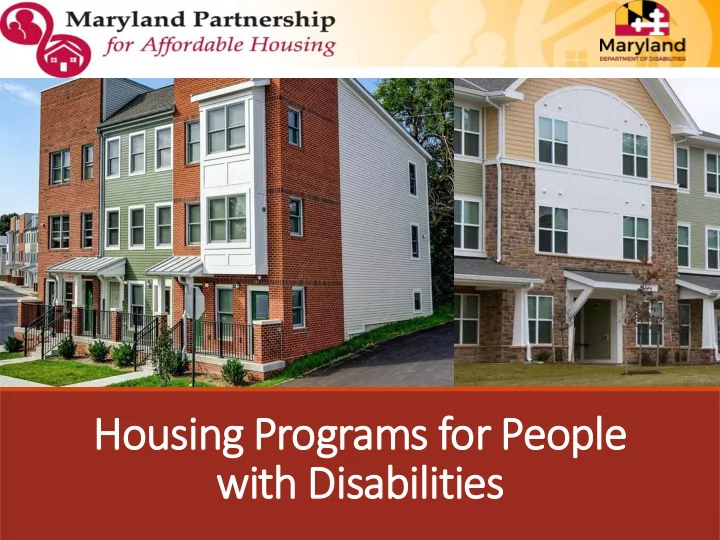
Housing Programs for People with Disabilities We believe that - - PowerPoint PPT Presentation
Housing Programs for People with Disabilities We believe that People control where and with whom they live. People live in inclusive communities. People choose who will best support them to meet their goals and needs. Environments support
and utilities combined
Housing Affordability
household income in a Federally defined area
Area Median Income (AMI)
Fair Market Rent (FMR)
HH members
Household (HH)
Public Housing Agency/Authority (PHA)
Priced Out in 2016*
disabilities on SSI living in Maryland
SSI are at 19.9% of AMI
– lowest in the Nation!
bedroom rent is $1,222 which is 167% of SSI
Out of Reach 2019*
income renter households have a severe cost burden
income renter households have a disability
bedroom apartment in Howard County is $20.65. Howard County minimum wage is $10.10.
bedroom is $1,074.
Housing is separate from services Supports & services are
required Person controls where & with whom they live Housing is integrated in community
❑ Apply for services ❑ Apply for SSI ❑ Create a circle of support ❑ Establish credit ❑ Create a budget ❑ Identify financial resources ❑ Make a housing plan ❑ Find support staff
6
Consumer Financial Protection Bureau: https://www.consumerfinance.gov/
Your Money Your Goals Building credit: https://www.consumerfinance.gov/ask-
cfpb/i-want-to-help-my-daughter-start-her-credit-history- what-should-i-do-en-1643/
Federal Deposit Insurance Corporation https://www.fdic.gov/consumers/consumer/moneysmart/
7
Developing a Housing Strategy: Gather Information
What is the person’s income? In which cities and/or towns does the person choose to live? Does the person need to live close to public transportation, shopping, medical facilities, faith-based organization, family? What size unit does the person need, considering other household members, live- in aide and/or need to store medical equipment? Are special design features needed, such as accessibility? Does the person have any identified barriers to housing, such as a criminal background, poor credit or poor rental history?
9
Project-Based Rental Assistance
in a building.
individual must live in that unit.
Tenant-Based Rental Assistance
community.
participants move, the subsidy moves with them.
Maryland Mainstream Awards 2019
New HUD funding for tenant-based Housing Choice Vouchers for households that include a person with a disability. Prioritizes people living in institutions & congregate settings, homeless
An additional NOFA notice will be published in FY20.
PHA Number Frederick City 30
100 Howard County 26 Washington County 15 Cecil County 30 Carroll County 31 Baltimore County 25
www.gosection8.com
www.mdhousingsearch.org
voucher)
MD Department of Housing and Community Development MD Department of Disabilities MD Department of Health
people with disabilities.
2020.
Age: between 18 and 62 at time of leasing Disabled and receiving SSI and/or SSDI cash payment Gross household income between 10% and 30% AMI in the county in which the unit is located Criminal background does not include
property Tenant Rent Contribution
Weinberg Apartments Prioritization and Unit Identification
Priority: Location of unit and those with greatest need. Factors considered include (not in any order)
promote independent living and successful tenancy
Unit selection
$21 million for project- based rental assistance
received award for $11 million in HUD 811 PRA
received award for additional $10 million
submitted another application for HUD 811 PRA funding
2nd Award is Statewide Locations: 1st Award
811 PRA Program Overview
Program Type
affordable housing funds
for people with disabilities
Eligible Applicants
Tenant Rent Contribution
Goal: 300 permanent supportive housing units
individuals with intellectual disability, state psychiatric hospital, chronic hospital
home due to accessibility needs; deplorable housing conditions
Brain Injury waiver ALU, BHA Residential Rehabilitation Program, OHCQ-licensed Assisted Living Facility
1-Person Household 2-Person Household
Jurisdiction Area Median Income (AMI) Income Limit 30% Income Limit 30% Baltimore Metro Area $101,000 $21,250 $24,250 Washington, D.C. Metro Area $121,300 $25,500 $29,150 Statewide Non-Metro $101,300 $21,250 $24,300
MDOD manages the waitlist and referral process for Weinberg Apartments, Section 811, MFP Bridge Subsidy and CCH. Applications must be submitted by a person’s Coordinator of Community Services (CCS) or case manager
This is a secure, online, centralized eligibility screening tool to help Case Managers determine which housing programs their consumers are eligible for and refer them to the appropriate program.
Housing Documentation Checklist
❑ Birth certificate (all household members) ❑ https://health.Maryland.gov/vsa/Pages/birth.aspx ❑ Valid Government Issued Photo ID (passport or state ID) - all household members over age 18 ❑ Social Security card (all household members) ❑ Proof of citizenship/legal status (if applicable) ❑ Child Custody - Court documentation showing custody or guardianship ❑ Divorce decree or separation agreement, if applicable
Housing Documentation Checklist
❑ Social Security Award Letter - NO MORE THAN 60 DAYS OLD
needed stating this and that applicant is not currently receiving any SSI/SSDI ❑ Income
❑ Documentation of all mortgages held on property currently owned along with rental info if renting the property ❑ Checking Account or Direct Express: 6 most recent ❑ Savings, Retirement Plans, IRAs, Money Markets, Mutual Funds, annuities, stocks, 401(k) accounts, life insurance – most recent statement ❑ TDAP or TANF—documentation of amount received ❑ Child Support—documentation of amount received; paperwork from Child Enforcement Agency; paperwork from court system
WORK ON THIS WITHIN 60 DAYS OF LEASING
Tenant Training Manual:
http://mdod.maryland.gov/housin g/Documents/My%20Own%20Fro nt%20Door%20finalPWP.pdf
Case Management Manual:
http://mdod.maryland.gov/housin g/Documents/Case%20Manager% 20ManualPWP.pdf
Community Development https://www.howardcountymd.gov/Departments/ Housing-and-Community-Development
https://www.howardcountymd.gov/LinkClick.aspx ?fileticket=d3OAYs8CviI%3d&tabid=2944&portalid =0
an equal/fair share of room and board (mortgage, utilities and food).
and utilities: www.marylandable.org
https://mmp.maryland.gov/Pages/HomeAbility/default.aspx
❑ Title VI
❑ Fair Housing Act ❑ Section 504 of the Rehab Act of 1973 ❑ Americans with Disabilities Act
Seven Protected Classes
❑ Race ❑ Color ❑ Religion ❑ Gender ❑ Familial Status ❑ National Origin ❑ Disability
Nationwide, people with disabilities experience the most frequent Fair Housing violations.
Federal Fair Housing Laws
❑ Refuse to rent to someone ONLY because they have an intellectual disability. ❑ Charge someone a higher rent or security deposit because of their
power wheelchair and other equipment a higher rent. ❑ Refuse to allow someone with a disability to use the residential
laundry facilities. ❑ Deny eligibility to a supportive housing program because the applicant is blind
Reasonable Accommodation: A change, exception, or adjustment to a rule, policy, practice, or service that may be necessary for a person with a disability to have an equal
use and enjoy a dwelling. Reasonable Accommodations require a housing provider to do more: they must make changes in rules, procedures, policies, practices or services if necessary to afford a person with a disability equal opportunity to use and enjoy a dwelling.
Reasonable modifications are paid for by the person unless Federal funding
resources (including LIHTC) are involved. Applies to builders, developers, property managers and
housing related activities Reasonable Modification: A structural change to housing that may be needed by a person with a disability in order to benefit from the housing because of the disability
State and Federal Housing and Community Development Legislative Updates
State ▪ HOME Act (SB 530/HB231) ▪ Community Development Program Act (SB 387/HB472) ▪ Property Tax Credit for Disabled Veterans (SB 417/HB 257) ▪ Property Tax Exemption – Disabled Veterans (SB 349) ▪ Frederick County – Grants for Elderly or Disabled Renters (SB 264) ▪ Residential Leases – Tenant Protection Act (HB 744) ▪ Workgroup on Funding for a Low- or No-Interest Mortgage Program (SB 568/HB 815) ▪ Affordable Housing Development Credit Program (SB 715/HB1567) Federal ▪ Housing Choice Voucher Mobility (HR 1122) ▪ Affirmatively Furthering Fair Housing changes (https://www.hud.gov/press/press_releases_med ia_advisories/HUD_No_20_002) ▪ Community Reinvestment Act (CRA) changes (https://www.occ.treas.gov/news- issuances/news-releases/2019/nr-ia-2019- 147.html)
“I love my new place. It’s close to tons
and I feel right at home.”
~ Linda C. - Weinberg Apartments Participant
Chelsea Hayman Director of Housing Policy and Programs Maryland Department of Disabilities chelsea.hayman@maryland.gov 410-767-3635