Trappers, Traders, Trailblazers: Mountain Men in the Rocky - - PowerPoint PPT Presentation

trappers traders
SMART_READER_LITE
LIVE PREVIEW

Trappers, Traders, Trailblazers: Mountain Men in the Rocky - - PowerPoint PPT Presentation

Trappers, Traders, Trailblazers: Mountain Men in the Rocky Mountain West Buffalo Bill Center of the West Supplemental Skype in the Classroom Presentation Timber Jack Joe and His Fox by James Bama (19.98) In Search of Furs For hundreds of

slide-1
SLIDE 1

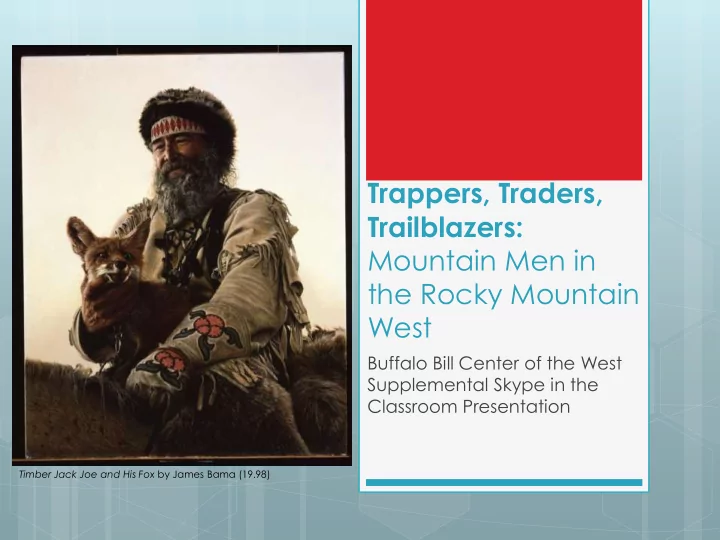
Trappers, Traders, Trailblazers: Mountain Men in the Rocky Mountain West

Buffalo Bill Center of the West Supplemental Skype in the Classroom Presentation

Timber Jack Joe and His Fox by James Bama (19.98)

slide-2
SLIDE 2

For hundreds of years, well-to- do Europeans made furs a part of their attire. They wore fur coats, cloaks, and robes; fur trim on dresses, collars, and bonnets; and men’s top hats made from beaver fur. The French, and later the British, trapped beaver through areas of North America beginning in the 1600s. Reports by Lewis and Clark, and the stories of John Colter, enticed trappers, traders, and trailblazers to the Rocky Mountain West in the 1820’s. In Search of Furs

Beaver Felt Hat (3.78.19A)

slide-3
SLIDE 3

Mountain men were self- sufficient for the following reasons:

  • 1. They could only take

essential items that they were able to carry, and sometimes a packhorse or mule.

  • 2. They had to hunt for their

food, build shelter, and repair their guns and traps.

  • 3. They had to mend and

make their own clothes.

  • 4. They had to check their

traps, prepare pelts daily, and haul the pelts out of the mountains. The Life of the Mountain Men

  • Mr. Mountain Man by Richard V. Greeves (5.71)
slide-4
SLIDE 4

Frederic Remington provided a detailed account of the mountain man’s appearance in this drawing. A mountain man always carried the necessary tools with him. These included his rifle, his tomahawk, and his possibles bag. A possibles bag carried the mountain man’s necessities, such as knife and flint. Describe what the mountain man in the drawing is

  • wearing. Why do you think he

chose this clothing? Art of the Mountain Man By Frederic Remington

French Trapper by Frederic Remington (61.72)

slide-5
SLIDE 5

Art of the Mountain Man By John Clymer The Free Trapper, painted by John Clymer in 1967, is a more modern painting looking back at the romantic image of the mountain man. This painting shows the mountain man on horseback leading a

  • packhorse. He was

free to travel long distances with the help of the horse. The packhorse carried supplies and beaver

  • pelts. Clymer tried to

portray the mountain man as an explorer.

The Free Trapper by John Clymer (6.74)

slide-6
SLIDE 6

Alfred Jacob Miller completed Louis—Rocky Mountain Trapper in 1837. This watercolor is similar to Frederic Remington’s drawing. They are both historical documentations of the mountain man’s appearance. This portrait reflects a mountain man that Miller actually met. Miller was able to travel west and meet the real trappers, traders, and trailblazers in his journey. This watercolor also shows the mountain men’s need to hunt for survival. Wild meat was

  • ften their only source of food.

Art of the Mountain Man By Alfred Jacob Miller

Louis—Rocky Mountain Trapper by Alfred Jacob Miller (36.64)

slide-7
SLIDE 7

Art of the Mountain Man By Alfred Jacob Miller Alfred Jacob Miller’s

  • riginal painting, Our

Camp, depicts a rendezvous site in

  • Wyoming. It is not a

recreation of an event from a story told by someone else. Rendezvous usually took place in the summer on or around present day Green River, Wyoming, but there were others in Wyoming, Utah, and

  • Idaho. Native

Americans, suppliers, and trappers all attended the rendezvous.

Our Camp by Alfred Jacob Miller (11.70)

slide-8
SLIDE 8

Art of the Mountain Man By Alfred Jacob Miller Miller painted Trapper Saluting the Rocky Mountains depicting his memory of the West. He presented the awe and amazement a mountain man must have felt when seeing the Rocky Mountains for the first time.

Trapper Saluting the Rocky Mountains by Alfred Jacob Miller (10.70)

slide-9
SLIDE 9

Art of the Mountain Man By W.H.D Koerner W.H.D. Koerner created this painting, Blackfoot Captive, in 1931. It depicts the capture of a mountain man by warriors of the Blackfeet

  • tribe. Some tribes, such as

the Blackfeet, saw the mountain men as a threat to their way of life. Mountain men did make friends with many other American Indian tribes. They depended on these tribes for survival.

Blackfoot Captive by W.H.D. Koerner (18.77)

slide-10
SLIDE 10

Harvey T. Dunn created The Scout in 1910. The painting gives a lasting impression of the nobility of the mountain

  • man. After the beaver

population drastically declined and their demand decreased, mountain men became guides or scouts for the traveling wagon trains heading to the West. The mountain man was the perfect candidate to lead the wagon trains to the best route to Oregon and California, because they had already explored its unknown territory and learned to survive in its hostile environment. Art of the Mountain Man By Harvey T. Dunn

The Scout by Harvey T. Dunn (5.77)

slide-11
SLIDE 11

Beaver Traps and Pelts A mountain man usually owned six to eight traps. Each trap weighed up to ten pounds. He carried these with his other supplies. A mountain man checked his traps every day. When a trap had a beaver in it, he pulled it to shore to retrieve the beaver and reset his trap. The beaver pelt, or plew, was often used to make men’s beaver felt top hats.

Beaver traps and beaver pelt (or plew) on willow branches bent in circle

slide-12
SLIDE 12

The mountain man carried a leather pouch called a possible bag. A possible bag contained everything a mountain man needed to survive in the wilderness. The mountain man carried the supplies he needed in the bag. He carried:

  • a metal tobacco tin with

a glass disk to hold tobacco or flint and steel strikers to start fires

  • a spoon made from cow
  • r buffalo horn and a

crude fork

  • Beads and trinkets for

trade with the American Indians Possibles Bag

Possibles bag

slide-13
SLIDE 13

Flint and Striker To start a fire with a flint and striker, the mountain man first prepared a nest of dry grass or other dry materials. He placed a piece of charcloth (partially burned or charred cloth), if it was available, in an angle of the flint to catch the spark. He then hit the edge of the flint nearest the charcloth with the striker. This created sparks that the charcloth or tinder nest caught. He then blew lightly on the sparks until the added tinder caught fire.

Tobacco tin, striker, and flint

slide-14
SLIDE 14

Mountain men frequently encountered American Indian tribes in their trapping areas. Friendly tribes were eager to acquire some of the trade goods the mountain men brought with them. The mountain men also wanted items, such as fur and new clothing, that the American Indians had available. The mountain carried glass beads from Italy, brass bells, tin cones, wool blankets, metal knives, and cast iron pots to trade with the American Indians. Trade Goods

Trade goods (beads) from possibles bag

slide-15
SLIDE 15

When a mountain man’s store-bought coat wore

  • ut, he or an American

Indian made a new coat, called a capote, out of a

  • blanket. The mountain man

used the “tails” on the hood for decoration as well as a tie to secure the hood under his chin and to protect his neck from the

  • cold. The mountain man

wore his regular belt over the capote. This kept his knife and tomahawk accessible, even when he was bundled up against the winter weather. Capote (ka-poat)

Capote (NA.202.481) and Hudson Bay Four Point Blanket (NA.202.449)

slide-16
SLIDE 16

The mountain man wore clothing that was similar to what men wore in the United States at that time. When these clothes wore out, the mountain man used his old clothes for a pattern to make new garments out of the tanned hides of the deer, elk, moose, and buffalo he hunted. Although, they preferred the tailored clothing they were used to wearing, mountain man did wear the moccasins

  • f the American Indians.

Moccasins were easy to make, comfortable to wear, and lightweight to carry. Clothing

Mountain Man’s coat (NA.202.590) Mountain Man’s shirt (NA.202.588)

slide-17
SLIDE 17

Knives One or more knives were a vital part of the mountain man’s essential gear. He used his knives for skinning beavers, cutting meat, and defending himself. His knife was especially useful in battle because his flintlock rifle only allowed one shot, making it a complicated process to reload and shoot his rifle.

Mountain man’s knife (top) and sample illustrations of mountain men’s knives (bottom)

slide-18
SLIDE 18

Tomahawks were an essential supply for the mountain man. These small axes or hatchets were also popular trade items with the American Indians. Mountain men used the blade for chopping wood for fires and shelter, and for

  • defense. The back of the

head served as a hammer for pounding a stake that secured the chain on the beaver trap. Tomahawks

Tomahawk

slide-19
SLIDE 19

Local gunsmiths made guns by hand during the time of the mountain men. Each mountain man usually carried a gun of his choice. Later, guns were available at the rendezvous with one

  • r two types of

manufactured guns. The mountain man also carried the tools and supplies to keep his rifle

  • working. Powder horns held

gunpowder and kept it dry. Mountain men melted bars

  • f lead over a fire in a

special ladle. They then poured it into a small mold to make his rifle’s balls. Flintlock Rifle

Illustration of flintlock rifle’s mechanism (top) and powder horn (1.69.400.19) (bottom)

slide-20
SLIDE 20

Hats The mountain man brought his first hat from home. These hats were straw or felt with a wide

  • brim. The hats

wore out quickly, so mountain men had to make new

  • nes. Mountain

men made hats with a few cuts and quick stitches, from tanned skunk, fox, raccoon, coyote,

  • r similar hide.

The Lost Greenhorn by Alfred Jacob Miller (9.70)

slide-21
SLIDE 21

What do you think is the legacy of the mountain men of the Rocky Mountain West?