Transversity IN NUCLEAR PHYSICS AND RELATED AREAS TRENTO, ITALY - - PowerPoint PPT Presentation

transversity
SMART_READER_LITE
LIVE PREVIEW

Transversity IN NUCLEAR PHYSICS AND RELATED AREAS TRENTO, ITALY - - PowerPoint PPT Presentation

ECT* EUROPEAN CENTRE FOR THEORETICAL STUDIES Transversity IN NUCLEAR PHYSICS AND RELATED AREAS TRENTO, ITALY Institutional Member of the European Expert Committee NUPECC Tensor Charge overview Castello di Trento (Trint), watercolor 19.8


slide-1
SLIDE 1

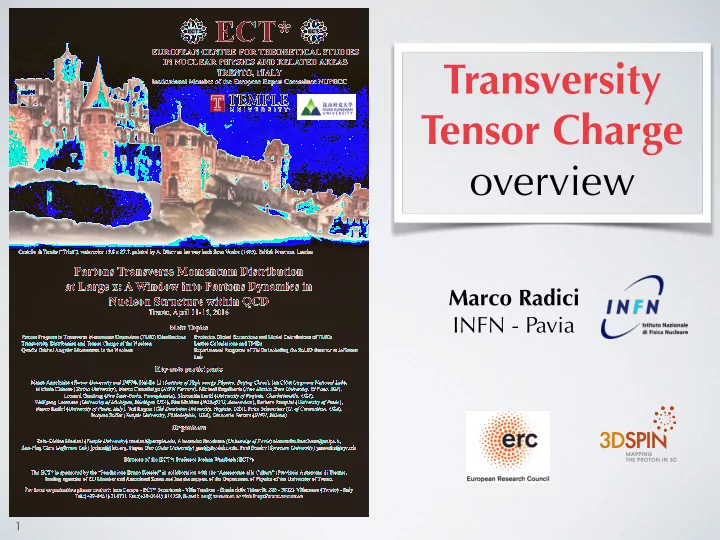
Marco Radici INFN - Pavia

Transversity Tensor Charge

  • verview

1

  • ECT*

EUROPEAN CENTRE FOR THEORETICAL STUDIES IN NUCLEAR PHYSICS AND RELATED AREAS TRENTO, ITALY

Institutional Member of the European Expert Committee NUPECC

Castello di Trento (“Trint”), watercolor 19.8 x 27.7, painted by A. Dürer on his way back from Venice (1495). British Museum, London

Partons Transverse Momentum Distribution at Large x: A Window into Partons Dynamics in Nucleon Structure within QCD

Trento, April 11-15, 2016

Main Topics Key-note participants

Mauro Anselmino (Torino University and INFN), Hai-Bo Li (Institute of High energy Physics, Beijing China), Ian Clöet (Argonne National Lab), Michela Chiosso (Torino University), Marco Contalbrigo (INFN Ferrara), Michael Engelhardt (New Mexico State University, El Paso, NM), Leonard Gamberg (Pen State-Berks, Pennsylvania), Simonetta Liutti (University of Virginia, Charlottesville, USA), Wolfgang Lorenzon (University of Michigan, Michigan USA), Piet Mulders (Nikhef/VU, Amsterdam), Barbara Pasquini (University of Pavia), Marco Radici (University of Pavia, Italy), Ted Rogers (Old Dominion University, Virginia, USA), Peter Schweitzer (U. of Connecticut, USA), Jacques Soffer (Temple University, Philadelphia, USA), Giancarlo Ferrara (INFN, Milano)

Organisers

Zein-Eddine Meziani (Temple University) meziani@temple.edu, Alessandro Bacchetta (University of Pavia) alessandro.bacchetta@unipv.it, Jian-Ping Chen (Jefferson Lab) jpchen@jlab.org, Hayan Gao (Duke University) gao@phy.duke.edu, Paul Souder (Syracuse University) pasouder@syr.edu Director of the ECT*: Professor Jochen Wambach (ECT*) The ECT* is sponsored by the “Fondazione Bruno Kessler” in collaboration with the “Assessorato alla Cultura” (Provincia Autonoma di Trento), funding agencies of EU Member and Associated States and has the support of the Department of Physics of the University of Trento. For local organization please contact: Ines Campo - ECT* Secretariat - Villa Tambosi - Strada delle Tabarelle 286 - 38123 Villazzano (Trento) - Italy Tel.:(+39-0461) 314721 Fax:(+39-0461) 314750, E-mail: ect@ectstar.eu or visit http://www.ectstar.eu Recent Progress in Transverse Momentum Dependent (TMD) Distributions Transversity Distribution and Tensor Charge of the Nucleon Quarks Orbital Angular Momentum in the Nucleon Evolution Global Extractions and Model Calculations of TMDs Lattice Calculations and TMDs Experimental Programs of TMDs including the SoLID detector at Jefferson Lab

slide-2
SLIDE 2

U L T U

f1

h1

L

g1L

h1L

T f1T

g1T

h1 h1T

=

1

f

pT nucleon polarization

leading-twist TMD map

quark polarization

slide-3
SLIDE 3

U L T U

f1

h1

L

g1L

h1L

T f1T

g1T

h1 h1T

=

1

f

pT nucleon polarization f1 g1 h1

leading-twist TMD map PDF map

=

1

h

  • =

g1

=

1

f

quark polarization

slide-4
SLIDE 4

U L T U

f1

h1

L

g1L

h1L

T f1T

g1T

h1 h1T

=

1

f

pT nucleon polarization f1 g1 h1

leading-twist TMD map PDF map

=

1

h

  • =

g1

=

1

f

f1 from fits of thousands data

~ 3000 CT14, arXiv:1506.07443 ~ 4000 CJ12, P.R. D84 (11) 014008 ~ 4300 NNPDF3.0, JHEP 1504 (15) 040 …. ~ 500 NNPDFpol1.1, N.P. B887 (14) 276

( ~ 2500 (?) JAM

arXiv:1601.07782 ) 268 “Collins” Anselmino et al., P.R. D92 (15) 114023 68 “DiFF” Radici et al., JHEP 1505 (15) 123

g1 from fits of hundreds data h1 from fits of tens data

poorly known

quark polarization

slide-5
SLIDE 5

5

=

1

h

  • transversity is very different from helicity
  • =

g1

boosted Nucleon

helicity basis

g1 diagonal

h1 non diagonal ( “chiral-odd” )

no h1 for gluons ( in Nucleon )

pure non-singlet evolution

Transversity : Why

slide-6
SLIDE 6

6

=

1

h

  • transversity is very different from helicity
  • =

g1

boosted Nucleon

helicity basis

g1 diagonal

h1 non diagonal ( “chiral-odd” )

no h1 for gluons ( in Nucleon )

pure non-singlet evolution

Transversity : Why

playground for tests of perturbative and nonperturbative QCD

slide-7
SLIDE 7

7

1st Mellin moment of transversity ⇒ tensor “charge”

Tensor Charge

δq ≡ gq

T =

Z 1 dx ⇥ hq

1(x, Q2) − h¯ q 1(x, Q2)

slide-8
SLIDE 8

8

tensor “charge” gT scales with Q2 C-odd

1st Mellin moment of transversity ⇒ tensor “charge” axial charge gA conserved C-even

Tensor Charge

δq ≡ gq

T =

Z 1 dx ⇥ hq

1(x, Q2) − h¯ q 1(x, Q2)

no associated conserved current in LQCD

slide-9
SLIDE 9

9

tensor “charge” gT scales with Q2 C-odd

1st Mellin moment of transversity ⇒ tensor “charge” axial charge gA conserved C-even

Tensor Charge

δq ≡ gq

T =

Z 1 dx ⇥ hq

1(x, Q2) − h¯ q 1(x, Q2)

no associated conserved current in LQCD tensor charge not directly accessible in LSM low-energy footprint of new physics at higher scales ?

slide-10
SLIDE 10

10

potential for BSM discovery ?

search for new physics Beyond Standard Model

direct access indirect access virtual effects MBSM high energy E Eexp ≪ MBSM low energy high precision

slide-11
SLIDE 11

11

potential for BSM discovery ?

search for new physics Beyond Standard Model

direct access indirect access virtual effects MBSM high energy E Eexp ≪ MBSM low energy high precision

footprint: new local

  • perators

W g g

GF ~ g2/Mw2

Example: weak CC interaction

q2 ≪ MW2

slide-12
SLIDE 12

gV gA

potential for BSM discovery ?

Example: neutron β−decay n → p e− νe

_

(+ radiative corr.’s…)

LSM ⇠ GF Vud ¯ eγµ(1 γ5)νe hp|¯ uγµ(1 γ5)d|ni

q2 ∼ (Mp − Mn)2 ≈ 0

tree-level SM, V-A universality

GF ∼ g2 M 2

W

slide-13
SLIDE 13

gV gA

13

potential for BSM discovery ?

Example: neutron β−decay n → p e− νe

1/Λ2

2

_

(+ radiative corr.’s…)

LSM ⇠ GF Vud ¯ eγµ(1 γ5)νe hp|¯ uγµ(1 γ5)d|ni

q2 ∼ (Mp − Mn)2 ≈ 0

Γ = V-A, V+A, 1, γ5, σμν

gS , gP , gT tree-level SM, V-A universality effective couplings

+Leff ⇠ GF Vud X

Γ

h ✏Γ ¯ e Γ ⌫eL hp|¯ uΓd|ni + . . . i

GF ∼ g2 M 2

W

slide-14
SLIDE 14

gV gA

14

potential for BSM discovery ?

precision of measurement

Example: neutron β−decay n → p e− νe

1/Λ2

2

_

(+ radiative corr.’s…)

LSM ⇠ GF Vud ¯ eγµ(1 γ5)νe hp|¯ uγµ(1 γ5)d|ni

q2 ∼ (Mp − Mn)2 ≈ 0

Γ = V-A, V+A, 1, γ5, σμν

gS , gP , gT

✏Γ gΓ ≈ M 2

W

M 2

BSM

bound on BSM scale

precision of 0.1% ⇒ [3-5] TeV for BSM scale

tree-level SM, V-A universality effective couplings

+Leff ⇠ GF Vud X

Γ

h ✏Γ ¯ e Γ ⌫eL hp|¯ uΓd|ni + . . . i

GF ∼ g2 M 2

W

slide-15
SLIDE 15

15

neutron β−decay and tensor charge

tensor contribution to neutron β-decay Leff, T ⇠ GF Vud ✏T ¯ e µν ⌫eL hp|¯ u µν d|ni

slide-16
SLIDE 16

16

neutron β−decay and tensor charge

tensor contribution to neutron β-decay Leff, T ⇠ GF Vud ✏T ¯ e µν ⌫eL hp|¯ u µν d|ni

same structure of isovector component of 1st Mellin moment of transversity

isospin symmetry

hp, Sp| ¯ u σµνu ¯ d σµνd |p, Spi

hp, Sp| ¯ q σµν q |p, Spi =

  • P µSν

p P νSµ p

  • gq

T (Q2)

=

  • P µSν

p P νSµ p

Z dx hq−¯

q 1

(x, Q2)

slide-17
SLIDE 17

17

neutron β−decay and tensor charge

tensor contribution to neutron β-decay Leff, T ⇠ GF Vud ✏T ¯ e µν ⌫eL hp|¯ u µν d|ni

same structure of isovector component of 1st Mellin moment of transversity

isospin symmetry

hp, Sp| ¯ u σµνu ¯ d σµνd |p, Spi

hp, Sp| ¯ q σµν q |p, Spi =

  • P µSν

p P νSµ p

  • gq

T (Q2)

=

  • P µSν

p P νSµ p

Z dx hq−¯

q 1

(x, Q2)

knowledge of isovector tensor charge gTu-d affects precision of tensor coupling GF Vud εT gT in β-decay

slide-18
SLIDE 18

18

CP violation in BSM

in some BSM theories, the leading CP-violating (CPV) couplings are related to fermion Electric Dipole Moments (EDM)

LCPV ⊃ ie X

f=u,d,s,e

df ¯ f σµνγ5 f F µν

F µν = ∂µAν − ∂νAµ

neutron EDM

dn = gu

T du + gd T dd + gs T ds

slide-19
SLIDE 19

19

CP violation in BSM

in some BSM theories, the leading CP-violating (CPV) couplings are related to fermion Electric Dipole Moments (EDM)

LCPV ⊃ ie X

f=u,d,s,e

df ¯ f σµνγ5 f F µν

F µν = ∂µAν − ∂νAµ

neutron EDM

dn = gu

T du + gd T dd + gs T ds

  • exp. bounds

+ improved knowledge

  • n flavor-diagonal

tensor charges

slide-20
SLIDE 20

20

CP violation in BSM

in some BSM theories, the leading CP-violating (CPV) couplings are related to fermion Electric Dipole Moments (EDM)

LCPV ⊃ ie X

f=u,d,s,e

df ¯ f σµνγ5 f F µν

F µν = ∂µAν − ∂νAµ

neutron EDM

dn = gu

T du + gd T dd + gs T ds

  • exp. bounds

+ improved knowledge

  • n flavor-diagonal

tensor charges constraints on CP violation encoded in q EDM

slide-21
SLIDE 21

21

Present extractions of transversity

U L T U

f1

h1

L

g1L

h1L

T f1T

g1T

h1 h1T

nucleon polarization

h1

quark polarization

h1 “considered” as a TMD

H⊥

1 (z, pT )

h1(x, kT )

Collins funct.

TMD factorization

slide-22
SLIDE 22

22

Present extractions of transversity

U L T U

f1

h1

L

g1L

h1L

T f1T

g1T

h1 h1T

nucleon polarization

h1

quark polarization

h1 “considered” as a TMD

H⊥

1 (z, pT )

h1(x, kT )

Collins funct.

TMD factorization

h1 “considered” as a PDF

h1(x)

H^

1 (z, Mh)

collinear factorization

Interference

  • Fragm. Funct. (IFF)
slide-23
SLIDE 23

The status of the art

)

2

(x,Q

1

x h u d x

0.1 0.2 0.3

0.2 0.4 0.6 0.8 1

  • 0.15
  • 0.1
  • 0.05

0.05

Kang et al (2015) Anselmino et al (2013)

TMD factorization

Kang et al., P.R. D93 (16) 014009 Anselmino et al., P.R. D87 (13) 094019

collinear factorization

Radici et al., JHEP 1505 (15) 123 Anselmino et al., 2013 Kang et al., 2015

up down

slide-24
SLIDE 24

The status of the art

1.0

χQSM KPSY15 Lattice

  • 0.4
  • 0.2

0.2 0.4 0.6 0.8 1.0 0.2 0.4 0.6 0.8

x x (δu - δd)

very recently, also lattice calculation of “quasi-transversity” using Ji’s LaMET

Chen et al., arXiv:1603.06664 Kang et al., P.R. D93 (16) 014009 Schweitzer et al., P.R. D64 (01) 034013

slide-25
SLIDE 25

single-hadron fragmentation : the Collins effect

SIDIS

y z x

hadron plane lepton plane

l′ l ST P

h

P

h⊥

φh φS

T

e+ e− qT Ph1 Ph2

dy

PhT1 = -z1

ˆ z

θ

e+e−

Asin(φh+φS)

SIDIS

(x, z, P 2

T ) ∼

P

q e2 q hq 1(x, k2 ⊥) ⊗ H⊥ 1,q(z, p2 ⊥)

P

q e2 q f q 1 (x, k2 ⊥) ⊗ D1,q(z, p2 ⊥)

Acos 2φ1

e+e− (z1, z2,P 2 1T ) ∼

sin2 θ 1 + cos2 θ × P

q e2 q H⊥ 1,q(z1, p2 1⊥) ⊗ H⊥ 1,¯ q(z2, p2 2⊥)

P

q e2 q D1,q(z1, p2 1⊥) ⊗ D1,¯ q(z2, p2 2⊥)

slide-26
SLIDE 26

single-hadron fragmentation : the Collins effect

SIDIS

. . . ⊗ . . . − → Z dk⊥ dp⊥ δ(zk⊥ + p⊥ − PT ) . . .

. . . ⊗ . . . − → Z dp1⊥ dp2⊥ δ(p1⊥ + p2⊥ + P1T z1 ) . . .

y z x

hadron plane lepton plane

l′ l ST P

h

P

h⊥

φh φS

T

e+ e− qT Ph1 Ph2

dy

PhT1 = -z1

ˆ z

θ

e+e−

Asin(φh+φS)

SIDIS

(x, z, P 2

T ) ∼

P

q e2 q hq 1(x, k2 ⊥) ⊗ H⊥ 1,q(z, p2 ⊥)

P

q e2 q f q 1 (x, k2 ⊥) ⊗ D1,q(z, p2 ⊥)

Acos 2φ1

e+e− (z1, z2,P 2 1T ) ∼

sin2 θ 1 + cos2 θ × P

q e2 q H⊥ 1,q(z1, p2 1⊥) ⊗ H⊥ 1,¯ q(z2, p2 2⊥)

P

q e2 q D1,q(z1, p2 1⊥) ⊗ D1,¯ q(z2, p2 2⊥)

slide-27
SLIDE 27

Collins effect : the TORINO extraction

  • separate collinear x (z) and k⊥ (p⊥) dependence
  • Q2-independent Gaussian ansatz for k⊥ (p⊥) dependence

<k2⊥> = 0.57 GeV2 <p2⊥> = 0.12 GeV2 from analysis of SIDIS multiplicities

Anselmino et al., P.R. D92 (15) 114023

  • same Gaussian widths for h1 & f1; different for H1

⊥ & D1

slide-28
SLIDE 28

Collins effect : the TORINO extraction

  • separate collinear x (z) and k⊥ (p⊥) dependence
  • Q2-independent Gaussian ansatz for k⊥ (p⊥) dependence

<k2⊥> = 0.57 GeV2 <p2⊥> = 0.12 GeV2 from analysis of SIDIS multiplicities

Anselmino et al., P.R. D92 (15) 114023

  • same Gaussian widths for h1 & f1; different for H1

⊥ & D1

  • different collinear shape for favored & disfavored H1

  • DGLAP evolution of collinear dependence; Soffer bound built in h1(x,Q0)
  • two schemes: chiral-odd evo for h1 only; or for h1 and H1

slide-29
SLIDE 29

Collins effect : the TORINO extraction

  • separate collinear x (z) and k⊥ (p⊥) dependence
  • Q2-independent Gaussian ansatz for k⊥ (p⊥) dependence

<k2⊥> = 0.57 GeV2 <p2⊥> = 0.12 GeV2 from analysis of SIDIS multiplicities

Anselmino et al., P.R. D92 (15) 114023

  • same Gaussian widths for h1 & f1; different for H1

⊥ & D1

  • different collinear shape for favored & disfavored H1

  • DGLAP evolution of collinear dependence; Soffer bound built in h1(x,Q0)
  • two schemes: chiral-odd evo for h1 only; or for h1 and H1

  • 4 parameters for h1, 5 for H1

⊥ => total 9 fit parameters

  • 122 e+e− data from (z1,z2) dep. and (z1,z2,P1T) dep.
  • global χ2/dof in [0.84 - 1.2] at 95.45% C.L. (⇔ Δχ2 = 17.2)
  • 146 SIDIS data from and

hermes

slide-30
SLIDE 30

Collins effect with TMD evolution

  • first analysis implementing TMD evolution
  • NLO + NLL resummation

Kang et al., P.R. D93 (16) 014009

  • chiral-odd evo for both “PDF terms”, but only homogen. eq. for H(3)
  • different fav. & disfav. “PDF term” H(3) at Q0 “ “ “
  • Soffer bound built in “PDF term” h1(x,Q0) as in TORINO param.
slide-31
SLIDE 31

Collins effect with TMD evolution

  • first analysis implementing TMD evolution
  • NLO + NLL resummation

Kang et al., P.R. D93 (16) 014009

  • chiral-odd evo for both “PDF terms”, but only homogen. eq. for H(3)
  • different fav. & disfav. “PDF term” H(3) at Q0 “ “ “
  • Soffer bound built in “PDF term” h1(x,Q0) as in TORINO param.
  • total 13 fit parameters
  • 122 e+e− data from (z1,z2) dep. and (z1,z2,P1T) dep.
  • global χ2/dof = 0.88 with Δχ2 = 22.3
  • 140 SIDIS data from and and

hermes

slide-32
SLIDE 32

Transversity from Collins effect

)

2

(x,Q

1

x h u d x

0.1 0.2 0.3

0.2 0.4 0.6 0.8 1

  • 0.15
  • 0.1
  • 0.05

0.05

Kang et al (2015) Anselmino et al (2013)

Kang et al., P.R. D93 (16) 014009 Anselmino et al., P.R. D87 (13) 094019

)

2

(z,Q

(3)

H

  • z

fav unfav z

0.02 0.04

Kang et al (2015) Anselmino et al (2013)

0.2 0.4 0.6 0.8 1

  • 0.04
  • 0.02

−z ˆ H(3)(z) = 1 2mh H⊥(1)

1

(z)

very compatible no sensitivity to evolution

Collins function

slide-33
SLIDE 33

Transversity from Collins effect

)

2

(x,Q

1

x h u d x

0.1 0.2 0.3

0.2 0.4 0.6 0.8 1

  • 0.15
  • 0.1
  • 0.05

0.05

Kang et al (2015) Anselmino et al (2013)

  • 0.4
  • 0.2

0.001 0.01 0.1 1 ΔT d x 2013 2015 0.2 0.4 ΔT u Q2=2.4 GeV2

Kang et al., P.R. D93 (16) 014009 Anselmino et al., P.R. D87 (13) 094019

recently updated

Anselmino et al., P.R. D92 (15) 114023

)

2

(z,Q

(3)

H

  • z

fav unfav z

0.02 0.04

Kang et al (2015) Anselmino et al (2013)

0.2 0.4 0.6 0.8 1

  • 0.04
  • 0.02

−z ˆ H(3)(z) = 1 2mh H⊥(1)

1

(z)

  • 0.4
  • 0.3
  • 0.2
  • 0.1

0.2 0.4 0.6 0.8 z ΔN Du/π-(z) z 2013 2015 0.1 0.2 z ΔN Du/π+(z)

Collins function

very compatible no sensitivity to evolution

slide-34
SLIDE 34

Transversity from Collins effect

)

2

(x,Q

1

x h u d x

0.1 0.2 0.3

0.2 0.4 0.6 0.8 1

  • 0.15
  • 0.1
  • 0.05

0.05

Kang et al (2015) Anselmino et al (2013)

  • 0.4
  • 0.2

0.001 0.01 0.1 1 ΔT d x 2013 2015 0.2 0.4 ΔT u Q2=2.4 GeV2

Kang et al., P.R. D93 (16) 014009 Anselmino et al., P.R. D87 (13) 094019

recently updated

Anselmino et al., P.R. D92 (15) 114023

)

2

(z,Q

(3)

H

  • z

fav unfav z

0.02 0.04

Kang et al (2015) Anselmino et al (2013)

0.2 0.4 0.6 0.8 1

  • 0.04
  • 0.02

−z ˆ H(3)(z) = 1 2mh H⊥(1)

1

(z)

  • 0.4
  • 0.3
  • 0.2
  • 0.1

0.2 0.4 0.6 0.8 z ΔN Du/π-(z) z 2013 2015 0.1 0.2 z ΔN Du/π+(z)

)

) (x, k

1

h

T

(GeV) k

T

1 2 3 4

  • 3

10

  • 2

10

  • 1

10

k⊥ spread with Q2 Collins function

2.4 10 1000

very compatible no sensitivity to evolution

slide-35
SLIDE 35

P1 P2 Ph ϕR e- e+ θ2 P1 P2 Ph π-ϕR

di-hadron fragmentation

SIDIS e+e−

Asin(φR+φS)

SIDIS

(x, z, M 2

h) ∼ −

P

q e2 q hq 1(x) |RT | Mh H^ 1,q(z, M 2 h)

P

q e2 q f q 1 (x) D1,q(z, M 2 h)

Acos(φR+ ¯

φR) e+e−

(z,M 2

h, ¯

z, ¯ M 2

h) =

sin2 θ2 1 + cos2 θ2 × P

q e2 q |RT | Mh H^ 1,q(z, M 2 h) | ¯ RT | ¯ Mh H^ 1,¯ q(¯

z, ¯ M 2

h)

P

q e2 q D1,q(z, M 2 h) D1,¯ q(¯

z, ¯ M 2

h)

e p↑ → e’ (π,π) X

e+ e− → (π+π−) (π+π−) X

Radici, Jakob, Bianconi, P.R. D65 (02) 074031 Bacchetta & Radici, P.R. D67 (03) 094002

Boer, Jakob, Radici, P.R. D67 (03) 094003 Artru & Collins, Z.Ph. C69 (96) 277

slide-36
SLIDE 36

P1 P2 Ph ϕR e- e+ θ2 P1 P2 Ph π-ϕR

di-hadron fragmentation

SIDIS e+e−

Asin(φR+φS)

SIDIS

(x, z, M 2

h) ∼ −

P

q e2 q hq 1(x) |RT | Mh H^ 1,q(z, M 2 h)

P

q e2 q f q 1 (x) D1,q(z, M 2 h)

Acos(φR+ ¯

φR) e+e−

(z,M 2

h, ¯

z, ¯ M 2

h) =

sin2 θ2 1 + cos2 θ2 × P

q e2 q |RT | Mh H^ 1,q(z, M 2 h) | ¯ RT | ¯ Mh H^ 1,¯ q(¯

z, ¯ M 2

h)

P

q e2 q D1,q(z, M 2 h) D1,¯ q(¯

z, ¯ M 2

h)

no convolution simple products e p↑ → e’ (π,π) X

e+ e− → (π+π−) (π+π−) X

DGLAP evolution

Radici, Jakob, Bianconi, P.R. D65 (02) 074031 Bacchetta & Radici, P.R. D67 (03) 094002

Boer, Jakob, Radici, P.R. D67 (03) 094003 Artru & Collins, Z.Ph. C69 (96) 277

slide-37
SLIDE 37

chiral-odd DiFF as quark spin analyzer

quark

h2 h1

2RT

quark

h2 h1

2RT

It is ≠ 0 even if we integrate over the pair total transverse momentum ∫ d(Ph1T + Ph2T)

(equivalent to take Ph1+Ph2 ‖ quark, as in figure)

quark polarization connected to 2RT = Ph1T - Ph2T (only if h1 ≠ h2 ) effect encoded in chiral-odd with z=z1+z2 and pair invariant mass Mh (<-> |RT|)

H^

1 (z, M 2 h)

Collins, Heppelman, Ladinsky, N.P. B420 (94)

slide-38
SLIDE 38

extraction of DiFF

Vossen et al., P.R.L. 107 (11) 072004

  • 1.2e-01
  • 8.0e-02
  • 4.0e-02
0.0e+00 4.0e-02 0.4 0.6 0.8 1.0 1.2 1.4 A(z, Mh) Mh [GeV] 0.2<z<0.27 ; Q2=100GeV2 data fit
  • 1.2e-01
  • 8.0e-02
  • 4.0e-02
0.0e+00 4.0e-02 0.4 0.6 0.8 1.0 1.2 1.4 A(z, Mh) Mh [GeV] 0.27<z<0.33 ; Q2=100GeV2 data fit
  • 1.2e-01
  • 8.0e-02
  • 4.0e-02
0.0e+00 4.0e-02 0.4 0.6 0.8 1.0 1.2 1.4 A(z, Mh) Mh [GeV] 0.33<z<0.4 ; Q2=100GeV2 data fit
  • 1.2e-01
  • 8.0e-02
  • 4.0e-02
0.0e+00 4.0e-02 0.4 0.6 0.8 1.0 1.2 1.4 A(z, Mh) Mh [GeV] 0.4<z<0.5 ; Q2=100GeV2 data fit
  • 1.2e-01
  • 8.0e-02
  • 4.0e-02
0.0e+00 4.0e-02 0.4 0.6 0.8 1.0 1.2 1.4 A(z, Mh) Mh [GeV] 0.5<z<0.6 ; Q2=100GeV2 data fit
  • 1.2e-01
  • 8.0e-02
  • 4.0e-02
0.0e+00 4.0e-02 0.4 0.6 0.8 1.0 1.2 1.4 A(z, Mh) Mh [GeV] 0.6<z<0.7 ; Q2=100GeV2 data fit
  • 1.2e-01
  • 8.0e-02
  • 4.0e-02
0.0e+00 4.0e-02 0.4 0.6 0.8 1.0 1.2 1.4 A(z, Mh) Mh [GeV] 0.7<z<0.8 ; Q2=100GeV2 data fit

extract DiFF from e+ e− → (π+π−) (π+π−) X

46 bins in (z, Mh) 9 parameters χ2/d.o.f. = 0.57

Courtoy et al., P.R. D85 (12) 114023

slide-39
SLIDE 39

extraction of DiFF

Vossen et al., P.R.L. 107 (11) 072004

  • 1.2e-01
  • 8.0e-02
  • 4.0e-02
0.0e+00 4.0e-02 0.4 0.6 0.8 1.0 1.2 1.4 A(z, Mh) Mh [GeV] 0.2<z<0.27 ; Q2=100GeV2 data fit
  • 1.2e-01
  • 8.0e-02
  • 4.0e-02
0.0e+00 4.0e-02 0.4 0.6 0.8 1.0 1.2 1.4 A(z, Mh) Mh [GeV] 0.27<z<0.33 ; Q2=100GeV2 data fit
  • 1.2e-01
  • 8.0e-02
  • 4.0e-02
0.0e+00 4.0e-02 0.4 0.6 0.8 1.0 1.2 1.4 A(z, Mh) Mh [GeV] 0.33<z<0.4 ; Q2=100GeV2 data fit
  • 1.2e-01
  • 8.0e-02
  • 4.0e-02
0.0e+00 4.0e-02 0.4 0.6 0.8 1.0 1.2 1.4 A(z, Mh) Mh [GeV] 0.4<z<0.5 ; Q2=100GeV2 data fit
  • 1.2e-01
  • 8.0e-02
  • 4.0e-02
0.0e+00 4.0e-02 0.4 0.6 0.8 1.0 1.2 1.4 A(z, Mh) Mh [GeV] 0.5<z<0.6 ; Q2=100GeV2 data fit
  • 1.2e-01
  • 8.0e-02
  • 4.0e-02
0.0e+00 4.0e-02 0.4 0.6 0.8 1.0 1.2 1.4 A(z, Mh) Mh [GeV] 0.6<z<0.7 ; Q2=100GeV2 data fit
  • 1.2e-01
  • 8.0e-02
  • 4.0e-02
0.0e+00 4.0e-02 0.4 0.6 0.8 1.0 1.2 1.4 A(z, Mh) Mh [GeV] 0.7<z<0.8 ; Q2=100GeV2 data fit

extract DiFF from e+ e− → (π+π−) (π+π−) X

46 bins in (z, Mh) 9 parameters χ2/d.o.f. = 0.57

Courtoy et al., P.R. D85 (12) 114023

Limitations

  • no unpolarized data for D1

need multiplicities for e+e− → (π+π−) X

e p → e’ (π+π−) X

  • little sensitivity to gluon D1g
  • no data for z < 0.2
  • approach valid for Mh ≪ Q
slide-40
SLIDE 40

DiFF and transversity : the Pavia extraction

Asin(φR+φS)

SIDIS

(x, z, M 2

h) ∼ −

P

q e2 q hq 1(x) |RT | Mh H^ 1,q(z, M 2 h)

P

q e2 q f q 1 (x) D1,q(z, M 2 h)

x-dep. of SSA given by PDFs only

slide-41
SLIDE 41

DiFF and transversity : the Pavia extraction

Asin(φR+φS)

SIDIS

(x, z, M 2

h) ∼ −

P

q e2 q hq 1(x) |RT | Mh H^ 1,q(z, M 2 h)

P

q e2 q f q 1 (x) D1,q(z, M 2 h)

x-dep. of SSA given by PDFs only

n↑

q =

Z dz Z dM 2

h

|R| Mh H^ q

1,sp(z, M 2 h)

nq = Z dz Z dM 2

h Dq 1(z, M 2 h)

nq = n¯

q

n↑

q = −n↑ ¯ q

n↑

u = −n↑ d

xhD

1 (x) ≡ xhuv 1 (x) + xhdv 1 (x)

= − A(y) B(y) [Asin(φR+φS)

UT

]D e2

u n↑ u

3 X

q=u,d,s

[e2

q nq + e2 ˜ q n˜ q] xf q+¯ q 1

(x)

xhp

1(x) ≡ xhuv 1 (x) − 1

4 xhdv

1 (x)

= − A(y) B(y) [Asin(φR+φS)

UT

]p e2

u n↑ u

9 4 X

q=u,d,s

e2

q xf q+¯ q 1

(x) nq

˜ q = d, u, s

proton

hermes

deuteron

separate valence u and d

slide-42
SLIDE 42

DiFF and transversity : the Pavia extraction

  • parametrization at Q02 = 1 GeV2

xhqv

1 (x) = tanh

⇥√x

  • Aq + Bqx + Cqx2 + Dqx3⇤ ⇥

x SBq(x) + x SB¯

q(x)

satisfies Soffer Bound at any Q2

2|hq

1(x, Q2)| ≤ 2 SBq(x) = |f q 1 (x) + gq 1(x)|

slide-43
SLIDE 43

DiFF and transversity : the Pavia extraction

  • parametrization at Q02 = 1 GeV2

xhqv

1 (x) = tanh

⇥√x

  • Aq + Bqx + Cqx2 + Dqx3⇤ ⇥

x SBq(x) + x SB¯

q(x)

satisfies Soffer Bound at any Q2

2|hq

1(x, Q2)| ≤ 2 SBq(x) = |f q 1 (x) + gq 1(x)|

rigid

le

slide-44
SLIDE 44

DiFF and transversity : the Pavia extraction

  • parametrization at Q02 = 1 GeV2

xhqv

1 (x) = tanh

⇥√x

  • Aq + Bqx + Cqx2 + Dqx3⇤ ⇥

x SBq(x) + x SB¯

q(x)

satisfies Soffer Bound at any Q2

2|hq

1(x, Q2)| ≤ 2 SBq(x) = |f q 1 (x) + gq 1(x)|

rigid

le

flexible

le

slide-45
SLIDE 45

DiFF and transversity : the Pavia extraction

  • parametrization at Q02 = 1 GeV2

xhqv

1 (x) = tanh

⇥√x

  • Aq + Bqx + Cqx2 + Dqx3⇤ ⇥

x SBq(x) + x SB¯

q(x)

satisfies Soffer Bound at any Q2

2|hq

1(x, Q2)| ≤ 2 SBq(x) = |f q 1 (x) + gq 1(x)|

rigid

le

flexible

le

extra-flexible

slide-46
SLIDE 46

DiFF and transversity : the Pavia extraction

  • parametrization at Q02 = 1 GeV2

xhqv

1 (x) = tanh

⇥√x

  • Aq + Bqx + Cqx2 + Dqx3⇤ ⇥

x SBq(x) + x SB¯

q(x)

satisfies Soffer Bound at any Q2

2|hq

1(x, Q2)| ≤ 2 SBq(x) = |f q 1 (x) + gq 1(x)|

rigid

le

flexible

le

extra-flexible

  • 22 SIDIS data from and

hermes

Airapetian et al., JHEP 0806 (08) 017 Adolph et al., P.L. B713 (12) Braun et al., E.P.J. Web Conf. 85 (15) 02018

history of upgrading fits

Bacchetta, Courtoy, Radici, JHEP 1303 (13) 119 Bacchetta, Courtoy, Radici, P.R.L. 107 (11) 012001 Radici et al., JHEP 1505 (15) 123

slide-47
SLIDE 47

u

  • 102

101 1 0.2 0.1 0.0 0.1 0.2 0.3 x x h1

uvxx

4 h1

dvx

  • 102

101 1 0.5 0.0 0.5 x x h1

uvxx h1 dvx

Hermes Compass

proton deuteron

error analysis : the replica method

slide-48
SLIDE 48

u

fit with 10 replica

  • 102

101 1 0.2 0.1 0.0 0.1 0.2 0.3 x x h1

uvxx

4 h1

dvx

  • 102

101 1 0.5 0.0 0.5 x x h1

uvxx h1 dvx

Hermes Compass

proton deuteron

error analysis : the replica method

slide-49
SLIDE 49

u

fit with 40 replica

  • 102

101 1 0.2 0.1 0.0 0.1 0.2 0.3 x x h1

uvxx

4 h1

dvx

  • 102

101 1 0.5 0.0 0.5 x x h1

uvxx h1 dvx

Hermes Compass

proton deuteron

error analysis : the replica method

slide-50
SLIDE 50

u

fit with 70 replica

  • 102

101 1 0.2 0.1 0.0 0.1 0.2 0.3 x x h1

uvxx

4 h1

dvx

  • 102

101 1 0.5 0.0 0.5 x x h1

uvxx h1 dvx

Hermes Compass

proton deuteron

error analysis : the replica method

slide-51
SLIDE 51

u

fit with 100 replica

  • 102

101 1 0.2 0.1 0.0 0.1 0.2 0.3 x x h1

uvxx

4 h1

dvx

  • 102

101 1 0.5 0.0 0.5 x x h1

uvxx h1 dvx

Hermes Compass

proton deuteron

error analysis : the replica method

slide-52
SLIDE 52

u

taking the 68% band (distribution is not necessarily a Gaussian)

  • 102

101 1 0.2 0.1 0.0 0.1 0.2 0.3 x x h1

uvxx

4 h1

dvx

  • 102

101 1 0.5 0.0 0.5 x x h1

uvxx h1 dvx

Hermes Compass

proton deuteron “average” χ2/d.o.f. ~ 1.65

error analysis : the replica method

le

slide-53
SLIDE 53

comparison with Collins effect

up down data

(a)

)

2

(x,Q

1

x h u d x

  • 0.2

0.2 0.4

0.2 0.4 0.6 0.8 1

  • 0.2
  • 0.1

0.1

Kang et al (2015) Radici et al (2015)

le

Anselmino et al., 2013 Kang et al., 2015

Kang et al. 2015 <-> Pavia 2015 linear scale Q2=2.4 GeV2

Radici et al., JHEP 1505 (15) 123

slide-54
SLIDE 54

comparison with Collins effect

tension driven by COMPASS deuteron data data

(a)

)

2

(x,Q

1

x h u d x

  • 0.2

0.2 0.4

0.2 0.4 0.6 0.8 1

  • 0.2
  • 0.1

0.1

Kang et al (2015) Radici et al (2015)

Anselmino et al., 2013 Kang et al., 2015

Kang et al. 2015 <-> Pavia 2015 linear scale Soffer bound @10 GeV2 Q2 ~ 9,15 GeV2

is Soffer bound violated ?

Q2=2.4 GeV2

Ralston, arXiv:0810.0871

up down

le

Radici et al., JHEP 1505 (15) 123

slide-55
SLIDE 55

55

collinear factorization in hard processes

proton lepton lepton 2 pions electron positron

e+e–

proton proton

p-p

2 pions 2 pions

SIDIS

factorization factorization

Bacchetta & Radici, P.R. D70 (04) 094032 Artru & Collins, Z.Phys. C69 (96) 277 Boer, Jakob, Radici, P.R.D67 (03) 094003

factorization

Jaffe, Jin, Tang, P.R.L.80 (98) 1166 Radici, Jakob, Bianconi, P.R.D65 (02) 074031 Bacchetta & Radici, P.R. D67 (03) 094002

slide-56
SLIDE 56

56

collinear factorization in hard processes

proton lepton lepton 2 pions electron positron

e+e–

proton proton

p-p

2 pions 2 pions

DeFlorian & Vanni, P.L.B578 (04) 139 Ceccopieri, Radici, Bacchetta, P.L.B650 (07) 81 (see also Zhou and Metz, P.R.L. 106 (11) 172001 for Mh—evolution of DiFFs)

SIDIS

standard DGLAP evolution eq.’s factorization factorization

Bacchetta & Radici, P.R. D70 (04) 094032 Artru & Collins, Z.Phys. C69 (96) 277 Boer, Jakob, Radici, P.R.D67 (03) 094003

factorization

Jaffe, Jin, Tang, P.R.L.80 (98) 1166 Radici, Jakob, Bianconi, P.R.D65 (02) 074031 Bacchetta & Radici, P.R. D67 (03) 094002

slide-57
SLIDE 57

𝒒h, h,2 𝒒be beam 𝒕𝒃 𝝔𝑻 𝒒h, h,1 𝝔𝑺 𝒒h 𝑺

pA SBT

P

R pB p1 p2

the process p + p↑ → (π π) + X

dσ ~ dσ0 + sin(ΦS-ΦR) dσUT

dσUT dη d|PT | dM = |SBT | 2 |PT | |R| M sin θ X

a,b,c,d

Z dxa dxb 8π2¯ z f a

1 (xa) hb 1(xb) d∆ˆ

σab↑→c↑d dˆ t H^c

1 (¯

z, M)

dσ0 dη d|PT | dM = 2 |PT | X

a,b,c,d

Z dxa dxb 8π2¯ z f a

1 (xa) f b 1(xb) dˆ

σab→cd dˆ t Dc

1(¯

z, M)

B beam polarized forward polarized particles at η < 0

ˆ t = t xa/¯ z

Bacchetta & Radici, P.R. D70 (04) 094032

slide-58
SLIDE 58

𝒒h, h,2 𝒒be beam 𝒕𝒃 𝝔𝑻 𝒒h, h,1 𝝔𝑺 𝒒h 𝑺

pA SBT

P

R pB p1 p2

the process p + p↑ → (π π) + X

dσ ~ dσ0 + sin(ΦS-ΦR) dσUT

dσUT dη d|PT | dM = |SBT | 2 |PT | |R| M sin θ X

a,b,c,d

Z dxa dxb 8π2¯ z f a

1 (xa) hb 1(xb) d∆ˆ

σab↑→c↑d dˆ t H^c

1 (¯

z, M)

dσ0 dη d|PT | dM = 2 |PT | X

a,b,c,d

Z dxa dxb 8π2¯ z f a

1 (xa) f b 1(xb) dˆ

σab→cd dˆ t Dc

1(¯

z, M)

B beam polarized forward polarized particles at η < 0

ˆ t = t xa/¯ z

specific spin asymmetry due to transversity and chiral-odd DiFF not possible for single-hadron production (no factorization th.)

slide-59
SLIDE 59

𝒒h, h,2 𝒒be beam 𝒕𝒃 𝝔𝑻 𝒒h, h,1 𝝔𝑺 𝒒h 𝑺

pA SBT

P

R pB p1 p2

the process p + p↑ → (π π) + X

dσ ~ dσ0 + sin(ΦS-ΦR) dσUT

dσUT dη d|PT | dM = |SBT | 2 |PT | |R| M sin θ X

a,b,c,d

Z dxa dxb 8π2¯ z f a

1 (xa) hb 1(xb) d∆ˆ

σab↑→c↑d dˆ t H^c

1 (¯

z, M)

dσ0 dη d|PT | dM = 2 |PT | X

a,b,c,d

Z dxa dxb 8π2¯ z f a

1 (xa) f b 1(xb) dˆ

σab→cd dˆ t Dc

1(¯

z, M)

B beam polarized forward polarized particles at η < 0

M = invariant mass of (π π)

|R| M = 1 2 r 1 − 4 m2

π

M 2 ˆ t = t xa/¯ z

slide-60
SLIDE 60

𝒒h, h,2 𝒒be beam 𝒕𝒃 𝝔𝑻 𝒒h, h,1 𝝔𝑺 𝒒h 𝑺

pA SBT

P

R pB p1 p2

the process p + p↑ → (π π) + X

dσ ~ dσ0 + sin(ΦS-ΦR) dσUT

dσUT dη d|PT | dM = |SBT | 2 |PT | |R| M sin θ X

a,b,c,d

Z dxa dxb 8π2¯ z f a

1 (xa) hb 1(xb) d∆ˆ

σab↑→c↑d dˆ t H^c

1 (¯

z, M)

dσ0 dη d|PT | dM = 2 |PT | X

a,b,c,d

Z dxa dxb 8π2¯ z f a

1 (xa) f b 1(xb) dˆ

σab→cd dˆ t Dc

1(¯

z, M)

B beam polarized forward polarized particles at η < 0

ˆ t = t xa/¯ z

η = pseudorapidity

¯ z = |PT | √s xae−η + xbeη xaxb

conservation of momenta in ab→cd ⇒ (ππ) fract. energy fixed to

slide-61
SLIDE 61

𝒒h, h,2 𝒒be beam 𝒕𝒃 𝝔𝑻 𝒒h, h,1 𝝔𝑺 𝒒h 𝑺

pA SBT

P

R pB p1 p2

the process p + p↑ → (π π) + X

dσ ~ dσ0 + sin(ΦS-ΦR) dσUT

dσUT dη d|PT | dM = |SBT | 2 |PT | |R| M sin θ X

a,b,c,d

Z dxa dxb 8π2¯ z f a

1 (xa) hb 1(xb) d∆ˆ

σab↑→c↑d dˆ t H^c

1 (¯

z, M)

dσ0 dη d|PT | dM = 2 |PT | X

a,b,c,d

Z dxa dxb 8π2¯ z f a

1 (xa) f b 1(xb) dˆ

σab→cd dˆ t Dc

1(¯

z, M)

B beam polarized forward polarized particles at η < 0

ˆ t = t xa/¯ z

|PT| = transverse component of pair total momentum with respect to A beam

hard scale |PT| ≫ M, MA, MB

slide-62
SLIDE 62

62

prediction of new STAR data using 68% of replicas forward AUT(M)

run 2006

Adamczyk et al. (STAR), P.R.L. 115 (2015) 242501

run 2012

  • K. Landry, talk at APS 2015

PRELIMINARY

forward AUT(M)

slide-63
SLIDE 63

63

prediction of new STAR data using 68% of replicas backward AUT(M)

run 2006 run 2012

  • K. Landry, talk at APS 2015

PRELIMINARY

backward AUT(M)

Adamczyk et al. (STAR), P.R.L. 115 (2015) 242501

slide-64
SLIDE 64

64

AUT(η)

prediction of new STAR data using 68% of replicas AUT(η)

run 2006 run 2012

  • K. Landry, talk at APS 2015

problem ?

backward forward

Adamczyk et al. (STAR), P.R.L. 115 (2015) 242501

slide-65
SLIDE 65

65

Q2 = 10 GeV2

[0.0065,0.35]

u δ

0.2 0.4

Kang et al (2015) Radici et al (2015)

[0.0065,0.35]

d δ

  • 0.4
  • 0.2

Kang et al (2015) Radici et al (2015)

[0,1]

u

0.4

back to tensor charge

Radici et al. 2015 Kang et al. 2015

truncated to data range x ∈ [0.0065, 0.35]

slide-66
SLIDE 66

66

Q2 = 10 GeV2

[0.0065,0.35]

u δ

0.2 0.4

Kang et al (2015) Radici et al (2015)

[0,1]

u δ

0.2 0.4 0.6

Kang et al (2015) Radici et al (2015) Anselmino et al (2013) Anselmino et al (2013)

[0.0065,0.35]

d δ

  • 0.4
  • 0.2

Kang et al (2015) Radici et al (2015)

[0,1]

u

0.4 [0,1]

d δ

  • 1
  • 0.5

Kang et al (2015) Radici et al (2015) Anselmino et al (2013) Anselmino et al (2013)

Q2 = 0.8 Q2 = 1 Q2 = 10

  • extrapolation to [0,1]

back to tensor charge

Radici et al. 2015 Kang et al. 2015

truncated to data range x ∈ [0.0065, 0.35]

Anselmino et al. 2013 Radici et al. 2015 Kang et al. 2015

expect larger uncertainties

slide-67
SLIDE 67

67

neutron β-decay <—> isovector tensor charge

gTu-d affects tensor coupling in β-decay

lattice

slide-68
SLIDE 68

68

neutron β-decay <—> isovector tensor charge

gTu-d affects tensor coupling in β-decay

lattice

1) Radici et al. 2015

Q2 = 4 GeV2 le αS = 0.125

{ {

slide-69
SLIDE 69

69

Q2 = 4 GeV2 except

2) Kang et al. 2015

Q2 = 10

3) Anselmino et al. 2013 Q2 = 0.8

neutron β-decay <—> isovector tensor charge

gTu-d affects tensor coupling in β-decay

lattice

1) Radici et al. 2015

Q2 = 4 GeV2 le αS = 0.125

{ {

2) Kang et al. 2015 3) Anselmino et al. 2013

slide-70
SLIDE 70

70

Q2 = 4 GeV2 except

2) Kang et al. 2015

Q2 = 10

3) Anselmino et al. 2013 Q2 = 0.8

neutron β-decay <—> isovector tensor charge

gTu-d affects tensor coupling in β-decay

lattice

1) Radici et al. 2015

Q2 = 4 GeV2 le αS = 0.125

{ {

2) Kang et al. 2015 3) Anselmino et al. 2013

4) PNDME ‘15 5) LHPC ‘12 6) RQCD ‘14 7) RBC-UKQCD 8) ETMC ‘15 9) ETMC ‘15

Bhattacharya et al., P.R. D92 (15) Green et al., P.R. D86 (12)

Bali et al., P.R. D91 (15)

Aoki et al., P.R. D82 (10) Abdel-Rehim et al., P.R.D92 (15); E P.R.D93 (16)

slide-71
SLIDE 71

precision of gT u-d

current most stringent constraints on BSM tensor coupling come from

  • Dalitz-plot study of radiative pion decay π+ → e+ νe γ
  • measurement of correlation parameters in neutron β-decay of

various nuclei

Bychkov et al. (PIBETA), P.R.L. 103 (09) 051802 Pattie et al., P.R. C88 (13) 048501

| εT gT | ≲ 5 × 10⁻⁴

slide-72
SLIDE 72

precision of gT u-d

current most stringent constraints on BSM tensor coupling come from

  • Dalitz-plot study of radiative pion decay π+ → e+ νe γ
  • measurement of correlation parameters in neutron β-decay of

various nuclei

Bychkov et al. (PIBETA), P.R.L. 103 (09) 051802 Pattie et al., P.R. C88 (13) 048501

ΔεΤ assuming ΔgT=0 ΔεΤ from Anselmino et al. 2013 ΔεΤ from Radici et al. 2015

Goldstein et al., arXiv:1401.0438

RQCD’14 PNDME’15 LHPC’12

Courtoy et al., P.R.L. 115 (2015) 162001

| εT gT | ≲ 5 × 10⁻⁴

slide-73
SLIDE 73

precision of gT u-d

current most stringent constraints on BSM tensor coupling come from

  • Dalitz-plot study of radiative pion decay π+ → e+ νe γ
  • measurement of correlation parameters in neutron β-decay of

various nuclei

Bychkov et al. (PIBETA), P.R.L. 103 (09) 051802 Pattie et al., P.R. C88 (13) 048501

ΔεΤ assuming ΔgT=0 ΔεΤ from Anselmino et al. 2013 ΔεΤ from Radici et al. 2015

Goldstein et al., arXiv:1401.0438

RQCD’14 PNDME’15 LHPC’12

Courtoy et al., P.R.L. 115 (2015) 162001

need more data to adapt phenomenology to precision of measurements and lattice

(to be improved with RHIC data)

| εT gT | ≲ 5 × 10⁻⁴

slide-74
SLIDE 74

PR12-12-009 Hall B, using CLAS12 detector with transversely polarized HD-Ice target

A 12 GeV Research Proposal to Jefferson Lab (PAC 39)

Measurement of transversity with dihadron production in SIDIS with transversely polarized target

  • H. Avakian†∗, V.D. Burkert, L. Elouadrhiri, T. Kageya, V. Kubarovsky
  • M. Lowry, A. Prokudin, A. Puckett, A. Sandorfi, Yu. Sharabian, X. Wei

Jefferson Lab, Newport News, VA 23606, USA

  • S. Anefalos Pereira†, M. Aghasyan, E. De Sanctis, D. Hasch, L. Hovsepyan,
  • V. Lucherini, M. Mirazita, S. Pisano, and P. Rossi

INFN, Laboratori Nazionali di Frascati , Frascati, Italy

  • A. Courtoy†

IFPA-Institut de Physique Universite de Liege (ULg), Allee du 6 Aout 17, bat. B5 4000 Liege, Belgium

  • A. Bacchetta, M. Radici†, B. Pasquini

Universita’ di Pavia and INFN Sezione di Pavia, via Bassi 6, 27100 Pavia, Italy

  • L. Pappalardo†, L. Barion, G. Ciullo, M. Contalbrigo, P.F. Dalpiaz,P. Lenisa, M. Statera

PAC39: rating A , approval C1 (subject to further test

  • n HD-Ice target)

Dihadron Electroproduction in DIS with Transversely Polarized 3He Target at 11 and 8.8 GeV

June 2, 2014

(A Proposal to Jefferson Lab (PAC 42))

  • J. Huang, X. Qian

Brookhaven National Laboratory, Upton, NY, 11973

  • H. Yao

College of William & Mary, Williamburg, VA

  • I. Akushevich, P.H. Chu, H. Gao (co-spokesperson), M. Huang, X. Li,

Hall A, using SoLID detector with transversely polarized 3He target ⇒ separate u and d

PAC42: “valid addition” to approved E12-10-006 (E12-10-006A)

JLab12 Di-hadron proposals

slide-75
SLIDE 75

(x, Q2) (future) data coverage

  • x

Q2 [GeV2]

EIC s = 140 GeV, 0.01 y 0.95 EIC s = 45 GeV, 0.01 y 0.95

current data for Collins and Sivers asymmetry:

COMPASS

h±: PhT < 1.6 GeV

HERMES

0,±, K±: PhT < 1 GeV

JLab Hall-A

±: PhT < 0.45 GeV

JLab 12 (upcoming) STAR W bosons RHIC 500 GeV -1 < < 1 Collins RHIC 200 GeV -1 < < 1 Collins RHIC 500 GeV 1 < < 4 Collins

1 10 10 2 10 3 10 4 10

  • 4

10

  • 3

10

  • 2

10

  • 1

1

Aschenauer et al. (RHIC SPIN Coll.), arXiv:1602.03922

slide-76
SLIDE 76

Conclusions

  • transversity can be extracted from data using two independent

methods: - Collins effect in single-hadron production

  • Di-hadron production
  • limited data set → substantial overlap of results (except for d at large x)
slide-77
SLIDE 77

Conclusions

  • transversity can be extracted from data using two independent

methods: - Collins effect in single-hadron production

  • Di-hadron production
  • limited data set → substantial overlap of results (except for d at large x)
  • Di-hadron method complementary to Collins effect:
  • collinear factorization vs. TMD fact.
  • DGLAP evolution vs. TMD evolution
  • extension to p-p collisions

crosscheck of TMD approach

}

slide-78
SLIDE 78

Conclusions

  • transversity can be extracted from data using two independent

methods: - Collins effect in single-hadron production

  • Di-hadron production
  • limited data set → substantial overlap of results (except for d at large x)
  • Di-hadron method complementary to Collins effect:
  • collinear factorization vs. TMD fact.
  • DGLAP evolution vs. TMD evolution
  • extension to p-p collisions

crosscheck of TMD approach

}

  • tensor charge useful for low-energy explorations of BSM new physics

definitely need of more data at (very) large and (very) small x

slide-79
SLIDE 79

Conclusions

  • transversity can be extracted from data using two independent

methods: - Collins effect in single-hadron production

  • Di-hadron production
  • limited data set → substantial overlap of results (except for d at large x)
  • Di-hadron method complementary to Collins effect:
  • collinear factorization vs. TMD fact.
  • DGLAP evolution vs. TMD evolution
  • extension to p-p collisions

crosscheck of TMD approach

}

  • tensor charge useful for low-energy explorations of BSM new physics

definitely need of more data at (very) large and (very) small x

JLab12 EIC

Hallo, I’m coming…