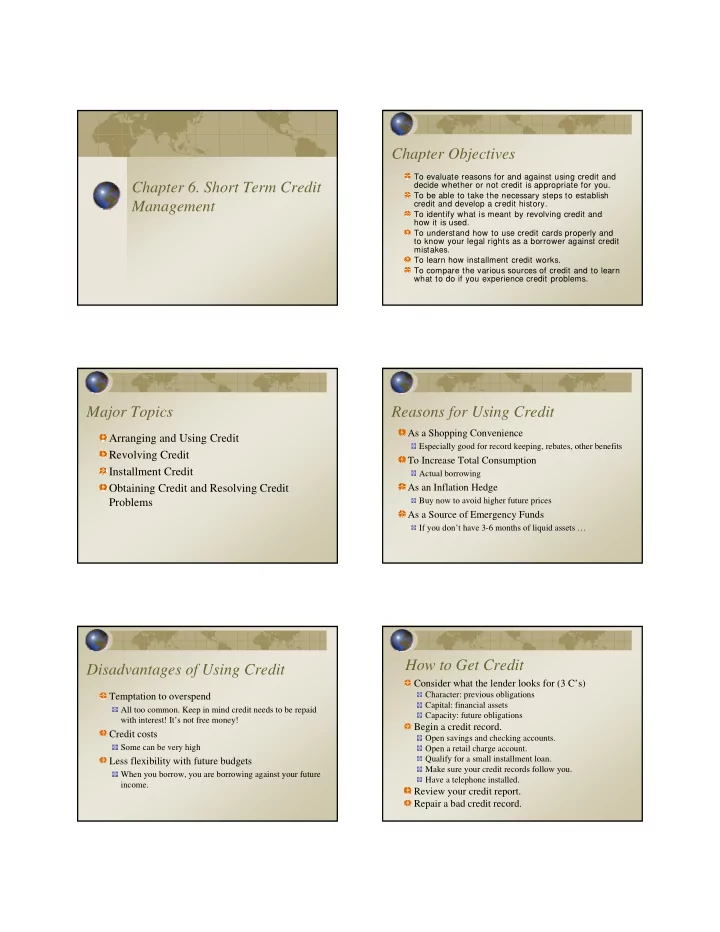
Chapter Objectives To evaluate reasons for and against using credit - - PDF document
Chapter Objectives To evaluate reasons for and against using credit and Chapter 6. Short Term Credit decide whether or not credit is appropriate for you. To be able to take the necessary steps to establish Management credit and develop a
Special Concerns for Spouses Establishing Credit
Make sure your credit history is in your name. Don’t use a social title. ex., Mrs.Edward Hall Inform creditors that you wish to maintain your own credit history. Know the difference between a joint and individual credit account.
Joint Credit Account:
- Both spouses responsible for debt.
- Divorced or separated spouses should cancel joint accounts.
Individual Credit Account
- Only you are responsible for debt.
- Account will appear only on you credit report.
The Role of the Credit Bureau
Does not decide who receives credit. Stores information on past use of credit Stores information on legal actions against you. Sells credit reports to lenders.
Contents of a Credit Report
Existing credit accounts Information on each credit account includes
credit limit, loan amount and account balance who is responsible for paying the account
Public record information
bankruptcies, tax liens and monetary judgments
Who has obtained a copy
Credit Report
The three largest credit bureaus
Equifax: http://www.equifax.com Trans Union: http://www.transunion.com Experian: http://www.experian.com
Now consumers can obtain credit reports for free once a year.
For more information about credit, visit Federal Trade Commission Website at http://www.ftc.gov/bcp/conline/edcams/credit/index.html For your free credit report, visit https://www.annualcreditreport.com/cra/index.jsp
Credit report and credit score are used for many purposes (insurance, job, rental, etc.) these days. In addition, identity theft is becoming a major consumer fraud issue. You need to be diligent about checking your credit report. It is a good idea to
- btain one credit report every four months, rotating among the
three credit bureaus.
If You are Denied Credit
Obtain a copy of your report. Correct any mistakes. Submit your own statement on disputed claims. Have adverse information that is old removed from report. Have those who received report notified of any incorrect entries.
Credit Accounts
Revolving credit account
An open-end account with an established line of credit and rules for minimum payments.
Retail installment account
An closed-end account that has a separate installment contract for each purchase
Revolving Credit Account
Credit limit determined by credit record and net worth. Partial payment must be made each month. Interest charged on unpaid balance. Account may never actually be paid off.
Required Information on Revolving Charge Account Truth in Lending Act
Annual percentage rate (APR) applied to balance. Method for calculating interest. Grace period, if any. Minimum monthly payment, and penalties for late payment. Permission to investigate credit history.
Interest Computation Methods
Previous balance method
Rate applied to balance at end of previous month.
Adjusted balance method
Equal to the previous balance less any payments or returns made during the current billing cycle
Average daily balance method (most common)
including current purchases excluding current purchases
Two-cycle average daily balance method
Eliminates a grace period in the previous month when you fail to completely pay off the balance in the present month. Can go back two periods to collect interest on unpaid balance.
Major Issuers of Credit Cards
Bank Credit Cards
Discover MasterCard Visa
Travel & Entertainment Cards
American Express
Other Cards
Department store chains Major gasoline retailers
Credit Card Cost Comparison
Annual membership fee Variable rate information Balance computation method Late payment fee Copy charge Annual percentage rate Grace period Cash advance fee Over-the-limit penalty Replacement fee Fees for optional services
Credit Card Benefit Comparison
Credit limit Disability insurance Accident insurance Rental car collision insurance Warranty protection Merchandise loss protection Credit life Rebates & discounts Frequent flyer miles Credit card registry Purchase price protection
Payback Period $3,000 Credit Balance @ 19% APR
$2,991 1,790 1,102 804 100 64 42 31 $60 75 100 125 Total Interest Months Monthly Payment
Protect Against Credit Card Fraud
Record card numbers, expiration dates and phone number for card company. Destroy old bills, receipts and credit cards. Check sales receipt and compare with credit card statement. Be careful giving out your card number. Report lost and stolen cards immediately.
Correcting Credit Mistakes
Notify the creditor in writing within 60 days after bill was mailed. Pay parts of the bill that are not in dispute. Creditor will notify you within 30 days of its decision. If no error is found, you must pay or you will be reported as delinquent. If you still challenge in writing the creditor must report that information. Provide credit bureau with your explanation of the dispute.
Other Credit Terms
Chargeback
a disputed amount charged back to the merchant by the credit card company.
Credit blocking
a reduced credit limit based upon an expected purchase
Debit Cards
Bank deposit is immediately reduced You do not have the protections afforded credit card purchases Lost or stolen credit cards are covered by the Electronic Funds Transfer Act
you can lose up to $500 if you fail to notify issuer within two days after learning of theft if you wait 60 days your losses may be unlimited
Installment Credit
Repay the debt by
A series of uniform payments called installments
Elements of a retail installment contract
Promissory note Security agreement
Methods for Charging Interest
Simple Interest Method
percentage rate applied to outstanding loan balance
Discount Method
interest deducted from credit extended you
Add-on Method
interest added to amount borrowed at beginning of loan
- Figure. A 12-month installment loan with
annual simple interest of 12 percent
Monthly Outstanding Balance Monthly Payment Finance Charge Loan Repayment 1 $1,000.00 $88.85 $10.00 $78.85 2 921.15 88.85 9.21 79.85
.... ... ... ... ...
11 175.07 88.85 1.75 87.10 12 87.97 88.85 0.88 87.97 Total $1,066.19 $66.19 $1,000
Discount Method
Need $1,000 Borrow $1,136.36 at 12% simple interest
1000/(1-12%)= 1136.36
Monthly payment: 1136.36/12= $94.72
Add-on Method
Need $1,000 Total payments= $1,120 for 12% simple interest
1000* (1+ 12%)= 1,120
Monthly payment: 1120/12= $93.33
Annual Percentage Rate (APR)
Same as annual simple interest. Takes into consideration fees and methods
- f computation
In the previous example:
Simple interest: APR=12% Discount: APR=24.28% Add-on: APR=21.46%
In credit shopping, compare APRs!!!
Sources of Credit
Banking Institutions
Overdraft protections Unsecured personal loans Home equity line of credit
Consumer Finance Companies
Specialized loans (GM cars)
Other
Life insurance policies Margin accounts on stocks and bonds Pawnbroker
A Credit Management Strategy
Use the grace period. Avoid expensive credit on revolving charge accounts. Take a broad view of credit sources. Carefully consider the use of variable rate loans.
If You have Personal Debt Problems – Credit Counseling
National Foundation of Credit Counseling
http://www.nfcc.org The only Utah location is in St. George
- Credit Counseling of Utah, 163 West 1600 South # 2
Saint George, UT 84770 (800) 451-4505
Utah State University Family Life Center: Housing and Financial Counseling
http://www.usu.edu/fchd/hfc.cfm
What a counselor will do:
Develop a budget and a repayment plan to repay debt Negotiate a more reasonable repayment plan with the lenders
Last Resort - Bankruptcy
Bankruptcy statistics
American Bankruptcy Institution: http://www.abiworld.org/
Straight Bankruptcy (Chapter 7)
Primary form of bankruptcy. Discharges all debts and provides a fresh start. Homeowner’s equity and some personal assets may be partially protected. Cannot file again for 6 years. Record remains on credit report for 10 years.
Wage Earner Plan (Chapter 13)
Repayment schedule established by court. Debtor may retain property. Lenders receive partial or total repayment over 3-5 year period. Remains on credit report for 7 years.
Utah’s Bankruptcy Situation
National Rank is # 1 in 2003 and previous years – 1 in 36.5 households filed for bankruptcy in 2003: http://www.abiworld.org/statcharts/Hou seRank.htm Utah-specific laws: http://www.utahbankruptcylaw.com/
Assignment for Chapter 6
If you have never obtained a copy of your credit report, you should try to get a
- copy. For a free copy go to
https://www.annualcreditreport.com/cra/i ndex.jsp Take a close look at the credit cards you
- have. What’s the interest rate? What is