Transport to Affordable Supermarkets Challenge: The lack of direct - - PDF document

transport to affordable
SMART_READER_LITE
LIVE PREVIEW

Transport to Affordable Supermarkets Challenge: The lack of direct - - PDF document

Transport to Affordable Supermarkets Challenge: The lack of direct public transport links to affordable supermarkets from Barton makes accessing them costly and time consuming. Solutions: Provide direct and affordable access to affordable


slide-1
SLIDE 1

Transport to Affordable

Supermarkets

Challenge:

The lack of direct public transport links to affordable supermarkets from Barton makes accessing them costly and time consuming.

Solutions:

Provide direct and affordable access to affordable supermarkets from Barton

The Pilot:

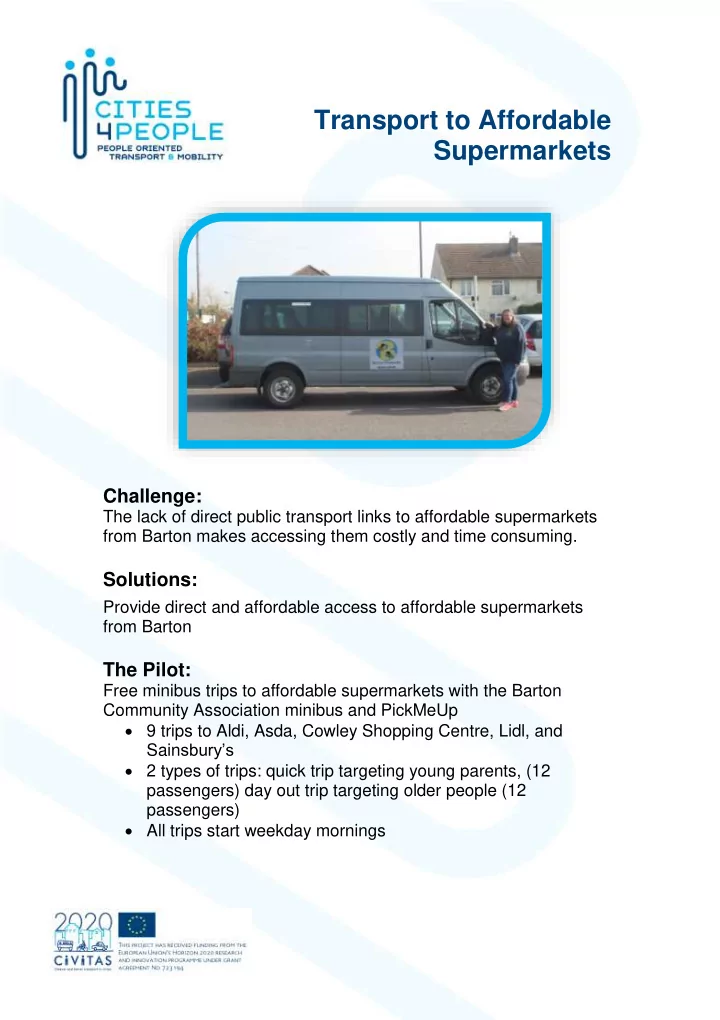
Free minibus trips to affordable supermarkets with the Barton Community Association minibus and PickMeUp

  • 9 trips to Aldi, Asda, Cowley Shopping Centre, Lidl, and

Sainsbury’s

  • 2 types of trips: quick trip targeting young parents, (12

passengers) day out trip targeting older people (12 passengers)

  • All trips start weekday mornings
slide-2
SLIDE 2

Pilot Evaluation and Monitoring Results:

Baseline data was collected from a paper-based and online questionnaire -- Transport & Mobility in Oxford: What Matters to you? – between Feb-March 2019, prior to the pilot’s deployment. 92 participant responses were collected in total from the Baseline questionnaire, and the age/gender split of the respondents can be seen below: The purpose of this questionnaire was to gather perceptions and

  • pinions from citizens and to thereby inform potential options for

transport and urban design interventions in the local area. After the pilot was deployed a second questionnaire was then deployed --People Post-Pilot Intervention -- between May-June

  • 2019. 18 participant responses were collected in total from this Post-

pilot Intervention questionnaire. However, only 10 responses will be included as those were from participants who experienced the pilot. The data was used to evaluate the impacts of the pilot against the Baseline line data collected previously. The following questions/charts have been selected from this analysis to support decisions about which pilot should be scaled up.

7% 8% 13% 14% 23% 4% 3% 0% 2% 7% 5% 2% 6% 2% 5% 0% 25% 20% 15% 10% 5% 0% 5% 10% 15%

Age/gender chart of survey respondents

Female % Male %

slide-3
SLIDE 3
  • Q17. The duration of my regular journeys takes away precious time

from my personal free time

  • Q27. How satisfied are you with the level of comfort on your regular

journeys?

  • Q30. How convenient are the public transportation options available to

you for carrying out day-to-day tasks?

  • 60
  • 40
  • 20

20 40 60 80 100 120

  • 37%

63% 0% 100%

  • 60
  • 40
  • 20

20 40 60 80 100

  • 43%

57%

  • 25%

75%

Strongly Disagree Disagree Neutral Agree Strongly Agree

Baseline (All) Post Pilot Intervention (All)

  • 60
  • 40
  • 20

20 40 60 80

  • 39%

61%

  • 30%

70%

Very Dissatisfied Dissatisfied Neutral Satisfied Very Satisfied Very inconvenient Inconvenient Neutral Convenient Very Convenient

Baseline (All) Post Pilot Intervention (All) Baseline (All) Post Pilot Intervention (All)

slide-4
SLIDE 4

14% 57% 29% 0%

0% 10% 20% 30% 40% 50% 60%

10 20 40 90

Percentage share of maximum time prepared to travel

Maximum distance to supermarket in mins

Maximum time prepared to travel to reach your preferred supermarket for your main household food shop? Q.31.How affordable do you find the transport options in Oxford?

  • The following results were derived from survey materials (questionnaire

and anonymized receipt data) of participants during the pilot from the trips to affordable supermarkets (10 in total): 10% 20% 70%

0% 10% 20% 30% 40% 50% 60% 70% 80%

Every_Day Once_a_month Once_a_week Food Shopping trip percentage by frequency type

Food Shopping trip frquency

How often do you go food shopping in a typical month?

  • 80
  • 60
  • 40
  • 20

20 40 60 80 100

  • 59%

41%

  • 10%

90%

Very Unaffordable Unaffordable Neutral Affordable Very Affordable

Baseline (All) Post Pilot Intervention (All)

Once a Week Once a Month Every Day

slide-5
SLIDE 5

Which mode of transport do you typically use for your main household food shop?

25% 13% 6% 13% 6% 0% 31% 0% 6% 21% 21% 21% 14% 0% 7% 0% 0% 0%

0% 5% 10% 15% 20% 25% 30% 35%

Stated Barriers to preferred supermarket:

  • Non accessible location

(i.e., walking)

  • Distance (mins)
  • No direct public transport

e

Comparison between desired and current supermarket store usage

Preferred supermarket Existing supermarket

slide-6
SLIDE 6

Affordable Price rices 34% 34% Wid ide Sele election/Choice 33% 33% Good Bu Bus Ser ervice 33% 33%

Anonymized receipt data:

Like-4-Like Average % of Savings Comparison Store No of Receipts

  • Av. Value to

store

3

£35.71

35% 32%

12

£23.44

36% 39%

Which of the following items are important when choosing a supermarket for your main household shop?

Opening Hours Other shops nearby Other services 0% 0% 0%

slide-7
SLIDE 7

Potetial Scale-Up Opportunities

The options below are a non-exhaustive list of the possible ways the ‘Transport to Affordable Supermarkets’ intervention could be scaled-up and piloted in Jan-Feb 2020. These will be developed in public workshops and decided on in a public vote.

Expanded Community Transport Routes

The shuttle service to affordable supermarkets was popular with users, but more passengers are needed to create a sustainable

  • service. Interest in setting up a community transport service has

been well established in nearby villages as well as neighbourhoods within Oxford such as Rose Hill. A transport needs survey is currently being undertaken in Horsepath and Wheatly Parishes. This scaled-up pilot would design and implement community transport routes connecting peripheral villages and neighbourhoods in Oxford to affordable supermarkets and potentially other

  • destinations. This would increase the customer base for community

transport services that would otherwise focus catchment areas

  • utside of Oxford, creating a more sustainable service that benefits

a greater number of people.

Setting up Community Networks to Benefit from PickMeUp Group Discounts

This pilot was originally selected to address 2 challenges raised by the Barton community: the lack of direct public transport links to affordable supermarkets and the high cost of public transport. These could also be addressed by organised use of PickMeUp

  • promotions. From the launch of the service, PickMeUp has offered

a 3 travel for the price of 2 promotion, reducing the journey cost for bookings of 3 or more. This pilot would develop the informal

  • rganisation of groups of people to benefit from this and other

discounts offered on PickMeUp.