Translating economic growth into job creation and poverty reduction - - PowerPoint PPT Presentation

translating economic growth into job creation and poverty
SMART_READER_LITE
LIVE PREVIEW

Translating economic growth into job creation and poverty reduction - - PowerPoint PPT Presentation

Translating economic growth into job creation and poverty reduction Launch of the Labour and Social Trends in Indonesia report 13:00 Opening remarks 13:10 Labour and social trends in Indonesia 13:40 Youth employment and skills


slide-1
SLIDE 1

Translating economic growth into job creation and poverty reduction

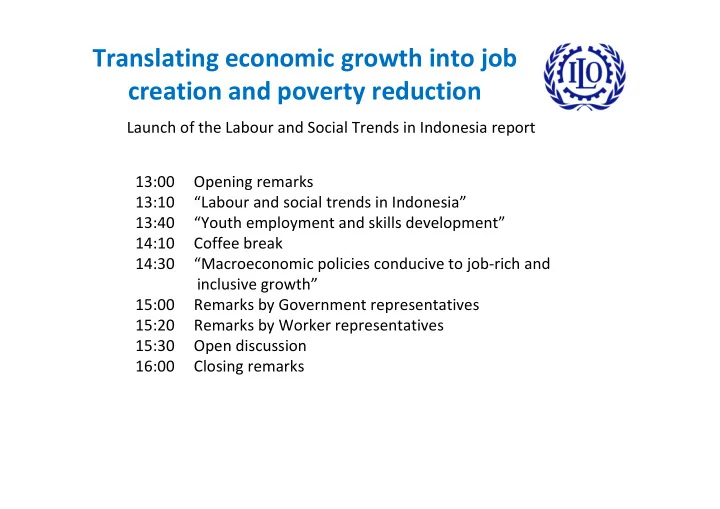
13:00 Opening remarks 13:10 “Labour and social trends in Indonesia” 13:40 “Youth employment and skills development” 14:10 Coffee break 14:30 “Macroeconomic policies conducive to job‐rich and inclusive growth” 15:00 Remarks by Government representatives 15:20 Remarks by Worker representatives 15:30 Open discussion 16:00 Closing remarks Launch of the Labour and Social Trends in Indonesia report

slide-2
SLIDE 2

Labour and Social Trends in Indonesia

Jakarta, 14 April 2011

Translating economic growth into job creation

Kazutoshi Chatani Technical Officer (economist), ILO Jakarta Office chatani@ilo.org

slide-3
SLIDE 3

1.Economic trends 2.Labour market trends 3.Translating economic growth into job creation and poverty reduction

Topics

slide-4
SLIDE 4

Economic growth in Indonesia slowed after the Asian financial crisis.

Source: World Bank, World Databank

‐15 ‐10 ‐5 5 10 15 1976 1977 1978 1979 1980 1981 1982 1983 1984 1985 1986 1987 1988 1989 1990 1991 1992 1993 1994 1995 1996 1997 1998 1999 2000 2001 2002 2003 2004 2005 2006 2007 2008 Indonesia Thailand Vietnam Cambodia Malaysia Philippines Lao PDR

slide-5
SLIDE 5

Private consumption and investment contributed to growth

Source: BPS

Gross domestic product at constant 2000 prices (billion Rupiah)

slide-6
SLIDE 6

Services‐sector‐led growth

Contribution to GDP growth by sector (%, at 2000 Constant Market Prices)

Source: BPS, ILO staff calculation

slide-7
SLIDE 7

Source: BPS, ILO staff calculation

High growth of employment in the services sector

Output and employment growth (2000‐09, annual %)

slide-8
SLIDE 8

Changing skills demand as the structure of economy shifts

Share of workers by education and sector (%)

Source: BPS, ILO staff calculation

slide-9
SLIDE 9

Source: BPS

Improving net enrolment rates in education

Time trends in net enrolment rate in Indonesia (%, selected years)

slide-10
SLIDE 10

Source: Public expenditure on education: UNESCO Institute for Statistics, Data Centre Other data: UNDP, Human Development Indicators database

Education still lags behind regional competitors…

Growth of the labour force and employment (1990=100) Mean years

  • f schooling

Expected years

  • f schooling

Public expenditure on education

(of adults) (of children) (as % of GDP) (as % of total public spending) Year 2010 2010 2008 2008

Cambodia 5.8 9.8 1.6

(2007)

12.4

(2007)

Indonesia 5.7 12.7 2.8 17.9 Lao PDR 4.6 9.2 2.3 12.2 Malaysia 9.5 12.5 4.1 17.2 Philippines 8.7 11.5 2.8 16.9 Thailand 6.6 13.5 3.8 20.5 Viet Nam 5.5 10.4 5.3 19.8

slide-11
SLIDE 11

Employment growth lagged behind labour force expansion

Source: BPS

Growth of the labour force and employment (1990=100)

slide-12
SLIDE 12

Youth suffers from hardly growing employment opportunities

Source: BPS

Growth of the labour force and employment (1990=100)

slide-13
SLIDE 13

Source: BPS

Share of informal employment and underemployment (%) Underemployment: working less than 35 hours per week

Quality of employment requires attention

slide-14
SLIDE 14

Large disparities across provinces

9 8 8 9 6 8 5 7 6 8 12 11 7 6 5 15 3 5 5 6 11 11 5 9 5 6 5 11 7 8 4 6 4 61 63 67 53 64 70 77 72 56 34 26 57 64 58 66 50 56 70 68 61 48 61 71 68 71 71 73 74 74 61 82 72 83 22 12 10 9 9 16 19 20 7 8 4 12 18 17 17 8 5 9 7 5 8 10 19 12 19 25 15 28 10 36 38 23 23

10 20 30 40 50 60 70 80 90 NAD Sumatra Utara Sumatra Barat Riau Jambi Sumatra Selatan Bengkulu Lampung Bangka Belitung Kepuluan Riau DKI Jakarta Java Barat Java Tengah DI Yogyakarta Java Timur Banten Bali Kalimantan Barat Kalimantan Tengah Kalimantan Selatan Kalimantan Timur Sulawesi Utara Sulawesi Tengah Sulawesi Selatan Sulawesi Tenggara Gorontalo Sulawesi Barat Maluku Maluku Utara Papua Barat Papua Nusa Tenggara Barat Nusa Tenggara Timur Sumatra Java & Bali Kalimantan Sulawesi Maluku, Papua, & NT (%)

Unemployment Informal employment Percentage of poor people (provincial poverty line) Informal employment (62.1%) Unemployment (7.9%) Percentage of poor people (14,2%)

Sources: BPS (Unemployment data in August 2009 informal employment in February 2009 and poverty incidence in March 2009)

National average Performances of provinces
slide-15
SLIDE 15

Economic growth, employment and poverty reduction Economic Growth Employment Creation Poverty Reduction

Job‐less growth

  • Informal/casual employment
  • Low wages
  • Unequal access to

productive employment

slide-16
SLIDE 16

Source: ADB‐IDB‐ILO (2009) Indonesia: Critical Development Constraints

  • 1. Inadequate and poor quality of infrastructure
  • Difficulties in land acquisition
  • 2. Weaknesses in governance and institutions
  • Prevalence of corruption and insufficient

control

  • Lack of effective coordination
  • 3. Unequal access to and poor quality of education
  • Financial burden (incl. non‐school fees such as

transportation)

Critical constraints to growth:

slide-17
SLIDE 17

Source: World Databank, KILM 6th ed., author’s calculation

Low density of formal businesses in Indonesia

2001 2005 2006 Population (%) below US$1.25 a day (year) Population (%) below US$2 a day Brazil 26.5 30.5 ‐ 5.2 (2007) 12.7 Hong Kong SAR, China 55.9 65.9 71.7 ‐ ‐ India 0.6 0.7 0.7 41.6 (2005) 75.6 Indonesia 1.0 1.2 1.2 21.4 (2005) 53.8 Russian Federation 12.5 20.3 20.8 0.2(2005) 1.5 Singapore 20.6 24.1 26.3 ‐ ‐ Thailand 3.6 4.1 4.3 0.4 (2005) 11.5 Vietnam 0.2 0.6 ‐ 21.5 (2006) 48.4 The number of registered businesses per 1 thousand citizens and poverty incidences

slide-18
SLIDE 18

Source: World Bank and International Finance Corporation, Doing Business in Indonesia 2010

Ease of doing business in selected Indonesian cities

It’s difficult to start a business in Indonesia

Indicator Best performing city (global rank of 183 economies) Worst performing city Number of procedures to deal with construction permits Yogyakarta 8 procedures (5) Manado 15 procedures Days to deal with construction permits Makassar 56 days (9) Surabaya 230 days Days to register property Manado 12 days (24) Surakarta 54 days Days to start a business Yogyakarta and Bandung 43 days (143) Jakarta 60 days Cost to start a business Jakarta 26% of income per capita (117) Manado 38.3% of income per capita

slide-19
SLIDE 19

Role of the Government in financing SMEs and infrastructure development in Japan

10,000 Yen 10,000 Yen 10,000 Yen Business and employment growth Tax revenue Post Office (Post Bank) Government Public financial corporations Long‐term loans with low interest rates

slide-20
SLIDE 20

Real wage growth for income‐led growth

Real wage index (2005 March=100)

Source: BPS, ILO staff calculation

slide-21
SLIDE 21

Labour productivity in the region

Labour productivity per person employed (in 2010 US$)

Source: The Conference Board Total Economy Database, January 2011

slide-22
SLIDE 22

Public investment on social security can be higher in Indonesia

Public social security expenditure (as % of GDP, latest available

year)

Source: ILO, World social security report 2010/11

slide-23
SLIDE 23
  • Employment creation
  • Strengthening industrial relations
  • Enhancing the quality and coverage of social protection
  • Improving labour productivity

Indonesian Jobs Pact:

Tripartite consensus on job‐rich & inclusive growth

slide-24
SLIDE 24
  • Economic prospects are bright. It is time to reinforce the link

between economic growth, creation of productive employment and poverty reduction

  • For Indonesia to tap into growth potential, improvement in

infrastructure, governance and education is the key

  • Creating enabling environment for business would accelerate

job growth in the formal economy

  • Gradual shift to income‐led growth: purchasing power of wages

requires monitoring

  • Equipping the youth with skills and adopting technology and

innovation would enhance productivity

  • Social security (social protection floor) can enhance income

security, conducive to income‐led growth

  • Tripartite action on priority issues will pave the way to

prosperity

Conclusions