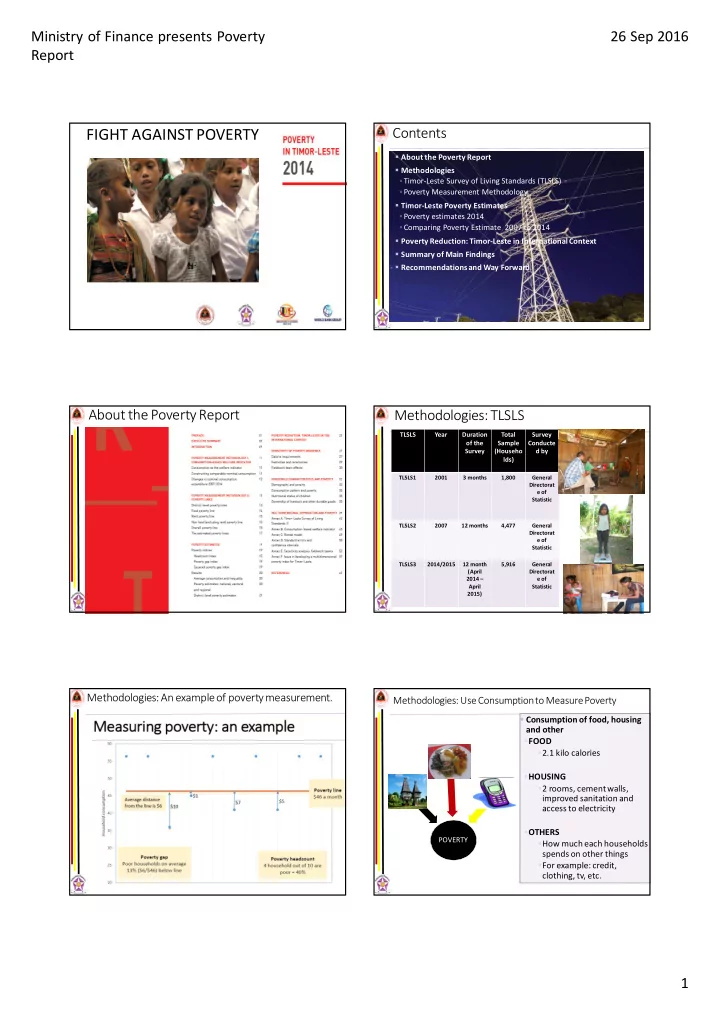
FIGHT AGAINST POVERTY About the Poverty Report Methodologies - - PDF document

fight against poverty
SMART_READER_LITE
LIVE PREVIEW

FIGHT AGAINST POVERTY About the Poverty Report Methodologies - - PDF document

Ministry of Finance presents Poverty 26 Sep 2016 Report Contents FIGHT AGAINST POVERTY About the Poverty Report Methodologies Timor-Leste Survey of Living Standards (TLSLS) Poverty Measurement Methodology Timor-Leste Poverty


slide-1
SLIDE 1

Ministry of Finance presents Poverty Report 26 Sep 2016 1

FIGHT AGAINST POVERTY

Contents

About the Poverty Report Methodologies

  • Timor-Leste Survey of Living Standards (TLSLS)
  • Poverty Measurement Methodology

Timor-Leste Poverty Estimates

  • Poverty estimates 2014
  • Comparing Poverty Estimate 2007 to 2014

Poverty Reduction: Timor-Leste in International Context Summary of Main Findings Recommendations and Way Forward

About the Poverty Report

3

Methodologies: TLSLS

4 TLSLS Year Duration

  • f the

Survey Total Sample (Househo lds) Survey Conducte d by

TLSLS1 2001 3 months 1,800 General Directorat e of Statistic TLSLS2 2007 12 months 4,477 General Directorat e of Statistic TLSLS3 2014/2015 12 month (April 2014 – April 2015) 5,916 General Directorat e of Statistic

Methodologies: An example of poverty measurement.

Methodologies: Use Consumption to Measure Poverty

POVERTY Housing Other

Consumption of food, housing and other

  • FOOD
  • 2.1 kilo calories
  • HOUSING
  • 2 rooms, cement walls,

improved sanitation and access to electricity

  • OTHERS
  • How much each households

spends on other things

  • For example: credit,

clothing, tv, etc.

slide-2
SLIDE 2

Ministry of Finance presents Poverty Report 26 Sep 2016 2

Methodologies: Poverty lines - Trends in consumption in Districts in 2014/2015

T ABLE 4 : P O VERTY LI N ES PER PERSO N PER MO N TH, 2 0 1 4

Food Rent Other Total East Baucau 24.86 10.64 7.83 43.33 Lautem 21.29 12.94 7.34 41.57 Viqueque 24.06 12.37 8.07 44.51 Centre Ainaro 24.38 11.15 8.75 44.28 Aileu 23.89 8.80 8.45 41.14 Dili 29.07 12.64 14.45 56.16 Ermera 21.74 8.82 7.42 37.97 Liquiça 23.00 8.57 6.22 37.79 Manufahi 25.57 11.79 10.51 47.87 Manatuto 24.16 11.15 8.51 43.81 West Bobonaro 24.83 9.73 9.89 44.45 Covalima 25.66 11.68 12.11 49.45 Oecussi 24.05 17.69 9.37 51.12 Timor-Leste 25.01 11.50 9.86 46.37

Poverty Estimates: Summary of Trends of Poverty Lines and Headcounts

US$ per person per month

Trends in national poverty 2007 2014 Headcount (internationalline) 47.2% 30.3% Headcount (National line) 50.4% 41.8% Poverty gap 13.8% 10.4% National poverty lines 2007 2014 Food $15.40 $25.01 Housing $4.57 $11.50 Other $5.17 $9.86 TOTAL $25.14 $46.37 ComparationPoverty Headcount of 2014 using the National and International Poverty Lines

Poverty Rate using the National Poverty line 2014

Poverty Estimates: Poverty Headcount 2014

Poverty Rate using the International Poverty line 2014

  • Poverty line: $1.33 per person or

$40.45/person /month;

  • Poverty Headcount 30.3%
  • Poverty line: $1.54 per person or

$46.37/person /month;

  • Poverty Headcount 41.8%

Poverty Estimates: Poverty Headcounts 2014

Poverty headcount Poverty gap 2007 2014 2007 2014 TIMOR-LESTE (International Poverty Line 47.2% 30.3% TIMOR-LESTE (National Poverty line) 50.4% 41.8% 13.8 10.4 Rural 54.7% 47.1% 15.5 12.2 Urban 38.3% 28.3% 9.0 5.9 East 31.6% 33.8% 6.0 7.1 Central 54.6% 40.0% 15.4 9.8 West 60.3% 55.5% 18.2 15.8 East rural 32.2% 36.0% 6.1 7.7 East urban 25.4% 21.0% 5.1 3.8 Central rural 64.4% 48.3% 19.4 12.6 Central urban 39.1% 26.4% 9.2 5.3 West rural 62.7% 57.6% 19.2 16.8 West urban 42.5% 46.0%

10.6 11.5

Poverty Estimates: Comparing poverty Headcount 2007 to 2014

Poverty Rate using the National Poverty line 2007 Poverty Rate using the National Poverty line 2014

Poverty Estimates: Comparing Poverty Levels 2007 to 2014 using National Poverty Line

  • The National Poverty line is $46.37
  • Poverty headcount decreased from 50.4% to 41.8%
  • The maps show the improvement of living standards in municipalities
slide-3
SLIDE 3

Ministry of Finance presents Poverty Report 26 Sep 2016 3

Poverty headcount using the International Poverty Line 2014

Poverty Estimates: Comparing Poverty Levels 2007 to 2014 using International Poverty Line

Poverty Headcount using the National Poverty line 2007

  • Maps are not comparable for the municipalities because one using the international

poverty line and the other one use the national poverty line.

  • But they give us a proxy that using the international poverty line, living standard in

Timor-Leste is much better in 2014 relative to 2007.

Poverty Estimates: Poverty Headcounts by Region using International Line

Poverty headcounts in Eastern region Poverty headcounts in Western region Poverty headcounts in the central region

Poverty Estimates: Gini Index, a measure of inequality - Inequality is very small in TL

Poverty Estimates: Poverty Indices and Real

per Capita Consumption by District, 2014 Poverty Estimates: Trend Dwelling Conditions 2007

  • 2014

Poverty Estimates: Durable Goods Ownership by Urban

and Rural Areas 2007-2014

10 20 30 40 50 60 70 80 90 Fans Televisions Video players Tape players/CD players Mobile phone Motorcycles/scooters Electric rice cooker Timor-Leste 2007 Timor-Leste 2014 Rural 2007 Rural 2014 Urban 2007 Urban 2014

slide-4
SLIDE 4

Ministry of Finance presents Poverty Report 26 Sep 2016 4

Poverty Estimates: Overall performance in key poverty

dimensions

INDICATORS (% of Population Living in Households …..) 2007 2014 Improvement With no electricity connection 64 28 56% With poor sanitation 58 40 31% With no access to safe drinking water 40 25 38% With poor quality floor in their dwelling 61 48 21% Using poor cooking fuel 97 87 10% With very few assets 83 56 33% With at least one child not attending school 42 17 60% Without anyone with at least 5 years school 17 13 24% With at least one underweight child under 5 years of age 35 16 54% With at least one stunted child under 5 years of age 38 24 37% With at least one child under 5 years of age with wasting 20 7 65%

Poverty Reduction: Timor-Leste in International Context

The World Economic Forum has reported that Timor-Leste is ranked in the top ten countries to make the most progress in converting economic growth into wellbeing over the period 2006 to 2014.

Summary: Main Findings

Poverty headcounts: 47.2% in 2007 down to 30.3% in 2014 (international line); and 50.4% in 2007 down 41.8% 2014; this implies that poverty still exist, but reduced significantly; Timor-Leste is ranked in the 7th place of the countries that make the most progress in converting economic growth into wellbeing over the period of 2006 to 2014; Inequality in Timor-Leste is very small (Gini Index 29) During 2007-2014, Timor-Leste reduced poverty at 2.4% annually, among the fastest in the world

Recommendations and Way Forward

  • 1. To do analysis on the

multidimensional poverty;

  • 2. To do analysis on the

drivers of poverty in Timor-Leste;

  • 3. Encourage people to

use these official poverty figures;

“THERE ARE STILL SO MUCH TO KNOW”