Transition Radiation Transition radiation is emitted whenever a - - PowerPoint PPT Presentation

transition radiation
SMART_READER_LITE
LIVE PREVIEW

Transition Radiation Transition radiation is emitted whenever a - - PowerPoint PPT Presentation

Transition Radiation Transition radiation is emitted whenever a charged particle cross the boundary between two media with different electrical properties If we consider the case of an electron crossing a vacuum/ perfect conductor


slide-1
SLIDE 1
  • P. Piot, PHYS 571 – Fall 2007

Transition Radiation

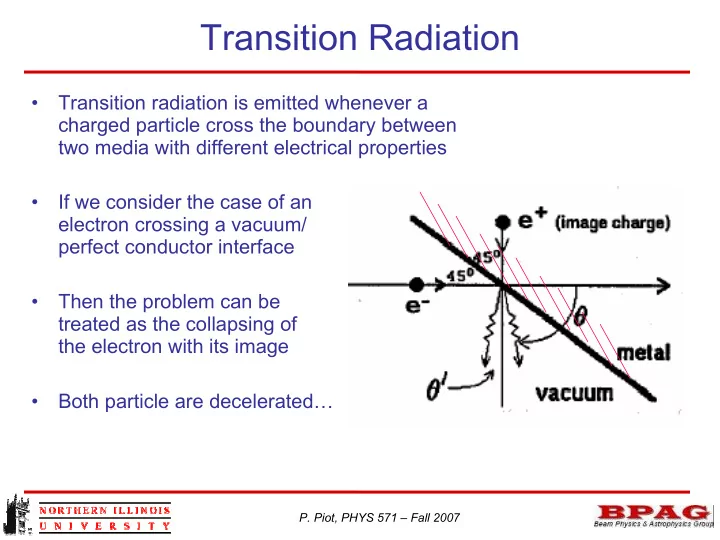
  • Transition radiation is emitted whenever a

charged particle cross the boundary between two media with different electrical properties

  • If we consider the case of an

electron crossing a vacuum/ perfect conductor interface

  • Then the problem can be

treated as the collapsing of the electron with its image

  • Both particle are decelerated…
slide-2
SLIDE 2
  • P. Piot, PHYS 571 – Fall 2007

TR fluence I

  • Start with the spectral fluence:
  • Let t=0 be the time corresponding to the charge hitting the boundary,

so at t=0 the charge suddenly disappear.

Angle between β and n

slide-3
SLIDE 3
  • P. Piot, PHYS 571 – Fall 2007

TR fluence II

  • The spectral fluence seems independent of frequency!
  • Physically impossible integrating over the frequency spectrum should

be a finite energy value

  • Simple argument…

– Another way of explaining transition radiation is to consider the e.m. fields associated to the moving charge – When the charge passes through the foil these field are “reflected” – Reflection impose the interface to be a good mirror, and this generally introduce a frequency dependence – For instance the X-ray components of the e.m. field will not be

  • reflected. The typical cut-off frequency is the plasma frequency

– A similar argument hold for the low frequency (diffraction!)

slide-4
SLIDE 4
  • P. Piot, PHYS 571 – Fall 2007

TR fluence III

  • In the relativistic and small angle approximation
  • the fluence simplifies to
  • So the angular distribution is peaked at θ=±1/γ
slide-5
SLIDE 5
  • P. Piot, PHYS 571 – Fall 2007

Angular distribution of TR fluence

γ=100 γ=10 γ=√2 θ (rad) Fluence (arb. Units)

slide-6
SLIDE 6
  • P. Piot, PHYS 571 – Fall 2007

Forward and backward TR

  • We consider the case of the particle which suddenly disappears this

gives the forward transition radiation

  • Considering the particle which suddenly appears give the backward

transition radiation

slide-7
SLIDE 7
  • P. Piot, PHYS 571 – Fall 2007

Angular distribution of TR (polar plots)

slide-8
SLIDE 8
  • P. Piot, PHYS 571 – Fall 2007

Angle integrated TR

  • To compute the total energy radiated per unit of frequency, we just

need to evaluate the integral over the solid angle

  • In the relativistic limit
slide-9
SLIDE 9
  • P. Piot, PHYS 571 – Fall 2007

Angle integrated TR

Energy (MeV) Angle (rad) Fraction of TR energy within θ Fraction of TR within 1/γ cone

slide-10
SLIDE 10
  • P. Piot, PHYS 571 – Fall 2007

Example of use of Optical TR I

  • Angular distribution of transition

radiation can be used to infer some of a charged particle beam properties: – Energy – divergence

Give the energy

slide-11
SLIDE 11
  • P. Piot, PHYS 571 – Fall 2007

Example of use of Optical TR II

slide-12
SLIDE 12
  • P. Piot, PHYS 571 – Fall 2007

Example of use of Coherent TR

  • CTR can be used to measure

the time distribution of charged particle beam