Transfer of Development Rights (TDR) Market and Economic Analysis - - PowerPoint PPT Presentation

transfer of development rights tdr market and economic
SMART_READER_LITE
LIVE PREVIEW

Transfer of Development Rights (TDR) Market and Economic Analysis - - PowerPoint PPT Presentation

DRAFT Transfer of Development Rights (TDR) Market and Economic Analysis January 7, 2013 DRAFT Table of Contents Introduction Phase II Analysis Methodology Findings Phase III Analysis Bayview Ridge CRA Burlington CRA


slide-1
SLIDE 1

January 7, 2013

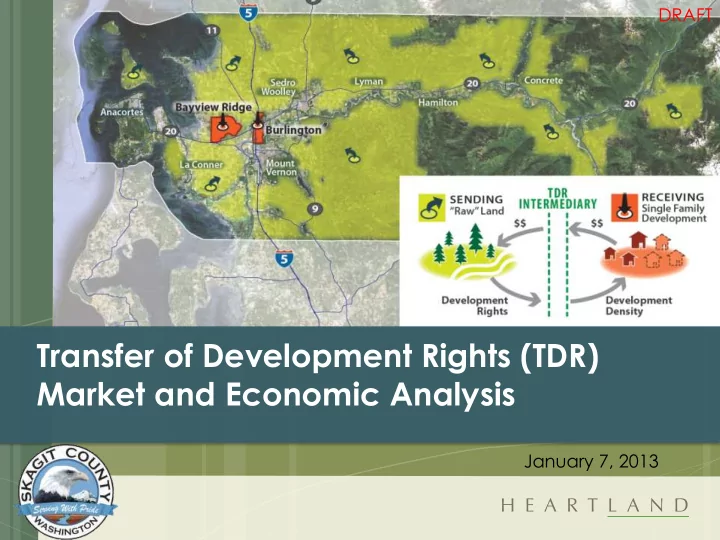
Transfer of Development Rights (TDR) Market and Economic Analysis

DRAFT
slide-2
SLIDE 2

Table of Contents

  • Introduction
  • Phase II Analysis
  • Methodology
  • Findings
  • Phase III Analysis
  • Bayview Ridge CRA
  • Burlington CRA
  • Rural Upzones CRA
  • Sending Zones
  • Exchange Rate Analysis
  • Possible Program Structure

DRAFT

1

slide-3
SLIDE 3

Introduction

  • Who We Are
  • Criteria of Successful TDR Programs
  • Process Outline
  • Timeline

DRAFT

2

slide-4
SLIDE 4

Who We Are

Introduction

DRAFT

3

slide-5
SLIDE 5

TDR Programs

  • Four Criteria of Successful TDR Programs

Introduction

DRAFT

4

slide-6
SLIDE 6

TDR Program is Voluntary

Introduction

DRAFT

5

  • Sending-area landowner participation is voluntary
  • Willing sellers only (like Farmland Legacy)
  • No forced downzones
  • Receiving-area landowners/developers:
  • Optional TDR purchase allows access to additional

development potential

  • Pricing provides economic incentive
slide-7
SLIDE 7

Process Outline

Introduction

DRAFT

6

slide-8
SLIDE 8

Approach

  • Phase II: Initial Rough-Order-of-Magnitude (“ROM”)

findings based on review and assimilation of existing projections, studies and reports.

  • Goal: Determine study areas for further consideration in

Phase III.

  • Phase III: Deeper analysis of selected areas from

Phase II, using primary data to inform TDR program economics

  • Goal: Determine relative value of density credits for sending

and receiving sites to inform a TDR program exchange ratio

Introduction

DRAFT

7

slide-9
SLIDE 9

Timeline

Introduction

DRAFT

8

slide-10
SLIDE 10

Phase II Analysis

  • Methodology
  • Findings

DRAFT

9

slide-11
SLIDE 11

Supply & Demand Methodology

Phase II Supply & Demand

DRAFT

10

  • Phase III CRAs:
  • Burlington Residential/Commercial
  • Bayview Ridge Residential
  • Rural Upzones
slide-12
SLIDE 12

TDR Economics Findings

  • Areas of focus in Phase III:
  • Sending Site Values for Non-Ag Land
  • Ag-NRL Values from Expanded Suttles Appraisal Set
  • Updated Receiving Site Ability-to-Pay
  • Rural Upzone Sending/Receiving Values

Phase II TDR Economics

DRAFT

11

slide-13
SLIDE 13

Phase III Analysis

  • Methodology
  • Bayview Ridge CRA
  • Burlington CRA
  • Rural Upzones CRA
  • Sending Zones
  • Exchange Rate Analysis
  • Existing Programs

DRAFT

12

slide-14
SLIDE 14

Methodology

  • Residual Land Value (RLV) =

What new development can afford to pay for land given:

  • Development Value
  • Development Cost
  • Return on Capital (profit) to

Equity

  • Land Sales
  • Market-driven indication of

land value

  • Preferable to RLV when

robust set exists

Phase III Methodology

DRAFT

13

slide-15
SLIDE 15

Methodology

  • Residual Land Value
  • Calculate Base Land

Value

  • Calculate Bonus

Increment

  • Actual Fee Charged for

Density

  • Lower of Incremental

Value and Cost of Additional Land

  • TDR only attractive if

less expensive than next available option

Phase III Methodology

DRAFT

14

slide-16
SLIDE 16

Bayview Ridge CRA

Phase III Bayview Ridge

DRAFT

15

slide-17
SLIDE 17

Bayview Ridge Residential

Phase III Bayview Ridge

DRAFT

16

slide-18
SLIDE 18

Burlington CRA

Phase III Burlington

  • Majority of

buildable land exists in C-1, C-2 and M-1 zones

  • Geographic

concentrations of buildable land

DRAFT

17

slide-19
SLIDE 19

Burlington Commercial

Phase III Burlington Commercial

DRAFT

18

slide-20
SLIDE 20

Rural Upzones

  • Rural Residential Upzone Activity (To Date)
  • 12 Permit applications involving a total of 57 unique parcels
  • A total of roughly 400 acres comprise the permits relative to over 440k acres in eligible zones.
  • A total of roughly 31 (w/o CaRD) and 42 (w/ CaRD) development rights added

DRAFT

Phase III Rural Upzones

19

slide-21
SLIDE 21

Rural Upzones

DRAFT

Phase III Rural Upzones

20

slide-22
SLIDE 22

Sending Zones Sales Activity

Phase III Sending Zones

DRAFT

21

  • Market Transactions within Sending Zones
  • This set is used to estimate the implied TDR value per credit
slide-23
SLIDE 23

Sending Value Methodology- AG-NRL

  • Proxy for TDR credit pricing based on:
  • Farmland Preservation appraisals
  • Snohomish County PDR/TDR pricing relationship

DRAFT

Phase III Sending Zones

22

slide-24
SLIDE 24

Sending Value Estimates

DRAFT

Phase III Sending Zones

23

  • Value Range for TDRs (per Development Right)
slide-25
SLIDE 25

Exchange Rate Analysis

Bayview Ridge

Phase III Exchange Rate Analysis

DRAFT

24

slide-26
SLIDE 26

Exchange Rate Analysis

Burlington

Phase III Exchange Rate Analysis

DRAFT

25

slide-27
SLIDE 27

Exchange Rate Analysis

Rural Upzones

Phase III Exchange Rate Analysis

DRAFT

26

slide-28
SLIDE 28

Program Structure Discussion

DRAFT

27

slide-29
SLIDE 29

Potential Program Structure:

TDR vs. Density Credit Program

  • TDR Component “Traditional Program”
  • Private market transaction between buyer & seller
  • Sales price negotiated directly between the two
  • Potential economies of scale pricing
  • Program issues development certificates, records conservation easement
  • Density Credit Component / “Fee in Lieu Program”
  • Developer purchased density credits at a set price
  • Revenues aggregated and used for conservation purposes (Burlington >

Farmland Legacy)

  • Efficient, easy mechanism by which to access additional density

Phase III Existing Programs

DRAFT

28

slide-30
SLIDE 30

Potential Program Structure:

One Possible Option

  • Density Credit Component / “Fee in Lieu Program”
  • Functions like Burlington Ag Heritage Program (but expanded to non-Ag land)
  • Revenues provided to Farmland Legacy (or other conservation program, if

desired)

  • TDR Component “Traditional Program”
  • Private buyer-seller option (better-enables large transactions)
  • Potential sending areas: SF-NRL, RRc-NRL, IF-NRL, RRv
  • Does not interact with or disrupt Ag-NRL purchases in Farmland Legacy

Program

Phase III Existing Programs

DRAFT

29

slide-31
SLIDE 31

Reference Slides

DRAFT

30

slide-32
SLIDE 32

BVR-UR RLV Model Inputs

Phase III Existing Programs

DRAFT

31

BVR-UR RLV Model Inputs

Value/Input Unit Acres Per Unit 5 Lot Size 43,560 SF Space Program Site Area 30 Acres Total Lots 6 Lots Circulation 20% % over lot size Total Residual Land Area 993,168 SF Residual Land Area Value $4,500 $/Acre Finished Lot Revenue Finished Home Size 3,250 SF $/SF $180 Avg Finished Home Value $585,000 Finished Lot-to-Home Ratio 20% Finished Lot Value $117,000 Gross Finished Lot Value $702,000 Gross Open Space Value $102,600 Gross Project Revenue $804,600 Costs Soft Costs $19,250 $/Lot Hard Costs $55,000 $/Lot Developer Profit 15% % of Total Value Total Project Cost $445,500 Developer Profit $104,948 Residual Land Value $254,152 $8,472 $/Acre $42,359 $/Lot

slide-33
SLIDE 33

Bayview Ridge Residential BVR-UR -> BVR-R

  • Incremental value
  • 30-Acre development
  • 6 lots under base
  • 120 lots under bonus
  • Gross value added: $1.5M
  • $13K/Lot
  • Credit Pricing:
  • Base land value: $42K/Lot
  • Pricing based off

incremental

  • @ 50% Fee, credits at

$6,500

Phase III Bayview RIdge

DRAFT

32

slide-34
SLIDE 34

BVR-R RLV Model Inputs

Phase III Existing Programs

DRAFT

33

BVR-R RLV Model Inputs

Scenario 1 Scenario 2 Scenario 3 Unit Units/Acre 4 5 6 Space Program Site Area 30 30 30 Acres Total Lots 120 150 180 Lots Circulation 25% 25% 25% % Loss Lot Size 8,100 6,500 5,400 SF Finished Lot Revenue Finished Home Area 2,350 2,300 2,250 SF $/SF $120 $120 $115 Avg Finished Home Value $282,000 $276,000 $258,750 Finished Lot-to-Home Ratio 22.5% 22.5% 22.5% Finished Lot Value $63,450 $62,100 $58,219 Gross Project Revenue $7,614,000 $9,315,000 $10,479,375 Costs Soft Costs $10,500 $9,188 $7,875 $/Lot Hard Costs $30,000 $26,250 $22,500 $/Lot Developer Profit 15% 15% 15% % of Total Value Total Project Cost $4,860,000 $5,315,625 $5,467,500 Developer Profit $993,130 $1,215,000 $1,366,875 Residual Land Value $1,760,870 $2,784,375 $3,645,000 Per SF $1.35 $2.13 $2.79 $/SF Incremental Value Added $1,023,505 $860,625 Per Unit $34,117 $28,688 $/Unit Per Unit from 4 -> 6 $31,402

slide-35
SLIDE 35

Bayview Ridge Residential BVR-R 4 DU -> 6 DU

  • Incremental Value
  • 30-acre development
  • 120 lots under base
  • 150/180 lots under

bonus

  • 4 -> 5 = $1M, $34K/lot
  • 5 -> 6 = $860K,

$28K/lot

  • Credit Pricing:
  • Base land value:

$15K/Lot

  • Pricing based off land

value

  • @ 50% Fee, credits at

$7,500

Phase III Bayview Ridge

DRAFT

34

slide-36
SLIDE 36

Rural Upzones RLV Model Inputs

Phase III Existing Programs

DRAFT

35

Rural Upzones Model Inputs

Value/Input Value/Input Value/Input Value/Input Unit

Zone RRc RRv RI RVR

Acres Per Unit 10 5 2.5 1 Lot Size 43,560 43,560 21,780 21,780 SF Space Program Site Area 40 40 40 40 Acres Total Lots 4 8 16 40 Lots Total Lot Area 174,240 348,480 348,480 871,200 SF Circulation 15% 15% 20% 20% % over lot size Total Lot Area + Circ 200,376 400,752 418,176 1,045,440 SF Total Residual Land Area 1,542,024 1,341,648 1,324,224 696,960 SF Finished Lot Revenue Finished Home Area 2,500 2,500 2,350 2,350 SF $/SF $190 $190 $175 $175 Avg Finished Home Value $475,000 $475,000 $411,250 $411,250 Finished Lot-to-Home Ratio 22.5% 22.5% 22.5% 22.5% Finished Lot Value $106,875 $106,875 $92,531 $92,531 Gross Finished Lot Value $427,500 $855,000 $1,480,500 $3,701,250 # of lots x finished lot value Open Space Value $4,500 $4,500 $4,500 $4,500 $/Acre Gross Open Space Value $159,300 $138,600 $136,800 $72,000 Gross Project Revenue $586,800 $993,600 $1,617,300 $3,773,250 Costs Soft Costs $17,500 $17,500 $15,750 $14,000 $/Lot Hard Costs $60,000 $50,000 $45,000 $40,000 $/Lot Developer Profit 15% 15% 15% 15% % of Total Value Total Project Cost $310,000 $540,000 $972,000 $2,160,000 Developer Profit $76,539 $129,600 $210,952 $492,163 Static RLV $200,261 $324,000 $434,348 $1,121,087 $5,007 $8,100 $10,859 $28,027 $/Acre $50,065 $40,500 $27,147 $28,027 $/Lot

slide-37
SLIDE 37

Rural Upzones

  • 40-acre

development

  • 4/8 lots under base
  • 8/16/40 lots under

bonus

  • RRc -> RRv: $31K/Lot
  • RRv -> RI: $34K/Lot
  • RRv -> RVR: $25K/Lot

Phase III Rural Upzones

  • Credit Pricing:
  • Base land value:

$27K - $50K/lot

  • Pricing based off

increment value

  • @ 50% Fee, credits at

$12,500- $17,000

  • Incremental Value

DRAFT

36

slide-38
SLIDE 38

Burlington Residential Zoning Context

Phase III Burlington Residential

DRAFT

37

Burlington Residential Zoning C-1 C-2 MR-NB B-1 District Description: General Commercial District Heavy Commercial District Medium Density Res & Neighborhood Bus. Business District Residential Dev Qualification: Mixed-use buildings have limited restrictions. Single- purpose have the following restrictions: Single-purpose or mixed- use have the following restrictions: Single-purpose or mixed- use have the following restrictions: Only allowed with ground floor commercial uses. Density Max DU / Ac 14 14 14 14 Max Units None None 8 units No Limit Max Building Size 8,000 8,000 6,500 No Limit Max Parcel Size No Limit No Limit 24,000 No Limit Max Height Stories 2 2 2 4 Height (ft) 30 30 35 45 Site Restrictions Min Lot Depth 80 Min Lot Width 60 Max Lot Coverage Impervious 70% 70% 100% 100% Buildings 30% 30% 100% 100%

slide-39
SLIDE 39

Burlington Residential RLV Model Inputs

Phase III Existing Programs

DRAFT

38

Burlington Residential RLV Model Inputs

Value/Input Value/Input Unit Lot Size 43,560 43,560 SF Density 14 23 DU/Acre Space Program Units 14 23 Unit Size 1,000 1,000 GSF Community Space 10% 10% Of Bldg Total GSF 15,400 25,300 GSF Parking 1.5 1.5 Stalls/Unit Value Inputs Base Leasing Income $1.20 $1.20 $/NRSF Vacancy 5% 5%

  • f gross income

Operating Expenses $5,015 $5,015 $/Unit/Yr NOI $134,637 $221,189 Cap Rate 6.0% 6.0% Gross Project Value $2,243,943 $3,686,478 Cost Inputs

All-In Hard Costs

$87 $87

$/GBSF Soft Costs 35% 35% % of hard

Project Cost $1,811,762 $2,979,764 Developer Profit $320,563 $526,640 Residual Land Value $111,618 $180,075 Per Unit Incremental Value $7,606

slide-40
SLIDE 40

Burlington Residential

  • Incremental Value
  • 1-acre development
  • 14 units under base
  • 23 units under bonus
  • Value increment: $68K
  • $7K/unit
  • Credit Pricing:
  • Base land value: $8K/unit
  • Pricing based off value

increment

  • @ 50% Fee, credits at

$3,500

Phase III Burlington Residential

DRAFT

39

slide-41
SLIDE 41

Burlington Commercial Zoning Context

  • Few dimensional/density restrictions on commercial

development

  • Development density dictated by market demand for

space/parking

Phase III Burlington Commercial

DRAFT

Burlington Commercial Zoning C-1 C-2 M-1 B-P B-1 District Description: General Commercial District Heavy Commercial District Industrial District Business Park Business District Density Min Lot Area 435,600 Min Lot Depth Max Lot Coverage 100% 100% 100% 100% 100% Max Height Stories 4 4 No limit No limit 4 Height (ft) 45 45 45 35 45

40

slide-42
SLIDE 42

Burlington Commercial RLV Model Inputs

Phase III Existing Programs

DRAFT

41

Burlington Commercial RLV Model Inputs

Value/Input Value/Input Unit Lot Size 43,560 43,560 SF Density 0.30 0.35 FAR Space Program Building Size 13,068 15,246 GBSF Parking 5.0 4.0 Stalls/KSF Value Inputs Base Leasing Income $1.83 $1.83 $/RSF, NNN Vacancy 8% 8%

  • f gross income

NOI $264,015 $308,018 Cap Rate 7.25% 7.25% Gross Project Value $3,641,592 $4,248,524 Cost Inputs

All-In Hard Costs

$87 $87

$/GBSF Soft Costs 35% 35% % of hard Tenant Improvements $45 $45 $/GBSF

Project Cost $2,740,956 $3,099,931 Developer Profit $441,405 $514,973 Residual Land Value $459,231 $633,620 Per SF Incremental Value $80

slide-43
SLIDE 43

Burlington Commercial

  • Incremental Value
  • 1-acre development
  • 13 KSF under base
  • 15 KSF under bonus
  • Value increment: $174K
  • $80/GBSF
  • Credit Pricing:
  • Base land value:

$35/GBSF

  • Pricing based off land

value

  • @ 50% Fee, credits at

$17.50/GBSF

Phase III Burlington Commercial

DRAFT

42

slide-44
SLIDE 44

43

FLP Ag-NRL Valuation Trends

slide-45
SLIDE 45

44

PDR/TDR Relationship | TDR Pricing Check

Snohomish County Proxy Before1 $234,375 $312,500 PDR2 $75,000 $100,000 TDR2 $30,000 $40,000 TDR/PDR 40% 40% PDR/Before 32% 32% TDR/Before 13% 13% Check with FLP Before Value Average FLP Average Before Value $296,978 Calculated TDR Average3 $38,600 Calcuated TDR/FLP Before Value 13.0%

  • 1. Estimated using FLP easement to Market value average of 32%
  • 2. Values provided by Forterra
  • 3. Average of implied easement values based on market transactions multiplied by 20%.
slide-46
SLIDE 46

Review of Existing Programs

Farmland Legacy Program

Phase III Existing Programs

  • Purchase of Development Right Program that purchases

land/easements in the Ag-NRL zone

  • Nearly 7,000 acres protected by 2009 (est. in 1996)
  • Conservation purchases funded by:
  • Conservation futures tax revenues
  • Donations
  • State/federal grant funding
  • Developer purchase of Farmland Density Credits (minimal to date)
  • Conservation easement pricing based on Suttles’ appraisals

DRAFT

45

slide-47
SLIDE 47

Review of Existing Programs

Agricultural Heritage Program

  • Burlington’s existing Purchase

Development Rights (PDR) Program

  • Available in MR-NB, B-1, C-1

and R-3 zones in Burlington

  • Credit pricing based on Mundy

findings

Phase III Existing Programs

Credit Pricing Bonus Units $/DU 1 - 5 $2,500 6 - 10 $1,500 11 or more $1,000

  • Use since implementation:
  • One Project
  • July 20, 2010
  • Purchased 2 credits

DRAFT

46