Le TDR et la Prospective de Physique dans CMS Palaiseau TDR de - - PowerPoint PPT Presentation

le tdr et la prospective de physique dans cms
SMART_READER_LITE
LIVE PREVIEW

Le TDR et la Prospective de Physique dans CMS Palaiseau TDR de - - PowerPoint PPT Presentation

Le TDR et la Prospective de Physique dans CMS Palaiseau TDR de Physique de CMS fin 2005 Principaux objectifs: Dveloppement des outils de reconstruction et danalyse et dune stratgie dtaille (e.g. calibration, poids


slide-1
SLIDE 1
  • Y. Sirois, LLR Ecole Polytechnique

Palaiseau

Le TDR et la Prospective de Physique dans CMS

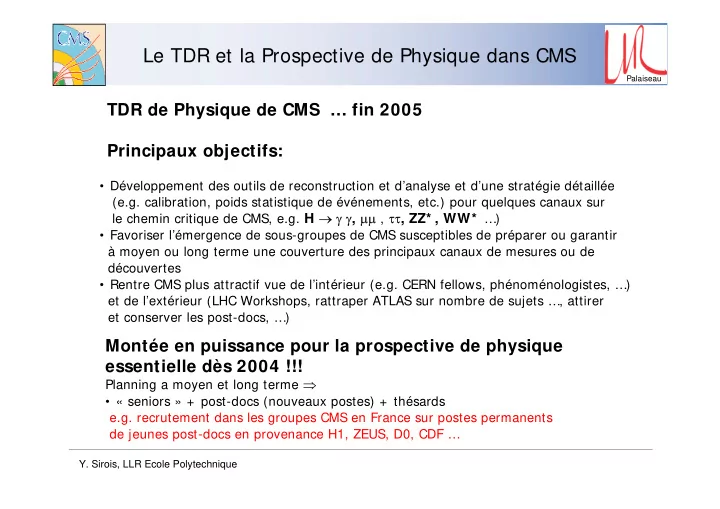
TDR de Physique de CMS … fin 2005 Principaux objectifs:

  • Développement des outils de reconstruction et d’analyse et d’une stratégie détaillée

(e.g. calibration, poids statistique de événements, etc.) pour quelques canaux sur le chemin critique de CMS, e.g. H → γ γ, µµ , ττ, ZZ* , WW* …)

  • Favoriser l’émergence de sous-groupes de CMS susceptibles de préparer ou garantir

à moyen ou long terme une couverture des principaux canaux de mesures ou de découvertes

  • Rentre CMS plus attractif vue de l’intérieur (e.g. CERN fellows, phénoménologistes, …)

et de l’extérieur (LHC Workshops, rattraper ATLAS sur nombre de sujets …, attirer et conserver les post-docs, …)

Montée en puissance pour la prospective de physique essentielle dès 2004 !!!

Planning a moyen et long terme ⇒

  • « seniors » + post-docs (nouveaux postes) + thésards

e.g. recrutement dans les groupes CMS en France sur postes permanents de jeunes post-docs en provenance H1, ZEUS, D0, CDF …

slide-2
SLIDE 2
  • Y. Sirois, LLR Ecole Polytechnique

Palaiseau

Analyse Détaillée: e.g. H → γ γ , H → ZZ* →4e

  • Approche intégrée globale:
  • figer l’ensemble des paramètres de la mesure (e.g. clustering simple, coupures

fixes) en « absorbant » les défauts (leakeage, collection partielle de l’energie, etc.)

  • procédure de calibration relative et absolue in situe basée (presqu’) exclusivement

sur des données réelles (Z → ee, W → eν, symétrie azymutale, …) ⇔ vise à dépendre aussi peu que possible du Monte Carlo (i.e. d’une connaissance a priori détaillée détaillée du détecteur) Difficultés techniques diverses: e.g. inter-calibration relative et absolue Limitations des performances pour la physique ?: e.g. combinaisons likelihoods …

Stratégie actuelle de CMS e.g. H → γ γ Nécessité d’une approche complémentaire e.g. H → ZZ* → 4e

  • Ré-évaluer la stratégie de mesure du quadri-vecteur de l’e incident (Bremss recovery,

constant fraction of energy collection ?, E-P combinations, etc.) + e ID. etc.

  • Développer une méthode complète intégrant des poids statistiques (cinématique et

mesure des événements) événement par événement (likelihood combinations)

slide-3
SLIDE 3

ECAL Test Beam Meeting - 23/03/2003 3

  • Y. Sirois, LLR Ecole Polytechnique

Palaiseau

Calibration W→e ν : oui mais comment ?

  • En faisceau test:

– » 103 électrons par crystal – On regarde un cristal à la fois – Lissage de l’energie vs. point d’impact

  • en deux dimensions séparément

– On determine la position du maximum de réponse … facteur de correction vs. position

  • suffisant pour une zone centrale de 7x7mm2

(i.e. ~10% de la surface d’un crystal)

– Lissage de l’énergie corrigée

  • In situ:

– On devra travailler avec 10 à 102 électrons par cristal – On doit donc résoudre le problème de la “mesure d’énergie vs. le point d’impact” en reconstruisant toute la gerbe – Il faut determiner les constantes de calibration sur plusieurs cristaux – Il faut développer des techniques itératives

Plots from Alessio Ghezzi (WACH4, Milan, Mar 2004)

e.g. C. Seez, CPT week May 2004

slide-4
SLIDE 4

ECAL Test Beam Meeting - 23/03/2003 4

  • Y. Sirois, LLR Ecole Polytechnique

Palaiseau

Radiations dans le matériel du trajectomètre

– La queue de Emeas/Etrue varie avec le matériel du trajectomètre – Pmeas/Ptrue dépend aussi du Bremms et du matériel dans le trajectomètre

– Aim is to inter-calibrate in small regions where tracker material is ~constant – Then inter-calibrate these regions with each other using very tight selection which largely excludes brem

  • There are other η-dependent effects, besides bremsstrahlung

E5x5/Etrue for 17 η bins in the barrel, pT

e=35GeV

slide-5
SLIDE 5

ECAL Test Beam Meeting - 23/03/2003 5

  • Y. Sirois, LLR Ecole Polytechnique

Palaiseau

L’échelle d’énergie et les algorithmes de clustering [1]

  • “Energy scale” correction needed for Monte-Carlo

data

  • Variation of the fraction of energy contained (for

whatever reason) can be corrected at the same time

– Electron super-clustering algorithms corrected by f(Ncry) — compensate for brems loss – Recent studies show current corrections only valid for a very limited energy

  • Les algorithmes de clustering ne collectent pas 100% de

l’énergie déposée dans le ECAL

– Once enough energy is collected to reduce sampling fluctuations, there is no special benefit in collecting more… (“enough” ≥ ~ 90%) – Most important: collect a constant fraction!

  • Spatial uniformity
  • Energy linearity
slide-6
SLIDE 6

ECAL Test Beam Meeting - 23/03/2003 6

  • Y. Sirois, LLR Ecole Polytechnique

Palaiseau

  • Unconverted photon 5x5 clusters can be corrected for lateral

containment variation as f(Σ1/Σ9) – Σ1/Σ9 measures the impact position w/r to the crystal centre

linear correction of S25 for S1/S9 linear correction of S25 for S1/S9

Example from J. Branson et al in H→γγ analysis MC containment study (1998) (arbitrary vertical axis) – No current implementation in ElectronPhoton

L’échelle d’énergie et les algorithmes de clustering [2]

slide-7
SLIDE 7

ECAL Test Beam Meeting - 23/03/2003 7

  • Y. Sirois, LLR Ecole Polytechnique

Palaiseau

Dépendance en η

  • The large variation of e response versus η due to variation of thickness
  • f tracker material is not the ONLY η-dependence in the barrel
  • Conclusion: global inter-calibration depends on particle type and

reconstruction algorithm

– Or: push these corrections into the reconstruction algorithms

Study of Maiko Takahashi “Umbrella effect” mentioned by Alain Givernaud, Elizabeth Locci et al (see CMS TN1995/151)

slide-8
SLIDE 8

ECAL Test Beam Meeting - 23/03/2003 8

  • Y. Sirois, LLR Ecole Polytechnique

Palaiseau

Energie des Photons en Bords de Modules

  • Pertes d’énergie pour les gerbes traversant les bords de modules;
  • La perte d’énergie peut etre corrigée en fonction de

ln(Eone side/ Eother side)

Daponte, Givernaud, Locci CMS Note-1997/087.

  • Correction déjà appliquée pour les études du ECAL TDR

(outils implémentées dans ElectronPhoton de ORCA)

0.4 0.5 0.6 0.7 0.8 0.9 1 1.1

  • 10
  • 5

5 10

log(E1/E2) Erec/Eincident Erec/Eincident

0.4 0.5 0.6 0.7 0.8 0.9 1 1.1

  • 10

0.4 0.5 0.6 0.7 0.8 0.9 1 1.1

  • 10
  • 5

5 10

log(E1/E2) log(E1/E2)

0.4 0.5 0.6 0.7 0.8 0.9 1 1.1

  • 10

a) b)

ECAL TDR: Uncorrected Corrected Discarded

slide-9
SLIDE 9

ECAL Test Beam Meeting - 23/03/2003 9

  • Y. Sirois, LLR Ecole Polytechnique

Palaiseau

Event-by-event likelihoods

Analyse H → γ γ USCD/ Caltech

QCD Background Selection des événements avec photon non- convertie ou convertie plus ou moins tôt (étalement du dépôt d’énergie, pouvoir de discrimination du bruit QCD, …): Event Categories Signal (unconverted)

slide-10
SLIDE 10

ECAL Test Beam Meeting - 23/03/2003 10

  • Y. Sirois, LLR Ecole Polytechnique

Palaiseau

Event-by-event likelihoods

  • J. Branson, UCSD Caltech

« Gain a factor 2 (conservative) to 5 (actual simulations) in luminosity reduction for a 5 σ discovery … i.e. < 10 fb-1 instead of 20 to 40 fb-1» !!!

CPT Week May 2004

slide-11
SLIDE 11

ECAL Test Beam Meeting - 23/03/2003 11

  • Y. Sirois, LLR Ecole Polytechnique

Palaiseau

e Road MAP

Track finding efficiency

specific algorithm development track parameter optimization

e I D

track-cluster matching resolving ambiguities shower profile

Energy-momentum estimation

Ecal E estimation Tracker P estimation Combination E-P

I solation

Ecal, Tracker, Hcal and Combined isolation underlying events …

I nternal Bremsstrahlung recovery

slide-12
SLIDE 12
  • Y. Sirois, LLR Ecole Polytechnique

Palaiseau

LLR Palaiseau - FESB Split

Search for Single Higgs Boson Production in H → ZZ* and WW* with final state leptons

slide-13
SLIDE 13
  • Y. Sirois, LLR Ecole Polytechnique

Palaiseau

Search for Single Higgs Boson Production in H → ZZ* and WW* with final state leptons

Goal: perform a complete prospective analysis to optimize the Higgs boson discovery potential and measurements in the channels pp → H + X → ZZ* or WW* + X in event topologies containing al least two high P⊥ leptons

LLR Palaiseau - FESB Split

  • S. Bimbot* , P. Busson, C. Charlot, F. Ferri* ,
  • N. Godinovitch, P. Paganini, I . Puljak, C. Rovelli* , Y. Sirois

Profit some specific expertise of the LLR-CMS group:

  • Ecal detector and CMS triggering system, e reconstruction and identification,

data reduction, etc. Extend from previous LLR-SPLIT work on prospective for the Higgs boson:

  • H → ZZ* → 4e
  • I. Puljak (LLR, supervisor C. Charlot); … first detailed study of discovery potential
  • N. Godinovitc (Split, supervisor I. Puljak), … measuring Higgs Spin and CP

Connect with LLR activities (C. Collard, Ph. Miné et al.) on Extra-Dimension Searches:

  • Common focusing/expertise on event topologies containing at least two

(very) high P⊥ leptons (possibility to extend to G → l+l-, ZZ* , …

slide-14
SLIDE 14
  • Y. Sirois, LLR Ecole Polytechnique

Palaiseau

  • H → ZZ* → 4e
  • S. Bimbot (LLR, supervisor P. Paganini)

e reconstruction in the Ecal (clustering, Bremmstrahlung recovery, …) lowest possible P⊥ threshold (effects from selective readout, noise etc.), control of systematics (trigger and measurements efficiencies, intercalibration, … )

  • ptimize discovery potential down to lowest possible MH (versus L )

(e.g. with sequential set of cuts)

extend to H → Zγ

(high L)

  • H → ZZ* → 4 leptons±
  • F. Ferri (LLR-Milano, supervisors Y.Sirois/A. Pullia)

combination of l+ l- final states including τ leptons (µ or e-like modes); e and τ lepton identification (isolation, cluster-track matching)

  • ptimize discovery potential in intermediate MH range (versus L )

(e.g. with likelihood combination of observables and decay channels)

constraints and measurements of Spin and CP quantum numbers (high L)

  • H → WW* → l+ ν l− ν
  • C. Rovelli (LLR-Milano, supervisors P. Busson/S. Ragazzi)

global Eflow variables l+ l- final states including τ leptons (hadronic modes);

  • ptimize discovery potential for 130 < MH < 2 MZ (versus L )

exploit spin-chirality induced final state correlations extension H → ZZ* → l+ l− ν ν (discovery potential at MH > > 2 MZ)

Thèses en cours au LLR

slide-15
SLIDE 15
  • Y. Sirois, LLR Ecole Polytechnique

Palaiseau

Measuring electrons for ZZ* channel in CMS

  • In ZZ* → 4 e± channel, preserving the highest possible efficiency ε is essential
  • Sharp Z* threshold for H → ZZ* ⇒ in most cases MH ~ MZ + MZ* for MH < 2 MZ
  • Main challenge: lowest P⊥ electron (generally originating from Z* )

Lowest P⊥ electron: 4-momentum measurement ≡ tracker issue for single isolated tracks (most precise P, easy signed) but tracker + calorimetry issue for early showering electrons ? Pattern Recognition ≡ calorimetry issue for single isolated tracks (known showering profile) but tracker + calorimetry issue for early showering electrons (?) and isolation

« A la recherche du lepton perdu » Marcel Proust 1923 (!)

Q ? Can we recover substantial ε in H → ZZ* by relaxing pattern recognition and

isolation requirements on the lowest P⊥ e while preserving proper rejection

power for misidentified background ?

slide-16
SLIDE 16
  • Y. Sirois, LLR Ecole Polytechnique

Palaiseau

Search for Extra-Dimensions at the LHC

Short term Goal: perform a complete prospective overview of the field and of the corresponding status of the analyses in CMS

Mini-Workshop au LLR le Vendredi 28 Mai 2004 !!!

Towards a LLR Palaiseau - CERN …. Global Effort ?

  • C. Charlot, C. Collard, P. Miné, ….. A. DeRoeck, …. Y. S. ….