Training for Transfer Learning objective Be able to develop a first - - PDF document

training for transfer
SMART_READER_LITE
LIVE PREVIEW

Training for Transfer Learning objective Be able to develop a first - - PDF document

INF3280 19 Feb 2019 Training for Transfer Learning objective Be able to develop a first version of a complete sequence of instruction for Assignment 4 Core Literature Textbook Chapter 7 & 8 Additional literature


slide-1
SLIDE 1

Jens Kaasbøll INF3280 – 19 Feb 2019

Training for Transfer

  • Learning objective

– Be able to develop a first version of a complete sequence of instruction for Assignment 4

  • Core Literature

– Textbook Chapter 7 & 8

  • Additional literature

– Mayer (1989) Models for Understanding – Chillarege et.al. (2003) Learning from our mistakes: error management training for mature learners – Grossman & Salas (2011) The transfer of training: what really matters

1

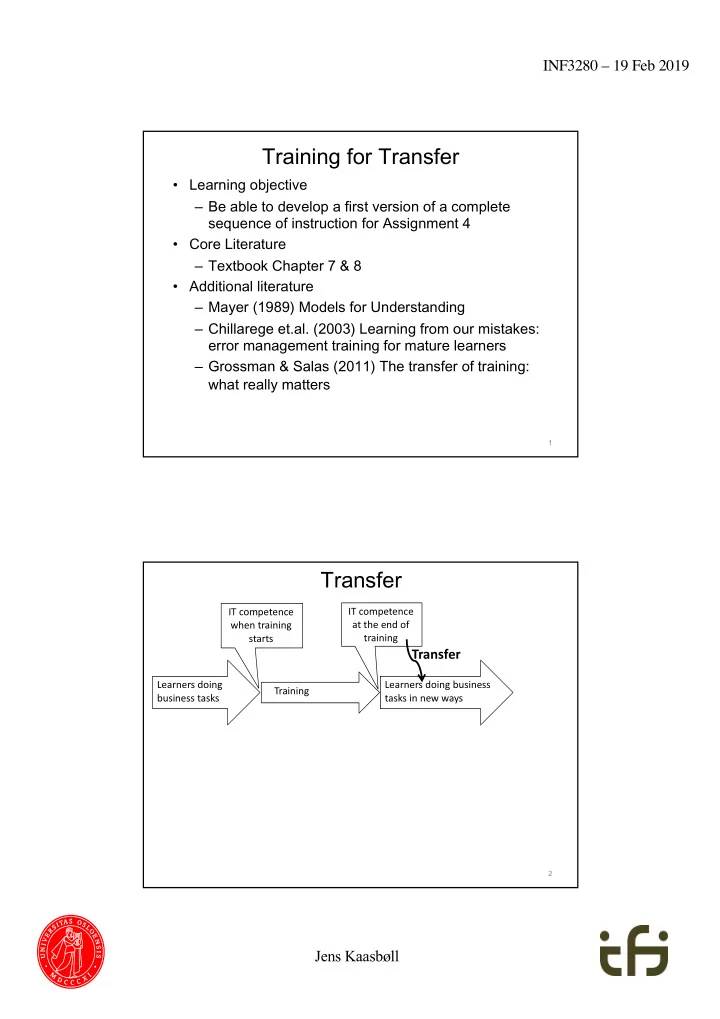
Training Learners doing business tasks IT competence when training starts IT competence at the end of training

Transfer

Learners doing business tasks in new ways

Transfer

2

slide-2
SLIDE 2

Jens Kaasbøll INF3280 – 19 Feb 2019

What went wrong – 1

The training for the new corporate information system concerning accounting, stock and production, took place as planned. During 50 training sessions, each lasting for 2 hours, a total of 1500 staff members were given hands on training

  • n all of the functions in the system.

When starting up, the three system support technicians were completely bogged down with all kinds of questions from users. Most of these questions had been covered in the training.

3

Training Use

What went wrong – 2

Each group of 20 staff were given training for the new workflow system for a whole day. Two weeks were spent on training to cover all 200 users. The system implementation was unfortunately delayed for a couple of months due to some software issues. When starting up, very few people actually used the

  • system. Upon request, they said they didn’t know how.

4

Training Use

slide-3
SLIDE 3

Jens Kaasbøll INF3280 – 19 Feb 2019

What went wrong – 3

Training for the new client and customer system was carried out for one hour. In addition, the participants were requested to become member of the corporate FaceBook group where they could ask questions and find instruction videos. A big mess appeared at system implementation Customers were double and triple registered, often with somewhat different contact information. The customer statistics was completely flawed.

5

Training Use

Training Learners doing business tasks IT competence when training starts IT competence at the end of training

Transfer + Motivation + Imitation + Realistic training environment + Problem solving + Self-efficacy + Opportunities to perform including timing + Social influence + Support

Learners doing business tasks in new ways

Factors improving transfer

6

Previously Today

slide-4
SLIDE 4

Jens Kaasbøll INF3280 – 19 Feb 2019

Timing

  • When the system can be used immediately after the course
  • Because

– Forgetting half of what’s learnt in one month – Waiting is demotivating

7

Result of Training and Transfer

Learning outco comes s after Tr Training

  • What the trainee is capable
  • f doing after training
  • Being able to use

CustManager for

– Updating – Correcting customer data – Reporting – Responding to alerts

Outco comes s of Transf sfer

  • The change in the business

as a result of training

  • Monthly customer contact
  • 10% sales increase

8

Example

slide-5
SLIDE 5

Jens Kaasbøll INF3280 – 19 Feb 2019

Learners’ background

9

Participants at the same level of competence Too advanced à learners do not understand Too simple à learners get bored or disturb others

Training module for skills and understanding

Training activities and scaffolds

  • 1. Introductory presentation of

– Learning objective

  • Usefulness for Individual or Business

– Business / Functional / Structural models

  • 2. Practicals

– Handing out Minimal Manuals, exercises – Guiding learners

  • 3. Summary

– Discuss Usefulness with learners – Discuss Structure and functionality with learners

  • Possibly a test

– Confront misconceptions

10

Learning outcomes

Vague understanding Skills Understanding

slide-6
SLIDE 6

Jens Kaasbøll INF3280 – 19 Feb 2019

Prerequisites before new concepts

Module on understanding Styles Module on understanding Table of Contents Module for problem solving with Styles

11

A n y

  • r

d e r

Concepts which are specialisations of other concepts

Table of Contents Footnote Index Cross reference Bookmark

12

Reference P r

  • c

e e d t

  • m
  • r

e s p e c i f i c c

  • n

c e p t s . A n y

  • r

d e r Proceed to more abstract concept based on two specific concepts

slide-7
SLIDE 7

Jens Kaasbøll INF3280 – 19 Feb 2019

Pair working learners

13

  • Improves understanding
  • Prepares for continued conversation

after training

Training environment differs from use environment

14

− transfer − transfer

  • Negative for transfer

Course Business

slide-8
SLIDE 8

Jens Kaasbøll INF3280 – 19 Feb 2019

Realistic training environment

15

Course Business Course leader Business manager Reach agreement on participants and course content Classroom Workplace Reduce use of projector – furnish participants with handouts Classmates and teacher Colleagues and superiors Several colleagues to the same training Simple and unknown examples Real and known examples Use business examples in training + transfer

Training Learners doing business tasks IT competence when training starts IT competence at the end of training

Transfer + Motivation + Imitation + Realistic training environment + Problem solving + Self-efficacy + Opportunities to perform including timing + Social influence + Support

Learners doing business tasks in new ways

Factors improving transfer

16

slide-9
SLIDE 9

Jens Kaasbøll INF3280 – 19 Feb 2019

Golden rules for IT user training

5.

  • 5. Divi

vide training into 30 minutes s modules s and incl clude problem so solvi ving modules s 6.

  • 6. Organise

se training at the sa same time as s the syst system is s inst stalled.

17