The Leadership Challenge Personalisation: To deliver 'just enough - - PowerPoint PPT Presentation

the leadership challenge
SMART_READER_LITE
LIVE PREVIEW

The Leadership Challenge Personalisation: To deliver 'just enough - - PowerPoint PPT Presentation

The Leadership Challenge Personalisation: To deliver 'just enough support' that reflects the aspirations of every person we support. (Key strategic aim 2011 -2016) Number of Number of Number of Number of days people staff


slide-1
SLIDE 1

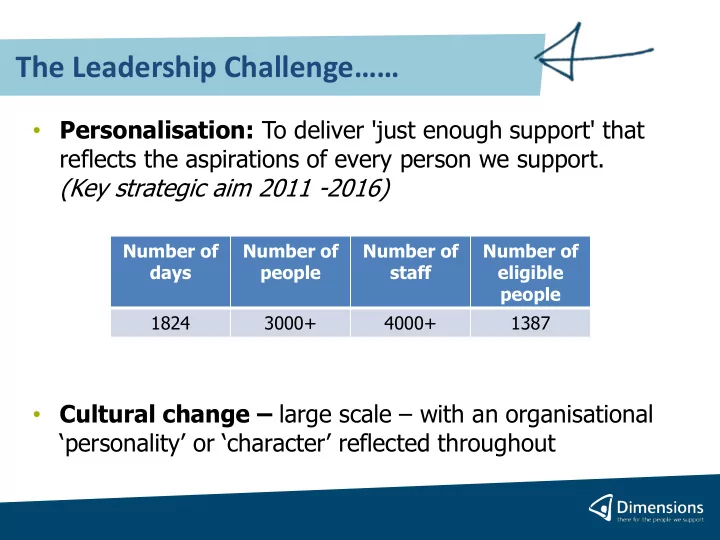
The Leadership Challenge……

  • Personalisation: To deliver 'just enough support' that

reflects the aspirations of every person we support. (Key strategic aim 2011 -2016)

  • Cultural change – large scale – with an organisational

‘personality’ or ‘character’ reflected throughout

Number of days Number of people Number of staff Number of eligible people 1824 3000+ 4000+ 1387

slide-2
SLIDE 2

What we already knew………

  • Train to gain – invest in the workforce
  • The money – the root of all evil – complex funding

arrangements/times of austerity

  • Having choice and control over the money is a fundamental

starting point but doesn’t guarantee a better life

  • Not just operations – business support
  • External ‘buy in’ and ‘support’
  • Communication, communication, communication
  • It would be a long journey
  • No pain – no gain!!!!
slide-3
SLIDE 3

The Leadership Challenge……

  • The elevator pitch – what would

we say?

  • Success criteria – what would

good look like – how would we know?

  • Where are we now – the size of

challenge (baseline – how?)

  • Excitement and anticipation –

create a ‘buzz’

  • HOW!!
slide-4
SLIDE 4

The heart of change - Kotter

  • Increase urgency – we’d done that
  • Build the (a) guiding team – we’d done that
  • Get the vision right – we’d done that
  • Communicate for buy-in – no!
  • Empower action – no!
  • Create short term wins – no!
  • Don’t let up………
  • Make change stick…………
slide-5
SLIDE 5

How we went about it – our personalisation guide and toolkit

  • Personalisation Journey workshops
  • Our guide – based on the top 10 tips

– Success Criteria – Skills for staff; person-centred thinking tools, holding positive & productive meetings; performance management – Finance; being clear about the money – HR; implications for staff – Rota Planning; people we support at the centre – Employment for people we support – On-going support; impact of change – Dealing with Home Truths

slide-6
SLIDE 6

How we went about it…………..

  • Progress for Providers – baselines
  • Regional and business support project

plans and communication plans (creating the ‘buzz’)

  • One page profiles for everyone
  • Leadership pledges – 143 pledges
  • Fun – quiz
  • Positive and productive meetings
  • Risks – what are the risks of implementing this?
slide-7
SLIDE 7

Embedding person-centred thinking

  • Assessment – getting to know you
  • Support planning and daily records
  • Performance management
  • Lessons learnt
  • Positive and productive meetings
  • One page profiles, introductions, recruitment, email

footers, reception

  • Recruitment and selection
  • Common language
  • Role modelling
slide-8
SLIDE 8

Embedding person-centred thinking

slide-9
SLIDE 9

One Page Profiles – guidance & top tips

slide-10
SLIDE 10

One Page Profiles

slide-11
SLIDE 11

101 Ways to use One Page Profiles

  • Recruitment and selection
  • Performance management
  • Learning and development, project and teams
  • Introductions – auditors, lawyers
  • Board/SMT Away Days
  • Team profiles
  • E mail footers
  • http://www.dimensions-uk.org/news-and-

events/101-ways-to-use-a-one-page-profile/

slide-12
SLIDE 12

Learning & Review

  • What’s working/not working
  • Clarification & further guidance
slide-13
SLIDE 13

Short term wins

slide-14
SLIDE 14

Sharing learning and good practice?

  • Local workshops working through the guide with managers

looking at specific areas, i.e. risk maps, roles & responsibilities

  • Identifying service champions
  • Regularly repeating Progress for Providers
  • Regional newsletters
  • Making videos with staff and people supported to track the

journey

  • Personalisation journey diaries for managers
  • Connecting senior managers within regions to services
  • Involving external people on local project teams
slide-15
SLIDE 15

Where are we now?

Kotter would say…………..

  • Don’t let up
  • Make change stick

What we would say…………………….

  • 935 days to go – don’t let up and make change

stick!!!

slide-16
SLIDE 16

What are we doing about this?

  • Check ins (not check ups) with core group
  • SMT check ins with people we support via SMT Forums
  • Measuring progress against our identified milestones
  • Capturing the stories – bringing the journey to life

(everywhere)

  • Dispelling myths and inaccuracies
  • Talking a language that everyone understands
  • Listening and acting
slide-17
SLIDE 17

Thoughts on managing change

  • Be realistic about what you’re aiming to achieve. Major

change to working practices takes courage, determination - and time.

  • Recognise and feel comfortable with accepting you will

discover some things that must change. You’ll learn much more and achieve positive change more quickly by clarifying your expectations and engaging in honest and

  • pen dialogue and avoiding the ‘blame game’.
slide-18
SLIDE 18

Thoughts on managing change

  • Ensure your leaders are all actively engaged and prepared

for the change.

  • Establish your criteria for success at the outset, based on

what you want to achieve for the people you support and for your organisation.

slide-19
SLIDE 19

Thoughts on managing change

  • Develop your own views very early as to how you would

allocate Individual Service Funds, what should constitute core services and what people can have under their own personal control.

  • Develop your organisational response to dealing with a

member of staff whom nobody wants to support them.

slide-20
SLIDE 20

Thoughts on managing change

  • Provide people with clear information about the principles
  • f personalisation, individual budgets and Individual Service

Funds at the outset.

  • Everyone, including business support, but particularly every

member of operations should be familiar with person- centred thinking tools and should work towards becoming ‘fluent’ in them.

slide-21
SLIDE 21

Thoughts on managing change

  • Help your staff understand they must have their own

personal offer for the people they are supporting. If they haven’t got one, help them to develop one.

  • Find anchor points that are real and use stories and

journeys to connect people to change.

slide-22
SLIDE 22

Thoughts on managing change

  • Use person-centred supervision on a regular basis. Having

the feedback of people being supported as an explicit component of individual staff supervision and appraisal is very beneficial.

  • Be prepared to provide higher levels of support, training,

independent challenge and coaching than you think necessary.

slide-23
SLIDE 23

Thoughts on managing change

  • Don’t under-estimate the impact of broader organisational

change upon local services and their attempts to improve how they provide support.

  • Accept it will never be right and just keep on going.
slide-24
SLIDE 24

Questions to ponder...

  • How person centred is your organisation?
  • How prepared is organisation for this challenge?
  • How well does organisation manage change?
slide-25
SLIDE 25

How well do you think you are doing?

slide-26
SLIDE 26

“We cannot solve our problems from the same level of thinking that created them”

Albert Einstein

slide-27
SLIDE 27

Closing remarks… Catherine Garrod Providers & Personalisation