Tracking using CONDENSATION: Conditional Density Propagation M. - - PDF document

tracking using condensation conditional density
SMART_READER_LITE
LIVE PREVIEW

Tracking using CONDENSATION: Conditional Density Propagation M. - - PDF document

Tracking using CONDENSATION: Conditional Density Propagation M. Isard and A. Blake, CONDENSATION Conditional density propagation for visual tracking, Int. J. Computer Vision 29 (1), 1998, pp. 4-28. Goal Model-based visual tracking in


slide-1
SLIDE 1

1

Tracking using CONDENSATION: Conditional Density Propagation

  • M. Isard and A. Blake, CONDENSATION –

Conditional density propagation for visual tracking, Int. J. Computer Vision 29(1), 1998, pp. 4-28.

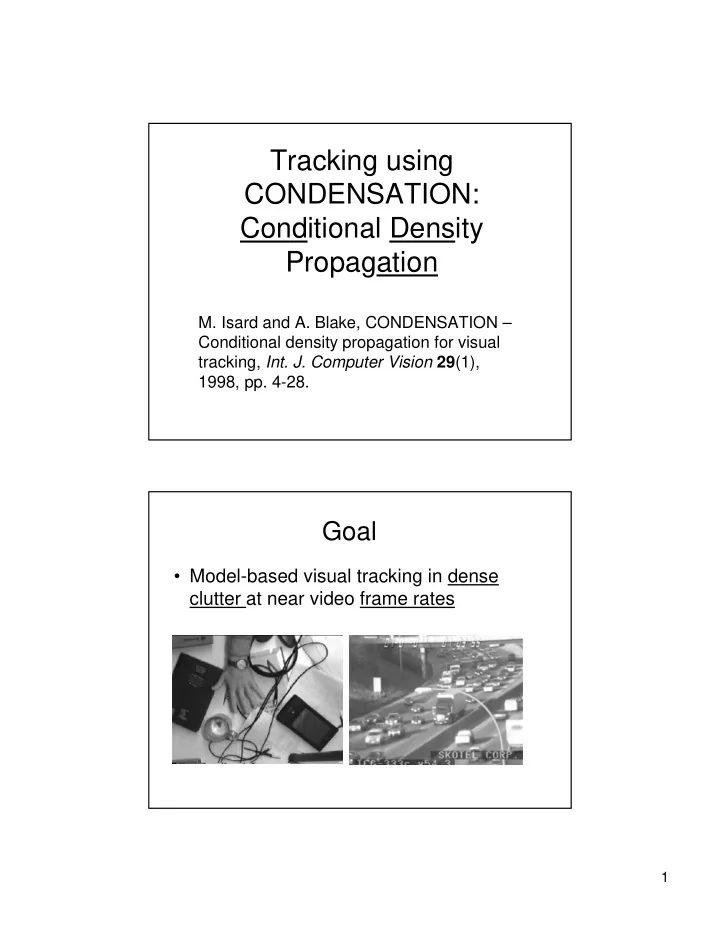
Goal

  • Model-based visual tracking in dense

clutter at near video frame rates

slide-2
SLIDE 2

2

Example of CONDENSATION Algorithm Approach

  • Probabilistic framework for tracking
  • bjects such as curves in clutter

using an iterative sampling algorithm

  • Model motion and shape of target
  • Top-down approach
  • Simulation instead of analytic

solution

slide-3
SLIDE 3

3

Probabilistic Framework

  • Object dynamics form a temporal Markov

chain

  • Observations, zt , are independent (mutually

and w.r.t process)

  • Use Bayes’ rule

( ) ( )

1 1

| |

− − =

Χ

t t t t

x x p x p ( ) ( ) ) | ( | | ,

1 1 1 1 1 i i t i t t t t t

x z p X x p X x Z p

− = − − −

∏ =

Notation

X State vector, e.g., curve’s position and orientation Z Measurement vector, e.g., image edge locations p(X) Prior probability of state vector; summarizes prior domain knowledge, e.g., by independent measurements p(Z) Probability of measuring Z; fixed for any given image p(Z | X) Probability of measuring Z given that the state is X; compares image to expectation based on state p(X | Z) Probability of X given that measurement Z has

  • ccurred; called state posterior
slide-4
SLIDE 4

4

Tracking as Estimation

  • Compute state posterior, p(X|Z), and select next

state to be the one that maximizes this (Maximum a Posteriori (MAP) estimate)

  • Measurements are complex and noisy, so

posterior cannot be evaluated in closed form

  • Particle filter (iterative sampling) idea:

Stochastically approximate the state posterior with a set of N weighted particles, (s, π), where s is a sample state and π is its weight

  • Use Bayes’ rule to compute p(X|Z)

Factored Sampling

  • Generate a set of samples that

approximates the posterior p(X|Z)

  • Sample set generated from

p(X); each sample has a weight (“probability”) } ,..., {

) ( ) 1 ( N

s s = s

  • =

=

N j j z i z i

s p s p

1 ) ( ) (

) ( ) ( π

) | ( ) ( x z p x pz =

slide-5
SLIDE 5

5

Factored Sampling

  • CONDENSATION for one image

N=15 X

Estimating Target State

slide-6
SLIDE 6

6

) ( ) ( ) | ( ) | ( Z X X Z Z X p p p p =

This is what you want. Knowing p(X|Z) will tell us what is the most likely state X. This is what you may know a priori, or what you can predict This is what you can evaluate

Bayes’ Rule

This is a constant for a given image

CONDENSATION Algorithm

  • 1. Select: Randomly select N particles from {st-1(n)}

based on weights πt-1(n); same particle may be picked multiple times (factored sampling)

  • 2. Predict: Move particles according to

deterministic dynamics (drift), then perturb individually (diffuse)

  • 3. Measure: Get a likelihood for each new sample

by comparing it with the image’s local appearance, i.e., based on p(zt|xt); then update weight accordingly to obtain {(st(n), πt(n))}

slide-7
SLIDE 7

7 Posterior at time k-1 Predicted state at time k Posterior at time k

  • bservation

density drift diffuse measure ) ( 1 ) ( 1, n k n k

s

− − π

) ( ) ( , n k n k

s π

) (n k

s

Notes on Updating

  • Enforcing plausibility: Particles that

represent impossible configurations are discarded

  • Diffusion modeled with a Gaussian
  • Likelihood function: Convert “goodness of

prediction” score to pseudo-probability

– More markings closer to predicted markings → higher likelihood

slide-8
SLIDE 8

8

State Posterior State Posterior Animation

slide-9
SLIDE 9

9

Object Motion Model

  • For video tracking we need a way to

propagate probability densities, so we need a “motion model” such as

X t+1 = A Xt + B Wt where W is a noise term and A and B are state transition matrices that can be learned from training sequences

  • The state, X, of an object, e.g., a B-spline

curve, can be represented as a point in a 6D state space of possible 2D affine transformations of the object

  • therwise

z x if z x

m m m m m

ρ δ φ < − − =

2

Evaluating p(Z | X)

  • =

+ =

M m m m p

x z p clutter z qp x z p

1

) ( ) , | ( ) | ( ) | ( φ φ

where φm = {true measurement is zm} for m = 1,…,M, and q = 1 - Σmp(φm) is the probability that the target is not visible

slide-10
SLIDE 10

10

Dancing Example Hand Example

slide-11
SLIDE 11

11

Pointing Hand Example Glasses Example

  • 6D state space of affine transformations of a spline

curve

  • Edge detector applied along normals to the spline
  • Autoregressive motion model
slide-12
SLIDE 12

12

3D Model-based Example

  • 3D state space: image position + angle
  • Polyhedral model of object

Minerva

  • Museum tour guide robot that used

CONDENSATION to track its position in the museum

Desired Location Exhibit

slide-13
SLIDE 13

13

Advantages of Particle Filtering

  • Nonlinear dynamics, measurement model

easily incorporated

  • Copes with lots of false positives
  • Multi-modal posterior okay (unlike Kalman

filter)

  • Multiple samples provides multiple

hypotheses

  • Fast and simple to implement