Machine Learning 10-601 Tom M. Mitchell Machine Learning Department - - PDF document

machine learning 10 601
SMART_READER_LITE
LIVE PREVIEW

Machine Learning 10-601 Tom M. Mitchell Machine Learning Department - - PDF document

Machine Learning 10-601 Tom M. Mitchell Machine Learning Department Carnegie Mellon University October 13, 2011 Today: Readings: Required: Graphical models Bishop chapter 8, through 8.2 Bayes Nets: Conditional


slide-1
SLIDE 1

1

Machine Learning 10-601

Tom M. Mitchell Machine Learning Department Carnegie Mellon University October 13, 2011

Today:

  • Graphical models
  • Bayes Nets:
  • Conditional

independencies

  • Inference
  • Learning

Readings:

Required:

  • Bishop chapter 8, through 8.2

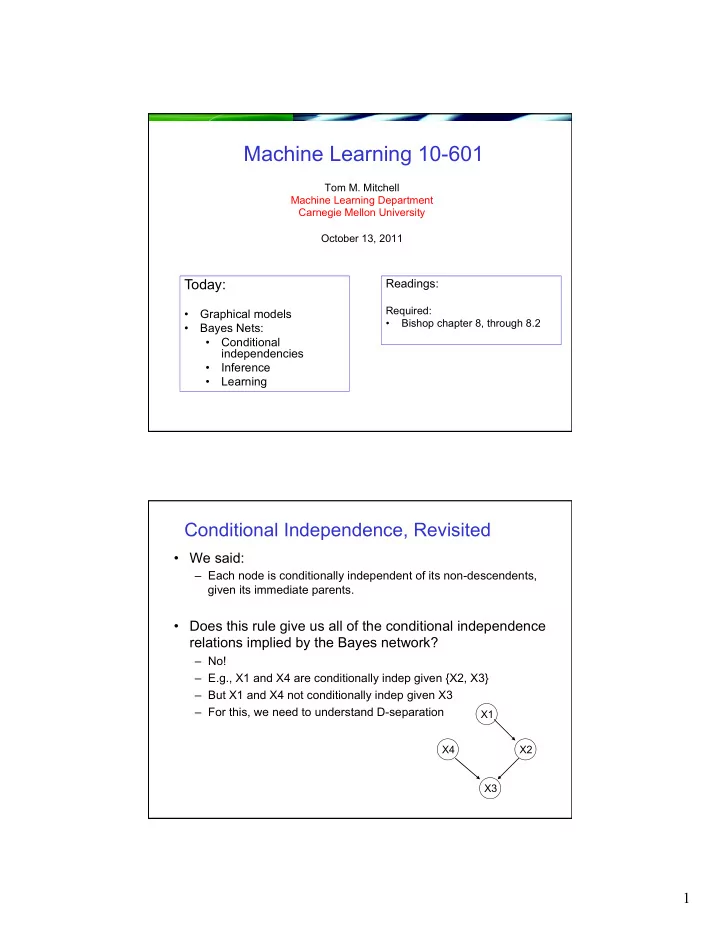
Conditional Independence, Revisited

  • We said:

– Each node is conditionally independent of its non-descendents, given its immediate parents.

  • Does this rule give us all of the conditional independence

relations implied by the Bayes network?

– No! – E.g., X1 and X4 are conditionally indep given {X2, X3} – But X1 and X4 not conditionally indep given X3 – For this, we need to understand D-separation

X1 X4 X2 X3

slide-2
SLIDE 2

2

prove A cond indep of B given C? ie., p(a,b|c) = p(a|c) p(b|c)

Easy Network 1: Head to Tail

A C B

let’s use p(a,b) as shorthand for p(A=a, B=b) prove A cond indep of B given C? ie., p(a,b|c) = p(a|c) p(b|c)

Easy Network 2: Tail to Tail

A C B

let’s use p(a,b) as shorthand for p(A=a, B=b)

slide-3
SLIDE 3

3

prove A cond indep of B given C? NO!

Summary:

  • p(a,b)=p(a)p(b)
  • p(a,b|c) NotEqual p(a|c)p(b|c)

Explaining away. e.g.,

  • A=earthquake
  • B=breakIn
  • C=motionAlarm

Easy Network 3: Head to Head

A C B

X and Y are conditionally independent given Z, if and only if X and Y are D-separated by Z.

Suppose we have three sets of random variables: X, Y and Z X and Y are D-separated by Z (and therefore conditionally indep, given Z) iff every path from every variable in X to every variable in Y is blocked A path from variable A to variable B is blocked if it includes a node such that either

  • 1. arrows on the path meet either head-to-tail or tail-to-tail at the node and

this node is in Z

  • 2. the arrows meet head-to-head at the node, and neither the node, nor any
  • f its descendants, is in Z

[Bishop, 8.2.2]

slide-4
SLIDE 4

4

X and Y are D-separated by Z (and therefore conditionally indep, given Z) iff every path from every variable in X to every variable in Y is blocked A path from variable A to variable B is blocked if it includes a node such that either

  • 1. arrows on the path meet either head-to-tail or tail-to-tail at the node and

this node is in Z

  • 2. the arrows meet head-to-head at the node, and neither the node, nor

any of its descendants, is in Z X1 indep of X3 given X2? X3 indep of X1 given X2? X4 indep of X1 given X2?

X1 X4 X2 X3 X and Y are D-separated by Z (and therefore conditionally indep, given Z) iff every path from any variable in X to any variable in Y is blocked by Z A path from variable A to variable B is blocked by Z if it includes a node such that either

  • 1. arrows on the path meet either head-to-tail or tail-to-tail at the node and this

node is in Z

  • 2. the arrows meet head-to-head at the node, and neither the node, nor any of

its descendants, is in Z X4 indep of X1 given X3? X4 indep of X1 given {X3, X2}? X4 indep of X1 given {}? X1 X4 X2 X3

slide-5
SLIDE 5

5

X and Y are D-separated by Z (and therefore conditionally indep, given Z) iff every path from any variable in X to any variable in Y is blocked A path from variable A to variable B is blocked if it includes a node such that either

  • 1. arrows on the path meet either head-to-tail or tail-to-tail at the node

and this node is in Z

  • 2. the arrows meet head-to-head at the node, and neither the node, nor

any of its descendants, is in Z

a indep of b given c? a indep of b given f ?

Markov Blanket

from [Bishop, 8.2]

slide-6
SLIDE 6

6

What You Should Know

  • Bayes nets are convenient representation for

encoding dependencies / conditional independence

  • BN = Graph plus parameters of CPD’s

– Defines joint distribution over variables – Can calculate everything else from that – Though inference may be intractable

  • Reading conditional independence relations from the

graph

– Each node is cond indep of non-descendents, given only its parents – D-separation – ‘Explaining away’

See Bayes Net applet: http://www.cs.cmu.edu/~javabayes/Home/applet.html

Inference in Bayes Nets

  • In general, intractable (NP-complete)
  • For certain cases, tractable

– Assigning probability to fully observed set of variables – Or if just one variable unobserved – Or for singly connected graphs (ie., no undirected loops)

  • Belief propagation
  • For multiply connected graphs
  • Junction tree
  • Sometimes use Monte Carlo methods

– Generate many samples according to the Bayes Net distribution, then count up the results

  • Variational methods for tractable approximate

solutions

slide-7
SLIDE 7

7

Example

  • Bird flu and Allegies both cause Sinus problems
  • Sinus problems cause Headaches and runny Nose
  • Prob. of joint assignment: easy
  • Suppose we are interested in joint

assignment <F=f,A=a,S=s,H=h,N=n> What is P(f,a,s,h,n)?

let’s use p(a,b) as shorthand for p(A=a, B=b)

slide-8
SLIDE 8

8

  • Prob. of marginals: not so easy
  • How do we calculate P(N=n) ?

let’s use p(a,b) as shorthand for p(A=a, B=b)

Generating a sample from joint distribution: easy

How can we generate random samples drawn according to P(F,A,S,H,N)?

let’s use p(a,b) as shorthand for p(A=a, B=b)

slide-9
SLIDE 9

9

Generating a sample from joint distribution: easy

Note we can estimate marginals like P(N=n) by generating many samples from joint distribution, then count the fraction of samples for which N=n Similarly, for anything else we care about P(F=1|H=1, N=0) à weak but general method for estimating any probability term…

let’s use p(a,b) as shorthand for p(A=a, B=b)

  • Prob. of marginals: not so easy

But sometimes the structure of the network allows us to be clever à avoid exponential work eg., chain

A D B C E

slide-10
SLIDE 10

10

Inference in Bayes Nets

  • In general, intractable (NP-complete)
  • For certain cases, tractable

– Assigning probability to fully observed set of variables – Or if just one variable unobserved – Or for singly connected graphs (ie., no undirected loops)

  • Variable elimination
  • Belief propagation
  • For multiply connected graphs
  • Junction tree
  • Sometimes use Monte Carlo methods

– Generate many samples according to the Bayes Net distribution, then count up the results

  • Variational methods for tractable approximate

solutions