11/15/16 Conditional distributions Let X and Y be discrete r.v.s. - - PDF document

11 15 16
SMART_READER_LITE
LIVE PREVIEW

11/15/16 Conditional distributions Let X and Y be discrete r.v.s. - - PDF document

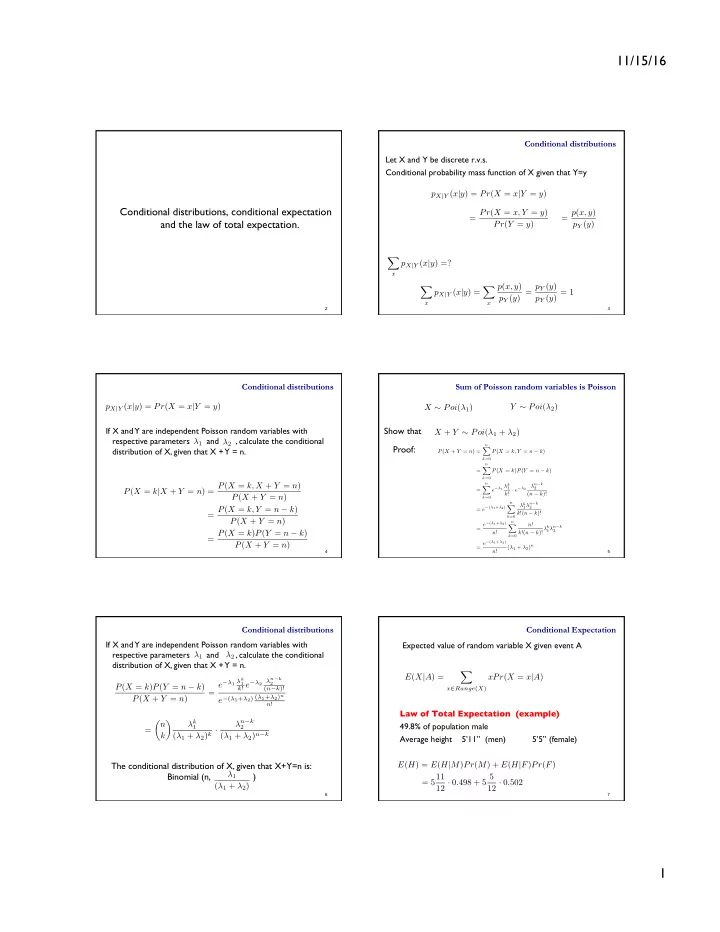
11/15/16 Conditional distributions Let X and Y be discrete r.v.s. Conditional probability mass function of X given that Y=y p X | Y ( x | y ) = Pr ( X = x | Y = y ) Conditional distributions, conditional expectation = Pr ( X = x, Y = y ) = p (


slide-1
SLIDE 1

11/15/16 1

Conditional distributions, conditional expectation and the law of total expectation.

2

Conditional distributions Let X and Y be discrete r.v.s. Conditional probability mass function of X given that Y=y

3

pX|Y (x|y) = Pr(X = x|Y = y) = Pr(X = x, Y = y) Pr(Y = y) = p(x, y) pY (y) X

x

pX|Y (x|y) =? X

x

pX|Y (x|y) = X

x

p(x, y) pY (y) = pY (y) pY (y) = 1 Conditional distributions

4

pX|Y (x|y) = Pr(X = x|Y = y) If X and Y are independent Poisson random variables with respective parameters and , calculate the conditional distribution of X, given that X + Y = n. λ1 λ2 P(X = k|X + Y = n) = P(X = k, X + Y = n) P(X + Y = n) = P(X = k, Y = n − k) P(X + Y = n) = P(X = k)P(Y = n − k) P(X + Y = n) Sum of Poisson random variables is Poisson

5

X ∼ Poi(λ1) Y ∼ Poi(λ2) X + Y ∼ Poi(λ1 + λ2) Show that Proof:

P(X + Y = n) =

n

X

k=0

P(X = k, Y = n − k) =

n

X

k=0

P(X = k)P(Y = n − k) =

n

X

k=0

e−λ1 λk

1

k! · e−λ2 λn−k

2

(n − k)! = e−(λ1+λ2)

n

X

k=0

λk

1λn−k 2

k!(n − k)! = e−(λ1+λ2) n!

n

X

k=0

n! k!(n − k)!λk

1λn−k 2

= e−(λ1+λ2) n! (λ1 + λ2)n

Conditional distributions

6

If X and Y are independent Poisson random variables with respective parameters and , calculate the conditional distribution of X, given that X + Y = n. λ1 λ2 P(X = k)P(Y = n − k) P(X + Y = n) = e−λ1 λk

1

k! e−λ2 λn−k

2

(n−k)!

e−(λ1+λ2) (λ1+λ2)n

n!

The conditional distribution of X, given that X+Y=n is: Binomial (n, ) λ1 (λ1 + λ2) = ✓n k ◆ λk

1

(λ1 + λ2)k · λn−k

2

(λ1 + λ2)n−k Conditional Expectation Expected value of random variable X given event A

7

E(X|A) = X

x∈Range(X)

xPr(X = x|A) Law of Total Expectation (example) 49.8% of population male Average height 5’11’’ (men) 5’5’’ (female) E(H) = E(H|M)Pr(M) + E(H|F)Pr(F) = 511 12 · 0.498 + 5 5 12 · 0.502

slide-2
SLIDE 2

11/15/16 2

Law of Total Expectation X random variable on a sample space S partition of S

8

A1, A2, . . . , Ak E(X) = X

i

E(X|Ai)Pr(Ai) = X

i

X

x

xPr(X = x|Ai)Pr(Ai) = X

i

xPr(X = x) = X

x

x X

i

Pr(X = x|Ai)Pr(Ai) = X

x

X

i

xPr(X = x|Ai)Pr(Ai) Law of Total Expectation X random variable on a sample space S partition of S Version with conditional distributions

9

A1, A2, . . . , Ak E(X) = X

i

E(X|Ai)Pr(Ai) E(X) = X

y

E(X|Y = y)P(Y = y) E(X|Y = y) = X

x

xpX|Y (x|y) = X

x

xPr(X = x|Y = y) Linearity of expectation applies To conditional expectation too!! E(X+ Y | A) = E(X | A) + E(Y |A) E(aX + b | A)= a E(X | A) + b

10

Law of Total Expectation : Application System that fails in step i independently with probability p X # steps to fail E(X) ?

11

Let A be the event that system fails in first step. E(X) = E(X|A)Pr(A) + E(X|A)Pr(A) = p + (1 + E(X))(1 − p) = 1 + (1 − p)E(X) E(X) = 1 p Law of Total Expectation : Example

A miner is trapped in a mine containing 3 doors.

  • D1: The 1st door leads to a tunnel that will take him to safety after 3

hours.

  • D2: The 2nd door leads to a tunnel that returns him to the mine after 5

hours.

  • D3: The 3rd door leads to a tunnel that returns him to the mine after a

number of hours that is Binomial with parameters (12, 1/3). At all times, he is equally likely to choose any one of the doors. E(time to reach safety) ?

12

Law of Total Expectation : Example

A miner is trapped in a mine containing 3 doors.

  • D1: The 1st door leads to a tunnel that will take him to safety after 3

hours.

  • D2: The 2nd door leads to a tunnel that returns him to the mine after 5

hours.

  • D3: The 3rd door leads to a tunnel that returns him to the mine after a

number of hours that is Binomial with parameters (12, 1/3). At all times, he is equally likely to choose any one of the doors. E(time to reach safety) ?

13

E(T) = E(T|D1)1 3 + E(T|D2)1 3 + E(T|D3)1 3 = 3 · 1 3 + 5 · 1 3 + (4 + E(T)) · 1 3 E(T) = 6

slide-3
SLIDE 3

11/15/16 3

Problem The number of people who enter an elevator on the ground floor is a Poisson random variable with mean 10. If there are N floors above the ground floor, and if each person is equally likely to get

  • ff at any one of the N floors, independently of where the others

get off, compute the expected number of stops that the elevator will make before discharging all the passengers.

14

Problem The number of people who enter an elevator on the ground floor is a Poisson random variable with mean 10. If there are N floors above the ground floor, and if each person is equally likely to get

  • ff at any one of the N floors, independently of where the others

get off, compute the expected number of stops that the elevator will make before discharging all the passengers.

15

X number of people who enter Y number of stops E(Yi|X = k) =

  • 1 − (1 − 1/N)k

Yi indicates a stop on floor i E(Y |X = k) = E(Y1 + . . . + YN|X = k) Pr(X = k) = e−10 10k k! E(Y ) =

X

k=0

E(Y |X = k)P(X = k) Game of Craps

  • Begin by rolling an ordinary pair of dice
  • If the sum of dice is 2, 3 or 12, the player loses
  • If the sum of dice is 7 or 11, the player wins
  • If it is any other number, say k, the player continues to

roll the dice until the sum is either 7 or k.

  • If it is 7, the player loses.
  • If it is k, the player wins.

Let R denote the number of rolls of the dice in a game of craps.

  • What is E(R)?

16