SLIDE 1 Some national history. . .
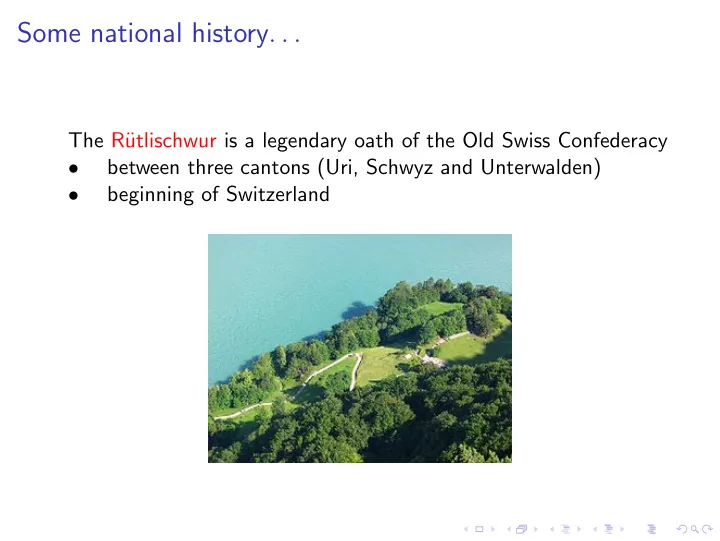
The R¨ utlischwur is a legendary oath of the Old Swiss Confederacy
- between three cantons (Uri, Schwyz and Unterwalden)
- beginning of Switzerland
SLIDE 2
Some local physics’ history. . .
But there is also the “Uetli Schwur” in physics: [. . .] It was not long after the publication of Bohr’s papers that Stern and von Laue went for a walk up the Uetliberg, a small mountain just outside Z¨ urich. On the top they sat down and talked about physics, in particular about the new atom model. There and then they made the “Uetli Schwur”: If that crazy model of Bohr turned out to be right, then they would leave physics. It did and they didn’t. [A. Pais]
SLIDE 3
15-th European Workshop on String Theory, Z¨ urich p-branes on the waves
Ben Craps,a Frederik De Rooa,b,1, Oleg Evnina and Federico Gallia
a Vrije Universiteit Brussel and
The International Solvay Institutes
b Universiteit Gent 1 Aspirant FWO
fderoo@tena4.vub.ac.be
September 8, 2009
SLIDE 4 Where does the universe come from?
Quantum gravity expected to resolve initial spacelike singularity String theory still has problems in presence of
- singularities
- time-dependences
⇒ investigate singular and time-dependent backgrounds in string theory Age of universe: ca. 14 Gyr 1 yr → 7 · 10−9 %
SLIDE 5 p-branes on the waves: outline
Singular and time-dependent backgrounds in string theory
- why plane waves?
- Matrix big bang
- p-branes embedded in plane waves
A family of 10-dimensional supergravity solutions [1] D0-branes embedded in plane waves [1] B. Craps, F.D.R., O. Evnin, F. Galli, arXiv: 0905.1843 [hep-th] + work in progress
SLIDE 6 Why plane waves?
Plane waves: first approximation to spacetime singularities
- btained by Penrose limit
- capture tidal forces of singularities
[Blau e.a.] Exact string theory solutions
[Horowitz, Steif; Amati, Klimˇ c´ ık] Exactly solvable σ-models [Papadopoulos, Russo, Tseytlin] Time-dependent waves possible
- add dilaton for background consistency (e.g.)
SLIDE 7 Matrix big bang
Flat Minkowski space + light-like linear dilaton
i=1
DLCQ
- compactify X − and focus on sector with p+ = 2πN/R
- Lorentz boost
- T and S duality
⇓ N D1-branes wrapped around x1 in IIB
i=1
[Craps, Sethi, Verlinde]
SLIDE 8 p-branes embedded in plane waves
Matrix big bang leads to D1 branes in a dilaton-gravity plane wave
- branes wrapped along x1
- ds2 = −dt2 + dx2 + (t + x) 8
i=1
φ = log(t + x)
✲ ✻ ✑ ✑ ✑ ✑ ✰
x1 x t φ(t + x) . . . . . . . . . . . . . . . . . . . . . . . . . . . . . . . . . . . . . . . . . . . . . . . . . . . . . . . . . . . . . . . . . . . . . . . D1-brane . . . . . . . . . . . . . . . . . . . . . . . . . . . . . . . . . . . . . . . . . . . . . . . . . . . . . . . . . . . Not supersymmetric, but static solutions exist (DBI analysis) D1 along dilaton preserves susy ⇒ easier supergravity solution?
SLIDE 9 p-branes on the waves: outline
Singular and time-dependent backgrounds in string theory A family of 10-dimensional supergravity solutions
- restricted ansatz for extremal branes
- solution strategy in four steps
- solution in Brinkmann coordinates
D0-branes embedded in plane waves
SLIDE 10 A family of ten-dimensional supergravity solutions
extended extremal supersymmetric Ramond-Ramond p-branes embedded into dilaton-gravity plane waves
- time-dependent (lightcone time u = t + x)
- arbitrary profile φ(u)
- isotropy in transverse coordinates xa, xb. . .
brane world-volume parallel with propagation direction of the wave
✲ ✻ ✑ ✑ ✑ ✑
v,α a,b u φ(u) . . . . . . . . . . . . . . . . . . . . . . . . . . . . . . . . . . . . . . . . . . . . . . . . . . . . . . . . . . . . . . . . . . . . . . . . . brane . . . . . . . . . . . . . . . . . . . . . . . . . . . . . . . . . . . . . . . . . . . . . . . . . . . . . . . . . . . . pp-wave ...
SLIDE 11 Equations of motion in Einstein frame
Rµν = 1 2∂µφ∂νφ + 1 2
1 (p + 2)!e(3−p)φ/2
µν − p + 1
8 gµνF2
4
3 − p (p + 2)!e(3−p)φ/2F2 ∂µ √−ge(3−p)φ/2Fµ··· = 0 ∂[µFν...] = 0 F : (p + 2)−form, F2
µν = Fµ...F ··· ν , F2 = F...F···
SLIDE 12 For extremal branes a restricted ansatz suffices
ds2 = A(u, r)
- −2dudv + K(u, r)du2 + dy2
α
a
φ = φ(u, r), r =
a
Fuvα1...αp−1a = xa
r F(u, r)A(p+1)/2B(p−7)/2ǫα1...αp−1,
p < 3, Electric Fa1...a8−p = xa
r F(u, r)ǫa1...a8−pa,
p > 3, Magnetic K(u, r) captures the wave profile plus some corrections What’s new? Relaxed assumptions for non-extremal branes ds2 = A(u, r)
- −2dudv + K(u, r)du2 + L(u, r)dy2
α
- +gua(u, r)du dxa + B(u, r)dx2
a
SLIDE 13 Restricted ansatz simplifies structure of Einstein’s equations
Rµν = 1
2∂µφ∂νφ + 1 2
1 (p+2)!e(3−p)φ/2
F2
µν − p+1 8 gµνF2
Nonzero components uu, ua uv = αα ab = δab + xaxb Electric ansatz satisfies Bianchi identity Magnetic ansatz satisfies form equation of motion Dilaton equation
SLIDE 14 Solution strategy in five steps
Step 1: Equations without time derivatives can be solved as for time-independent branes
- Dilaton equation;
- δab, xa · xb and uv components of Einstein equations
- Form equation: integrate ⇒ brane charge
Step 2: Promote all integration constants to functions of time Step 3: String frame and coordinate choice Step 4: Time-dependence is captured by uu and ua components of Einstein equations Step 5: Plane wave asymptotics and coordinate choice
SLIDE 15 Step 1: Equations without time-derivatives can be solved as for time-independent branes
Take particular integrals for extremal branes Dilaton equation
φ′ − 2(p−3)
7−p A′ A
′ = 0 δab equation uv equation Liouville equation xa · xb equation Energy conservation [L¨ u, Pope, Xu]
- ne constraint on integration constants
⇒ “φ(r)”, “A(r)”, “B(r)”
SLIDE 16 Step 2: Promote all integration constants to functions of time
Integration constants
- from φ(u, r), A(u, r), B(u, r)
- from F(u, r): time-dependent brane charge
- ne constraint on integrations constants
⇒ three time-dependent functions h(u), f (u), µ(u)
SLIDE 17 Step 3: String frame and coordinate choice
Switch to string frame: ds2
S = ds2 Eeφ/2
ds2
S = As(u, r)
- −2dudv + K(u, r)du2 + dy2
α
a
Coordinate choice for u: guvdudv → −2dudv when r → ∞ As(u, r) =
r7−p
−1/2 Bs(u, r) = µ(u)
r7−p
1/2 φ(u, r) = f (u) + 3−p
4 log
r7−p
- has 8 supersymmetries
- constant R is related to brane charge
Remaining coordinate freedom (˜ v(u, v, r) and ˜ x(u, x))
SLIDE 18 Step 4: ua and uu equations constrain time-dependence and determine wave profile K(u, r)
ds2
S = As(u, r)
- −2dudv + K(u, r)du2 + dy2
α
a
Further restrictions from remaining two equations ua equation ⇒ relation between h(u), µ(u) and f (u) uu equation ⇒ K(u, r) = κ1(u)r2 + κ2(u)rp−5 h = ef √µp−7 κ1(u) = 1
4µ
9−p ¨
f − 2 ¨
µ µ + ˙ µ2 µ2
1 p−5ef R7−p √µ5−p
f − ˙ f ˙
µ µ − ¨ µ µ + 9−p 4 ˙ µ2 µ2
SLIDE 19
Step 5: Plane wave asymptotics and coordinate choice
Wave profile K(u, r) = κ1(u) r2 + κ2(u) rp−5 For r → ∞ ds2
S = −2dudv + κ1(u)r2du2 + dy2 α + µ(u)dx2 a
φ = f (u) Brinkmann coordinates ds2 = −2dudv +
2 9−p ¨
f (u)r2du2 + dy2
α + dx2 a
φ = f (u) Rosen coordinates ds2 = −2dudv + dy2
α + µ(u)dx2 a
φ = f (u) Coordinate transformation between Brinkmann and Rosen can be extended to our metrics for all r Use remaining coordinate freedom to set µ(u) = 1
SLIDE 20 Solution in Brinkmann coordinates
ds2
S = 1
√
H(u,r) ¨ f (u) 5−pr2
2 + 1−p
9−p − H(u, r)
+
1
√
H(u,r)
α
a
φ = f (u) + 3−p
4
log H(u, r) Fuvα1...αp−1a = xa
r e−f (u) ∂ ∂r H−1(u, r) ǫα1...αp−1,
p < 3 Fa1...a8−p = xa
r e−f (u) ∂ ∂r H(u, r) ǫa1...a8−pa,
p > 3 H(u, r) = 1 + ef (u) R7−p
r7−p
SLIDE 21
p-branes on the waves: outline
Singular and time-dependent backgrounds in string theory A family of 10-dimensional supergravity solutions D0-branes embedded in plane waves
SLIDE 22
D0-branes embedded in plane waves
No aligment possible Solution suggested by DBI analysis Perturbation analysis
✲ ✻ ✑ ✑ ✑ ✑
x a,b t φ(t + x) D0 pp-wave ...
SLIDE 23 Summary
A family of ten-dimensional supergravity solutions
- p-branes embedded into dilaton-gravity plane waves
- brane world-volume parallel
with propagation direction of the wave
- time-dependent, supersymmetric solutions
and wave profile may be singular Currently studying D0-branes embedded into dilaton-gravity plane waves