Towards a culture of Research Integrity & Ethics @ KU Leuven - - PDF document

towards a culture of research
SMART_READER_LITE
LIVE PREVIEW

Towards a culture of Research Integrity & Ethics @ KU Leuven - - PDF document

16/05/2019 Towards a culture of Research Integrity & Ethics @ KU Leuven May 15, 2019 Research Coordination Office KU Leuven Research Integrity & Ethics @ KU Leuven 1 16/05/2019 Research Integrity Research Integrity as a Policy


slide-1
SLIDE 1

16/05/2019 1
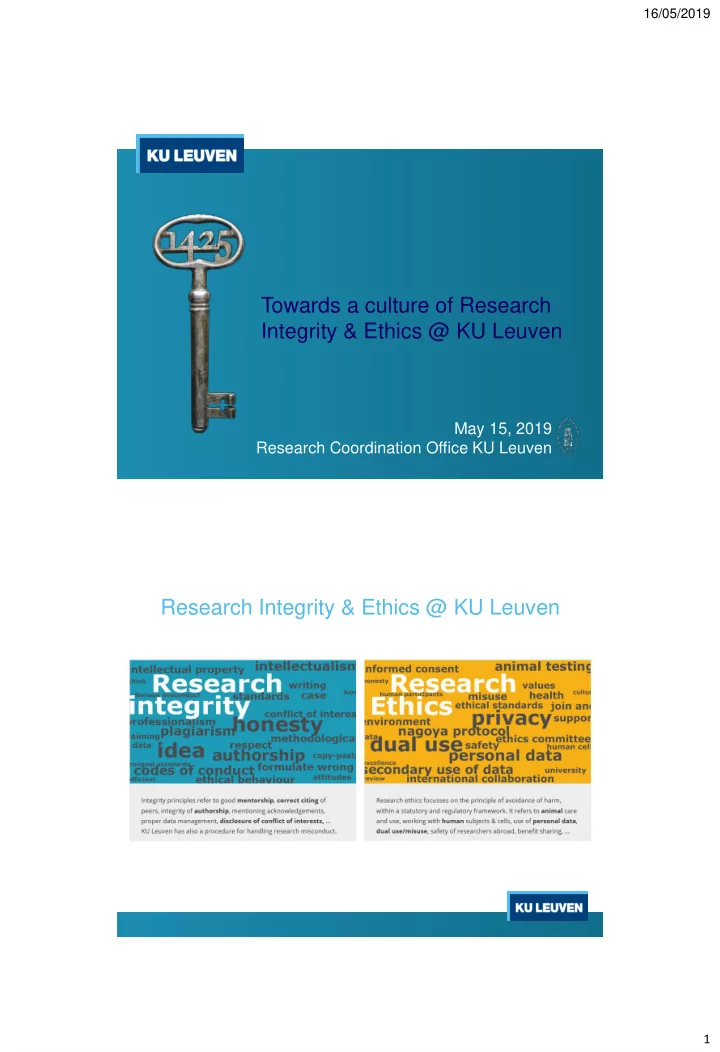
Towards a culture of Research Integrity & Ethics @ KU Leuven

May 15, 2019 Research Coordination Office KU Leuven

Research Integrity & Ethics @ KU Leuven

slide-2
SLIDE 2

16/05/2019 2

Research Integrity Research Integrity as a Policy

Research integrity has become an integral part of the institutional research policy. “Among the many challenges, interdisciplinarity, internationalization, impact, and integrity – the 4I’s – are high

  • n my agenda.”

Prof Reine Meylaerts Vice-President for Research

slide-3
SLIDE 3

16/05/2019 3

Bonn PRINTEGER Consensus Statement

Working with Research Integrity - Guidance for research performing organisations

1.

Providing information about research integrity

2.

Providing education, training and mentoring

3.

Strengthening a research integrity culture

4.

Facilitating open dialogue

5.

Wise incentive management

6.

Implementing quality assurance procedures

7.

Improving the work environment and work satisfaction

8.

Increasing transparency of misconduct cases

9.

Opening up research

10.

Implementing safe and effective whistle-blowing channels

11.

Protecting the alleged perpetrators

12.

Establishing a research integrity committee and appointing an ombudsperson

13.

Making explicit the applicable standards for research integrity Forsberg, Sci Eng Ethics, 2018

Good Practices

slide-4
SLIDE 4

16/05/2019 4

European Code of Conduct for Research Integrity

(ALLEA, revised 2017)

  • 1. Principles:

reliability, honesty, respect, accountability

  • 2. Good Research Practices:

in Research Environment; Training, Supervision and Mentoring; Research Procedures; Safeguards; Data Practices and Management; Collaborative Working; Publication and Dissemination; Reviewing, Evaluating and Editing

  • 3. Violations of Research Integrity

http://www.allea.org/wp-content/uploads/2017/05/ALLEA-European-Code-of-Conduct-for-Research-Integrity-2017.pdf

Integrity management instruments Institutional policy

  • Communicate clearly policies and standards for

researchers: good practices

  • Provide education and support to researchers to promote

responsible conduct of research (RCR): integrity as a culture

  • Develop transparent procedures for receiving and

investigating research misconduct: reporting desk and Commission on Research Integrity Central website: https://www.kuleuven.be/english/research/integrity

slide-5
SLIDE 5

16/05/2019 5

Central website Good Practices

slide-6
SLIDE 6

16/05/2019 6

Good Practices KU Leuven checklist for researchers

https://www.kuleuven.be/english/research/integrity/Checklist

slide-7
SLIDE 7

16/05/2019 7

Good Practices Publication and Authorship

slide-8
SLIDE 8

16/05/2019 8

KU Leuven Authorship Policy

https://www.kuleuven.be/english/research/integrity/practices/authorship

Authorship

1.

Authorship should be restricted to individuals who:

1)

made a substantial intellectual contribution to: conception and design; AND/OR collection of data; AND/OR analysis and interpretation of data;

2)

substantially contribute to the drafting of the manuscript and/or substantially critically revise its content

3)

approve the final version of the manuscript to be published.

4)

agree to be accountable for all aspects of the work (i.e. confidence in integrity of contributions of co-authors) Authors should meet conditions 1, 2, 3 and 4. [+ all those who meet criterion 1 should have the opportunity to meet 2 and 3]

slide-9
SLIDE 9

16/05/2019 9

  • 2. All individuals who are affected by authorship should be

involved in the communication, discussion and decision- making on authorship in order to ensure that they reach agreement together, have clear expectations about and can robustly defend their own individual authorship positions and the authorship position of others (individuals who join the project at a later stage, who are affected by authorship, should be involved). All authors should confirm the list of co-authors in a written understanding (written records, e-mails of decisions on authorship can help avoid potential misunderstandings).

Authorship

  • 3. No person who fulfils the authorship criteria may be

excluded as an author.

  • 4. Changes in authorship have to be communicated in a

timely manner and each alteration in the author list should be approved by all authors.

  • 5. The work of all contributors and collaborators who do not

meet the criteria for authorship should be properly acknowledged in publications.

  • 6. Where a research project would not have been possible

without, and builds upon, the efforts of other researchers’ previously published research, that previous research should be properly cited.

Authorship

slide-10
SLIDE 10

16/05/2019 10

Authorship is based on what you actually do, not on who you are!

CRediT (Contributor Roles Taxonomy)

Role Definition 1 Conceptualization ​Ideas; formulation or evolution of overarching research goals and aims. 2 Data curation Management activities to annotate (produce metadata), scrub data and maintain research data (including software code, where it is necessary for interpreting the data itself) for initial use and later re-use. 3 Formal analysis Application of statistical, mathematical, computational, or other formal techniques to analyse or synthesize study data. 4 Funding acquisition ​Acquisition of the financial support for the project leading to this publication. 5 Investigation ​Conducting a research and investigation process, specifically performing the experiments, or data/evidence collection. 6 ​Methodology ​Development or design of methodology; creation of models. 7 Project administration ​ ​Management and coordination responsibility for the research activity planning and execution. 8 Resources ​Provision of study materials, reagents, materials, patients, laboratory samples, animals, instrumentation, computing resources,

  • r other analysis tools.

9 Software ​Programming, software development; designing computer programs; implementation of the computer code and supporting algorithms; testing of existing code components. 10 Supervision ​Oversight and leadership responsibility for the research activity planning and execution, including mentorship external to the core team. 11 Validation ​Verification, whether as a part of the activity or separate, of the overall replication/reproducibility of results/experiments and other research outputs. 12 Visualization ​Preparation, creation and/or presentation of the published work, specifically visualization/data presentation. 13 Writing – original draft ​Preparation, creation and/or presentation of the published work, specifically writing the initial draft (including substantive translation). 14 Writing – review & editing ​Preparation, creation and/or presentation of the published work by those from the original research group, specifically critical review, commentary or revision – including pre- or post-publication stages.

https://www.casrai.org/credit.html

slide-11
SLIDE 11

16/05/2019 11

Good Practices

KU Leuven guidelines on image processing

https://www.kuleuven.be/english/research/integrity/practices/image-processing

slide-12
SLIDE 12

16/05/2019 12

  • 1. No specific feature within an image may be enhanced, obscured, moved, removed, or

introduced.

  • 2. Adjustments of brightness, contrast, or color balance are acceptable if they are applied to

the whole image and as long as they do not obscure, eliminate, or misrepresent any information present in the original. Color bars should be used as much as possible, indicating thresholding and range.

  • 3. The grouping of images from different parts of the same gel, or from different gels, fields,
  • r exposures must be made explicit by the arrangement of the figure (e.g., dividing lines)

and in the text of the figure legend.

  • 4. Nonlinear adjustments must be disclosed in the figure legend or clearly represented in a

quantitative color bar alongside the figure.

  • 5. Always have the original, unaltered file available in case the journal requests it. If you

cannot produce the original file, the journal will likely reject your submission. You should also be able to explain exactly what alterations were made to the image (i.e., the software and particular tools used).

  • 6. If you supervise any other researchers who have the ability to alter images or figures

before submission, make sure they are aware of which types of image manipulation are acceptable and which are not.

KU Leuven guidelines on image processing

Duplication within the same paper

Nature News April 22, 2016

slide-13
SLIDE 13

16/05/2019 13

Detection of duplication by comparing a figure across a database of figures KU Leuven guidelines on image processing

slide-14
SLIDE 14

16/05/2019 14

  • At bachelor – master level:
  • courses on methodology – statistics - plagiarism
  • At PhD level
  • Year 1: 3 hour lecture RI (compulsary – 900 drs/year)
  • generic content
  • university wide teaching team
  • Year 3: seminar/workshops (cases) of 1,5h (DS BMS)
  • smaller groups/ more discipline oriented and

interactive

  • organised by Doctoral Schools
  • Mentorship by the PhD-mentor

RCR training and education @KU Leuven

  • Mentorship by the PhD-mentor:

The policy document “the profile of the good promotor” provides a set of expectations for senior researchers in their role as PhD-mentor: The supervisor creates a research environment in which correct scientific behaviour (e.g. good data management, responsible authorship, …) is the norm. It is important that RCR is also taught in the context of everyday practice of science!

  • Attention paid to aspects of research integrity at

information session for all new supervisors of a PhD

  • For all KU Leuven researchers: online tool LIRIcs

RCR training and education @KU Leuven

slide-15
SLIDE 15

16/05/2019 15

LIRIcs = Leuven Institutional Research Integrity – culture and self reflection (< developed by Epigeum):

  • is accessible for both junior and senior researchers of

the KU Leuven via a community in Blackboard (Toledo)

  • interactive with polls and activities
  • 5 discipline oriented versions
  • up to 5 hours’ online study per version
  • contains links to KU Leuven policy documents
  • not compulsory at KU Leuven
  • doctoral researchers are strongly encouraged to consult

LIRIcs and to discuss it with their supervisors

Training and education @KU Leuven Procedure for Handling Misconduct

https://www.kuleuven.be/english/research/integrity/procedures/index

slide-16
SLIDE 16

16/05/2019 16

slide-17
SLIDE 17

16/05/2019 17

Towards research ethics and compliance @KU Leuven

Research Ethics

slide-18
SLIDE 18

16/05/2019 18

Institutional policy

  • Communicate clearly policies and standards for

researchers: 'Code of practice and principles for good ethical governance' (under construction)

  • Develop transparent procedures for ethical review of

protocols: ethical committees

  • Provide education and support/ guidance to researchers to

promote ethical compliance Central website: https://www.kuleuven.be/english/research/ethics

  • Ethical Committees
  • Ethics Committee Research UZ KU Leuven
  • Social and Societal Ethics Committee
  • Ethical Committee for Animal Experimentation
  • Committee for Ethics on Dual Use, Military Use and

Misuse of Research

  • Advisory Committee on Higher-risk Destinations
  • KU Leuven privacy team

KU Leuven ethical committees

slide-19
SLIDE 19

16/05/2019 19

  • Coordination of different ECs at the institutional level:
  • Installation of a Research Ethics Coordination platform

meetings with the chairs of the ECs

  • Exchange of working experiences
  • Promotion of best practices

KU Leuven ethical committees Guidance

slide-20
SLIDE 20

16/05/2019 20

  • Uniform legislation across Europe (European Directive -

> European Regulation)

  • Obligation to declare -> Obligation to document
  • Sanctions + large fines
  • Rights of data subjects
  • Demonstrate transparency regarding the processing of

the personal data

GDPR – Changes as of 2018 Privacy @ KU Leuven

slide-21
SLIDE 21

16/05/2019 21

Privacy and information security @ KU Leuven

  • Anonymized vs pseudonimized data
  • Restriction on the re-use of data for another project
  • Difficult to collaborate outside the EU
  • Personal data have to be deleted at the end of the

project

  • Consent is the default legal basis for the processing of

personal data

  • GDPR is incompatible with the Open Science movement

GDPR - Misconceptions

slide-22
SLIDE 22

16/05/2019 22

Guidance VLIR brochure

Result of a collaboration between the 5 Flemish universities within the ad hoc Working Group Dual Use of the Flemish Interuniversity Council (VLIR), with active participation of Imec, the Flanders Institute for Biotechnology (VIB) and the Export Control unit of Flemish government.

http://www.vlir.be/media/docs/Onderzoeksbeleid/Dual%20Use/2017VLIR003_FolderOnderzoek_EN_D EF_20180212.pdf

slide-23
SLIDE 23

16/05/2019 23

“ With the election of Donald J. Trump as president of the US and the upcoming Brexit, continental Europe seems to be losing its previous Anglo-American security guaranteeing forces. While the North Atlantic Treaty Organization (NATO) still exists, president Trump is very mercantilistic in the context of defence purchases. The EU will have to take matters in its own hands in more an more

  • domains. We might be on our own from now on.”

Translated from: https://www.mo.be/analyse/europa-staat-op-een- scharnierpunt-temidden-een-wereld-volle-geopolitieke-transitie

A world in geopolitical transition Guidance

slide-24
SLIDE 24

16/05/2019 24

Finds its origin in the UN Convention on Biological Diversity which went into effect December 29, 1993 Objectives:

  • Conservation of biological diversity
  • Sustainable use of the components of biological

diversity

  • Fair and equitable sharing of the benefits arising out of

the use of genetic resources (GR)

Nagoya Protocol

  • > Nagoya Protocol
  • Potentially applicable for everyone conducting R&D on genetic

resources (GR)

  • Any material of plant, animal, microbial or other origin containing

functional units of heredity

  • States now have sovereign rights on the genetic resources they

harbor.

  • In order to access and use GRs, users need to contact the

provider country to:

  • Apply for Prior Informed Consent (PIC)
  • Negotiate Mutually Agreed Terms (MAT)
  • In addition to local legislation, researchers have to demonstrate

compliance with EU Regulation 511/2014

Nagoya Protocol

slide-25
SLIDE 25

16/05/2019 25

Ethics in the context of Horizon 2020

  • Ethics is an integral part of all research activities funded by

the European Union.

  • Ethics should be embedded in the research design,

implementation and dissemination.

  • All possible domains of scientific research can raise ethical

issues (not only in life sciences). Include reflection on ethics right from the start – do not take care of ethics in the last 5 minutes before submission of the proposal!

Ethics in the context of Horizon 2020

  • The process to assess and address the ethical dimension
  • f activities funded under Horizon 2020 is called the

Ethics Appraisal Procedure. Ethics Self-Assessment Application phase – by the applicant Ethics Review Evaluation phase – by ethics experts Ethics Checks/Audits Implementation phase – by ethics experts

slide-26
SLIDE 26

16/05/2019 26

Proposal passes scientific evaluation

Ethics Review

by the ethics experts

Source: slide Isidoros Karatzas

Writing Horizon 2020 research proposals

slide-27
SLIDE 27

16/05/2019 27

Contact

Inge.Lerouge@kuleuven.be Research Integrity & Ethics coordinator Wouter.Vandevelde@kuleuven.be Research Integrity & Ethics advisor http://www.kuleuven.be/english/research/rri