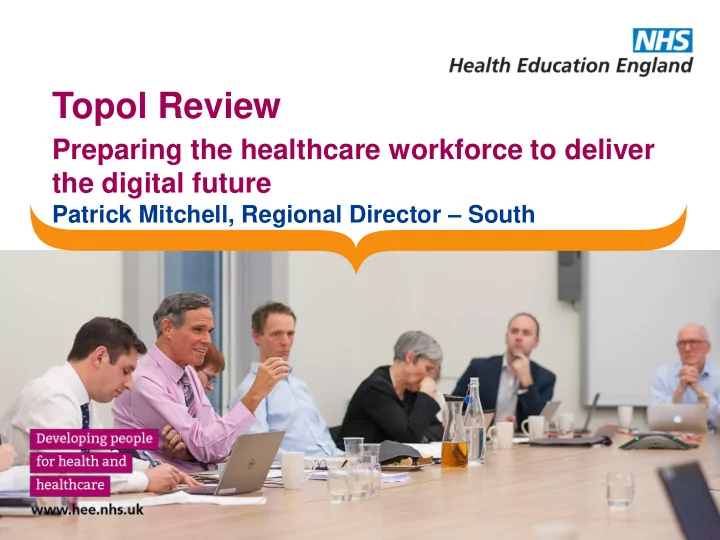
Topol Review Preparing the healthcare workforce to deliver the - - PowerPoint PPT Presentation

topol review
SMART_READER_LITE
LIVE PREVIEW

Topol Review Preparing the healthcare workforce to deliver the - - PowerPoint PPT Presentation

Topol Review Preparing the healthcare workforce to deliver the digital future Patrick Mitchell, Regional Director South #TopolReview The Secretary of State for Health and Social Care commissioned an independent review To ensure the


slide-1
SLIDE 1

Topol Review

Preparing the healthcare workforce to deliver the digital future

Patrick Mitchell, Regional Director – South

slide-2
SLIDE 2
  • The Secretary of State for

Health and Social Care commissioned an independent review

  • To ensure the NHS is at the

forefront of care

  • Led by Dr Eric Topol with

views of experts in relevant fields

#TopolReview

@NHS_HealthEdEng #HEENHS70

slide-3
SLIDE 3

@NHS_HealthEdEng #HEENHS70

slide-4
SLIDE 4

#TopolReview

Digital technologies are transforming our ability to empower patients to participate actively in their own care, with a greater focus on well-being, to prevent diseases such as cancer and hypertension, to predict the most appropriate treatments and to personalise the management of long-term conditions.

@NHS_HealthEdEng #HEENHS70

slide-5
SLIDE 5

The panels

Genomics Digital medicine Artificial intelligence and robotics

@NHS_HealthEdEng #HEENHS70

slide-6
SLIDE 6

The questions…

The Review will consider three key questions:

  • 1. How are technological developments likely to change

the roles and functions of clinical staff in all professions over the next two decades?

  • 2. What are the implications of these changes for the

skills required?

  • 3. What does this mean for the selection, curricula,

education, training and development of current and future NHS staff?

@NHS_HealthEdEng #HEENHS70

slide-7
SLIDE 7

The principles…

The interim report proposes three key principles: 1. Patients: if willing and able to do so, will be empowered by new tools to become more actively involved and engaged in their care. 2. Evidence: the introduction of any technology must be grounded in robust research evidence 3. Gift of time: Whenever possible, the adoption of technology should be used to give more time for care, creating an environment in which the patient-clinician relationship is enhanced.

@NHS_HealthEdEng #HEENHS70

slide-8
SLIDE 8

Of the three technologies considered, genomics is the most advanced, in terms of research evidence, implementation, and workforce development, with a new MSc programme and newly-created NHS roles for example, the Genetic Diabetes Nurse.

Genomics

@NHS_HealthEdEng #HEENHS70

slide-9
SLIDE 9

Genetics Diabetes Nurse

  • An initiative using experienced diabetes specialist nurses to help

integrate genetic findings into diabetes care.

  • The GDNs increase knowledge about Maturity Onset Diabetes of

the Young, a disease caused by a change in a single gene.

  • A national training programme, co-ordinated through a National

Centre of Excellence on Diabetes based in Exeter University, has developed the GDN workforce.

  • GDNs liaise with local healthcare teams and help co-ordinate

genetic testing for family members.

@NHS_HealthEdEng #HEENHS70

slide-10
SLIDE 10

Digital medicine is rapidly advancing with the spread of smartphones and computer tablets, although uptake remains

  • uneven. New roles, like Clinical

Bioinformatician, are emerging to support the use of digital tools, such as myCOPD app.

Digital Medicine

@NHS_HealthEdEng #HEENHS70

slide-11
SLIDE 11

AskNHS app

  • Avatar-based (pilot phase) virtual nurse app aims to address

urgent care and primary care demand.

  • The project uses digital mobile technology to relieve pressure on

NHS resources by enabling more effective self-care, and more appropriate and timely use of primary and urgent care services.

  • Features a virtual nurse that works using voice recognition

software and button presses. Patients can assess their symptoms, look up self-care information and book or cancel GP appointments.

@NHS_HealthEdEng #HEENHS70

slide-12
SLIDE 12

At the other end of the innovation pipeline, we are only just beginning to discover the potential for AI, and machine learning, to personalise care, improve patient outcomes and reduce the workload of healthcare professionals, for example the AI-enabled future

  • phthalmologist.

Robotics and Artificial Intelligence

@NHS_HealthEdEng #HEENHS70

slide-13
SLIDE 13

Future Ophthalmologist

  • Deep learning algorithms are used to identify pathology

automatically from optical scans, allowing early detection and triage of sight-threatening diabetic retinopathy & age-related macular degeneration.

  • This technology in clinical practice would greatly enable both
  • phthalmologists and optometrists to be able treat the most at-

risk patients, and allowing them to enhance their own diagnostic skills through learning from the technology.

@NHS_HealthEdEng #HEENHS70

slide-14
SLIDE 14

We are only just at the beginning. This major, independent review will elicit further evidence throughout the summer, and submit the final report to the Secretary of State by the end of 2018.

Can you help?

Your views and evidence can help to shape the future of the NHS.

What next?

@NHS_HealthEdEng #HEENHS70

slide-15
SLIDE 15

We need you!

The interim report published today

www.hee.nhs.uk/our-work/topol-review

Join in the conversation…

topol.hee.nhs.uk Share your experiences and understanding of these new technologies in practice and how it will change the way we educate and train our current, and future, staff.

@NHS_HealthEdEng #HEENHS70

slide-16
SLIDE 16

Questions…?

@NHS_HealthEdEng #HEENHS70