Vision Zero Safer Streets for Seattle Seattle Pedestrian and - - PowerPoint PPT Presentation

vision zero
SMART_READER_LITE
LIVE PREVIEW

Vision Zero Safer Streets for Seattle Seattle Pedestrian and - - PowerPoint PPT Presentation

Vision Zero Safer Streets for Seattle Seattle Pedestrian and Bicycle Advisory Boards Joint Meeting Department of Transportation Sam Zimbabwe, Jim Curtin, and Bradley Topol 01/08/2020 Historic Data Trends (1936 2019) Department of


slide-1
SLIDE 1

Department of Transportation

Seattle Pedestrian and Bicycle Advisory Boards Joint Meeting Sam Zimbabwe, Jim Curtin, and Bradley Topol 01/08/2020
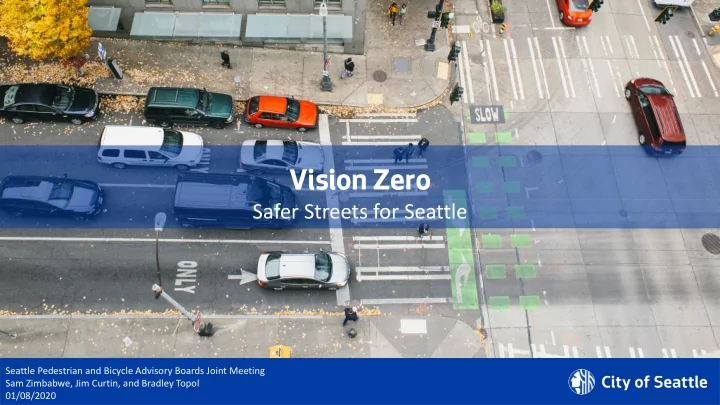
Vision Zero

Safer Streets for Seattle

slide-2
SLIDE 2

Department of Transportation

Historic Data Trends (1936 – 2019)

slide-3
SLIDE 3

Department of Transportation

Current Data Trends

  • 2019 preliminary data
  • 25 total fatalities
  • Highest in over a decade
  • Pedestrians continue to be
  • verrepresented
  • 164 serious injury collisions
  • As of 12/16
  • 3-year average = 170

5 10 15 20 25 30 2010 2011 2012 2013 2014 2015 2016 2017 2018 2019

Traffic Fatalities on Seattle Streets

(as of 1/2/2020)

Total Fatalities Motorcycle Fatalities Cyclist Pedestrian Fatalities Linear (Total Fatalities)

slide-4
SLIDE 4

Department of Transportation

Data Trends (2015-Oct 2019) Ped Crashes

2382 All Ped Crashes 1714 668 Intersection Midblock 1115 Signal 599 Non-Signal Arterials Residential 535 318 262 199 316 84 Left Turn Straight Right Turn Left Turn Straight Right Turn 13% 20% 4% 5% 16% 1% 36% 6% 521 147 ALL PED 22% 13% 11% 8% 13% 4% 22% 6% SERIOUS INJURY AND FATAL 312 129 183 111 18 40 61 11 17 50 4 SI/FATAL ALL PED 71 112

slide-5
SLIDE 5

Department of Transportation

Reactive & Proactive Crash Reduction

  • Reactive Actions
  • High collision locations (HCL’s)
  • High collision corridor projects
  • Targeted SPD enforcement
  • Red-light camera enforcement
  • Major Crash Review Task Force
  • Proactive Actions
  • BPSA 2.0 (Bike & Ped Safety Analysis)
  • LPI’s (Leading pedestrian intervals)
  • Citywide speed limit reductions
slide-6
SLIDE 6

Department of Transportation

Proactive Actions: BPSA Phase 2

Risk Factors

  • Pedestrian, bicyclist, motor vehicle volumes
  • Number of vehicle travel lanes
  • Number of legs at intersection
  • Roadway functional classification
  • Number of transit stops
  • Urban village/urban center designation
  • Non-through lanes (ie., left-turn lanes, right

turn lanes, bus lanes)

  • Intersections with one or more one-way

streets

slide-7
SLIDE 7

Department of Transportation

BPSA Phase 2

  • Hot spot locations are prioritized for

LPI’s

  • 110 LPI locations targeted for 2020
  • Review of hot spot locations for

additional pedestrian and bicycle safety improvements

slide-8
SLIDE 8

Department of Transportation

Proactive Actions: LPI’s

Leading Pedestrian Intervals (LPIs)

  • LPIs give pedestrians ‘walk’ signal

before vehicular traffic get green lights

  • LPIs reduce ped collisions up to 60%
  • 141 installed citywide (15% coverage)
  • 102 installed in 2019
  • 110 additional locations planned for

2020

slide-9
SLIDE 9

Department of Transportation

Speed Limits : Center City

Center City signal timing

  • Lowered speed limits in Center City to 25 MPH
  • Roughly 400 signals were retimed for 25 MPH

(40% of citywide signal network)

  • Gateway signs at all arterial entry points to city

2016 speed limit changes

Traffic signals were re-timed to reduce posted speed limit to 25 MPH

slide-10
SLIDE 10

Department of Transportation

Speed Limits : Center City

Center City signal timing results

  • Overall collisions reduced by 13%
  • Severe and fatal collisions reduced by 20%

200 400 600 800 1000 1200 1400 1600 2011 2012 2013 2014 2015 2016 2017 2018

# of crashes

Center City before/after

Total crashes Fatal, serious injury, and injury crashes

signal retiming

  • 13% total

crashes

  • 20% fatal,

serious injury, injury crashes

slide-11
SLIDE 11

Department of Transportation

Citywide Speed Limits – Existing Network

slide-12
SLIDE 12

Department of Transportation

Citywide Speed Limits

  • The World Health

Organization: A five percent reduction in average speed can result in a 30 percent decrease in traffic fatalities

slide-13
SLIDE 13

Department of Transportation

Speed Limits: Greenwood Ave N/Phinney Ave N

Action

  • Replaced existing 30mph signs (1 mile spacing)

and installed new 25mph signs at ¼ mile spacing

  • Implemented February 2018

Results

  • 85th %tile speed reduction of 34 to 31 mph
  • 50th %tile speed reduction of 29 to 27 mph (6.8%)
  • 34% reduction in all crashes (30 to 20 a year)
  • 10% reduction in injury crashes (12 to 11 a year)

N 65th St to N 90th St (1.3 miles)

slide-14
SLIDE 14

Department of Transportation

Speed Limits: N 85th St

Action

  • Previously unsigned
  • Installed new 25mph signs at ¼ mile spacing
  • Implemented February 2018

Results

  • 50th %tile speed reduction of 27 to 26mph (3.7%)
  • Number of drivers speeding reduced by 4%
  • 53% reduction in all crashes (36 to 17 a year)
  • 40% reduction in injury crashes (15 to 9 a year)

18th Ave NW to Fremont Ave N (1.4 miles)

slide-15
SLIDE 15

Department of Transportation

Speed Limits: Green Lake/Roosevelt Urban Village

Action

  • Posted all arterials to 25 mph (33 new signs)
  • 7 speed limit signs previously posted within urban village
  • Implemented November 2018

Results

  • 85th %tile speed reduction of 28 to 27 mph (3.5%)
  • 26% reduction in top end speeders (+10 mph over

speed limit)

  • 44% reduction in all crashes (65 to 36 a year)

Multiple Arterial Streets (6.2 miles)

slide-16
SLIDE 16

Department of Transportation

SPD Enforcement

Pedestrian Safety Patrols

  • Focusing on drivers that fail to stop for

pedestrians in crosswalks

Vision Zero Patrols

  • 600 hours of additional enforcement

focusing on high crash corridors and top contributing factors to collisions

Funded November 2019 – December 2021

slide-17
SLIDE 17

Department of Transportation

Red Light Cameras

Expand camera enforcement

  • Red-light cameras reduce angle and

pedestrian collisions

  • Double the number of red-light

cameras at high priority intersections from 31 to 62

  • Install an additional five school

zone speed cameras

slide-18
SLIDE 18

Department of Transportation

Major Crash Review Task Force

  • Review details of serious and fatal

collisions and develop recommendations to enhance safety Launch 2020

Potential Task Force Members

SDOT, SPD, and SFD Mayor’s Office Public Health – Seattle & King County City Attorney WSDOT Washington State Patrol King County Metro King County Medical Examiner Sound Transit Modal Advisory Board Representatives University of Washington Harborview Injury Prevention and Research Center

slide-19
SLIDE 19

Department of Transportation

Potential New Initiative: No Turns on Red

  • 105 Existing ‘No Turn on Red’ Signalized

Intersections

  • 11% citywide coverage
  • 2015-2019 Ped Crash Data
  • Of right turning ped crashes 60% are turns
  • n green and 40% are turns on red (typ.)
  • 4% of total ped crashes are RTOR (est.)
  • 0.7% of pedestrian serious injury crashes

are turns on red (2 of 269)

  • No known fatalities (2010-2019 crash data)
slide-20
SLIDE 20

Department of Transportation

High Collision Corridors

Aurora Avenue North (SR-99)

  • 2019 WSDOT partnership installed 63 new

curb ramps, intersection improvements at N 83rd St, new red bus lane markings and repaved entire corridor

  • Implement $2 million in capital

investments through Aurora Safety Corridor Project (2020-2024)

  • Launch planning study to develop long-

term, high capital street design concepts for Aurora Avenue North in (2021)

slide-21
SLIDE 21

Department of Transportation

High Collision Corridors

Lake City Way (SR-522)

  • $8.5 million of capital investments

through Lake City Way Safety Corridor Project (2020 – 2021)

  • Five blocks of new sidewalks
  • New signals and crosswalks at:
  • NE 82nd St
  • NE 135th St
  • Intersection improvements and

new crosswalks at:

  • NE 95th St
  • NE 137th St
  • Partnership with WSDOT
slide-22
SLIDE 22

Department of Transportation

High Collision Corridors

Additional projects to be delivered through the Levy including:

  • Rainier Avenue South
  • SW Roxbury Street
  • 23rd Avenue Phase 3
  • Martin Luther King Jr Way S
  • Sand Point Way

9

slide-23
SLIDE 23

Department of Transportation

Questions?

bradley.topol@seattle.gov| (206) 233-3855

www.seattle.gov/visionzero