Topic 14 Consider ; takes a tagged complex number and returns - - PDF document

topic 14
SMART_READER_LITE
LIVE PREVIEW

Topic 14 Consider ; takes a tagged complex number and returns - - PDF document

Data-Directed Programming Topic 14 Consider ; takes a tagged complex number and returns Multiple Representations of ; the real part Abstract Data Data Directed (define (real-part z) (cond ((rectangular? z) Programming and Additivity


slide-1
SLIDE 1

1

Fall 2008 Programming Development Techniques 1

Topic 14 Multiple Representations of Abstract Data – Data Directed Programming and Additivity

Section 2.4.3

Fall 2008 Programming Development Techniques 2

Data-Directed Programming

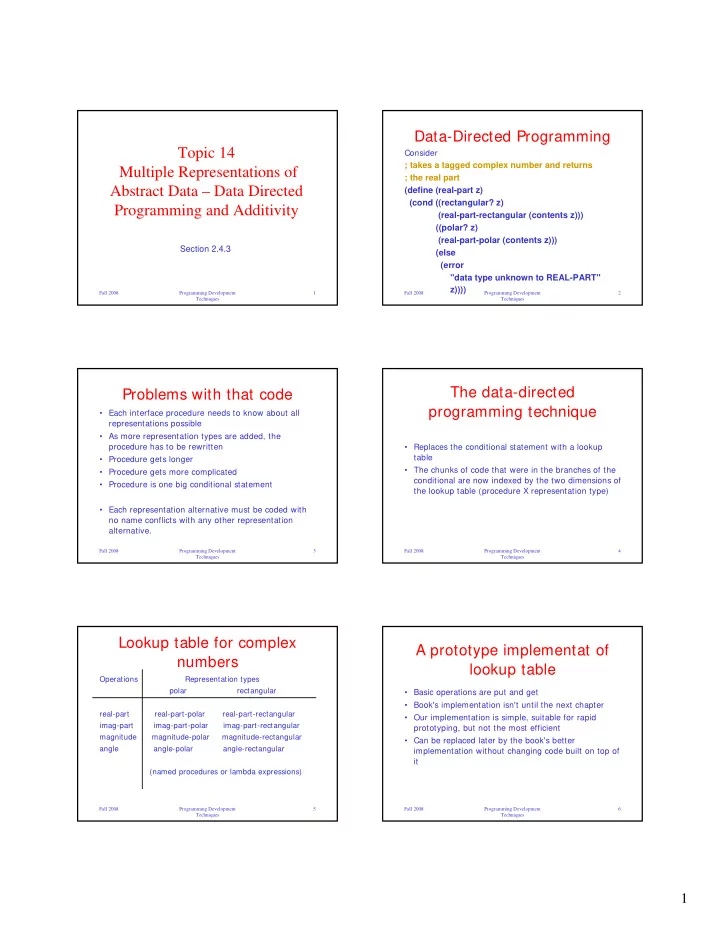
Consider ; takes a tagged complex number and returns ; the real part (define (real-part z) (cond ((rectangular? z) (real-part-rectangular (contents z))) ((polar? z) (real-part-polar (contents z))) (else (error "data type unknown to REAL-PART" z))))

Fall 2008 Programming Development Techniques 3

Problems with that code

  • Each interface procedure needs to know about all

representations possible

  • As more representation types are added, the

procedure has to be rewritten

  • Procedure gets longer
  • Procedure gets more complicated
  • Procedure is one big conditional statement
  • Each representation alternative must be coded with

no name conflicts with any other representation alternative.

Fall 2008 Programming Development Techniques 4

The data-directed programming technique

  • Replaces the conditional statement with a lookup

table

  • The chunks of code that were in the branches of the

conditional are now indexed by the two dimensions of the lookup table (procedure X representation type)

Fall 2008 Programming Development Techniques 5

Lookup table for complex numbers

Operations Representation types polar rectangular real-part real-part-polar real-part-rectangular imag-part imag-part-polar imag-part-rectangular magnitude magnitude-polar magnitude-rectangular angle angle-polar angle-rectangular (named procedures or lambda expressions)

Fall 2008 Programming Development Techniques 6

A prototype implementat of lookup table

  • Basic operations are put and get
  • Book's implementation isn't until the next chapter
  • Our implementation is simple, suitable for rapid

prototyping, but not the most efficient

  • Can be replaced later by the book's better

implementation without changing code built on top of it

slide-2
SLIDE 2

2

Fall 2008 Programming Development Techniques 7

Basic idea of our implementation

  • Lookup table is just a list of triples of the form

(operation type action)

  • Simulates a sparse array of infinite size
  • Put adds a triple to the list
  • Get searches the list for the right triple and returns

the action part

  • The type is a list of the representation types of the
  • peration's arguments

Fall 2008 Programming Development Techniques 8

And now for the implementation

; operation-table will hold the triples of

; operations, their type, and the associated action (define operation-table empty) ; takes an operation, the type of data it acts on, and an ; action that implements the operation on the type given. ; Adds the triple to the operation table (define (put operation type action) (set! operation-table (cons (list operation type action)

  • peration-table)))

(Forget you saw set!, the reassignment operator, until the next chapter.)

Fall 2008 Programming Development Techniques 9

The get procedure

; takes an operator and a type, and returns the ; action that implements the operator for that type ; in the operation-table (define (get operator type) (define (get-aux list) (cond ((null? list) #f) ((and (equal? operator (caar list)) (equal? type (cadar list))) (caddar list)) (else (get-aux (cdr list))))) (get-aux operation-table))

Fall 2008 Programming Development Techniques 10

So? What do we do with it?

  • Define a collection of procedures or a package for

each representation

  • These are installed in the table
  • Complex-arithmetic selectors access the table by

means of a general “operation” procedure called apply-generic

Fall 2008 Programming Development Techniques 11

Each representation type in its

  • wn package

; define the selectors in the rectangular representation ; each selector is defined as it was originally – and ; must put installed into the operation table (define (install-rectangular-package) (put 'real-part '(rectangular) car) (put 'imag-part '(rectangular) cdr) (put 'magnitude '(rectangular) (lambda (z) (sqrt (+ (square (car z)) (square (cdr z))))))

Fall 2008 Programming Development Techniques 12

Rectangular package continued

(put 'angle '(rectangular) (lambda (z) (atan (cdr z) (car z)))) (put 'make-from-real-imag 'rectangular (lambda (x y) (attach-tag 'rectangular (cons x y))))

slide-3
SLIDE 3

3

Fall 2008 Programming Development Techniques 13

part 3

(put 'make-from-mag-ang 'rectangular (lambda (r a) (attach-tag 'rectangular (cons (* r (cos a)) (* r (sin a)))))) 'done)

Fall 2008 Programming Development Techniques 14

Polar package

; define the selectors in the polar representation ; each selector is defined as it was originally -- ; and must put installed into the operation (define (install-polar-package) (put 'magnitude '(polar) car) (put 'angle '(polar) cdr) (put 'real-part '(polar) (lambda (z) (* (car z) (cos (cdr z)))))

Fall 2008 Programming Development Techniques 15

Polar package continued

(put 'imag-part '(polar) (lambda (z) (* (car z) (sin (cdr z))))) (put 'make-from-mag-ang 'polar (lambda (r a) (attach-tag 'polar (cons r a))))

Fall 2008 Programming Development Techniques 16

Part 3

(put 'make-from-real-imag 'polar (lambda (x y) (attach-tag 'polar (cons (sqrt (+ (square x) (square y))) (atan y x))))) 'done)

Fall 2008 Programming Development Techniques 17

The constructors

;; THE CONSTRUCTORS (define (make-from-real-imag x y) ((get 'make-from-real-imag 'rectangular) x y)) (define (make-from-mag-ang r a) ((get 'make-from-mag-ang 'polar) r a))

Fall 2008 Programming Development Techniques 18

Generic operation call

;;; general operation will implement selector ;; functions for complex numbers (define (apply-generic op . args) (let ((type-tags (map type-tag args))) (let ((proc (get op type-tags))) (if proc (apply proc (map contents args)) (error "APPLY-GENERIC failed" (list op type-tags))))))

(note: operations can have more than one argument)

slide-4
SLIDE 4

4

Fall 2008 Programming Development Techniques 19

The selectors

; selectors are implemented in terms of the ; generic operation (define (real-part z) (apply-generic 'real-part z)) (define (imag-part z) (apply-generic 'imag-part z)) (define (magnitude z) (apply-generic 'magnitude z)) (define (angle z) (apply-generic 'angle z))

Fall 2008 Programming Development Techniques 20

Three programming styles

1) Data-directed programming, where code for each

  • perator and representation type combination is

stored in a 2-dimensional operation table 2) Conventional-style programming, where each

  • perator decides what code to run by testing the

representation types of its arguments In effect, each operator has one row of operation table built into it.

Fall 2008 Programming Development Techniques 21

Continued

3) Message passing, where each data object decides what code to run by testing the name of the operation it is being asked to perform In effect, each data object has one column of the

  • peration table built into it.

Instead of intelligent operations that know what kind of data they work on, each data object is intelligent and can dispatch its own operations.

Fall 2008 Programming Development Techniques 22

A message passing version

; message passing version takes a real and imaginary ; part of a complex number and returns an intelligent data ; object that can dispatch its operations (define (make-from-real-imag-mp x y) (define (dispatch op) (cond ((eq? op 'real-part) x) ((eq? op 'imag-part y) ((eq? op 'magnitude)(sqrt (+ (square x) (square y)))) ((eq? op 'angle) (atan y x)) (else (error "MAKE-FROM-REAL-IMAG failed"

  • p)))))

dispatch)

Fall 2008 Programming Development Techniques 23

Uses a different apply-generic

; the individual parts are defined as above e.g. ;(define (real-part z) ; (apply-generic 'real-part z)) ; etc. ; apply-generic for message passing version ; notice that this function simply calls the data ; object as an function applied to the operator (define (apply-generic op arg) (arg op)) ;or more directly, (define (real-part-mp z) (z 'real-part))

Fall 2008 Programming Development Techniques 24

Advantage

The main advantage of the message passing programming style is that it more effectively hides the internal structure of data objects so that programmers are not tempted to access the insides of the data

  • bjects with cars and cdrs.

The programing style for classes in C+ + most closely resembles message passing.