Covalent Bonding and Geometry Free Response Slide 2 / 48 1 What - - PDF document

covalent bonding and geometry free response
SMART_READER_LITE
LIVE PREVIEW

Covalent Bonding and Geometry Free Response Slide 2 / 48 1 What - - PDF document

Slide 1 / 48 Covalent Bonding and Geometry Free Response Slide 2 / 48 1 What is the name of the compound N 2 F 4 ? Slide 3 / 48 2 What is the name of the compound CO? Slide 4 / 48 3 What is the name of the compound SF 6 ? Slide 5 / 48 4


slide-1
SLIDE 1

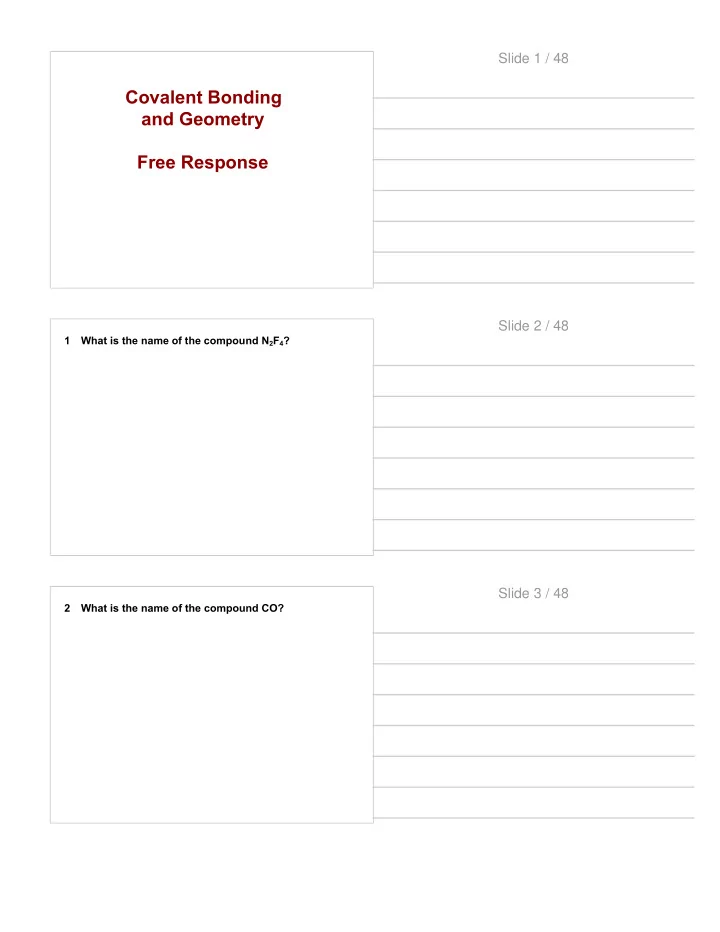
Covalent Bonding and Geometry Free Response

Slide 1 / 48

1 What is the name of the compound N2F4?

Slide 2 / 48

2 What is the name of the compound CO?

Slide 3 / 48

slide-2
SLIDE 2

3 What is the name of the compound SF6?

Slide 4 / 48

4 What is the name of the compound P4O10?

Slide 5 / 48

5 What is the formula of the compound Carbon Dioxide?

Slide 6 / 48

slide-3
SLIDE 3

6 What is the formula of the compound Nitrogen Triflouride?

Slide 7 / 48

7 What is the formula of the compound Dinitrogen Trisulfide?

Slide 8 / 48

8 What is the formula of the compound Iodine Pentaflouride?

Slide 9 / 48

slide-4
SLIDE 4

9 What is the name of the compound SCl4?

Slide 10 / 48

10 What is the name of the compound Si2Br6?

Slide 11 / 48

11 What is the name of the compound H2S?

Slide 12 / 48

slide-5
SLIDE 5

12 What is the name of the compound Cl2O6?

Slide 13 / 48

13 What is the formula of the compound Dinitrogen Pentoxide?

Slide 14 / 48

14 What is the formula of the compound Hexaboron Silicide?

Slide 15 / 48

slide-6
SLIDE 6

15 What is the formula of the compound Sulfur Trioxide?

Slide 16 / 48

16 What is the formula of the compound Hydrogen Monochloride?

Slide 17 / 48

17 Draw the Lewis Dot Structure for the compound N2F4?

Slide 18 / 48

slide-7
SLIDE 7

18 Draw the Lewis Dot Structure for the compound CO?

Slide 19 / 48

19 Draw the Lewis Dot Structure for the compound SF6?

Slide 20 / 48

20 Draw the Lewis Dot Structure for the compound SCl4?

Slide 21 / 48

slide-8
SLIDE 8

21 Draw the Lewis Dot Structure for the compound Si2Br6?

Slide 22 / 48

22 Draw the Lewis Dot Structure for the compound H2S?

Slide 23 / 48

23 Draw the Lewis Dot Structure for CO3

  • 2

A How many resonance structures does Carbonate have? B

Draw one of Carbonate's resonance structures.

Slide 24 / 48

slide-9
SLIDE 9

24 Draw the Lewis Dot Structure for O3

A How many resonance structures does Ozone have? B

Draw one of Ozone's resonance structures.

Slide 25 / 48

25 Draw the Lewis Dot Structure for NO2

  • A How many resonance structures does Nitrite have?

B

Draw one of Nitrite's resonance structures.

Slide 26 / 48

26 Draw the Lewis Dot Structure for NO3

  • A How many resonance structures does Nitrate have?

B

Draw one of Nitrate's resonance structures.

Slide 27 / 48

slide-10
SLIDE 10

27 Consider N2F4

A What are the VSEPR Numbers around either Nitrogen

atom?

B

What is the Electron Domain Geometry (EDG) around either Nitrogen atom?

C

What is the Electron Domain Geometry (EDG) around any Flourine atom?

D

What is the Molecular Domain Geometry (MDG) around either Nitrogen atom?

Slide 28 / 48

28 Consider CO

A What are the VSEPR Numbers around the Oxygen atom? B What is the Electron Domain Geometry (EDG) around the

Carbon atom?

C

What is the Electron Domain Geometry (EDG) around the Oxygen atom?

D

What is the Molecular Domain Geometry (MDG) of the molecule?

Slide 29 / 48

29 Consider SF6

A What are the VSEPR Numbers of the molecule? B

What is the Electron Domain Geometry (EDG) around the Sulfur atom?

C

What is the Electron Domain Geometry (EDG) around the Fluorine atom?

D

What is the Molecular Domain Geometry (MDG) of the molecule?

Slide 30 / 48

slide-11
SLIDE 11

30 Consider CO3

  • 2

A What are the VSEPR Numbers of the ion? B

What is the Electron Domain Geometry (EDG) around the Carbon atom?

C

What is the Electron Domain Geometry (EDG) around a single bonded Oxygen atom?

D

What is the Electron Domain Geometry (EDG) around a double bonded Oxygen atom?

E

What is the Molecular Domain Geometry (MDG) of the ion?

Slide 31 / 48

31 Consider O3

A What are the VSEPR Numbers of the molecule? B

What is the Electron Domain Geometry (EDG) around the central Oxygen atom?

C

What is the Electron Domain Geometry (EDG) around a single bonded Oxygen atom?

D

What is the Electron Domain Geometry (EDG) around a double bonded Oxygen atom?

E

What is the Molecular Domain Geometry (MDG) of the molecule?

Slide 32 / 48

32 Consider SCl4

A What are the VSEPR Numbers of the molecule? B

What is the Electron Domain Geometry (EDG) around the Sulfur atom?

C

What is the Electron Domain Geometry (EDG) around any Chlorine atom?

D

What is the Molecular Domain Geometry (MDG) of the molecule?

Slide 33 / 48

slide-12
SLIDE 12

33 Consider Si2Br6

A What are the VSEPR Numbers around either Silicon atom? B

What is the Electron Domain Geometry (EDG) around the either Silicon atom?

C

What is the Electron Domain Geometry (EDG) around any Bromine atom?

D

What is the Molecular Domain Geometry (MDG) around either Silicon atom?

Slide 34 / 48

34 Consider H2S

A What are the VSEPR Numbers of the molecule? B

What is the Electron Domain Geometry (EDG) around the Sulfur atom?

C

What is the Electron Domain Geometry (EDG) around the Hydrogen atom?

D

What is the Molecular Domain Geometry (MDG) of the molecule?

Slide 35 / 48

35 Consider NO2

  • A What are the VSEPR Numbers of the ion?

B

What is the Electron Domain Geometry (EDG) around the Nitrogen atom?

C

What is the Electron Domain Geometry (EDG) around a single bonded Oxygen atom?

D

What is the Electron Domain Geometry (EDG) around a double bonded Oxygen atom?

E

What is the Molecular Domain Geometry (MDG) of the ion?

Slide 36 / 48

slide-13
SLIDE 13

36 Consider NO3

  • A What are the VSEPR Numbers of the ion?

B

What is the Electron Domain Geometry (EDG) around the Nitrogen atom?

C

What is the Electron Domain Geometry (EDG) around a single bonded Oxygen atom?

D

What is the Electron Domain Geometry (EDG) around a double bonded Oxygen atom?

E

What is the Molecular Domain Geometry (MDG) of the ion?

Slide 37 / 48

37 Consider N2F4

  • A Is the N-F Bond Polar? Explain

B

Is the N-N Bond Polar? Explain

C

Is the molecule Polar? Explain

Slide 38 / 48

38 Consider CO

A Is the C-O Bond Polar? Explain B

Is the molecule Polar? Explain

Slide 39 / 48

slide-14
SLIDE 14

39 Consider SF6

A Is the S-F Bond Polar? Explain B

Is the molecule Polar? Explain

Slide 40 / 48

40 Consider CO3

  • 2

A Is the C-O bond Polar? Explain B

Is the C=O bond Polar? Explain

C

Is the molecule Polar? Explain

Slide 41 / 48

41 Consider O3

A Is the O-O bond Polar? Explain B

Is the O=O bond Polar? Explain

C

Is the molecule Polar? Explain

Slide 42 / 48

slide-15
SLIDE 15

42 Consider SCl4

A Is the S-Cl bond Polar? Explain B

Is the molecular Polar? Explain

Slide 43 / 48

43 Consider Si2Br6

A Is the Si-Si Bond Polar? Explain B

Is the Si-Br Bond Polar? Explain

C

Is the molecule Polar? Explain

Slide 44 / 48

44 Consider H2S

A Is the H-S Bond Polar? Explain B

Is the molecule Polar? Explain

Slide 45 / 48

slide-16
SLIDE 16

45 Consider NO2

  • A Is the N-O bond Polar? Explain

B

Is the N=O bond Polar? Explain

C

Is the molecule Polar? Explain

Slide 46 / 48

46 Consider NO3

  • A Is the N-O bond Polar? Explain

B

Is the N=O bond Polar? Explain

C

Is the molecule Polar? Explain

Slide 47 / 48 Slide 48 / 48