
1
1
Electronegativity Electronegativity
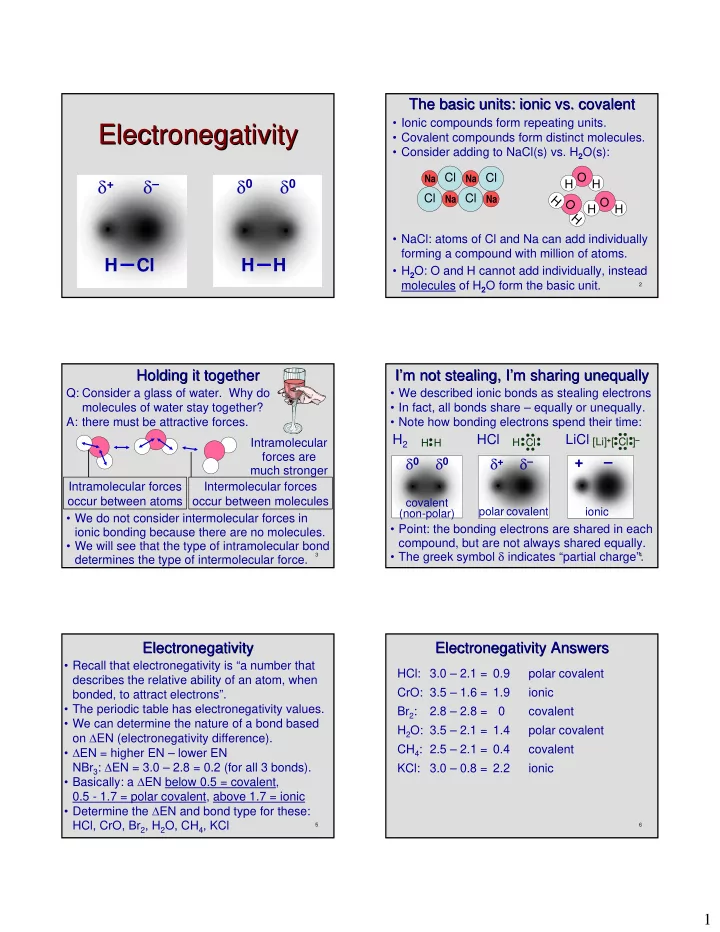
δ+ δ– δ0 δ0 H Cl H H
2
The basic units: ionic vs. covalent The basic units: ionic vs. covalent
- Ionic compounds form repeating units.
- Covalent compounds form distinct molecules.
- Consider adding to NaCl(s) vs. H2O(s):
H O H Cl
Na Na Cl
Cl Cl
Na Na
H O H H O H
- NaCl: atoms of Cl and Na can add individually
forming a compound with million of atoms.
- H2O: O and H cannot add individually, instead
molecules of H2O form the basic unit.
3
Holding it together Holding it together
Q: Consider a glass of water. Why do molecules of water stay together? A: there must be attractive forces. Intramolecular forces
- ccur between atoms
Intermolecular forces
- ccur between molecules
- We do not consider intermolecular forces in
ionic bonding because there are no molecules.
- We will see that the type of intramolecular bond
determines the type of intermolecular force. Intramolecular forces are much stronger
4
I I’ ’m not stealing, I m not stealing, I’ ’m sharing unequally m sharing unequally
- We described ionic bonds as stealing electrons
- In fact, all bonds share – equally or unequally.
- Note how bonding electrons spend their time:
- Point: the bonding electrons are shared in each
compound, but are not always shared equally.
- The greek symbol δ indicates “partial charge”.
H2 HCl LiCl
δ+ δ– δ0 δ0 + –
covalent (non-polar) polar covalent ionic
H H H Cl [Li]+[ Cl ]–
5
Electronegativity Electronegativity
- Recall that electronegativity is “a number that
describes the relative ability of an atom, when bonded, to attract electrons”.
- The periodic table has electronegativity values.
- We can determine the nature of a bond based
- n ∆EN (electronegativity difference).
- ∆EN = higher EN – lower EN
NBr3: ∆EN = 3.0 – 2.8 = 0.2 (for all 3 bonds).
- Basically: a ∆EN below 0.5 = covalent,
0.5 - 1.7 = polar covalent, above 1.7 = ionic
- Determine the ∆EN and bond type for these:
HCl, CrO, Br2, H2O, CH4, KCl
6
Electronegativity Answers Electronegativity Answers
HCl: 3.0 – 2.1 = 0.9 polar covalent CrO: 3.5 – 1.6 = 1.9 ionic Br2: 2.8 – 2.8 = covalent H2O: 3.5 – 2.1 = 1.4 polar covalent CH4: 2.5 – 2.1 = 0.4 covalent KCl: 3.0 – 0.8 = 2.2 ionic