PV = nRT 0C and a pressure of 1140 mm Hg. Calculate the number of - - PDF document

pv nrt
SMART_READER_LITE
LIVE PREVIEW

PV = nRT 0C and a pressure of 1140 mm Hg. Calculate the number of - - PDF document

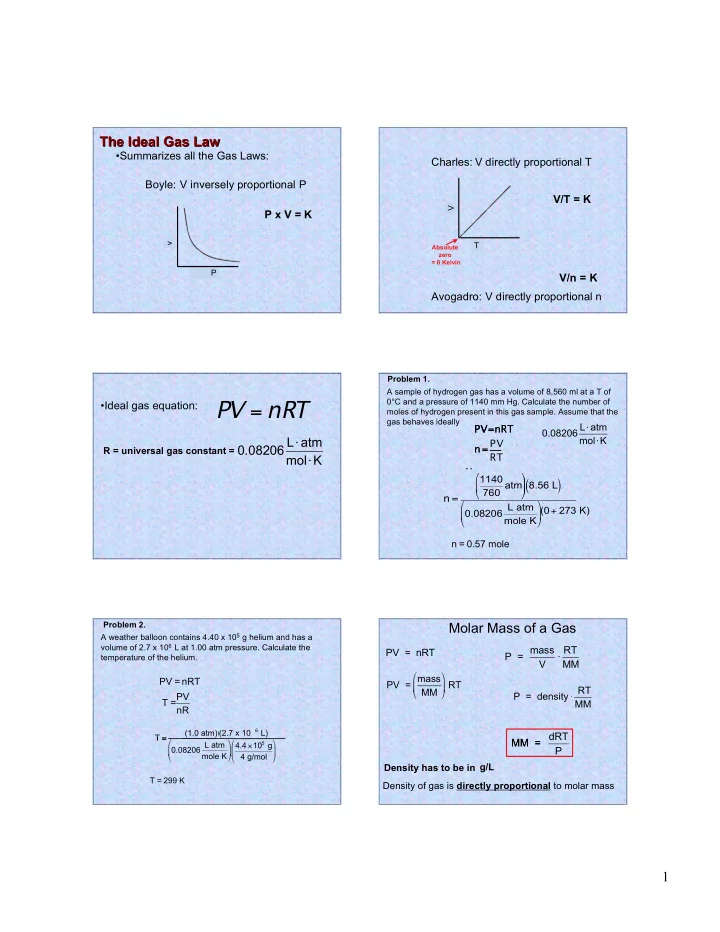
The Ideal Gas Law The Ideal Gas Law Summarizes all the Gas Laws: Charles: V directly proportional T Boyle: V inversely proportional P V/T = K V P x V = K T v Absolute zero = 0 Kelvin P V/n = K Avogadro: V directly proportional n


slide-1
SLIDE 1

1

v P

The Ideal Gas Law The Ideal Gas Law

  • Summarizes all the Gas Laws:

Boyle: V inversely proportional P P x V = K

V T

Absolute zero = 0 Kelvin

Charles: Avogadro: V directly proportional T V directly proportional n V/T = K V/n = K

PV = nRT

  • Ideal gas equation:

R = universal gas constant =

0.08206 L atm molK

Problem 1. A sample of hydrogen gas has a volume of 8,560 ml at a T of 0°C and a pressure of 1140 mm Hg. Calculate the number of moles of hydrogen present in this gas sample. Assume that the gas behaves ideally

PV=nRT PV= n = n = 0.57 mole n = PV=nRT n = PV RT RT 1140 760 atm

  • 8.56 L

( )

=

  • 0.08206 L atm

mole K

  • (0 + 273 K)

0.08206 L atm molK

Problem 2. A weather balloon contains 4.40 x 10⁵ g helium and has a volume of 2.7 x 10⁶ L at 1.00 atm pressure. Calculate the temperature of the helium.

PV = nRT T =

T = T = 299 K T =

  • (1.0 atm)(2.7 x 10

(1.0 atm)(2.7 x 10

6 L)

= 0.08206 L atm mole K

  • 4.4 105 g

4 g/mol

  • = PV

nR

Molar Mass of a Gas

molar mass PV = nRT PV = Density of gas is directly proportional to molar mass MM = P = P = mass V

  • mass RT

MM density RT MM MM = dRT P = mass MM

  • RT
  • RT

Density has to be in g/L

slide-2
SLIDE 2

2

Arrange the following gases in order of increasing density at 25°C:

Ne, Xe, Kr, Ar, H2 H2

Problem 3:

H2 < Ne H2 < Ne < Ar H2 < Ne < Ar< Kr H2 < Ne < Ar< Kr< Xe

Problem 4: An unknown gas has a density of 0.488 g/L at 0.355 atm and 100°C. What is the molar mass of the gas?

MM =

)

= 42.7 g/mol

dRT P = molK

  • 0.488g/L

( )

  • ) 0.08206 Latm

molK

  • 373K

( )

0.355 atm

Problem 5: Calculate the density (in g/L) of Ar at 32°C and 342 mm Hg.

M= dRT P d = d = MP RT d = = mol

  • 760
  • 40 g

mol

  • mol
  • 342

760

  • 0.08206 Latm

molK

  • 32+ 273

( )

= 0.719 g L

Calculate the volume of oxygen that gas can be produced by the complete decomposition of 10.5 g potassium chlorate (MM = 122.6 g/mol) at STP. When at STP: KClO3 → KCl + O2 10.5 g KClO3

  • Mass

KClO3 Moles KClO3 Moles O2 Volume O2

3

1 mol KClO3 122.6 gKClO3

  • 3 mol O2

2 mol KClO3

  • 22.4L

1 mol O2

  • = 2.88 L

2 2 3

STP:

0 °C = 273 K 1 atm

  • II. Gas Stoichiometry

Not at STP: What volume of nitrogen gas is produced at 27°C and 755 mm Hg if 1.24 g of NI3 decomposes? (MM = 395 g/mol) NI3 → N2 + I2 1.24 g NI

3

1.24 g NI

3

1 mol NI3 395 g NI3

  • 1 mol N2

2 mol NI3

  • = 0.00157 mole N2

Mass NI3 Moles NI3 Moles N2 Volume N2

PV = nRT V = nRT P = 0.0389 L

Convert P into atm Convert T to K

2 3

(0.00157)(0. )(0.08206)( )(300) (0.00157)(0.08206)(300) 755 760

C3H8 (g) + 5 O2 (g) → 3 CO2 (g) + 4 H2O (g)

If 3.75 L of carbon dioxide gas are produced at STP, what volume of

  • xygen gas is consumed?
  • = 6.25 L O2

V CO2 Moles CO2 V O2 Moles O2

  • 22.4 L O2

1 mol O2

  • 5 mol O2

3 mol CO2

  • 2

1 mol CO2 22.4 L CO2

  • 3.75 L CO2
slide-3
SLIDE 3

3

C3H8 (g) + 5 O2 (g) → 3 CO2 (g) + 4 H2O (g)

b) If the reaction begins with 2.75 L of propane (C3H8) gas at 50°C and 752 torr with excess oxygen, what mass of water vapor can be produced?

0.1027 mol C3H8

  • PV = nRT

n = = PV RT = 752 760

  • 2.75

( )

  • 0.08206

( ) ) 50+ 273 ( )

= 0.1027 mol C3H8

8

4 mol H2O 1 mol C3H

  • 18 g H2O

1 mol H2O

  • = 7.39 g H2O

mol C3H8 Moles H2O mass H2O