SLIDE 1 AUTOMATED REASONING Krysia Broda Room 378 kb@imperial.ac.uk SLIDES 0: INTRODUCTION and OVERVIEW
Introduction to the course -
what it covers and what it doesn’t cover Examples of problems for a theorem prover Prolog – an example of a theorem prover
KB - AR - 12 Problem can be answered:
with refutation methods (show data + ¬ conclusion give a contradiction) –
resolution and tableau methods covered here;
for equality using special deduction methods (covered here);
x directly, reasoning forwards from data using inference rules, or backwards from conclusion using procedural rules; eg natural deduction (but not here)
- Concerned with GENERAL DEDUCTION - applicable in many areas.
Specifically First order logic / equality - not modal or temporal logics PROBLEM: DATA |= CONCLUSION (|= read as “logically implies”)
- Data is generally expressed either:
in standard first order logic, or in clausal form, or as equalities only. ANSWER: YES/NO/DON'T KNOW (i.e. give up) machine does 'thinking' user does nothing user does 'thinking' machine keeps the books 0ai
- YES + 'proof' - usually just one and smallest if possible, or
- YES + all proofs (or all answers) - (c.f. logic programming)
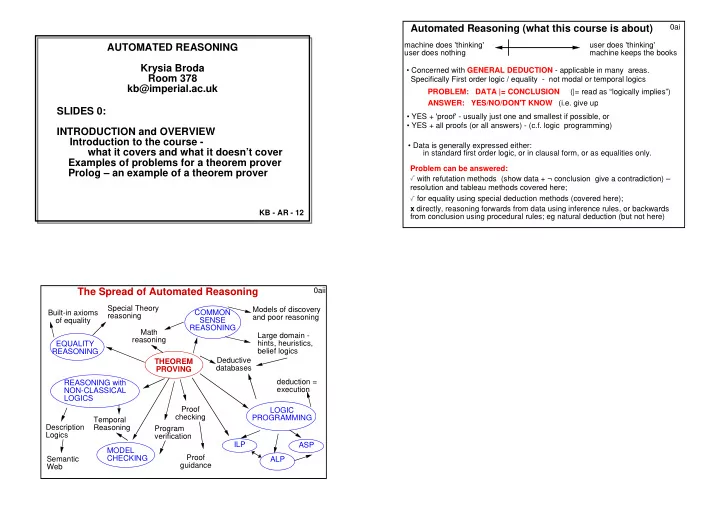
Automated Reasoning (what this course is about)
0aii THEOREM PROVING
The Spread of Automated Reasoning
Large domain - hints, heuristics, belief logics deduction = execution COMMON SENSE REASONING Built-in axioms
Special Theory reasoning EQUALITY REASONING Models of discovery and poor reasoning Deductive databases LOGIC PROGRAMMING ASP ALP ILP Temporal Reasoning REASONING with NON-CLASSICAL LOGICS MODEL CHECKING Description Logics Semantic Web Math reasoning Proof checking Proof guidance Program verification
SLIDE 2
Data: (1) a(Y):-b(Y),c(Y). (2) b(X):-c(X). (3) c(g). (Variables X,Y universally quantified) Conclusion: a(g) Show Data implies Conclusion. 0aiii
Prolog is a Theorem Prover (1)
(3) c(g) (2) (4) b(g) (1) (3) c(g) a(g) can also read tree backwards: to show c(g), again note c(g) is a fact to show b(g), by (2) show c(g) c(g) is a fact, so ok to show a(g), by (1) show (b(g) and c(g)) (i.e. show b(g) and show c(g)) Question: The proof is the same, whether read top-down or bottom-up. But the processes of searching for it are different. Which is better? Why? Can work forwards from facts eg from c(g) and b(X):-c(X) for all X, can derive b(g); from b(g), c(g) and a(Y):-b(Y),c(Y) for all Y can derive a(g) 0aiv
Prolog is a Theorem Prover (2)
?a(g) ?b(g), c(g) ?c(g), c(g) ?c(g) [ ] (1) (2) (3) (3) show a(g) show b(g) and c(g) show c(g) and c(g) show(c(g) done Prolog reading (procedural interpretation) Data: (1) a(Y):-b(Y),c(Y). (2) b(X):-c(X). (3) c(g). (Variables X,Y universally quantified) Conclusion: a(g) Show Data implies Conclusion. to show a(g), show (b(g) and c(g)) (i.e. show b(g) and show c(g)) to show b(g), show c(g) c(g) is a fact, so ok to show c(g), again note c(g) is a fact (3) c(g) (2) (4) b(g) (1) (3) c(g) a(g) Data: (1) a(Y):-b(Y),c(Y). (2) b(X):-c(X). (3) c(g). Conclusion: a(g) 0av
Prolog is a Theorem Prover (3)
(3) c(g) (2) (4) b(g) (1) (3) c(g) a(g) ¬a(g) ¬b(g) or ¬c(g) ¬c(g) (1) (2) (3) (3) Read bottom up - to show a(g), etc. Read top-down - assume ¬a(g), etc. In effect Prolog assumes conclusion false (i.e. ¬a(g)) and derives a contradiction – called a refutation From ¬a(g) and a(Y):-b(Y),c(Y) derive ¬(b(g) and c(g)) ≡ ¬b(g) or ¬c(g) (*) Case 1 of (*) if ¬b(g), then from b(X):-c(X) derive ¬c(g) ¬c(g) contradicts fact c(g) Case 2 of (*) if ¬c(g) again it contradicts c(g) Hence ¬b(g) or ¬c(g) leads to contradiction; Hence ¬a(g) leads to contradiction, so a(g) must be true The various interpretations are similar because the Data uses Horn clauses Data: (1) a(Y):-b(Y),c(Y). (2) b(X):-c(X). (3) c(g). Conclusion: a(g) 0avi
Prolog is a Theorem Prover (4)
¬a(g) may be read as "show a(g)" then the refutation and procedural interpretation are isomorphic to show a(g), show (b(g) and c(g)) (i.e. show b(g) and show c(g)) to show b(g), show c(g) c(g) is a fact, so ok to show c(g), again note c(g) is a fact ¬a(g) ¬b(g) or ¬c(g) ¬c(g) (1) (2) (3) (3) ?a(g) ?b(g), c(g) ?c(g), c(g) ?c(g) [ ] (1) (2) (3) (3) show a(g) show b(g) and c(g) show c(g) and c(g) show(c(g) done Prolog reading (procedural interpretation)
SLIDE 3 0avii Introduction: The course slides will generally be covered “as is” in class. Course notes (like this one) amplify the slides. There are also some longer, and older , (“chapter”) notes with more background material (not examinable) on my webpage (www.doc.ic.ac.uk/~kb). In this course we'll be concerned with methods for automating reasoning. We'll look at the "father" of all methods, resolution, as well as at tableaux methods. We'll also consider reasoning with equality, especially when the data consists only of
- equations. All data will be in first order logic.
Of course, there are special systems for automating other kinds of logics, for example modal logics. The methods may be extensions of methods for first order logic, or reduce to using theorem provers for first order logic in special ways. It is mainly for these reasons (but also because there isn't enough time) that we restrict things. Logic programming (LP) is a familiar, useful and simple automated reasoning system which we will occasionally use to draw analogies and contrasts. e.g in LP we usually desire all solutions to a goal. In theorem proving terms this usually amounts to generating all proofs, although often just one proof might be enough. In LP reasoning is done by refutation. The method of refutation assumes that the conclusion is false and attempts to draw a contradiction from this assumption and the given data. Nearly always, refutations are sought in automated deduction. A definite logic program clause A:-B,C can be used forwards: “from A and B conclude C” to reason directly from data to conclusion. Reasoning may be directed backwards from the conclusion, as in "to show A, show B and C". Deductions produced by LP are sometimes viewed in this way, when it is referred to as a procedural interpretation. Very often, derivations use resolution. Backwards reasoning: “to show C, show A and B” is implemented using resolution, in which the initial conclusion is negated. These things will be shown for the simple case of definite logic programming, and then more generally. What we won't be concerned with: particular methods of knowledge representation, user interaction with systems, reasoning in special domains (except equational systems), or model checking. All of these things are important; a problem can be represented in different ways, making it more or less difficult to solve; clever algorithms can be used in special domains; user interactive systems are important too - e.g. Isabelle or Perfect Developer, as they usually manage to prove the easy and tedious things and require intervention only for the hard proofs. Isabelle and its relations are now very sophisticated. If a proof seems to be hard it may mean that some crucial piece of data is missing (so the proof doesn't even exist!) and user interaction may enable such missing data to be detected
- easily. Satisfiability checking (satsolvers), and Symbolic model checking (eg Alloy) can
also be used to show a conclusion is not provable by finding a model of the data that falsifies the conclusion. In order to see what kinds of issues can arise in automated reasoning, here are 3 problems for you to try for yourself. Are they easy? How do you solve them? Are you sure your answer is correct? What are the difficulties? You should translate the first two into logic. In the third, assume all equations are implicitly quantified over variables x, y and z and that a, b, c and e are constants.
0aviii
Introduction (continued):
SLIDE 4 0bi Three naughty children: Dolly Ellen or Frances was the culprit and only one. The culprit was in the house. Dolly said " It wasn't me, I wasn't in the house; Ellen did it." Ellen said " It wasn't me and it wasn't Frances; but if I did do it then (Dolly did it too or was in the house)." Frances said " I didn't do it, Dolly was in the house; if Dolly was in the house and did it so did Ellen." None of the three told the truth. Who did it?
- A general theorem prover might be expected to solve all of the following
3 problems easily.
- The user would translate the data into logic first.
- How would YOU solve the problems?
- Are they easy? What are the difficulties?
- Are you sure the answer is correct?
EXAMPLE PROBLEMS Someone who lived in the house stole from Aunt Agatha. Agatha the butler and James live in the house and are the only people that do. A thief dislikes, and is never richer than, his victim. James dislikes no-one whom Aunt Agatha dislikes. Agatha dislikes everyone except the butler. The butler dislikes anyone not richer than Agatha and everyone she dislikes. No-one dislikes everyone. Agatha is not the butler. Therefore Agatha stole from herself (and also that neither James nor the butler stole from her) A harmonious household (!): 0bii A Mathematical Problem: a ο b = c ο is an associative binary operator: x ο (y ο z) = (x ο y) ο z x ο x = e x ο e = e ο x = x (e is the identity of ο) Show b ο a = c 0biii
Some hints for the problems.
For the naughty children: Let the constants be d, e and f (for Dolly, Ellen and Francis); You need predicates C(x) – x is a culprit, and H(x) – x is in the house; The second sentence is ∀x(C(x) → H(x)). For Aunt Agatha's Burglary: You can ignore "lives in the house". Let the constants be a, b, j and predicates be s(x,y): y is the victim of thief x, d(x,y): x dislikes y, r(x,y): x is richer than y and = (usual meaning); The first sentence is ∃x(s(x,a)), which can be simplified to s(m,a); The last piece of data is ¬ (a=b); You'll need to reason about equality: if data S holds for x, and x=y, then S holds for y. Mathematics: There are 4 constants, a, b, c and e, and predicate P(x,y,z) meaning x o y = z; You can either translate the data using P (remembering to translate the associativity property usng P as well)
- r keep with = only and reason directly with equality;
Try both!
SLIDE 5 0ci Some Useful References and Websites (See Chapter Notes for additional papers etc.) Alan Bundy: The Computer Modelling of Mathematical reasoning (Academic) Chang & Lee: Symbolic Logic and Mechanical Theorem Proving (Academic) Mel Fitting: First order Logic and Automated Theorem Proving (Springer) Alan Robinson: Logic:Form and Function (Edinburgh) Larry Wos: Automated Reasoning: Introduction and Applications (McGrawHill)
- J. Kalman: Automated reasoning with Otter (Rinton)
Blasius & Burckert: Deduction Systems in Artificial Intelligence (Ellis Horwood) Lassez & Plotkin (Eds): Computational Logic (MIT) Kakas & Sadri (Eds): Computational Logic: Logic Prog and Beyond (Springer)
- R. Veroff: Automated Reasoning and its Applications (MIT)
- J. Gallier: Logic for Computer Science: Foundations of Automated Theorem
Proving (Harper Row) Several “freetech” books from www.freetechbooks.com 0cii Useful References and Websites Continued CADE: Conference on Automated Deduction (Springer) http://www.cadeconference.org/ (old: http://www.cs.albany.edu/~nvm/cade.html) TABLEAUX: Conference on Analytic Tableau and Related Methods (Springer) http://i12www.ira.uka.de/TABLEAUX/
Workshop on First Order Theorem Proving http://www.csc.liv.ac.uk/FTP-WS/
(Old: http://www.mpi-sb.mpg.de/conferences/FTP-WS/) http://en.wikipedia.org/wiki/Automated_theorem_proving (Slightly biased contents) Theorem Proving at Argonne http://www-unix.mcs.anl.gov/AR/ (Includes Otter theorem Prover) http://www.uni-koblenz.de/~beckert/leantap/ (A tableau based prover) http://www.leancop.de/ (Another tableau based prover) http://www.cl.cam.ac.uk/research/hvg/Isabelle/ http://alloy.mit.edu/ http://www.cs.miami.edu/~tptp/ (Thousands of problems for Theorem Provers) http://www.cs.swan.ac.uk/~csetzer/logic-server/software.html (List of Provers) 0di Summary of Slides 0
- 1. This course is concerned with the automation of logical reasoning.
- 2. You are already familiar with one automated reasoner, Prolog. Its evaluation
can be viewed in two ways: either as a refutation whereby the conclusion is negated and a contradiction derived from it by resolution using the data, or as a natural deduction process working backwards from the goal. 3.There are other refutation methods, including general resolution and semantic tableaux, which will be covered in the course.
- 4. Problems can involve propositional data (without quantifiers), or data with
- quantifiers. Data may include use of the equality predicate, for which special
methods can be used (eg Knuth Bendix Procedure), also covered in the course.
- 5. There are other aspects to automated reasoning, including systems with
more user interaction, model checking, modal and temporal logic provers and knowledge representation. This course will not be considering these things.
- 6. You will be able to use several theorem provers in this course.
SLIDE 6 Gallery 1: Famous Names in Theorem Proving Alan Robinson Discovered Resolution 1961 Alan Bundy Clam Theorem Prover, excellent book, problem solving Gerard Huet Discovered rewrite systems 1976 Hillary Putnam Davis Putnam prover 1957 Larry Wos Wrote Otter prover (1980s) and successor Prover9 Reiner Hahnle LeanTap 1997 and
Key System for Program Correctness 2005 Gallery 2: Famous Names in Theorem Proving Robert Kowalski (1979) Theory
Programming Connection Graphs (1976) J S Moore Boyer MooreProver (1970s) Structure Sharing (1971) Chang and Lee First book on theorem Proving (1968) Donald Knuth Knuth Bendix Algorithm (1971) Tex Martin Davis Davis Putnam Algorithm (1957) Gallery 3: Famous Names in Theorem Proving Donald Loveland Model Elimination 1967 Alain Colmerauer first Prolog System Mark Stickel
Theorem Prover 1982 Reinhold Letz - Setheo, Free variable Tableau proving (1990s onwards) David Plaisted - Hyper-linking (1992) Gallery 4: Famous Names in Theorem Proving Andrei Voronkov - Vampire Theorem Prover Norbert Eisinger
Graph theory (1986) Woody Bledsoe - UT prover (natural deduction style) Ian Horrocks
Logic Theorem Prover Larry Paulson - Inventor of Isabelle