
SLIDE 1
Computer Graphics (Fall 2005) Computer Graphics (Fall 2005)
COMS 4160, Lecture 7: Curves 2
http://www.cs.columbia.edu/~cs4160
To Do To Do
Start on HW 2 (cannot be done at last moment)
This (and previous) lecture should have all information need
Start thinking about partners for HW 3 and HW 4
Remember though, that HW2 is done individually Your submission of HW 2 must include partner for HW 3
Outline of Unit Outline of Unit
Bezier curves (last time) deCasteljau algorithm, explicit, matrix (last time) Polar form labeling (blossoms) B-spline curves Not well covered in textbooks (especially as taught here). Main reference will be lecture notes. If you do want a printed ref, handouts from CAGD, Seidel
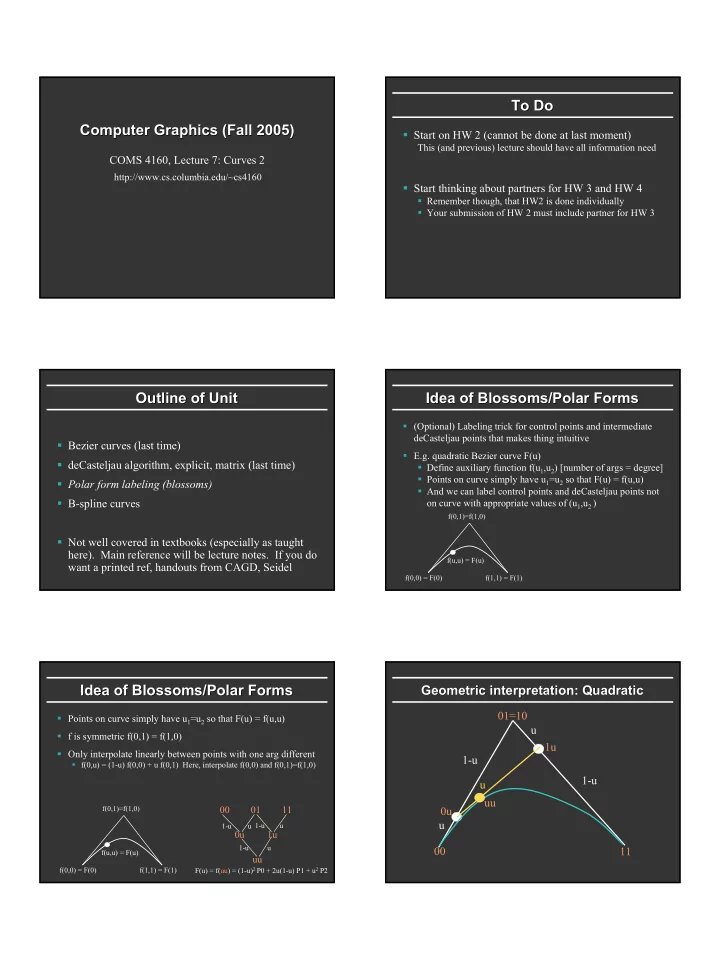
Idea of Blossoms/Polar Forms Idea of Blossoms/Polar Forms
(Optional) Labeling trick for control points and intermediate deCasteljau points that makes thing intuitive E.g. quadratic Bezier curve F(u) Define auxiliary function f(u1,u2) [number of args = degree] Points on curve simply have u1=u2 so that F(u) = f(u,u) And we can label control points and deCasteljau points not
- n curve with appropriate values of (u1,u2 )
f(0,0) = F(0) f(1,1) = F(1) f(0,1)=f(1,0) f(u,u) = F(u)
Idea of Blossoms/Polar Forms Idea of Blossoms/Polar Forms
Points on curve simply have u1=u2 so that F(u) = f(u,u) f is symmetric f(0,1) = f(1,0) Only interpolate linearly between points with one arg different
f(0,u) = (1-u) f(0,0) + u f(0,1) Here, interpolate f(0,0) and f(0,1)=f(1,0)
00 01 11
F(u) = f(uu) = (1-u)2 P0 + 2u(1-u) P1 + u2 P2 1-u 1-u u u 1-u u
0u 1u uu
f(0,0) = F(0) f(1,1) = F(1) f(0,1)=f(1,0) f(u,u) = F(u)