SLIDE 2 Slide 7 / 186
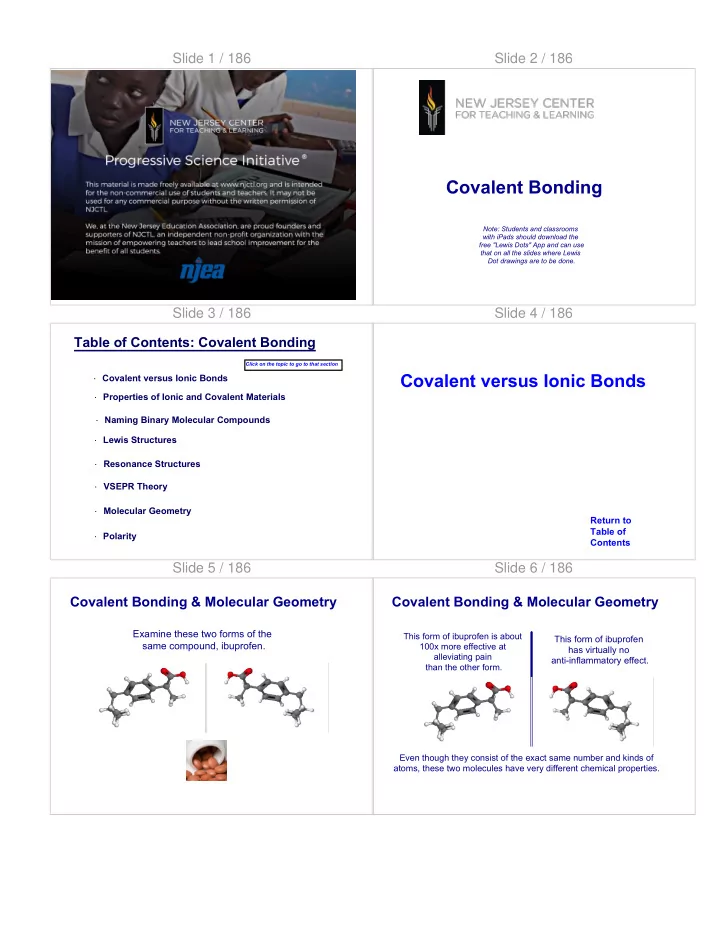
In this unit, we will explore what causes molecules to have various shapes. Later, we will then examine how molecular geometry affects different chemical properties.
Covalent Bonding & Molecular Geometry
Take a look around you. The chemistry of everything you see, hear, feel, touch and taste is a result of not only what it's made of but also how it's put together.(Remember this for next year in biology!)
Slide 8 / 186 Chemical Bonds
Ionic - The electrostatic attraction between ions Covalent - The sharing of electrons between atoms Metallic - Each metal atom bonds to
- ther metals atoms within a "sea" of
electrons (covered in a later unit) Chemical bonds hold atoms together to create chemical
- compounds. There are three basic types of bonds:
Slide 9 / 186 Chemical Bonds
How ionic or covalent a bond is depends on the difference in
- electronegativity. The smaller the difference, the more likely electrons
are "shared" and the bond is considered covalent, the greater the difference, the more likely electrons have been transferred and the atoms are ionized resulting in an ionic bond. Li Be B C N O F
Electronegativity 1.0 1.6 2.0 2.5 3.0 3.5 4.0 Bond Li-F Be-F B-F C-F N-F O-O F-F Electronegativity 3 2.4 2.0 1.5 1 0.5 0
Increasing Covalent Character
Slide 10 / 186 Chemical Bonds
We can make a few simplifications... Ionic Bonding Ionic bonds occur when the difference in electronegativity between two atoms is more than 1.7. Na ---- F electronegativity = 3 Covalent Bonding If the difference of electronegativity is less than 1.7, neither atom takes electrons from the other; they share electrons. This type of bonding typically takes place between two non-metals or between two metals. H ---- Cl electronegativity = 1.1
Slide 11 / 186
In the case of ionic bonding, a 3-D lattice of ions is the result . . . not individual molecules. The chemical formula for an ionic compound is just the ratio of each type of ion in the lattice, not a particular number of ions in a molecule. In contrast, covalent bonding can result in individual molecules or 3-D lattices depending on the elements
- involved. The bonding and the
shapes of these molecules help determine the physical and chemical properties of everything around us!
Ionic v. Covalent Bonding
click here for an animation about ionic and covalent bonding
Slide 12 / 186