SLIDE 1
Slide 1 / 109
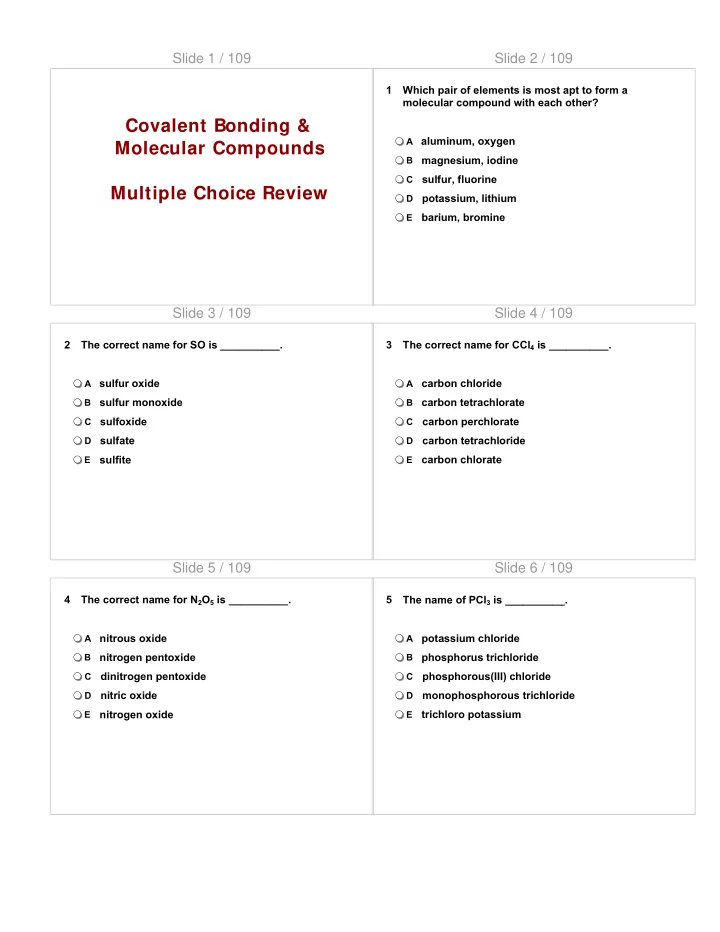
Covalent Bonding & Molecular Compounds Multiple Choice Review
Slide 2 / 109
1 Which pair of elements is most apt to form a molecular compound with each other?
A aluminum, oxygen B
magnesium, iodine
C
sulfur, fluorine
D
potassium, lithium
E
barium, bromine
Slide 3 / 109
2 The correct name for SO is __________.
A sulfur oxide B
sulfur monoxide
C
sulfoxide
D
sulfate
E
sulfite
Slide 4 / 109
3 The correct name for CCl4 is __________.
A carbon chloride B
carbon tetrachlorate
C
carbon perchlorate
D
carbon tetrachloride
E
carbon chlorate
Slide 5 / 109
4 The correct name for N2O5 is __________.
A nitrous oxide B
nitrogen pentoxide
C
dinitrogen pentoxide
D
nitric oxide
E
nitrogen oxide
Slide 6 / 109
5 The name of PCl3 is __________.
A potassium chloride B
phosphorus trichloride
C
phosphorous(III) chloride
D
monophosphorous trichloride
E
trichloro potassium
SLIDE 2 Slide 7 / 109
6 The name of the binary compound N2O4 is __________.
A nitrogen oxide B
nitrous oxide
C
nitrogen(IV) oxide
D
dinitrogen tetroxide
E
Slide 8 / 109
7 The correct name for H2O is __________.
A hydrogen oxide B
hydrogen(II) oxide
C
dihydrogen oxide
D
dihydrogen monoxide
E
hydrogen dioxide
Slide 9 / 109
8 The correct name for XeF4 is __________.
A monoxenon pentafluoride B
xenon pentafluoride
C
xenon tetrafluoride
D
monoxenon tetrafluoride
E
xenon fluorate
Slide 10 / 109
9 The correct name for P2O5 is __________.
A phosphorus oxide B
phosphorus pentoxide
C
diphosphorus oxide
D
phosphate
E
diphosphorus pentoxide
Slide 11 / 109
10 The name of BCl3 is __________.
A boron chloride B
boron trichloride
C
monoboron chloride
D
trichloro boron
E
monoboron trichloride
Slide 12 / 109
11 The name of the binary compound CS2 is __________.
A carbon sulfide B
monocarbon disulfide
C
carbon disulfide
D
carbon sulfate
E
carbon disulfate
SLIDE 3 Slide 13 / 109
12 The type of compound that is most likely to contain a covalent bond is __________.
A one that is composed of a metal and a nonmetal B
a solid metal
C
- ne that is composed of only nonmetals
D
held together by the electrostatic forces between
E
There is no general rule to predict covalency in bonds.
Slide 14 / 109
13 There are __________ paired and __________ unpaired electrons in the Lewis symbol for a Nitrogen atom.
A 4, 2 B
2, 4
C
2, 3
D
4, 3
E
0, 3
Slide 15 / 109
14 In the Lewis symbol for a sulfur atom, there are __________ paired and __________ unpaired electrons.
A 2, 2 B
4, 2
C
2, 4
D
0, 6
E
5, 1
Slide 16 / 109
15 In the Lewis symbol for an Iodine atom, there are __________ paired and __________ unpaired electrons.
A 4, 2 B
4,1
C
2, 5
D
6, 1
E
0, 5
Slide 17 / 109
16 There are __________ unpaired electrons in the Lewis symbol for an oxygen atom.
A 0 B
1
C
2
D
4
E
3
Slide 18 / 109
17 The only noble gas without eight valence electrons is __________.
A Ar B
Ne
C
He
D
Kr
E
All noble gases have eight valence electrons.
SLIDE 4
Slide 19 / 109
18 How many single covalent bonds must a silicon atom form to have a complete octet in its valence shell?
A 3 B
4
C
1
D
2
E
Slide 20 / 109
19 How many hydrogen atoms must bond to silicon to give it an octet of valence electrons?
A 1 B
2
C
3
D
4
E
5
Slide 21 / 109
20 A double bond consists of __________ pairs of electrons shared between two atoms.
A 1 B
2
C
3
D
4
E
6
Slide 22 / 109
21 A __________ covalent bond between the same two atoms is the longest.
A single B
double
C
triple
D
they are all the same length.
E
strong
Slide 23 / 109
22 As the number of covalent bonds between two atoms increases, the distance between the atoms __________ and the strength of the bond between them __________.
A increases, increases B
decreases, decreases
C
increases, decreases
D
decreases, increases
E
is unpredictable
Slide 24 / 109
23 What is the maximum number of double bonds that a hydrogen atom can form?
A 0 B
1
C
2
D
3
E
4
SLIDE 5 Slide 25 / 109
24 What is the maximum number of double bonds that a carbon atom can form?
A 4 B
1
C D
2
E
3
Slide 26 / 109
25 In which of the molecules below is the carbon- carbon distance the shortest?
A H2C = CH2 B
H -- C ≡ C -- H
C
H3C – CH3
D
H2C = C = CH2
E
H3C - CH2 - CH3
Slide 27 / 109
26 Of the bonds C – N, C = N, C ≡ N the C – N bond is __________.
A strongest/shortest B
strongest/longest
C
weakest/shortest
D
weakest/longest
E
intermediate in both strength and length
Slide 28 / 109
27 Of the possible bonds between carbon atoms (single, double, and triple), __________.
A a triple bond is longer than a single bond B
a double bond is stronger than a triple bond
C
a single bond is stronger than a triple bond
D
a double bond is longer than a triple bond
E
a single bond is stronger than a double bond
Slide 29 / 109
28 The ion ICl4
- has __________ valence electrons.
A 34 B
35
C
36
D
28
E
8
Slide 30 / 109
29 The ion NO- has __________ valence electrons.
A 15 B
14
C
16
D
10
E
12
SLIDE 6 Slide 31 / 109
30 The Lewis structure of AsH3 shows __________ nonbonding electron pair(s) on As.
A 0 B
1
C
2
D
3
E
This cannot be determined from the data given.
Slide 32 / 109
31 The Lewis structure of PF3 shows that the central phosphorus atom has __________ nonbonding and __________ bonding electron pairs.
A 2, 2 B
1, 3
C
3, 1
D
1, 2
E
3, 3
Slide 33 / 109
32 The Lewis structure of HCN (H – C≡N) shows that __________ has __________ nonbonding electron pairs.
A C, 1 B
N, 1
C
H, 1
D
N, 2
E
C, 2
Slide 34 / 109
33 Of the following, __________ cannot accommodate more than an octet of electrons.
A P B As C
O
D
S
E
I
Slide 35 / 109
34 A valid Lewis structure of __________ cannot be drawn without violating the octet rule.
A NH3 B IF3 C
PF3
D
SbCl3
E
NO3
Slide 36 / 109
35 A valid Lewis structure of __________ cannot be drawn without violating the octet rule.
A PO4
3-
B PF3 C
CCl4
D
SeF4
E
NF3
SLIDE 7 Slide 37 / 109
36 The central atom in __________ does not violate the octet rule. *
A SF4 B
KrF2
C
CF4
D
XeF4
E
ICl4
37 The central atom in __________ violates the octet rule.
A NH3 B
SeF2
C
BF3
D
AsF3
E
CH4
Slide 39 / 109
38 A valid Lewis structure of __________ cannot be drawn without violating the octet rule.
A ClF3 B
PCl3
C
SO3
D
CCl4
E
CO2
Slide 40 / 109
39 A valid Lewis structure of __________ cannot be drawn without violating the octet rule.
A NI3 B
SO2
C
ICl5
D
SiF4
E
CO2
Slide 41 / 109
40 A valid Lewis structure of __________ cannot be drawn without violating the octet rule.
A NF3 B BeH2 C
SO2
D
CF4
E
SO3
2-
Slide 42 / 109
41 The central iodine atom in the ICl4
__________ non-bonded electron pairs and __________ bonded electron pairs in its valence shell.
A 2, 2 B
3, 4
C
1, 3
D
3, 2
E
2, 4
SLIDE 8 Slide 43 / 109
42 The central iodine atom in IF5 has __________ non- bonded electron pairs and __________ bonded electron pairs in its valence shell.
A 1, 5 B
0, 5
C
5, 1
D
4, 1
E
1, 4
Slide 44 / 109
43 The central Xe atom in the XeF4 molecule has __________ non-bonded electron pairs and __________ bonded electron pairs in its valence shell.
A 1, 4 B
2, 4
C
4, 0
D
4, 1
E
4, 2
Slide 45 / 109
44 Resonance structures differ by __________.
A number and placement of electrons B
number of electrons only
C
placement of atoms only
D
number of atoms only
E
placement of electrons only
Slide 46 / 109
45 How many equivalent resonance forms can be drawn for CO3
- 2 (carbon is the central atom)?
A 1 B
2
C
3
D
4
E
Slide 47 / 109
46 How many equivalent resonance forms can be drawn for SO2 without expanding octet on the sulfur atom (sulfur is the central atom)?
A 0 B
2
C
3
D
4
E
1
Slide 48 / 109
47 How many equivalent resonance structures can be drawn for the molecule of SO3 without having to violate the octet rule on the sulfur atom?
A 5 B
2
C
1
D
4
E
3
SLIDE 9 Slide 49 / 109
48 How many different types of resonance structures can be drawn for the ion SO3
satisfy the octet rule?
A 1 B
2
C
3
D
4
E
5
Slide 50 / 109
49 In the nitrite ion NO2
A both bonds are single bonds B both bonds are double bonds C
- ne bond is a double bond and the other is a single bond
D
both bonds are the same
E
there are 20 valence electrons
Slide 51 / 109
50 The Lewis structure of the CO3
A E D C B
Slide 52 / 109
51 To convert from one resonance structure to another, __________.
A only atoms can be moved B
electrons and atoms can both be moved
C
- nly electrons can be moved
D
neither electrons nor atoms can be moved
E
electrons must be added
Slide 53 / 109
52 For resonance forms of a molecule or ion, __________.
A one always corresponds to the observed structure B all the resonance structures are observed in various
proportions
C
the observed structure is an average of the resonance forms
D
the same atoms need not be bonded to each other in all resonance forms
E
there cannot be more than two resonance structures for a given species
Slide 54 / 109
53 The basis of the VSEPR model of molecular bonding is __________.
A regions of electron density on an atom will organize
themselves so as to maximize s-character
B regions of electron density in the valence shell of an atom
will arrange themselves so as to maximize overlap
C
atomic orbitals of the bonding atoms must overlap for a bond to form
D
electron domains in the valence shell of an atom will arrange themselves so as to minimize repulsions
E
hybrid orbitals will form as necessary to, as closely as possible, achieve spherical symmetry
SLIDE 10 Slide 55 / 109
54 According to VSEPR theory, if there are three electron domains in the valence shell of an atom, they will be arranged in a(n) __________ geometry.
A octahedral B
linear
C
tetrahedral
D
trigonal planar
E
trigonal bipyramidal
Slide 56 / 109
55 An electron domain could consist of __________.
- a. a nonbonding pair of electrons
- b. a single bond
- c. a multiple bond
A a only B
b only
C
c only
D
a, b, and c
E
b and c
Slide 57 / 109
56 According to VSEPR theory, if there are five electron domains in the valence shell of an atom, they will be arranged in a(n) __________ geometry.
A octahedral B
linear
C
tetrahedral
D
trigonal planar
E
trigonal bipyramidal
Slide 58 / 109
57 According to VSEPR theory, if there are four electron domains in the valence shell of an atom, they will be arranged in a(n) __________ geometry.
A octahedral B
linear
C
tetrahedral
D
trigonal planar
E
trigonal bipyramidal
Slide 59 / 109
58 In the valence shell of an atom there are six electron domains. They will be arranged in a (an) __________ geometry.
A hexagonal B
tetrahedral
C
D
trigonal bipyramidal
E
see-saw
Slide 60 / 109
59 Using the VSEPR model, the electron-domain geometry of the central atom in BF3 is _________.
A linear B
trigonal planar
C
tetrahedral
D
trigonal bipyramidal
E
SLIDE 11 Slide 61 / 109
60 The electron-domain geometry of the central atom in OF2 is _________.
A linear B
trigonal planar
C
tetrahedral
D
trigonal bipyramidal
E
Slide 62 / 109
61 The electron-domain geometry of the central atom in BrF3 is _______.
A linear B
trigonal planar
C
tetrahedral
D
trigonal bipyramidal
E
Slide 63 / 109
62 Using the VSEPR model, the electron-domain geometry of the central atom in BrF4
A linear B
trigonal planar
C
tetrahedral
D
trigonal bipyramidal
E
Slide 64 / 109
63 The electron-domain geometry of __________ is tetrahedral.
A CH4 B
PH3
C
CCl2Br2
D
XeF4
E
all of the above except XeF4
Slide 65 / 109
64 The electron-domain geometry and the molecular geometry of a molecule of the general formula ABn are __________.
A never the same B
always the same
C
sometimes the same
D
not related
E
mirror images of one another
Slide 66 / 109
65 The electron-domain geometry and the molecular geometry of a molecule of the general formula ABn will always be the same if __________.
A there are no lone pairs on the central atom B
there is more than one central atom
C
n is greater than four
D
n is less than four
E
the octet rule is obeyed
SLIDE 12 Slide 67 / 109
66 For a molecule with the formula AB2 the molecular shape is __________.
A linear or bent B
linear or trigonal planar
C
linear or T-shaped
D
T-shaped
E
trigonal planar
Slide 68 / 109
67 PCl5 has __________ electron domains and a __________ molecular arrangement.
A 6, trigonal bipyramidal B
6, tetrahedral
C
5, square pyramidal
D
5, trigonal bipyramidal
E
6, seesaw
Slide 69 / 109
68 The electron-domain geometry and molecular geometry of iodine trichloride are __________ and __________, respectively.
A trigonal bipyramidal, trigonal planar B
tetrahedral, trigonal pyramidal
C
trigonal bipyramidal, T-shaped
D
- ctahedral, trigonal planar
E
T-shaped, trigonal planar
Slide 70 / 109
69 Using the VSEPR model, the molecular geometry of the central atom in XeF2 is __________.
A linear B
trigonal planar
C
tetrahedral
D
bent
E
trigonal pyramidal
Slide 71 / 109
70 Using the VSEPR model, the molecular geometry of the central atom in BCl3 is __________.
A linear B
trigonal planar
C
tetrahedral
D
bent
E
trigonal pyramidal
Slide 72 / 109
71 Using the VSEPR model, the molecular geometry of the central atom in CF4 is __________.
A linear B
trigonal planar
C
tetrahedral
D
bent
E
trigonal pyramidal
SLIDE 13 Slide 73 / 109
72 Using the VSEPR model, the molecular geometry of the central atom in SO2 is __________.
A linear B
trigonal planar
C
tetrahedral
D
bent
E
trigonal pyramidal
Slide 74 / 109
73 Using the VSEPR model, the molecular geometry of the central atom in NCl3 is __________.
A linear B
trigonal planar
C
tetrahedral
D
bent
E
trigonal pyramidal
Slide 75 / 109
74 Using the VSEPR model, the molecular geometry of the central atom in PF5 is __________.
A tetrahedral B
square planar
C
trigonal bipyramidal
D
seesaw
E
square pyramidal
Slide 76 / 109
75 The molecular geometry of __________ is square planar.
A CCl4 B
XeF4
C
PH3
D
XeF2
E
ICl3
Slide 77 / 109
76 The molecular geometry of the CS2 molecule is __________.
A linear B
bent
C
tetrahedral
D
trigonal planar
E
T-shaped
Slide 78 / 109
77 The molecular geometry of the SiH2Cl2 molecule is __________.
A trigonal planar B
tetrahedral
C
trigonal pyramidal
D
E
T-shaped
SLIDE 14 Slide 79 / 109
78 The molecular geometry of the PHCl2 molecule is __________.
A bent B
trigonal planar
C
trigonal pyramidal
D
tetrahedral
E
T-shaped
Slide 80 / 109
79 The molecular geometry of the CHl3 molecule is __________.
A bent B
trigonal planar
C
trigonal pyramidal
D
tetrahedral
E
T-shaped
Slide 81 / 109
80 The molecular geometry of the SF2 molecule is __________.
A linear B
bent
C
trigonal planar
D
tetrahedral
E
Slide 82 / 109
81 The molecular geometry of the H3O+ ion is __________.
A linear B
tetrahedral
C
bent
D
trigonal pyramidal
E
Slide 83 / 109
82 ClF3 has "T-shaped" geometry. There are __________ non-bonding domains in this molecule.
A 0 B
1
C
2
D
3
E
4
Slide 84 / 109
83 The electron domain and molecular geometry of BrO2
A tetrahedral, trigonal planar B
trigonal planar, trigonal planar
C
trigonal pyramidal, linear
D
tetrahedral, bent
E
trigonal pyramidal, seesaw
SLIDE 15 Slide 85 / 109
84 The molecular geometry of the BrO3
__________.
A trigonal pyramidal B
trigonal planar
C
bent
D
tetrahedral
E
T-shaped
Slide 86 / 109
85 The molecular geometry of the left-most carbon atom in the molecule below is _____
A trigonal planar B
trigonal bipyramidal
C
tetrahedral
D
E
T-shaped
Slide 87 / 109
86 The molecular geometry of the right-most carbon in the molecule below is __________.
A trigonal planar B
trigonal bipyramidal
C
tetrahedral
D
E
T-shaped
Slide 88 / 109
87 What is the molecular geometry of a molecule that has three bonding and two non-bonding domains?
A T-shaped B
Tetrahedral
C
See-saw
D
Square pyramidal
E
Trigonal bipyramidal
Slide 89 / 109
88
Consider the following species when answering the following questions: (i) PCl3 (ii) CCl4 (iii) TeCl4 (iv) XeF4 (v) SF6 For which of the molecules is the molecular geometry (shape) the same as the VSEPR electron domain arrangement (electron domain geometry)? A (i) and (ii)
B
(i) and (iii)
C
(ii) and (v)
D
(iv) and (v)
E
(v) only
Slide 90 / 109
89
Consider the following species when answering the following questions: (i) PCl3 (ii) CCl4 (iii) TeCl4 (iv) XeF4 (v) SF6
Which of the molecules has a see-saw shape?
A (i) B
(ii)
C
(iii)
D
(iv)
E
(v)
SLIDE 16
Slide 91 / 109
90 The ability of an atom in a molecule to attract electrons is best quantified by the __________.
A paramagnetism B
diamagnetism
C
electronegativity
D
electron change-to-mass ratio
E
first ionization potential
Slide 92 / 109
91 Electronegativity __________ from left to right within a period and __________ from top to bottom within a group.
A decreases, increases B
increases, increases
C
increases, decreases
D
stays the same, increases
E
increases, stays the same
Slide 93 / 109
92 Which covalent single bond is most polar?
A C — H B
N — H
C
O— H
D
O— C
E
O— N
Slide 94 / 109
93 A nonpolar bond will form between two __________ atoms of __________ electronegativity.
A different, opposite B
identical, different
C
different, different
D
similar, different
E
identical, equal
Slide 95 / 109
94 Of the molecules below, the bond in __________ is the most polar.
A HBr B
HI
C
HCl
D
HF
E
H2
Slide 96 / 109
95 Of the bonds below, __________ is the least polar.
A Na, S B
P, S
C
C, F
D
Si, Cl
E
Na, Cl
SLIDE 17
Slide 97 / 109
96 Which of the following has the bonds correctly arranged in order of increasing polarity?
A Be — F, Mg — F, N — F, O — F B
O— F, N — F, Be — F, Mg — F
C
O— F, Be — F, Mg — F, N — F
D
N — F, Be — F, Mg — F, O — F
E
Mg — F, Be — F, N — F, O — F
Slide 98 / 109
97 Which two bonds are most similar in polarity?
A O— F and Cl — F B
B — F and Cl — F
C
Al — Cl and I — Br
D
I — Br and Si — Cl
E
Cl — Cl and Be — Cl
Slide 99 / 109
98 Of the molecules below, only __________ is polar.
A SbF5 B
AsH3
C
I2
D
SF6
E
CH4
Slide 100 / 109
99 Of the molecules below, only __________ is nonpolar.
A CO2 B
H2O
C
NH3
D
HCl
E
TeCl2
Slide 101 / 109
100 Of the molecules below, only __________ is polar.
A CCl4 B
CH4
C
SeF4
D
SiCl4
E
CO2
Slide 102 / 109
101 Of the molecules below, only __________ is nonpolar.
A
BF3
B NF3 C
IF3
D
PBr3
E
BrCl3
SLIDE 18
Slide 103 / 109
102 The molecular geometry of the BeCl2 molecule is __________, and this molecule is __________.
A linear, nonpolar B
linear, polar
C
bent, nonpolar
D
bent, polar
E
trigonal planar, polar
Slide 104 / 109
103 The molecular geometry of the PF3 molecule is __________, and this molecule is __________.
A trigonal planar, polar B
trigonal planar, nonpolar
C
trigonal pyramidal, polar
D
trigonal pyramidal, nonpolar
E
tetrahedral, unipolar
Slide 105 / 109
104 Of the following molecules, only __________ is polar.
A BeCl2 B
BF3
C
CBr4
D
SiH2Cl2
E
Cl2
Slide 106 / 109
105 Of the following molecules, only __________ is polar.
A CCl4 B
BCl3
C
NCl3
D
BeCl2
E
Cl2
Slide 107 / 109
106 The molecular geometry of the CHF3 molecule is __________, and the molecule is __________.
A trigonal pyramidal, polar B
tetrahedral, nonpolar
C
seesaw, nonpolar
D
tetrahedral, polar
E
seesaw, polar
Slide 108 / 109
107 The molecular geometry of the BCl3 molecule is __________, and this molecule is __________.
A trigonal pyramidal, polar B
trigonal pyramidal, nonpolar
C
trigonal planar, polar
D
trigonal planar, nonpolar
E
trigonal bipyramidal, polar
SLIDE 19
Slide 109 / 109