
SLIDE 1
11/13/2017 1
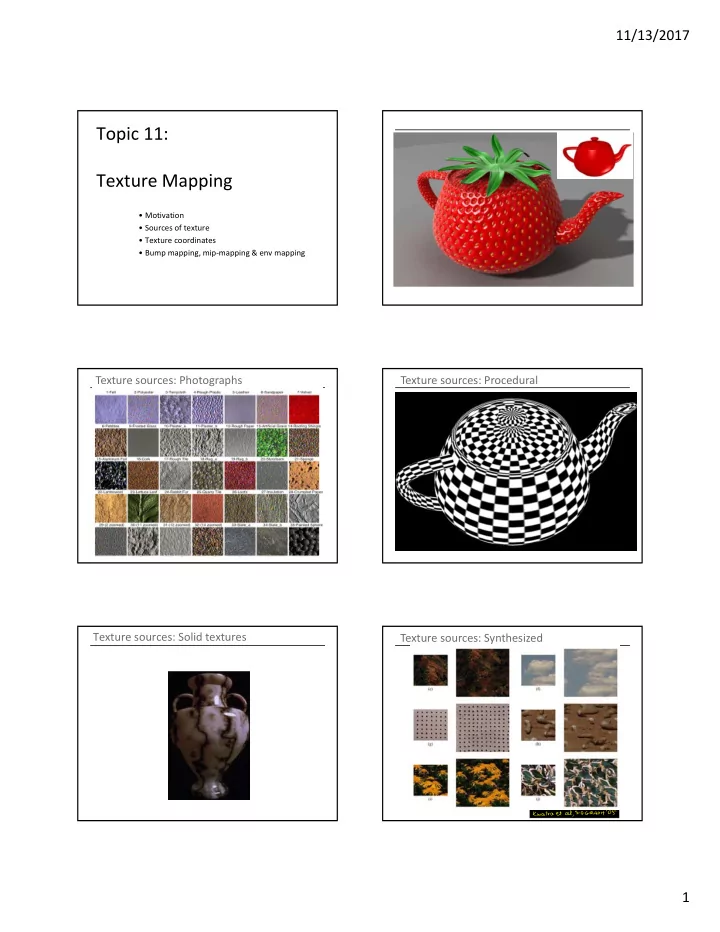
Topic 11: Texture Mapping
- Motivation
- Sources of texture
- Texture coordinates
- Bump mapping, mip‐mapping & env mapping
Topic 11: Texture Mapping Motivation Sources of texture - - PDF document
11/13/2017 Topic 11: Texture Mapping Motivation Sources of texture Texture coordinates Bump mapping, mipmapping & env mapping Texture sources: Photographs Texture sources: Procedural Texture sources: Solid textures
Original Synthesized Original Synthesized
How does one establish correspondence? (UV mapping)
aliasing
Given a polygon, use the texture image, where the projected polygon best matches the size of the polygon on screen.
Render a 3D scene as viewed from a central viewpoint in all directions (as projected onto a sphere or cube). Then use this rendered image as an environment texture… an approximation to the appearance of highly reflective objects.
Local Illumination Models e.g. Phong
towards the eye
which is normally constant across the scene Global Illumination Models e.g. ray tracing or radiosity (both are incomplete)
Specular surfaces
Incident ray is reflected back as a ray in a single direction Diffuse surfaces
General reflectance model: BRDF
Specular‐Specular Specular‐Diffuse Diffuse‐Diffuse Diffuse‐Specular
Traces path of specularly reflected or transmitted (refracted) rays through environment Rays are infinitely thin Don’t disperse Signature: shiny objects exhibiting sharp, multiple reflections Transport E ‐ S – S – S – D – L.
Unifies in one framework
Rasterization: ‐project geometry onto image. ‐pixel color computed by local illumination (direct lighting). Ray‐Tracing: ‐project image pixels (backwards) onto scene. ‐pixel color determined based on direct light as well indirectly by recursively following promising lights path of the ray.
Intersections and reflectance models.
indirect illumination, depth of field etc.
For each pixel q { compute r, the ray from the eye through q; find first intersection of r with the scene, a point p; estimate light reaching p; estimate light transmitted from p to q along r; }
Pixel q in local camera coords [x,y,d,1]T Let C be camera to world transform Sanity check e= C [0,0,0,1]T pixel q at (x,y) on screen is thus C [x,y,d,1]T Ray r has origin at q and direction (q‐e)/|q‐e|.
(x,y) e
Let ray be defined parameterically as q+rt for t>=0. Compute plane of triangle <p1,p2,p3> as a point p1 and normal n= (p2‐p1)x(p3‐p2). Now (p‐p1).n=0 is equation of plane. Compute the ray‐plane intersection value t by solving (q+rt‐p1).n=0 => t= (p1‐q).n /(r.n) Check if intersection point at the t above falls within triangle.
Implicit equation for quadrics is pTQp =0 where Q is a 4x4 matrix of coefficients. Substituting the ray equation q+rt for p gives us a quadratic equation in t, whose roots are the intersection points.
c q r d (c‐q)2 –((c‐q).r)2 =d2 ‐ k 2 Solve for k, if it exists. Intersections: q+r((c‐q).r +/‐ k) k
to return intersection pairs with the object.
Speed‐up the intersection process.
Sets of rays.
I(q) = L(n,v,l) + G(p)ks Intensity at q = phong local illum. + global specular illum.
q v l n G
For transparent objects spawn an additional ray along the refracted direction and recursively return the light contributed due to refraction. local illumination reflection refraction
algorithm can lead to exponential complexity.
Bounding volumes Spatial subdivision
Backwards ray tracing
the eye to the surfaces
from?”
Cone tracing
Distributed Ray Tracing
Stochastic Ray Tracing
1 ray/light 10 ray/light 20 ray/light 50 ray/light
Images taken from http://web.cs.wpi.edu/~matt/courses/cs563/talks/dist_ray/dist.html
point light area light jaggies w/ antialiasing