SLIDE 3 Particle Filtering
0.0 0.1 0.0 0.0 0.0 0.2 0.0 0.2 0.5
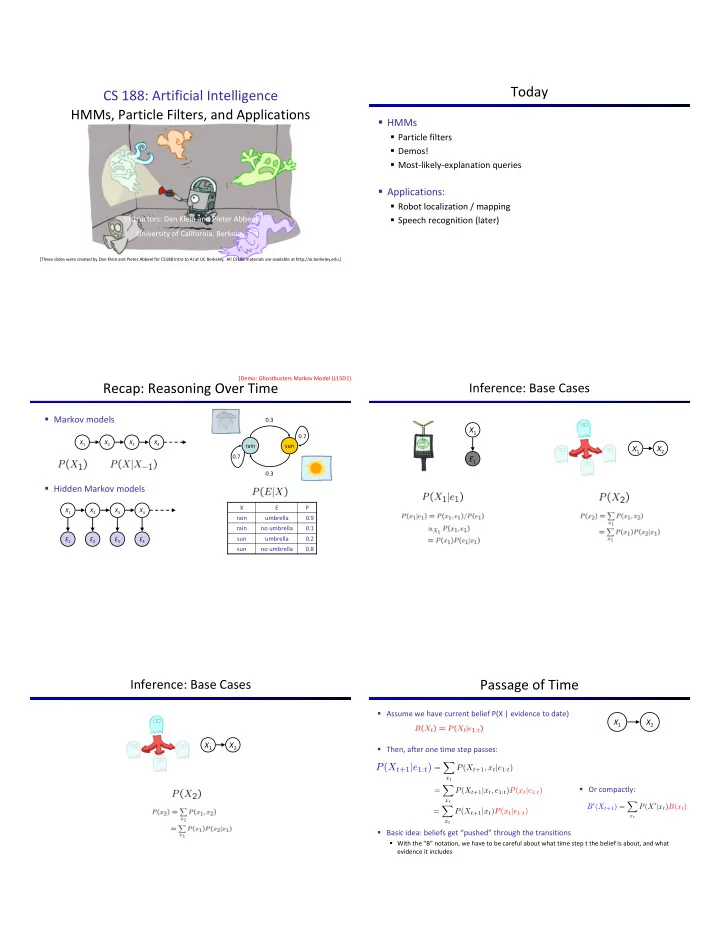
Filtering: approximate solution Sometimes |X| is too big to use exact inference
|X| may be too big to even store B(X) E.g. X is continuous
Solution: approximate inference
Track samples of X, not all values Samples are called particles Time per step is linear in the number of samples But: number needed may be large In memory: list of particles, not states
This is how robot localization works in practice Particle is just new name for sample
Representation: Particles
Our representation of P(X) is now a list of N particles (samples)
Generally, N << |X| Storing map from X to counts would defeat the point
P(x) approximated by number of particles with value x
So, many x may have P(x) = 0! More particles, more accuracy
For now, all particles have a weight of 1
Particles: (3,3) (2,3) (3,3) (3,2) (3,3) (3,2) (1,2) (3,3) (3,3) (2,3)
Particle Filtering: Elapse Time
Each particle is moved by sampling its next position from the transition model
This is like prior sampling – samples’ frequencies reflect the transition probabilities Here, most samples move clockwise, but some move in another direction or stay in place
This captures the passage of time
If enough samples, close to exact values before and after (consistent)
Particles: (3,3) (2,3) (3,3) (3,2) (3,3) (3,2) (1,2) (3,3) (3,3) (2,3) Particles: (3,2) (2,3) (3,2) (3,1) (3,3) (3,2) (1,3) (2,3) (3,2) (2,2)
Slightly trickier:
Don’t sample observation, fix it Similar to likelihood weighting, downweight samples based on the evidence As before, the probabilities don’t sum to one, since all have been downweighted (in fact they now sum to (N times) an approximation of P(e))
Particle Filtering: Observe
Particles: (3,2) w=.9 (2,3) w=.2 (3,2) w=.9 (3,1) w=.4 (3,3) w=.4 (3,2) w=.9 (1,3) w=.1 (2,3) w=.2 (3,2) w=.9 (2,2) w=.4 Particles: (3,2) (2,3) (3,2) (3,1) (3,3) (3,2) (1,3) (2,3) (3,2) (2,2)
Particle Filtering: Resample
Rather than tracking weighted samples, we resample N times, we choose from our weighted sample distribution (i.e. draw with replacement) This is equivalent to renormalizing the distribution Now the update is complete for this time step, continue with the next one
Particles: (3,2) w=.9 (2,3) w=.2 (3,2) w=.9 (3,1) w=.4 (3,3) w=.4 (3,2) w=.9 (1,3) w=.1 (2,3) w=.2 (3,2) w=.9 (2,2) w=.4 (New) Particles: (3,2) (2,2) (3,2) (2,3) (3,3) (3,2) (1,3) (2,3) (3,2) (3,2)
Recap: Particle Filtering
Particles: track samples of states rather than an explicit distribution
Particles: (3,3) (2,3) (3,3) (3,2) (3,3) (3,2) (1,2) (3,3) (3,3) (2,3)
Elapse Weight Resample
Particles: (3,2) (2,3) (3,2) (3,1) (3,3) (3,2) (1,3) (2,3) (3,2) (2,2) Particles: (3,2) w=.9 (2,3) w=.2 (3,2) w=.9 (3,1) w=.4 (3,3) w=.4 (3,2) w=.9 (1,3) w=.1 (2,3) w=.2 (3,2) w=.9 (2,2) w=.4 (New) Particles: (3,2) (2,2) (3,2) (2,3) (3,3) (3,2) (1,3) (2,3) (3,2) (3,2)
[Demos: ghostbusters particle filtering (L15D3,4,5)]